After Elon Musk went into space, AI computing power has set its sights on the ocean.
After Elon Musk announced his plan to send AI computing power into space, another group of practitioners is preparing to deploy AI data centers under the sea.
Imagine a vast storm-tossed stretch of open ocean, where a huge spherical buoy rises and falls with the rolling waves.
High-performance computing chips are mounted inside it, running AI models continuously; an energy system connected to its exterior can draw power from ocean waves; and the icy seawater acts as a natural heat dissipation system.
This is not a scene from a sci-fi movie, but a future that a company named Panthalassa is working to realize.
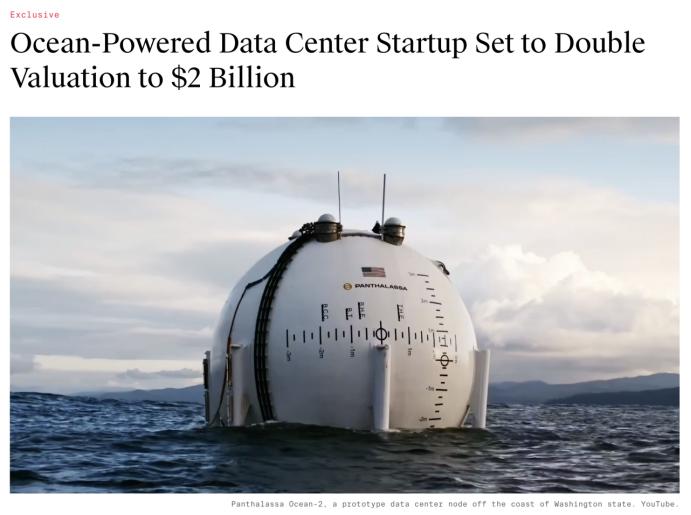
According to reports on August 7, wave energy firm Panthalassa is raising a new funding round of 225 million U.S. dollars, targeting a post-money valuation of about 2 billion U.S. dollars, nearly doubling its valuation from three months ago.
The company's goal is to deploy GPU-equipped computing nodes in the open ocean.
In the past, data centers have always been land-based, located close to cities and power grids, and relying on large tracts of land.
But as AI models continue to grow in size, training and running these models requires ever more electricity, heat dissipation capacity and deployment space, leading to a natural new question:
If there is not enough land left, where else can AI infrastructure go?
01
$2 Billion Valuation,
An Ocean Energy Company Steps Into the AI Era
In a sense, Panthalassa is very similar to SpaceX: starting from their names, both companies have revealed their core ambitions. SpaceX points to outer space, while the name Panthalassa comes from the global super-ocean that surrounded the Pangaea continent hundreds of millions of years ago.

The sky and the ocean are the two oldest directions for human beings to explore the unknown world. For thousands of years, mankind has looked up at the sky to try to understand the universe, and sailed to the sea again and again to search for new routes and resources.
Today, these two directions have formed new connections because of AI infrastructure.
SpaceX tries to send AI computing power into space, while Panthalassa is preparing to send AI data centers into the ocean.
According to reports on August 7, Panthalassa is seeking a new financing round of about 225 million U.S. dollars, with a targeted post-money valuation of about 2 billion U.S. dollars. Only three months ago, the company just completed a 140 million U.S. dollar financing at a valuation of about 1 billion U.S. dollars.
The doubling of valuation in just a few months reflects the capital's strong interest in new forms of AI infrastructure.
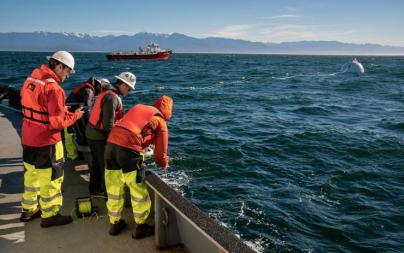
In Panthalassa's vision, the ocean can also become a place for data center construction - it exactly meets several conditions required for the expansion of AI data centers.
The first is space: compared with land, the ocean has a far wider deployment scope, and does not need to occupy the increasingly scarce land resources around cities.
The second is cooling: one of the biggest costs of data centers is removing the heat generated by servers, and the ocean naturally has a large amount of low-temperature water, providing a new heat dissipation environment for high-density computing.
The last is energy: as the scale of data centers continues to expand, electricity has become a key limiting factor, and the open ocean is rich in natural energy resources, providing another possibility for off-grid computing in the future.
Against the backdrop of rapidly growing demand for AI computing power, any solution that can provide additional energy and computing space has begun to attract capital attention, making the ocean a new potential development space.
For Panthalassa, the AI era has allowed this company, which originally focused on ocean energy research, to find a new application scenario.
02
Deploy Data Centers to the Ocean
Deploying data centers to the ocean is not a completely unfamiliar idea.
As early as 2015, Microsoft launched the Natick project to explore whether submarine data centers could become a form of cloud computing infrastructure in the future.
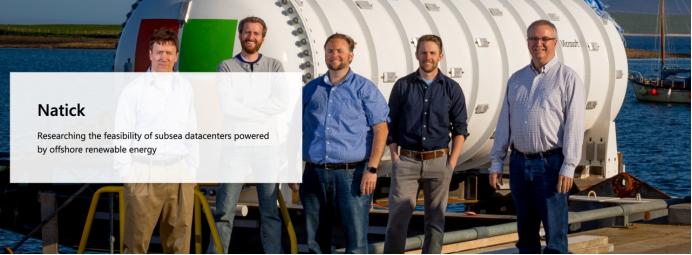
In 2015, Microsoft completed the first phase of the experiment, deploying a small data center prototype in the Pacific waters of the United States. Then in 2018, it launched the second phase of testing, deploying a larger steel container to the waters near the Orkney Islands in Scotland. The device contained 864 servers inside and operated on the seabed for two years.
The experimental results proved that the seabed environment does have several advantages: the sealed environment reduces equipment loss caused by oxygen and humidity; seawater provides a stable low-temperature environment, reducing heat dissipation pressure; the standardized modular design also enables rapid deployment of data centers.
After being recycled in 2020, Microsoft stated that the server failure rate inside the device was even lower than that of the land control group, only about one-eighth of the latter.
However, Natick finally stayed in the experimental stage. In 2024, Noelle Walsh, head of Microsoft Cloud Operations, confirmed that the company would no longer build submarine data centers, and said the team would apply the experience gained from the project to other fields.
China has further promoted submarine data centers from experimental exploration to industrial application.
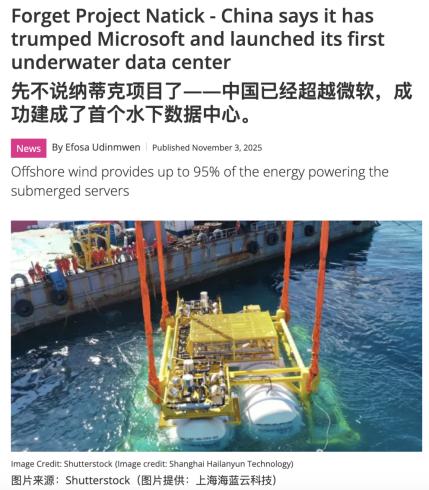
In 2026, the Shanghai Lingang Submarine Data Center project was officially put into operation. Located in the East China Sea, the project adopts the model of "direct connection of offshore wind power + natural seawater cooling", builds platforms on the sea, deploys data modules underwater, supplies power directly through offshore wind power, and uses seawater for heat dissipation. The total planned scale of the project is 24 MW, and the first-phase demonstration project has a scale of 2.3 MW.
Compared with traditional land data centers, this model tries to solve several practical problems: on the one hand, land resources in the eastern coastal areas are tight, making it difficult to build large-scale data centers; on the other hand, offshore wind power resources are abundant, but in the past, due to the limitation of matching power transmission and power demand, part of the electricity was difficult to be utilized in time.
Deploying data centers offshore can bring green power closer to computing power demand.
According to Xinhua News Agency, the project's designed PUE (Power Usage Effectiveness) target is lower than 1.15, the green power supply rate exceeds 95%, and it uses natural seawater cooling to reduce heat dissipation demand.
What makes Panthalassa special is that other organizations enter the ocean starting from data centers, while Panthalassa enters the data center sector starting from ocean technology.
Founded nearly a decade ago, the company has long studied how to generate energy from wave motion, and has accumulated a large amount of marine engineering capabilities: how to design equipment that can operate in the marine environment for a long time, how to capture the energy generated by wave motion, and how to deploy and maintain systems in environments far from land.
These irreplicable engineering capabilities are exactly the most critical part when offshore data centers move from experiments to practical applications.
In fact, Panthalassa has completed the deployment of prototypes in the marine environment.
In 2024, the company completed the Ocean-2 prototype deployment test, deploying marine nodes equipped with computing equipment in the waters near Washington State, USA.
In this test, Ocean-2 verified the coordinated operation of multiple key links, including wave energy capture, offshore equipment operation, computing node deployment and remote data transmission, proving that the ocean can be an environment where energy, computing and communication systems operate together.
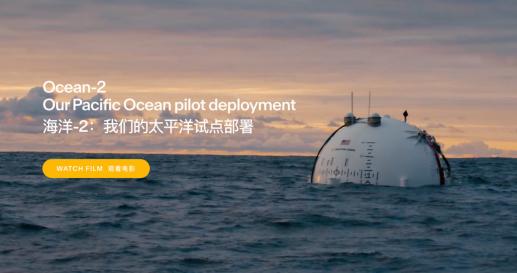
Now, with the rapid growth of demand for AI data centers, Panthalassa hopes to further integrate wave energy equipment, GPU computing nodes and satellite communication systems on this basis, and upgrade the marine energy platform into an offshore data center that can provide AI computing power.
According to the vision, future data centers may be directly deployed in the open ocean environment, powered by waves, cooled by seawater, complete AI inference at sea, and then transmit the computing results back to land via satellite.
03
Heading to Space and Sea, AI Computing Power Is Searching for New Continents
The scarcest resource of AI data centers may no longer be just GPUs and electricity, but also available land that can be used for construction.
According to The Information's report on August 7, NVIDIA plans to invest up to 3 billion U.S. dollars in Lancium, an energy infrastructure company supported by Blackstone, of which the first 2 billion U.S. dollar investment will get about 20% of the shares; if Lancium completes more milestones such as grid access, NVIDIA may add another 1 billion U.S. dollar in investment.
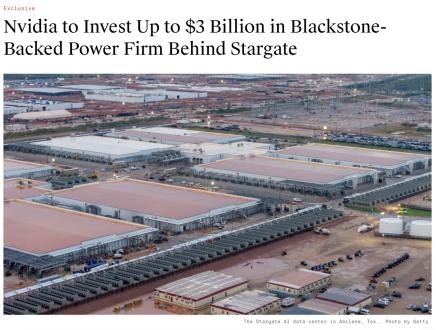
One of Lancium's most important assets is land resources that can host large-scale AI infrastructure. The company is developing multiple large AI data center parks in Texas, USA, including the site of the Stargate project in Abilene. Its park has approved grid access capacity that can support the construction of gigawatt-level data centers.
For NVIDIA, the significance of this investment is not limited to acquiring equity in a company, but also to pre-position for the continuous expansion of AI infrastructure, and lock in physical space that can accommodate more GPUs.
And such space is becoming increasingly scarce.
As of the beginning of August, there have been more than 500 suspensions or long-term restrictions on new data center development across the United States, with more than 150 new restrictions added in July alone.

Local governments are restricting new projects, and communities are worried about water, electricity and environmental issues - AI data centers are hitting a practical ceiling. So the question arises:
If the space on land is getting more and more limited, where can the next generation of computing power grow?
For this question, some people look to space.
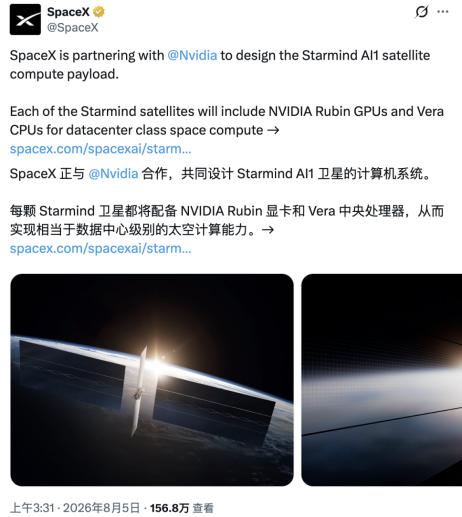
SpaceX is cooperating with NVIDIA to jointly design the computing system of the Starmind AI1 satellite. The satellite will be equipped with NVIDIA Rubin GPU and Vera CPU, giving it space computing capabilities at the data center level.
Compared with ground data centers, the biggest imagination of space computing is that it has vast deployment space and can directly use solar power for energy supply.
Others look to the ocean.
Panthalassa tries to deploy GPUs to the ocean that covers 70% of the Earth, using the ocean to provide new deployment space, cooling environment and energy possibilities.
Compared with space, the ocean is closer to the ground, and explorations such as Microsoft's Natick project and China's submarine data centers have already verified the technical feasibility of this route.
From competing for land and electricity in Texas to sending GPUs into the ocean and space, AI infrastructure is searching for the next "new continent" that can carry computing power.
Interestingly, in this process of searching for new continents, NVIDIA's figure is appearing over and over again.
On land, it invests in Lancium to compete for data center parks and power access; in space, it cooperates with SpaceX to explore orbital computing.
Although NVIDIA's name does not appear in Panthalassa's current financing list, if marine data centers really become an important direction of AI infrastructure, NVIDIA will most likely not be absent.
After all, for a company that sells GPUs, finding "land" that can fit GPUs is inherently a topic that it must participate in.
This article is from the WeChat official account "Alpha AI", written by Yuan Xinyue, edited by Wang Jing, and published with authorization from 36Kr.