Does the capital market still have confidence in Meitu?
"The era has no tears; all tears are our own." That's what Wu Xinhong, CEO of Meitu, said.
After 2020, Meitu's "octopus" expansion strategy failed after burning 4.2 billion yuan, and Wu Xinhong decided to abandon blind expansion and return to its core business of application tools.
Later, Meitu caught up with the AIGC wave.
As a result, the photo editing tool that was once a must-have for girls has now fully entered the AI track, launching multi-threaded AI image products.
And it has made profits.
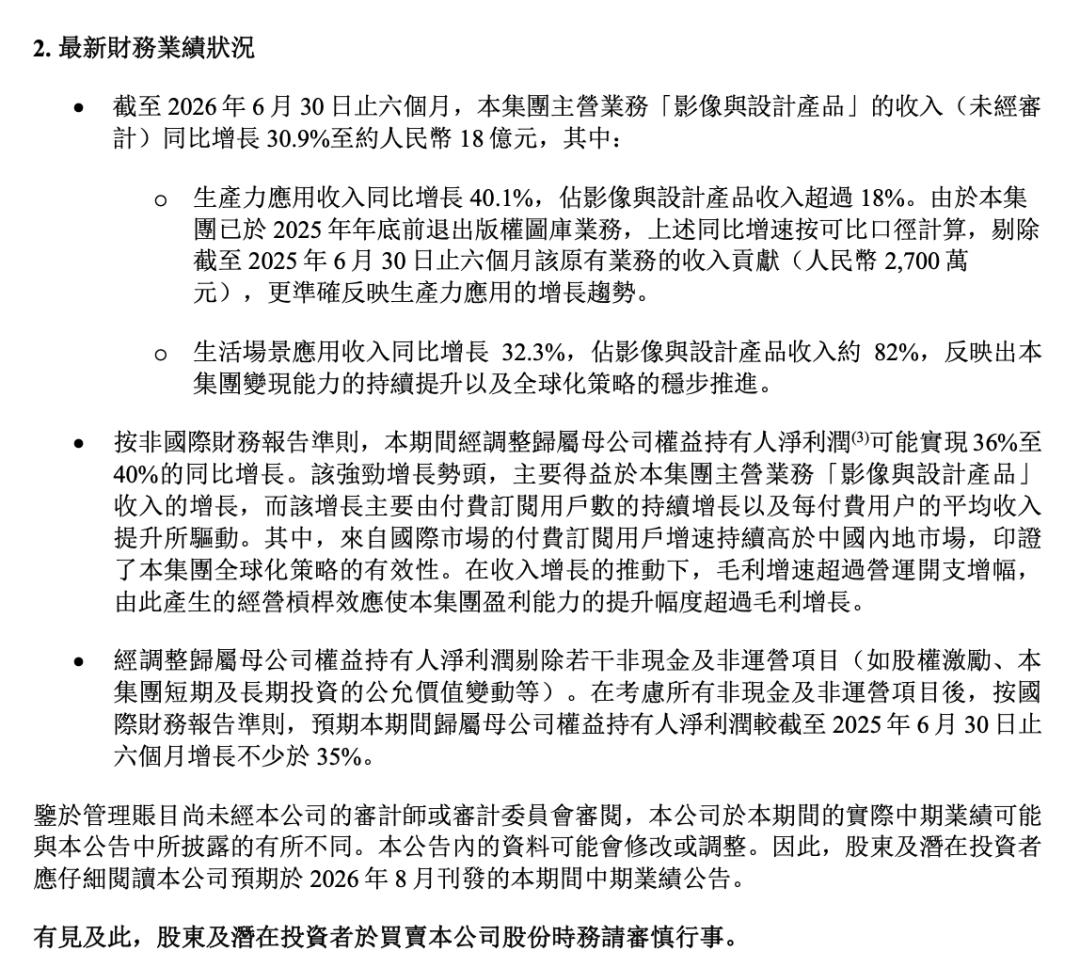
According to Meitu's 2026 half-year performance forecast, the company's adjusted net profit attributable to equity holders of the parent company in the first half of the year achieved a year-on-year growth of 36%-40%.
(Source: Meitu 2026 Half-year Performance Forecast)
The data looks very promising. Meitu, which has ridden the AI wave, has enjoyed a good period of development, but does that mean it can rest easy?
01
The Breakout of "Small yet Beautiful"
After the rise of the AIGC wave, Meitu began to strengthen the layout of AI image products, and its approach is very simple:
To build a toC APP factory.
Meitu first divided its product matrix into "life scenario applications" and "productivity applications". The former are all basic products such as Meitu Xiuxiu and Beauty Camera; the latter are more segmented and vertical, including Meitu Design Studio, Kaipai, RoboNeo, etc.
The difference is that basic products like Meitu Xiuxiu are more popular, while productivity applications are more professional, mainly adapted to segmented workflow scenarios, such as e-commerce product photo editing, influencer high-end photo retouching, etc.
Of course, to run an APP factory, the pace of new product launches must also keep up.
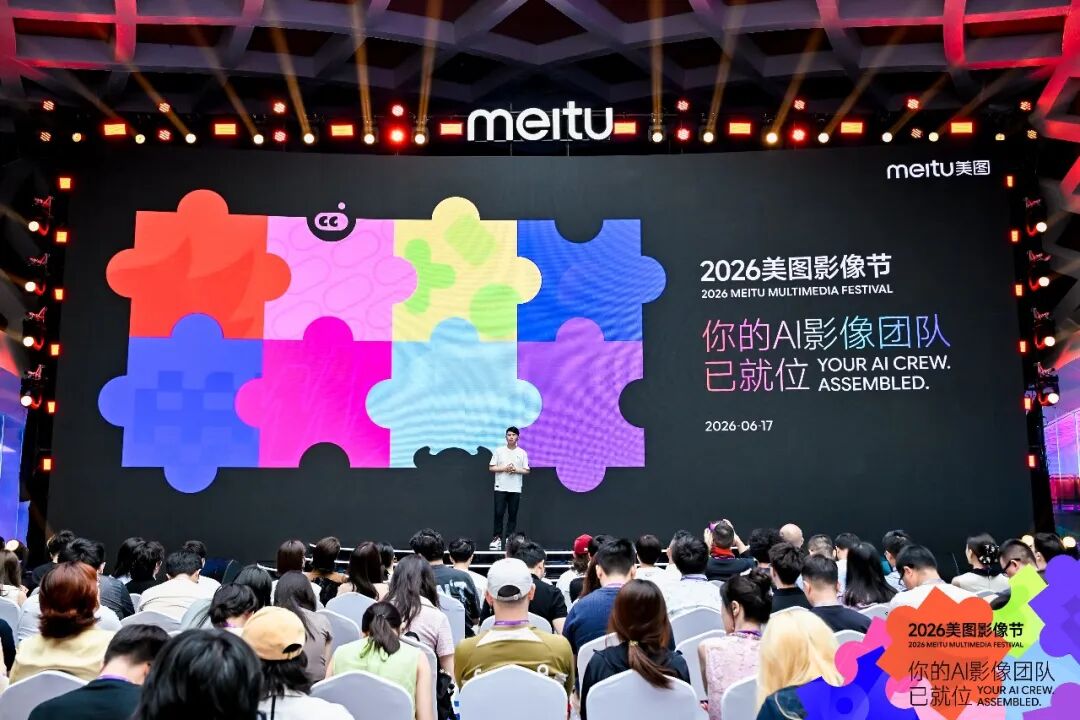
Based on the launch of several new AI imaging applications, Meitu released 8 AI products in one go in June this year, covering scenarios such as music visual design and AI short dramas, and set aside 100 million yuan to solicit "good products" from external parties.
(Source: Meitu Official Website)
With a sufficiently broad layout, Meitu's years of experience accumulated in the field of image design have come into play, which is the advantage of a "small yet beautiful" company.
At the same time, Meitu has also caught the segmented demand under the AI wave: e-commerce operations and influencer creators do need relatively professional and easy-to-use AI image tools, and Meitu has seized the opportunity in this mid-market.
Soon, Meitu's performance began to pick up.
In 2025, Meitu's total revenue increased by 28.8% year-on-year to 3.86 billion yuan, of which revenue from imaging and design products increased by 41.6% year-on-year to 2.954 billion yuan, accounting for as high as 76.6%; this part of revenue continued to grow by 30.9% to 1.8 billion yuan in the first half of this year.
In addition, Meitu's core business model has not only shifted from "selling ads to B-end" to "selling products to C-end", but also upgraded from a single membership subscription system to a computing power payment model.
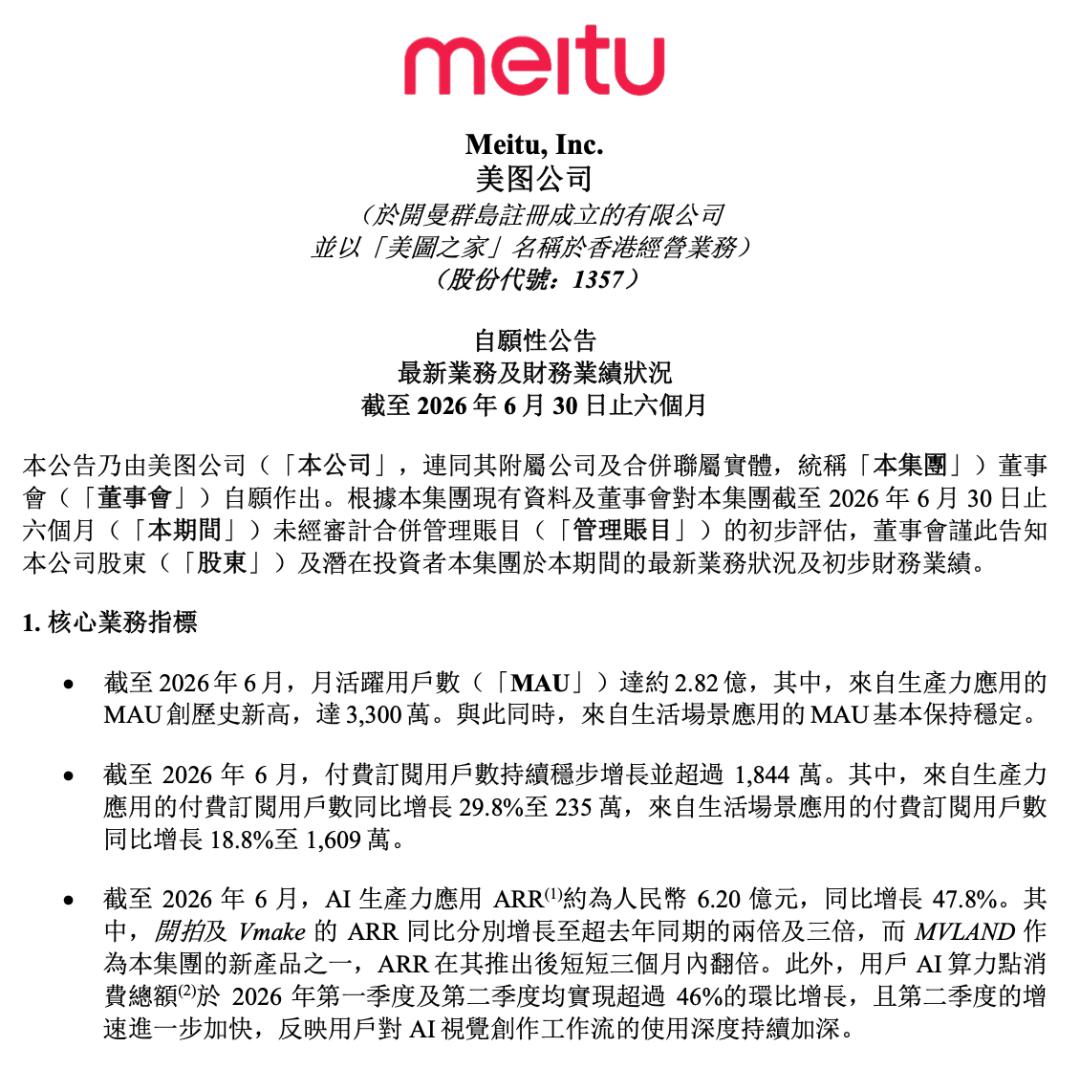
As of June 2026, the number of paid subscription users of Meitu has exceeded 18.44 million, hitting a record high; in the first two quarters of this year, the total consumption of AI computing power points by Meitu users has achieved a quarter-on-quarter growth of more than 46%.
(Source: Meitu 2026 Half-year Performance Forecast)
It seems that under the sweep of the AI wave, Meitu has quickly seized its own position relying on its "small yet beautiful" positioning and strategic pace of closely following the trend.
However, the progress of AI technology and related applications is extremely fast, and the position of "small yet beautiful" is not solid.
02
Encirclement by Large Tech Giants
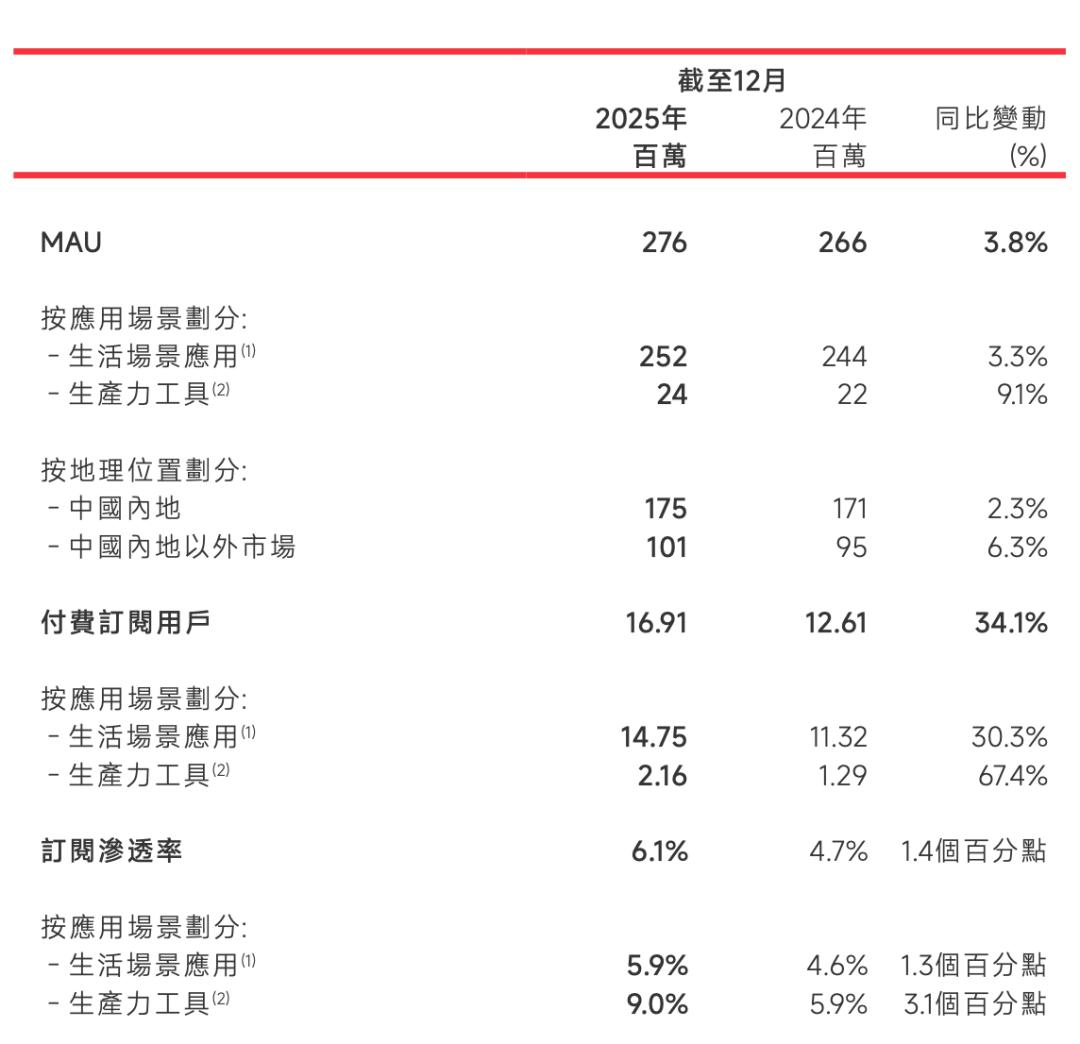
A close look at the financial report shows that among Meitu's 18.44 million paid users, 16.09 million come from life scenario applications, that is, Meitu's old products, and only 2.35 million come from the more professional productivity applications that are highly expected.
Further, according to the first half performance forecast, in the revenue segment of imaging and design products, life application scenarios account for about 82%, and productivity applications only account for about 18%.
Even though it has fully entered the AI imaging track, Meitu's performance still seems to be "living on past glories".
The more harsh fact is that although the high-profile Wu Xinhong has a high exposure in public occasions, and even talks about the future of AI imaging products together with product managers, the growth of its own professional productivity applications seems to lack sustainability.
Data shows that the year-on-year growth rate of monthly active users of Meitu's productivity applications has dropped from 74.3% in 2023 to 9.1% in 2025.
(Source: Meitu 2025 Annual Report)
But in the view of Niudao, such a situation is almost inevitable.
In the AIGC era, it is not difficult to find a segmented entry point for content applications like Meitu, and the efficient and professional production of images and videos is a relatively large cake in AI applications, so how could large manufacturers not get involved?
In terms of resource endowment and talent aggregation, large tech giants are far more powerful than Meitu; in terms of experience accumulation, large platforms such as Kuaishou and ByteDance have profound capabilities in the imaging and e-commerce fields.
Compared with Meitu, large manufacturers are equally radical in the layout of AI applications, and have reaped "great results".
Taking Kuaishou's Keling AI as an example, as of March this year, Keling's ARR (Annual Recurring Revenue) reached about 500 million US dollars (about 3.4 billion yuan).
In contrast, as of June this year, the ARR of Meitu's productivity applications reached 620 million yuan.
Directly comparing with large giants may not be fair to Meitu. After all, "small yet beautiful" companies can also get a share of the market, but how much cake the large manufacturers can leave for you and how much cake they will take back is another problem.
From the perspective of market logic, "small yet beautiful" cannot block the offensive pace of large manufacturers. Only by building a commercial moat with sufficient resource capabilities and technical strength can we hold the position for a longer time.
Is Meitu such an enterprise?
03
A New "Octopus" Strategy?
In fact, as early as 2024, Meitu officially released its self-developed visual large model MiracleVision, and Wu Xinhong even once said: Meitu will be the first visual large model company in China to achieve large-scale profitability.
But the result is that one month after the release of MiracleVision, OpenAI released Sora, igniting a new battlefield for visual large models, and Seedance 2.0 released in early 2026 even changed the direction of the tide.
"The release of Sora has given Meitu a relatively big psychological impact." Wu Xinhong also changed his statement.
Without the resource endowment of large manufacturers and lacking sufficient deep technical foundation, while your opponents are ByteDance and Tencent, and even startups include MoonShot AI and MiniMax, Meitu can hardly go down the road of self-developed large models.
Therefore, Meitu took a different approach and chose to be a "model orchestrator".
This concept is actually very easy to understand. The general logic is to directly combine mature external large models in its own applications. For example, RoboNeo combines external large models such as Seedance 2.0 and self-developed models to orchestrate workflows.
The ideal is very plump, but just imagine, under the contradiction between the continuous improvement of AI intelligence and the expanding computing power consumption, how much computing power third-party large models can allocate to external platforms, and how much completeness and smoothness can be retained.
On social media, some users complained about the usage experience of RoboNeo: The server is often crowded, the generation speed is still very slow after recharging, and even the finished product cannot be seen directly.
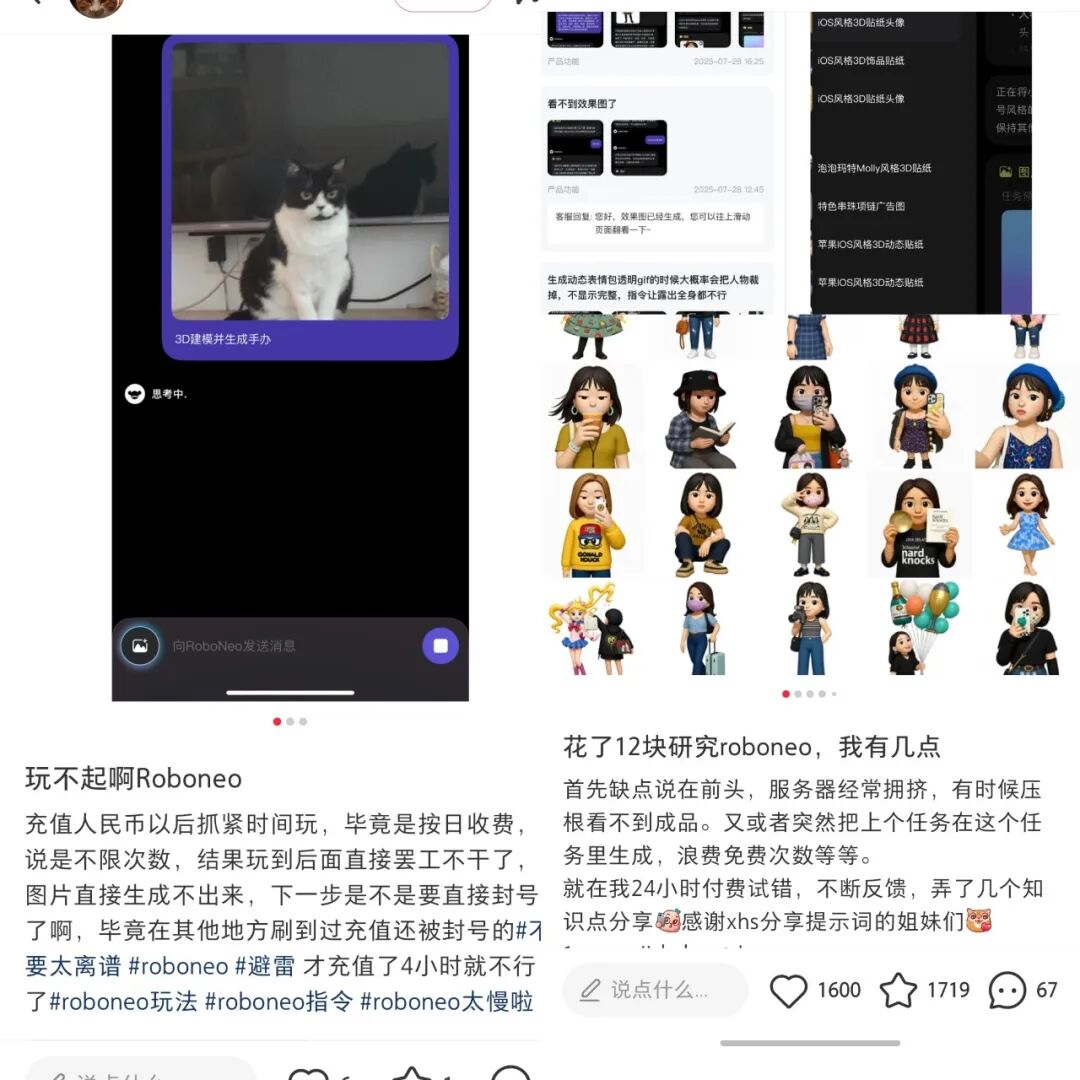
(Source: Third-party Social Media)
Even according to the Haitong Research Report, less than one month after RoboNeo went online, 75% of its C-end users in Chinese Mainland were lost.
In order to improve the smoothness of experience, enterprises must reserve computing power, which is another expensive expenditure.
In 2025, Meitu's gross profit margin (73.6%) decreased by 2.4 percentage points compared with the previous year, and one of the reasons given by the company was that the costs related to computing power and APIs increased.
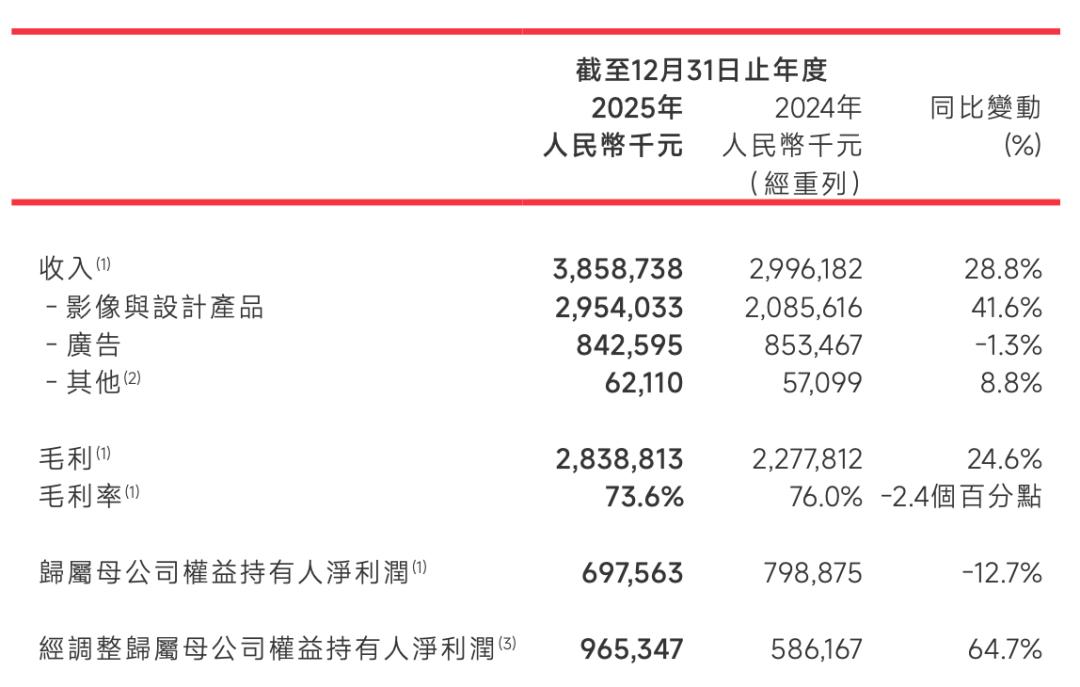
(Source: Meitu 2025 Annual Report)
In fact, Meitu invested firmly in technology for self-developed large models in the early years, and R&D expenses grew rapidly. But with the formation of the "APP factory" plan, Meitu tightened its R&D investment and instead increased marketing expenses to promote new products.
In 2025, Meitu's R&D expenses only increased by 3.8% year-on-year, while sales and marketing expenses increased by 25.5% year-on-year.
Obviously, Meitu's AI product "octopus" is still expanding its radius. It tries to make up for the shortcomings of relatively insufficient resources and technical capabilities by intensively launching new products, increasing exposure and keeping users fresh.
It may work in the short term, but in the long run, will this become another failure of Meitu's blind expansion?
Final Note
In fact, Wu Xinhong has predicted the competitive situation in the AI imaging field before.
He predicted that the competition in the track where Meitu is located will enter a white-hot stage in two or three years.
"We seize this two or three-year time window to build very strong competitiveness in these tracks. Otherwise, when opponents seize the opportunity, it will be difficult to catch up." Wu Xinhong once said.
But the two or three-year time window is not that long. The iteration of AI technology and related applications is very fast. Sora, which once made Wu Xinhong's prediction wrong, has been shut down, and the next AI application that has achieved great innovation in some aspects may be on the way.
Obviously, who can assert how long the window period in the AI imaging field will last?
At the same time, Meitu must continue to improve experience smoothness and technical performance in segmented fields, defend against the encirclement layout of large manufacturers in the AI imaging field, and maintain good performance in the capital market.
All the above problems are waiting for Wu Xinhong to lead Meitu to solve step by step.
This article is from the WeChat official account "Niudao Finance" (ID: niudaocaijing), written by Shi Jianqiao, published with authorization from 36Kr.