KingMed Diagnostics can hardly tell the growth story that the capital market loves to hear anymore.
The release of KingMed Diagnostics' H1 2026 pre-profit announcement has boosted its stock price, yet UBS still maintains a "sell" rating. The significant market divergence leads to our core question: after COVID-related bad debts are fully cleared, what is the actual quality of KingMed's profitability? What should the industry focus on in the second half of the ICL era?
We hold the view that:
This reported profit is almost free of inflated components, and the historical burdens have been thoroughly cleared. The accounts receivable generated from COVID-related revenue in 2021-2022 were fully written off on the books in 2025, and the credit impairment loss turned positive in Q1 2026; meanwhile, fixed assets and staff size have shrunk significantly, and the sticky cost burden expanded during the COVID period has also been fully resolved.
However, the real market divergence does not lie in the "past", but in the "future". The core strategic keynote for KingMed going forward will be "cost leadership" rather than "growth". For revenue growth, it has formulated a "universal accessibility" sinking strategy, but the market structure where about 80% of samples outsourced by district and county hospitals are general tests determines that the sinking of special tests can only bring marginal increments rather than breakthroughs, and this structural status quo cannot be altered by corporate behavior. In addition, the "internal outsourcing" and "one county, one center" policies for medical communities will forcibly shrink and concentrate the existing market share, it is difficult for KingMed to continue telling the "growth story" that the capital market demands.
Nevertheless, if KingMed still maintains an active dividend distribution policy, it can still be regarded as a cash cow target with marginal improvement under the "cost leadership" strategy; otherwise, without the support of growth potential, there will be little value opportunity for future discounted cash flow.
01
Pre-profit for H1 2026, but with significant market divergence
In July 2026, KingMed released an announcement of H1 pre-profit of 170 million to 220 million yuan; the stock price responded positively at that time, rising by 21% for 4 consecutive days. However, the divergence is also very prominent — UBS still assigns a "sell" rating to this performance, with a target price of 23.3 yuan for the next 12 months (of course, UBS's original text is also relatively optimistic about the performance itself, but the rating and pricing are very pragmatic) .
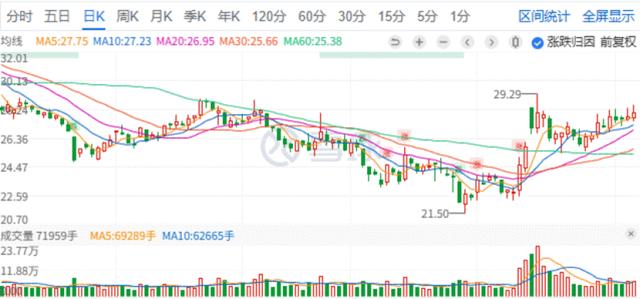
Figure: KingMed's stock price rose significantly in July 2026, Source: Xueqiu
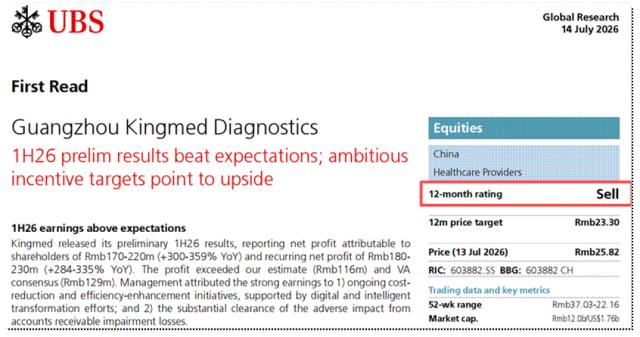
Figure: UBS still maintains a "sell" rating on KingMed in July 2026, Source: UBS
02
Profit contains almost no inflated components, historical burdens are thoroughly cleared
COVID-related bad debts were fully written off on the books in 2025. The biggest drag on KingMed's profits in the past was no more than COVID-related bad debts. Structurally, the revenue generated from COVID business in 2021-2022 became accounts receivable aged over 3 years in 2025. In accordance with KingMed's bad debt accounting policy, 100% of the bad debt loss was accrued, making 2025 the year of complete clearance of all COVID-related bad debts. Starting from Q1 2026, KingMed's credit impairment loss began to reverse.
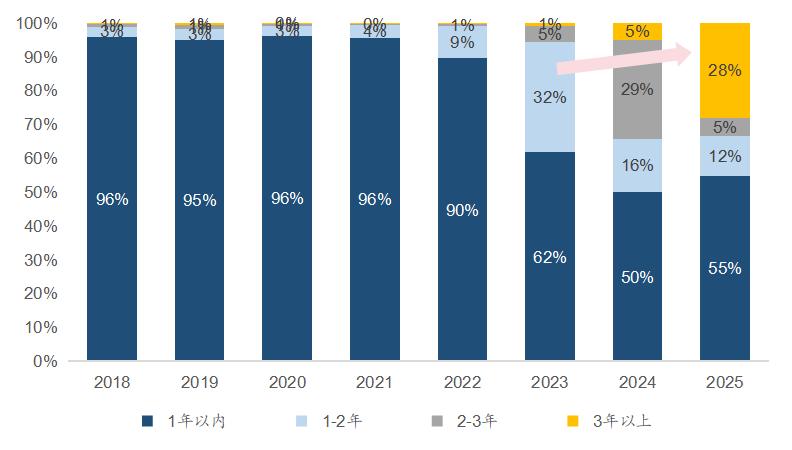
Figure: Changes in the aging structure of KingMed's accounts receivable at the end of 2018-2025, Data source: Tonghuashun
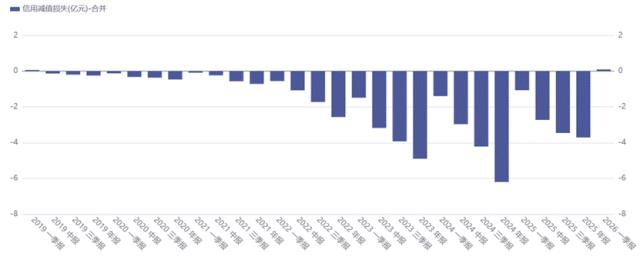
Figure: Amount of credit impairment loss in KingMed's historical financial reports from 2019 to Q1 2026, Source: Tonghuashun
The sticky cost burden from scale expansion during the COVID period has also been fully cleared. After the expansion during the COVID pandemic, both fixed assets and total number of employees have seen obvious decline and contraction. In Q1 2026, the scale of fixed assets dropped to the lowest level since 2019, and the personnel size in 2025 decreased by 34% compared with the peak during the COVID period.
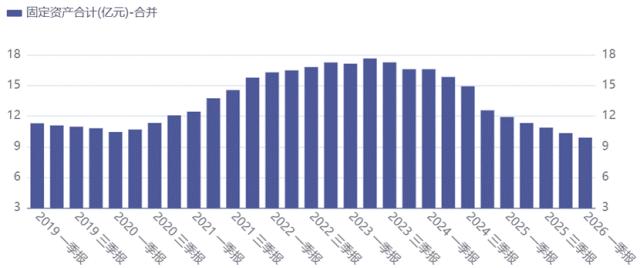
Figure: Scale of fixed assets in KingMed's historical financial reports from 2019 to Q1 2026, Source: Tonghuashun
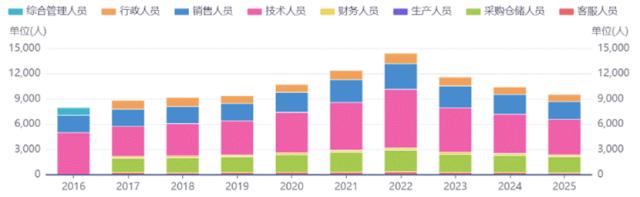
Figure: Total number of employees at the end of each year of KingMed from 2016 to 2025, Source: Tonghuashun
03
The future strategic keynote will be "cost leadership" rather than "growth"
KingMed's strategic planning has shifted from comprehensive construction to focusing on cost leadership. From the chairman's addresses in the 2023 to 2025 financial reports, it is not difficult to see that KingMed's strategic confidence and planning have shifted from the early confident "full-scale expansion" to the current cautious focus on cost control.
In the 2025 address, it was proposed to "take 'customer' and 'cost' as the center, and take 'cost leadership' and 'digitalization' as the long-term development strategy", "AI IN ALL... cultivate the second growth curve". In the short term, digitalization actually serves the cost leadership strategy, because even AI, the next step of digital transformation, cannot generate large-scale revenue in the short term. It mostly helps improve internal efficiency to reduce costs, or helps hospitals improve efficiency to enhance the competitiveness of other products (at an investor conference of a securities firm earlier this year, KingMed mentioned that its direct AI revenue target for this year is 50 million to 200 million yuan, and the AI business segment can only start to make profits when direct AI revenue reaches 200 million to 300 million yuan). The core focus in the short term is still the "cost leadership" strategy.
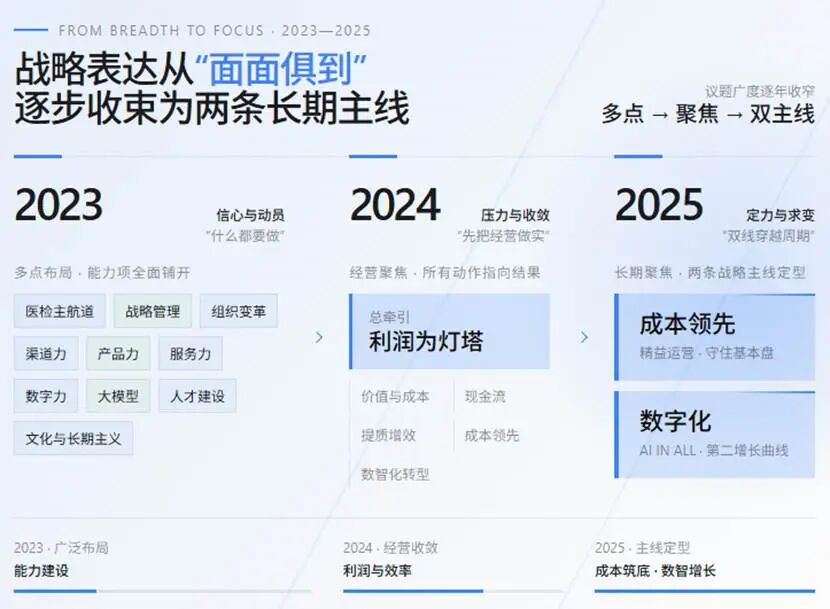
Figure: Chairman's address in KingMed's 2023-2025 financial reports, Source: Original
Although the core strategic keynote is cost leadership, what should we focus on for future revenue growth? In the short term, it depends on the market sinking of inclusive products, and in the medium term, it depends on the R&D and launch of specialized disease products. In the 2025 annual report, the company's "business discussion" section identified four planning routes:
① Product transformation featuring universal accessibility and in-depth cultivation of specialized diseases.
② Full-domain cost leadership with production intensification, digital intelligent empowerment for cost management, and smart laboratories.
③ Innovation capability improvement through technology breakthroughs, national platform construction, and industry-university-research collaboration.
④ AI empowerment of the whole chain covering AI marketing, digital intelligent production services, and data element opportunities.
Here we provide practical and targeted interpretation for you:
① is the company's planning for the revenue growth direction: in the short term, use inclusive products to expand the sinking market, and in the medium term, carry out R&D of specialized disease products to protect the base of tertiary hospitals that contribute 52% of the company's revenue and reserve growth momentum. The so-called "in-depth cultivation of specialized diseases" is actually a long-term plan — continuously innovate products to move products in the clinical research stage and LDT stage to the ICL stage, to replace mature products whose profit margin is gradually squeezed to near zero; "in-depth cultivation of specialized diseases" will not become the core support for KingMed's growth, but only the basic guarantee for KingMed's long-term survival. The short-term growth support lies in the sinking market mainly expanded through "universal accessibility".
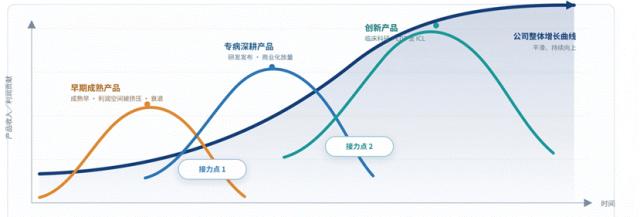
Figure: How to understand the strategic significance of KingMed's "in-depth cultivation of specialized diseases" from a long-term perspective, Source: Original
② is the cost leadership strategy itself; the AI empowerment in point ④, as mentioned earlier, also mainly serves cost reduction and efficiency improvement rather than direct revenue generation in the short term — both points lead to the goal of cost leadership.
The third point can be regarded as a conventional formal statement — this is what KingMed has been doing all along, and all medical enterprises need to carry out innovation to maintain sustained growth momentum. The policy logic behind it has been elaborated in our articles on Mindray Medical and Da'an Gene.
That is to say, in the short term, the improvement of KingMed's fundamentals mainly depends on two directions — internal "cost leadership" to cut costs, and external "universal accessibility" to achieve growth in sinking markets. (Of course, measures that KingMed has publicized such as AI revenue generation, in-depth cooperation with large hospitals, and growth of specialized disease products may also bring incremental contributions, but they are not the main driving force at present)
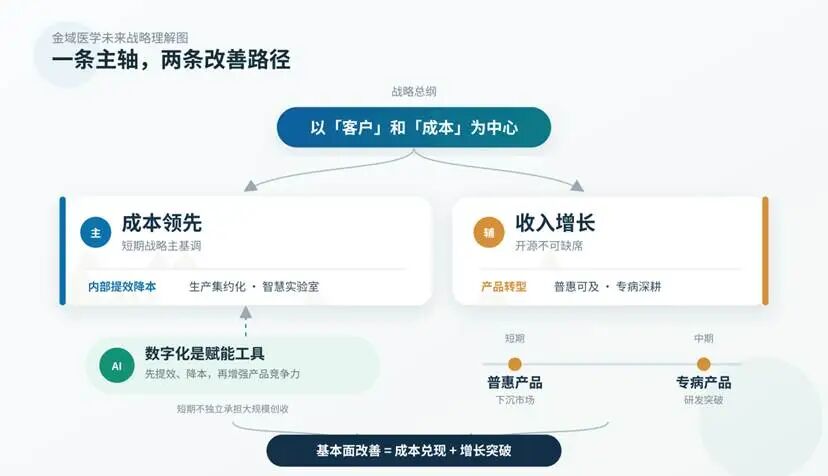
Figure: Analysis diagram of KingMed Diagnostics' short and medium term strategic planning in the future , Source: Original
04
Will the "universal accessibility" growth strategy become a breakthrough direction?
The core logic of KingMed's "universal accessibility" market sinking strategy lies in hospital penetration rate, rather than coverage. According to the data in the 2025 financial report, KingMed has covered 53% of leading district and county hospitals across the country, and its service network covers areas where more than 90% of the national population resides; this means that there is very limited room for further improvement in coverage, so the growth of KingMed's sinking market relies heavily on the improvement of penetration rate — expecting that every covered hospital will outsource more samples than before.
KingMed hopes to stimulate demand growth through product transformation of "universal accessibility" from the supply side, but the specific product direction does not fully match the long-standing outsourcing habits of district and county hospitals, which determines that the growth brought by this penetration rate strategy is marginal rather than breakthrough. KingMed's promoted "Huimin 3000" tumor companion diagnosis, early screening for Alzheimer's disease, "Jin Xue Hui" hematological disease NGS, etc. all belong to the special test track, which is out of necessity: general tests such as biochemistry and immunology have no profit growth space after multiple rounds of provincial-level alliance centralized procurement, so the company can only make inclusive design for special tests before pushing them to the sinking market. However, the outsourcing of district and county hospitals has long been dominated by general tests (accounting for about 80%), and special tests only account for 20%. This structure is not a price-related issue, but a rigid constraint under the hierarchical diagnosis and treatment system.
In the current system, district/county level 1 and level 2 hospitals undertake routine diagnosis and treatment and early prevention, and complex diseases naturally flow to provincial and municipal tertiary hospitals. The National Health Commission will not allocate excessive budget to district/county level 1 and level 2 hospitals to deploy too much special testing capacity (including personnel staffing and equipment, etc.); and from the perspective of medical habits, after patients complete basic tests, once doctors judge that the condition is complex, they usually directly recommend referral rather than doing supplementary special tests locally — after all, district and county hospitals lack follow-up treatment capacity, the medical service cannot form a closed loop, and excessive testing has limited practical significance.
Therefore, KingMed's special test inclusive oriented "universal accessibility" sinking strategy can only serve as a supplement for marginal increment, and it is difficult to become a breakthrough growth engine.
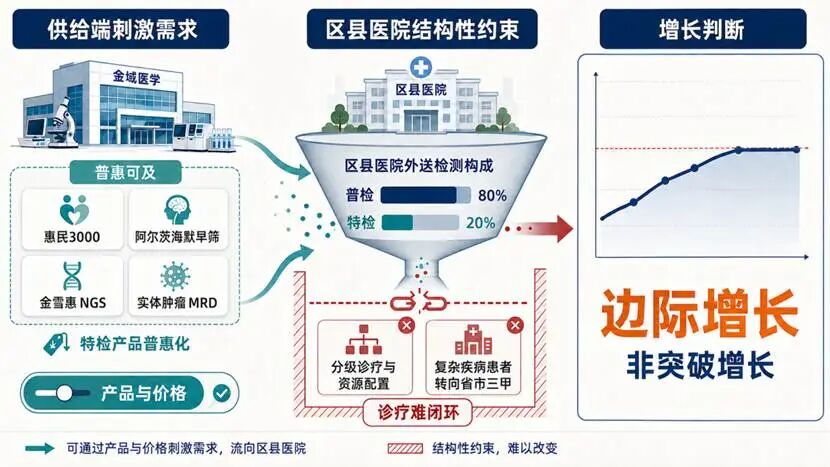
Figure: KingMed's "universal accessibility" sinking market strategy can only bring marginal growth rather than breakthrough, Source: Original
Compared with the intention of using "universal accessibility" products to obtain increments in district and county markets, KingMed's deeper concern may not be growth, but the defense of existing market share under the reform of medical community policies. From the ten departments' requirement in 2023 that medical communities should "achieve