A listed pharmaceutical e-commerce company selling "weight-loss drugs" surprisingly suffered a loss of 1.2 billion yuan in half a year?
At 4:05 a.m. Beijing Time on August 11, U.S. pharmaceutical e-commerce company Hims&Hers (referred to as "HIMS") released its financial results for the second quarter of 2026.
At first glance, this is still a report card that continues to deliver growth performance.
Quarterly revenue reached 753 million U.S. dollars, up 38% year on year; the number of subscribed users increased to 2.891 million, and the monthly revenue per user rose to 92 U.S. dollars.
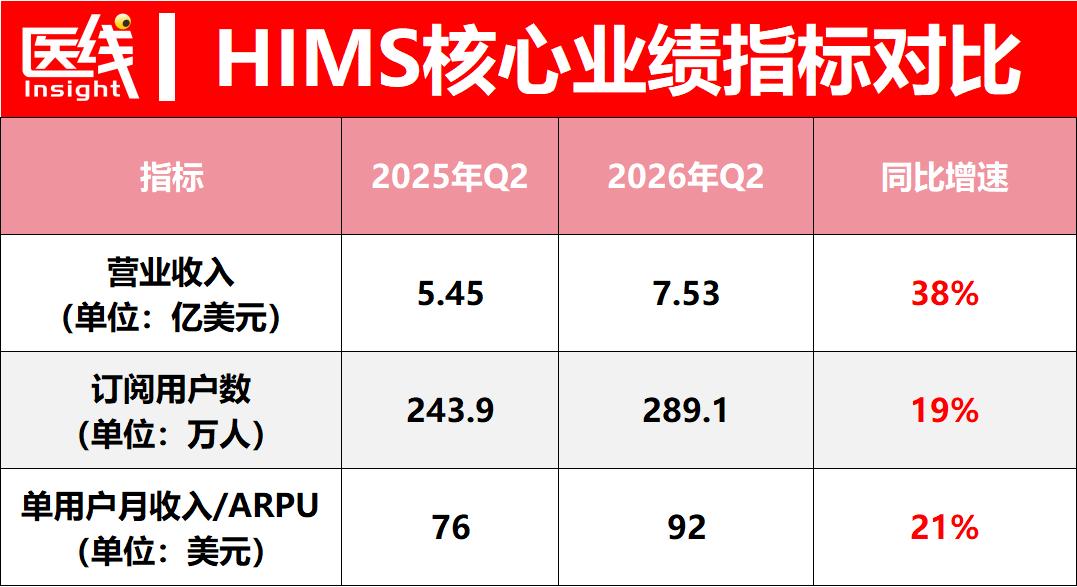
Data source: HIMS 2026 Q2 Financial Report
All three core indicators are trending upward, but the income statement suddenly took a downturn.
In the first quarter, HIMS recorded a net loss of 92.11 million U.S. dollars; in the second quarter, it posted another loss of 86.29 million U.S. dollars.
The total loss in the first half of the year was about 178 million U.S. dollars, equivalent to about 1.209 billion yuan.
At the same time, the gross profit margin in the second quarter dropped to 64% from 76% in the same period of the previous year.
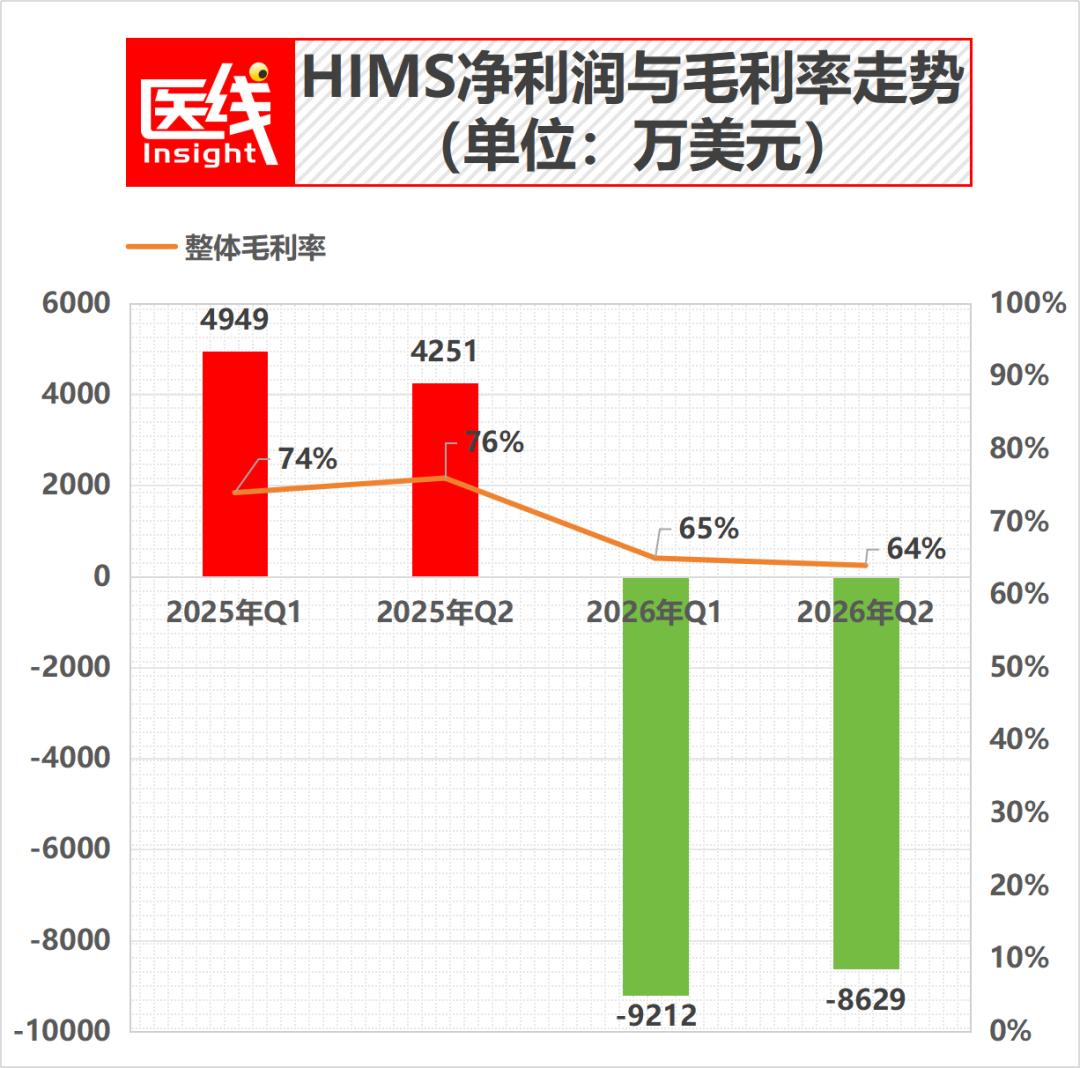
Data source: HIMS 2026 Q2 Financial Report
The contrast also lies in the fact that the company had been profitable for two consecutive years before.
User growth did not stop, ARPU continued to rise, demand for GLP-1 products remained strong, and the company even raised its full-year 2026 revenue guidance to 3.1 billion to 3.3 billion U.S. dollars.
Growth is still ongoing, but the profit generation model has changed.
The change started from the supply of weight-loss drugs.
First, HIMS shifted from large-scale provision of compounded GLP-1 drugs to branded original research drugs, which drove up procurement and fulfillment costs accordingly.
Second, regulatory and litigation risks related to subscriptions and compounded GLP-1 products have been concentratedly reflected in the income statement.
Third, to maintain expansion, the company continued to increase investment through mergers and acquisitions, bond issuance, accounts receivable factoring and physical capability building.
The once familiar internet growth curve has thus been rewritten by the cost, compliance and capital constraints of the healthcare industry.
For Chinese digital healthcare enterprises, the value of this half-year report lies exactly here.
That is, HIMS raises a more thought-provoking question:
Why does a growing digital healthcare company have a heavier business model the deeper it penetrates into the healthcare industry?
01
Supply Shift:
Betting on the weight-loss drug trend, which instead pushed up costs?
What HIMS used to attract the capital market most in the past is a set of growth model with distinct internet characteristics.
Acquire customers online, charge for subscriptions, and continuously increase user value with high-margin products.
In the first half of 2026, the first part of this model that changed was product supply.
The trigger emerged at the end of March.
At the end of the first quarter of 2026, HIMS announced the "strategic transformation of its U.S. weight management business".
The financial report disclosed that the company adjusted its weight-loss drug supply strategy, shifting from large-scale provision of compounded GLP-1 drugs to providing branded original research GLP-1 drugs, while compressing the supply of compounded GLP-1 drugs on the platform to a "limited scale".

HIMS promotes Novo Nordisk's Wegovy on its official website Image source: HIMS official website
The strategy shift first brought a round of concentrated losses.
In the first half of 2026, HIMS accrued $38.11 million in non-recurring restructuring and other related expenses, including $33.49 million in the first quarter and an additional $4.62 million in the second quarter.
Among these restructuring expenses, the loss on the inventory side is the most direct, with $28.46 million of "inventory impairment and scrapping" directly recorded in the main business cost.
After the one-off expense, the new cost structure began to affect operations in the long term.
The procurement cost of branded original research drugs is higher, and the gross profit margin space previously supported by product price difference is continuously squeezed.
To maintain user stickiness under the more expensive original drug system, HIMS launched a new membership system for the weight management business at the end of March: users need to maintain an active monthly recurring membership to obtain prescription weight-loss drugs.
The membership relationship has changed, and the fulfillment rhythm has also changed accordingly.
The financial report clearly mentioned that the new model brings "shorter and more frequent delivery cycles".
For DTC e-commerce, delivery frequency itself means cost.
The warehousing, packaging and logistics expenses that could be diluted through quarterly or semi-annual bulk shipments in the past are now split into higher-frequency and more fragmented fulfillment costs.
In the second quarter, this change has been reflected in the cost side.
According to the financial report, the overall revenue growth rate of HIMS in the quarter was 38%, but its main business cost skyrocketed 112% year on year (reaching 272 million U.S. dollars).
Among them, product and packaging costs increased by 141% year on year, logistics and transportation costs increased by 56% year on year, and medical consultation service costs increased by 30% year on year.
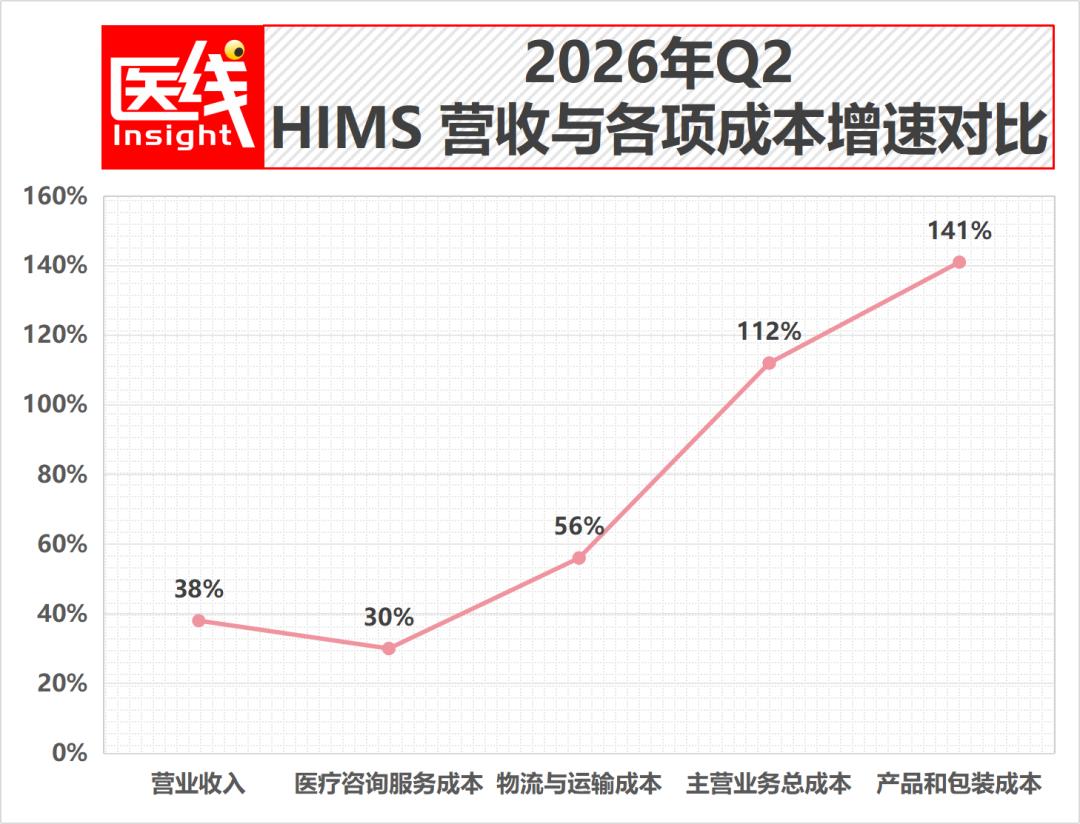
Data source: HIMS 2026 Q2 Financial Report
The serious inversion of revenue and cost growth rates has become the most intuitive footnote for the heavier business model.
So far, the shift of supply strategy has formed two layers of impact.
The front end is restructuring and inventory impairment, and the back end is the continuous rise of procurement, packaging, logistics and medical service costs.
This leads to the fact that the user scale is still expanding, ARPU is still rising, but the cost of serving each user is also increasing accordingly.
02
Gross Profit Stall:
The faster the growth, the greater the pressure to recover costs
Changes on the supply side are quickly transmitted to the gross profit margin.
In the second quarter of 2026, HIMS's overall gross profit margin dropped to 64% from 76% in the same period of last year; the overall gross profit margin in the first half of the year also dropped to 64% from 75%.
The 12 percentage points less gross profit margin space year on year in the second quarter has become one of the most striking changes in this half-year report.
In other words, revenue is still growing, but the profit retained from income has thinned significantly.
For a DTC medical platform, after the pricing space on the product side narrows and fulfillment costs rise synchronously, the profit amplification effect brought by scale will be weakened.
The faster the growth rate, the easier it is for the pressure on the cost side to be amplified synchronously.
After the gross profit margin thins, another key issue emerges: can the front-end customer acquisition be recovered smoothly?
HIMS used to acquire new users through continuous traffic purchase, and then extend the user life cycle through subscriptions.
The company has repeatedly emphasized investment in artificial intelligence and technology in its financial reports, but from the perspective of cost structure, marketing is still the main fuel for growth.
In the first half of 2026, the company's total marketing expenses reached 484 million U.S. dollars.
Among them, the customer acquisition cost for channels such as digital media, social platforms, TV and radio was as high as 422.3 million U.S. dollars, an increase of 32.3 million U.S. dollars compared with 390 million U.S. dollars in the same period of last year.
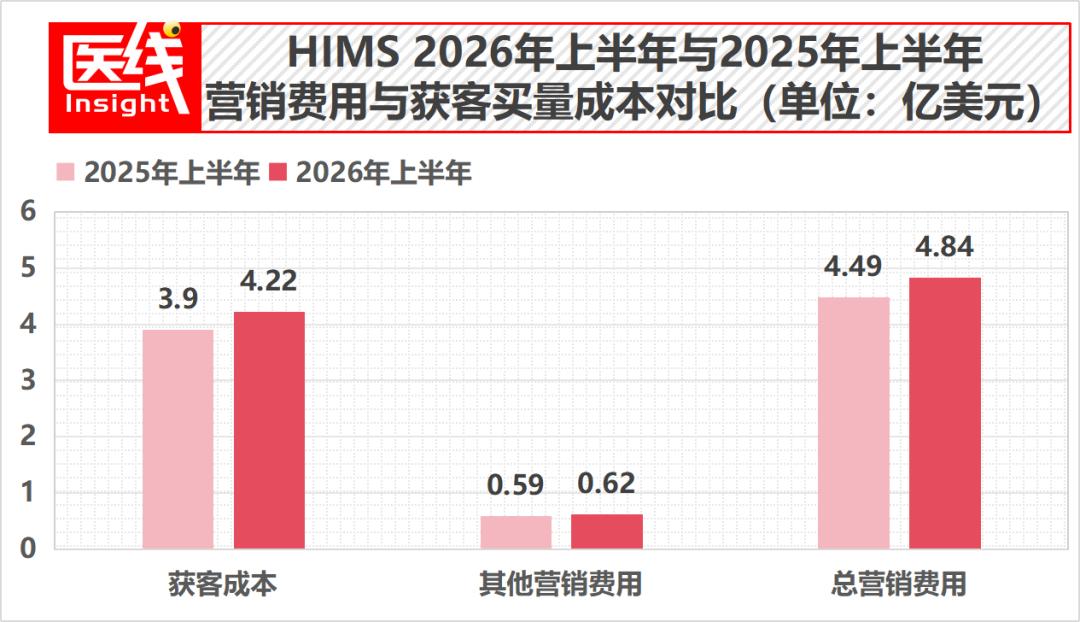
Data source: HIMS 2026 Q1 and Q2 Financial Reports
According to the Q2 financial report, the rise in customer acquisition costs is mainly due to the management's active decision to increase investment in "search and affiliate marketing" to drive new user growth and promote new products.
This means that under the condition that the gross profit margin space is greatly squeezed, HIMS is being forced to participate in more expensive and more intense traffic bidding.
More than 420 million U.S. dollars of traffic purchase expenditure in half a year pushes all the pressure to the back-end monetization.
Users need to continuously contribute revenue in a longer life cycle, so that the front-end customer acquisition cost can be covered.
When the gross profit per user declines, the role of subscription retention also changes accordingly, directly determining whether the customer acquisition investment can be recovered.
It so happens that in the subscription link, a years-long regulatory investigation was concentratedly upgraded in 2026.
03
Compliance is Approaching:
From unsubscription rules to drug regulation
The growth chain is tightening segment by segment
The first pressure comes from the subscription side.
The financial report disclosed that as early as October 2023, the U.S. Federal Trade Commission (FTC) issued a civil investigation demand to HIMS on the grounds that its "privacy, advertising, subscription and cancellation practices" were suspected of violating the Restore Online Shoppers' Confidence Act. Long-term settlement negotiations failed to reach an agreement.
On July 29, 2026, the FTC, together with the Utah Department of Consumer Protection and Los Angeles County, California, filed a lawsuit against HIMS in federal court, accusing it of obstructing users from unsubscribing, and seeking permanent injunctions and financial penalties.
Before the lawsuit was filed, the risk had already entered the income statement.
In the first half of 2026, HIMS accrued a total of up to 62.5 million U.S. dollars of legal contingent liability provisions (about 60 million U.S. dollars of which are specially used for the FTC lawsuit): 15 million U.S. dollars in the first quarter, and an additional 47.5 million U.S. dollars in the second quarter.
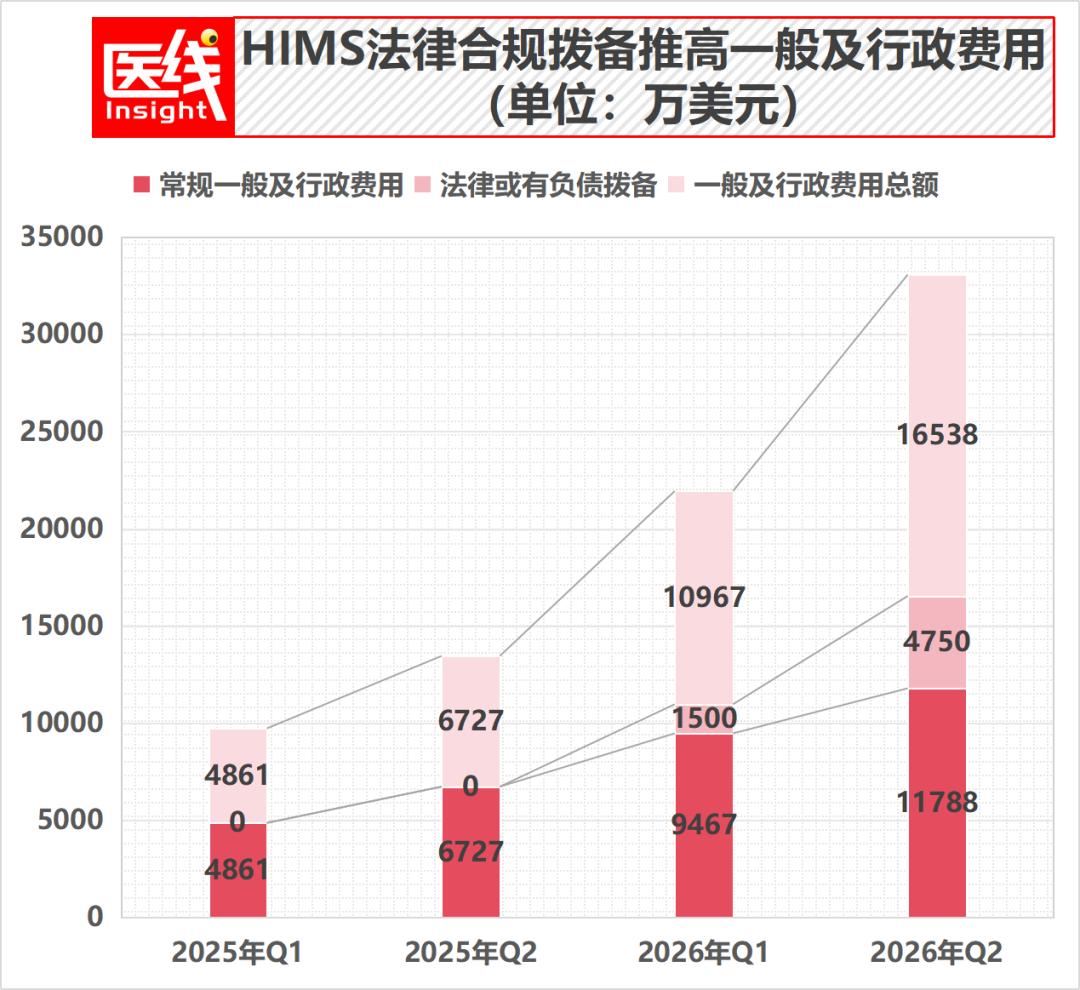
Data source: HIMS 2026 Q2 Financial Report
This huge expense was recorded in general and administrative expenses, which directly led to a 146% year-on-year surge in this expense in the second quarter, and became the core reason for the expansion of net loss in the first half of the year.
More tricky is that the regulatory action immediately triggered a chain reaction.
The financial report disclosed that right after the FTC filed the lawsuit, a consumer class action lawsuit against HIMS was launched immediately, accusing it of violating multiple privacy regulations such as the Electronic Communications Privacy Act, which further increased the compliance cost.
At the same time, the financial report mentioned that the FTC's actions may force the company to modify its "cancel subscription" operation process.
Once the unsubscription threshold is forcibly lowered, HIMS's back-end user retention will face serious challenges.
Apart from subscriptions, greater pressure is concentrated on compounded GLP-1 drugs.
Following the timeline disclosed in the financial report, the regulatory scope extends from drug regulation to criminal investigations, securities law enforcement and intellectual property litigation.
In September 2025, the FDA issued a warning letter to HIMS regarding the relevant statements on its website about compounded semaglutide products.
In February 2026, the FDA directly named HIMS in its official statement, and stated that it plans to restrict the large-scale commercial marketing of unapproved compounded drugs using GLP-1 active pharmaceutical ingredients.
Also in February 2026, the General Counsel of the U.S. Department of Health and Human Services publicly stated on X (formerly Twitter) that it had referred HIMS to the U.S. Department of Justice (DOJ) to investigate whether it may have violated the Federal Food, Drug, and Cosmetic Act and the relevant criminal provisions of Title 18, involving potential criminal fraud issues.
Securities regulators also followed up immediately.
The Enforcement Division of the U.S. Securities and Exchange Commission (SEC) sent a letter to HIMS notifying that an investigation has been launched, and requiring the company to properly retain public statements and disclosure documents related to its compounded semaglutide business relationship.
Consumer protection, drug regulation, criminal investigation, securities law enforcement and intellectual property litigation are superimposed in a similar period of time, making compliance move from back-end costs to the forefront of operations.
The unsubscription rules affect retention, drug regulation affects supply, and investigations and lawsuits directly push up expenses and operational uncertainty.
Since then, every key link on the growth chain has begun to face harder constraints.