Hangzhou has seen the "first publicly listed player in the wire-controlled chassis segment" come into the market, laying bare the "footless bird" status quo of the intelligent driving supply chain.
The movie *Days of Being Wild* mentions a kind of "footless bird".
"There is a kind of bird in the world that has no feet. It can only keep flying nonstop, and when it gets tired, it sleeps in the wind."
This description seems to fit the state of the by-wire chassis perfectly.
On August 7, Nasn Technology, known as "the first stock of by-wire chassis", was listed, with an issue price of HK$10.42 and a fundraising of HK$600 million.
From submitting its listing application on April 29 to passing the hearing on July 26, Nasn Technology's IPO journey seemed smooth, but under the calm surface there were undercurrents: the sponsor team underwent a last-minute reshuffle on July 22, the original overall coordinator CLSA withdrew, and Haitong International, BOC International and SDIC Securities took over; the China Securities Regulatory Commission once raised inquiries on financial internal control during the filing process; the company was also faced with the shadow of five patent infringement lawsuits filed by Bosch.
Founded by Tao Zhe, former electronic control head of SAIC Motor's by-wire chassis division, and his wife Liu Qian, the company reveals two situations faced by domestic intelligent driving supply chain enterprises.
01
The story of domestic substitution
Nasn Technology is an enterprise focusing on the R&D, design, manufacturing and sales of by-wire chassis solutions, headquartered in Hangzhou. It provides by-wire solutions, and its main products include NBS, ESC, NBC and other solutions.
At present, the opportunities for by-wire chassis solutions come from domestic substitution.
Brake-by-wire is one of the fields with the lowest localization rate in China's intelligent driving industrial chain — but the market sent a completely different signal in 2025, and the narrative of domestic substitution is shifting from "whether it can be done" to "how fast it can be done".
According to the comprehensive data of multiple industry reports, the market share of local suppliers in China's brake-by-wire market has risen from 12% in 2023 to 29% in 2025. Based on the 26.4% localization rate of brake-by-wire solution sales in 2024 adopted in the prospectus, the localization rate in 2025 continues to climb.
In contrast, Bosch's market share in China's brake-by-wire market once exceeded 90% in 2021; in the first half of 2024, Bosch's share in China's EHB market had dropped to 53.68%, and half of the top ten suppliers by market share were domestic suppliers. In just three years, the foreign monopoly pattern has been significantly broken.
The penetration rate data also points to the same trend: brake-by-wire is changing from an "optional configuration" to a "standard configuration". In 2025, the penetration rate of brake-by-wire (including EHB/EMB) in China was about 18.6%, and it had exceeded 22.3% in Q1 2026.
For Nasn Technology in this industry, this means that the market cake is expanding rapidly, but it also means that more competitors are pouring in.
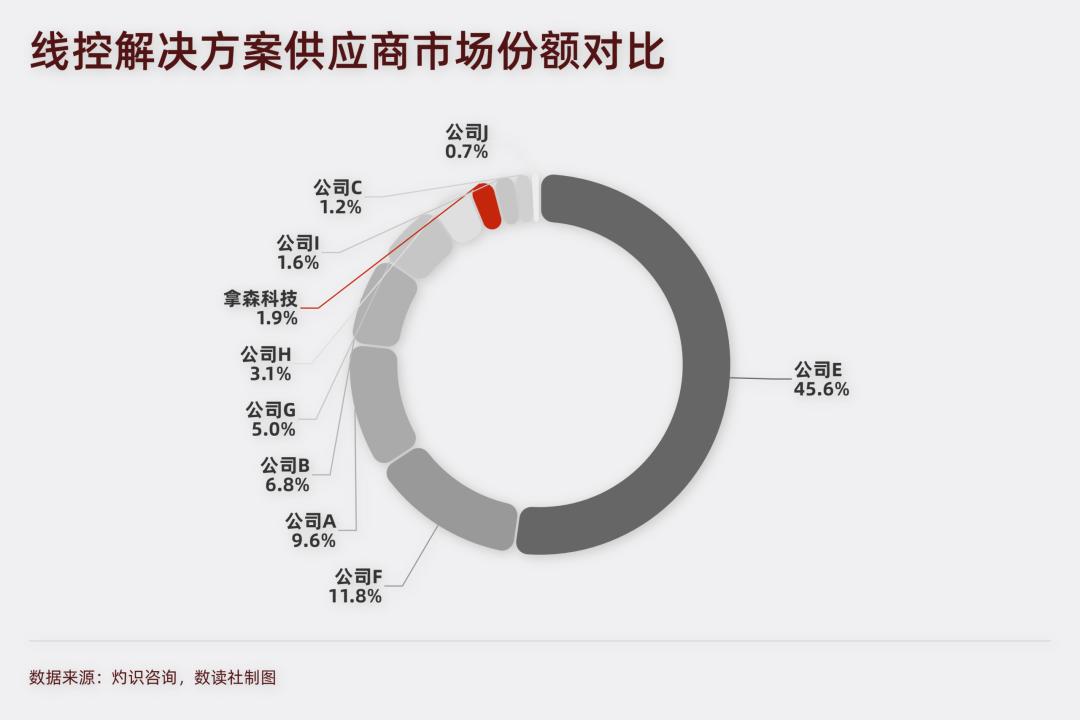
Nasn Technology's market share in 2025 (calculated based on the revenue of domestic brake-by-wire suppliers) was 1.9%, occupying a place in the wave of domestic substitution, but this figure is still too small. Facing the CR3 pattern formed by Bosch, Continental and ZF, 9.9% means that domestic substitution still takes time.
This catching-up process will definitely not be smooth.
Brake-by-wire is a field monopolized by foreign giants for nearly 40 years, and Bosch, Continental and other companies hold a large number of core patents. When local Chinese manufacturers begin to truly impact the market, patent lawsuits are almost the only way to go.
In March 2025, a German-headquartered technology and service provider filed five patent infringement lawsuits against Nasn Technology at the Suzhou Intermediate People's Court, accusing its ESC solutions of infringement, with a total claim of 50 million yuan.
One of the lawsuits was dismissed by the court in March 2026, and the remaining four are still under trial. The company has made a provision of 10 million yuan. The essence of this lawsuit is a "patent encirclement" that attempts to curb the pace of Chinese enterprises.
However, compared with the obstruction from foreign enterprises, the real challenge for Nasn Technology still comes from the domestic market and the realistic position in the supply chain.
02
"Footless bird"
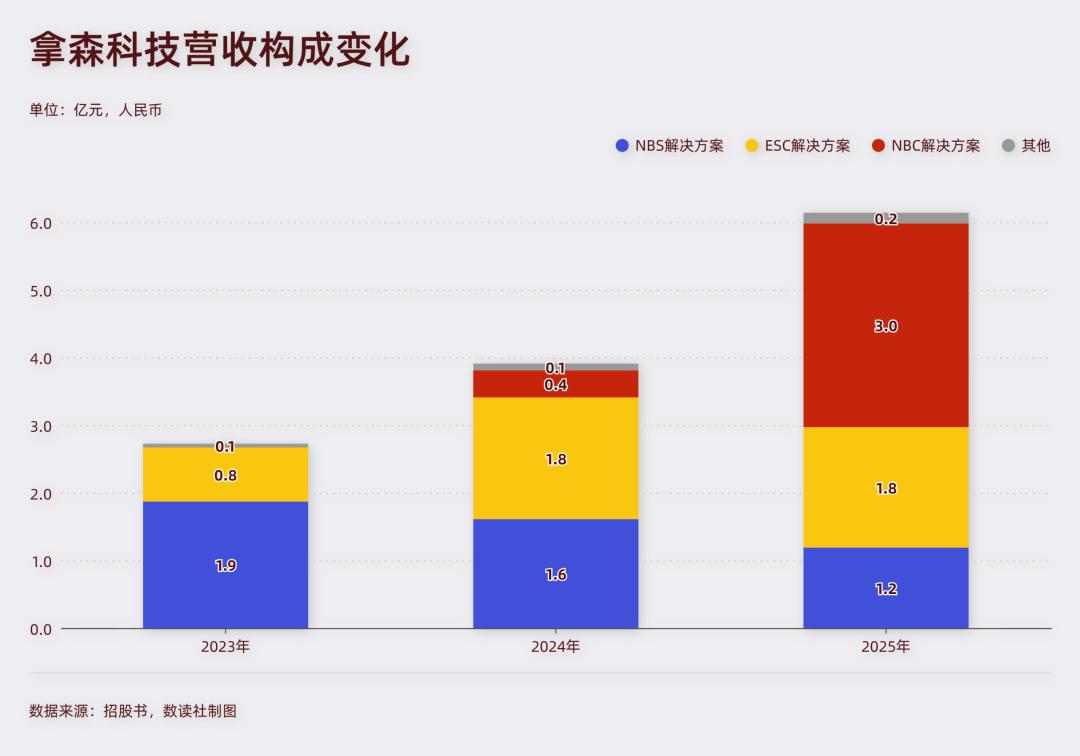
At present, NBS, ESC and NBC solutions are the main sources of revenue. All three solutions generate income, driving the company's revenue to grow from 272 million yuan in 2023 to 615 million yuan in 2025.
However, the three solutions did not develop synchronously, but followed a linear development path.
In 2023, NBS (Electronic Control Brake Assist System) contributed 68.6% of the company's revenue, ESC (Electronic Stability Control System) accounted for 29.3%, and NBC (Integrated Intelligent Braking System) had not yet generated revenue.
By 2025, this pattern had been completely rewritten. NBC revenue surged to 301 million yuan, a year-on-year increase of 661%, accounting for 49.1% of total revenue and becoming the largest source of revenue; ESC accounted for 28.9%, and the share of NBS solutions had dropped to 19.4%.
This reflects the evolution of technology. As an integrated One-Box solution, NBC has higher integration, lower cost and higher energy recovery efficiency compared with the traditional Two-Box solution.
With the accelerated popularization of 800V high-voltage platform models of new energy vehicles, the market demand for highly integrated braking products such as NBC continues to rise. Nasn Technology's NBC solution was launched in 2023, mass-produced in August 2024, and finally became the main product in 2025.
But at the same time, it also reflects a very realistic problem: when new technologies iterate, old technologies will basically withdraw from the market, and the cycle is getting shorter and shorter.
The NBS solution was mass-produced on a large scale in 2018, and its revenue continued to decline from 2023 to 2025. By the first quarter of this year, its revenue contribution was only 2.36 million yuan, accounting for only 1.6%. The ESC solution was mass-produced in 2020, and its revenue had declined in 2025, showing a sign of shortening product and technology cycles.
Nasn Technology has to make technical layouts for the future as much as possible to prevent a sharp drop in revenue caused by the replacement of new products. According to the prospectus, Nasn Technology has reserved five new solutions for the future, namely RBC, EMB, EPS, SBW and NXU, all of which will have mass production capacity or start mass production in 2027.
This leads to the situation that Nasn Technology needs to keep running like a "footless bird" to finally secure a place in the market. Once its existing solutions are surpassed or replaced, the end may come within 1 to 2 years.
In the first risk warning of the prospectus, Nasn Technology clearly mentioned that the by-wire industry is highly competitive. If the company fails to improve existing solutions or launch new ones, its business, operating performance and financial situation may be significantly affected.
All these fully demonstrate the cruelty of industry competition, which Nasn Technology can only adapt to but cannot change.
03
Big customers account for 94% of revenue
For intelligent driving supply chain enterprises like Nasn Technology, the number of downstream vehicle manufacturers is limited. The customer concentration is extremely high, and the industry is in a state of extreme involution, forcing the upstream of the supply chain to follow the involution trend. If the company cannot meet the requirements of big customers, the risk of losing customers is far greater than the risk of continuous investment.
In 2025, the top five customers of Nasn Technology contributed 94.4% of its revenue, and the single largest customer accounted for as high as 47.2%. The proportion of the largest customer is decreasing, from 59.2% in 2023 to 47.2% in 2025, and further dropped to 43.9% in the first quarter. But the proportion of the top five customers has always been very high, reaching 96.9% in the first quarter of this year.
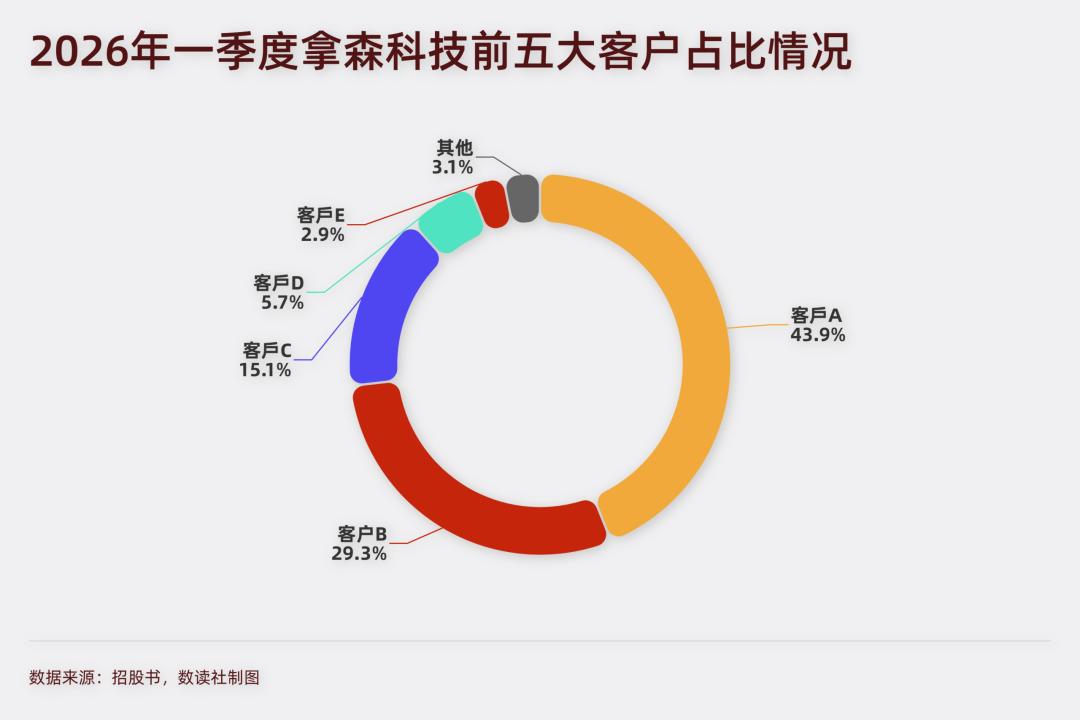
The market generally believes that the largest customer is Changan Automobile — which means that Changan alone contributes nearly half of Nasn Technology's revenue. If the customer's demand fluctuates, the designated project is delayed or the supplier is switched, it will have a direct impact on the company's operation.
The flip side of high customer concentration is that the company's bargaining power in the industrial chain is limited.
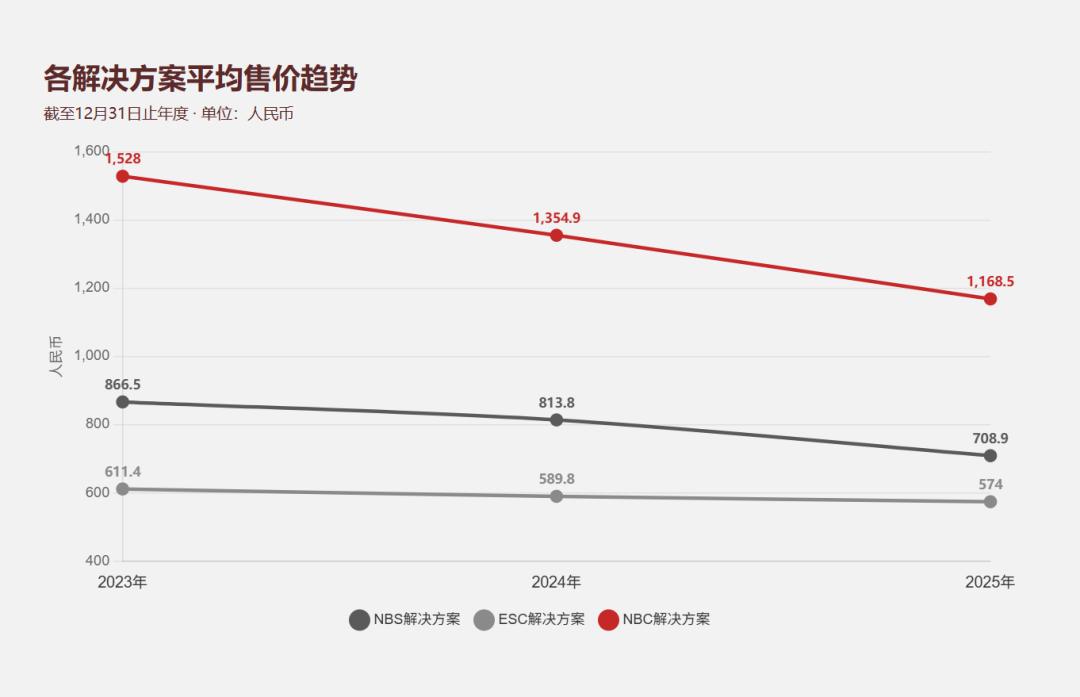
In order to meet the demand of customers' price wars, Nasn Technology has to cut prices to retain customers. In the past three years, all three solutions of its main business have almost been cut in price. Even the latest NBC solution has dropped from 1528 yuan to 1168.5 yuan, which is the solution with the largest price reduction.
At the same time, in order to maintain industry competitiveness, Nasn Technology has to continue to invest. This makes it difficult for its cash flow to turn positive.
In the past three years, Nasn Technology's sales cost has almost doubled, from 269 million yuan to 531 million yuan. Among the three expenses, although the marketing expense is low, it has grown rapidly, increasing to 14.248 million yuan in 2025, with a year-on-year increase of 167.5%. The administrative expense was 62.379 million yuan, a year-on-year increase of 91.5%.
Nasn Technology can only save costs on R&D, with the R&D expense reaching 82.959 million yuan, which has been reduced for two consecutive years. Obviously, the current expense situation has reached the stage where the company has to cut costs on R&D.
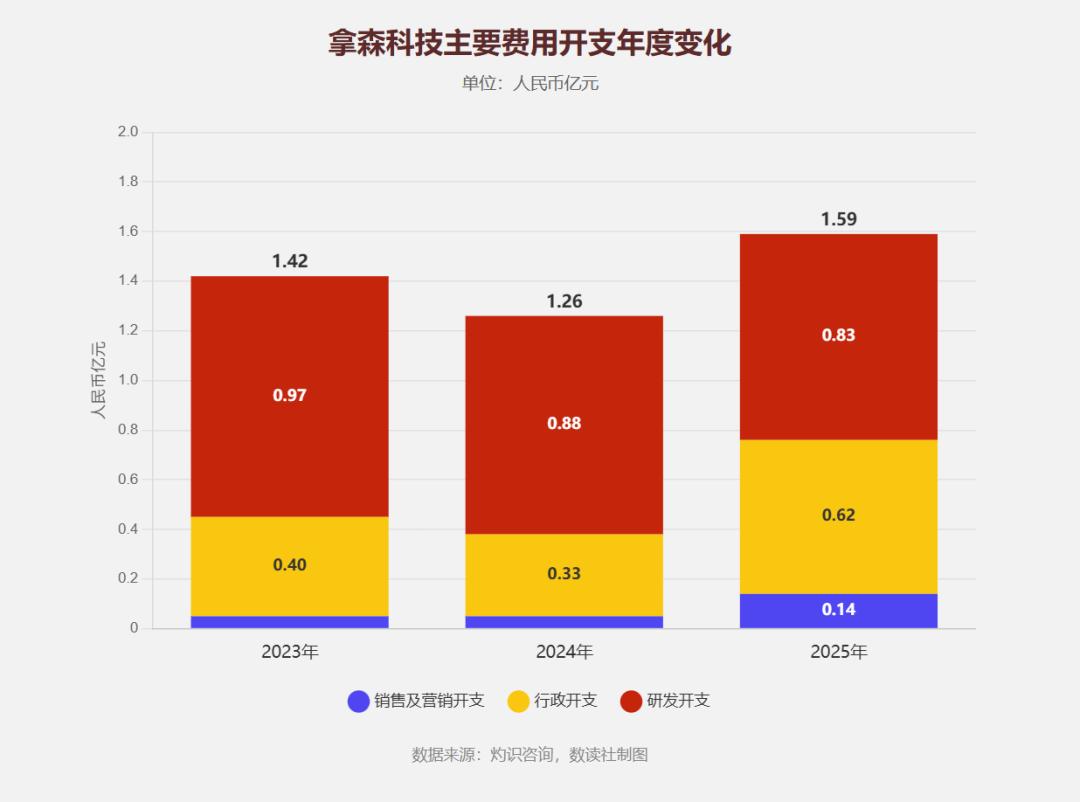
According to the employee and salary data in the prospectus, the average annual salary of sales personnel of Nasn Technology is 344,000 yuan, that of administrative personnel is 398,000 yuan, while the salary of R&D personnel is only 326,000 yuan. Obviously, the treatment of R&D personnel at Nasn Technology needs to be improved.
The reduction of R&D investment and the average salary of R&D personnel is naturally unfavorable to the long-term development of the company.
Even after reducing expenses, in 2025, its cash flow from operating activities still turned from positive to negative, with a net outflow of 165 million yuan — revenue increased by 57%, but cash flow deteriorated.
The cash and cash equivalents at the end of the year were only 149 million yuan, a year-on-year decrease of 17 million yuan. In the past three years, Nasn Technology's current ratio was only 0.4-0.5 times, far lower than 1 time, with high short-term debt repayment pressure and insufficient safety margin.
In this case, listing and financing has become a necessary choice for Nasn Technology.
04
10 rounds of financing in 10 years
After completing 10 rounds of financing in ten years of establishment and raising a total of about 1.294 billion yuan, Nasn Technology has reached the stage of listing to reward its shareholders.
Due to the large number of financing rounds, the shares held by the founder couple do not have absolute controlling power at present. Founder Tao Zhe holds 15.61% of the shares as the largest shareholder, and together with Liu Qian and the employee stock ownership platform, they control 22.58% of the voting rights, making them the single largest shareholder group.
In terms of external shareholders, angel investor Wang Jianming holds 11.21% of the shares as the second largest shareholder; Qiming Venture Partners holds 8.43% as the largest external institutional shareholder; Matrix Partners China holds 7.23%; CATL holds 3.98%; GL Ventures holds 3.64%; state-owned capital institutions such as BOC Capital have also invested heavily in the company.
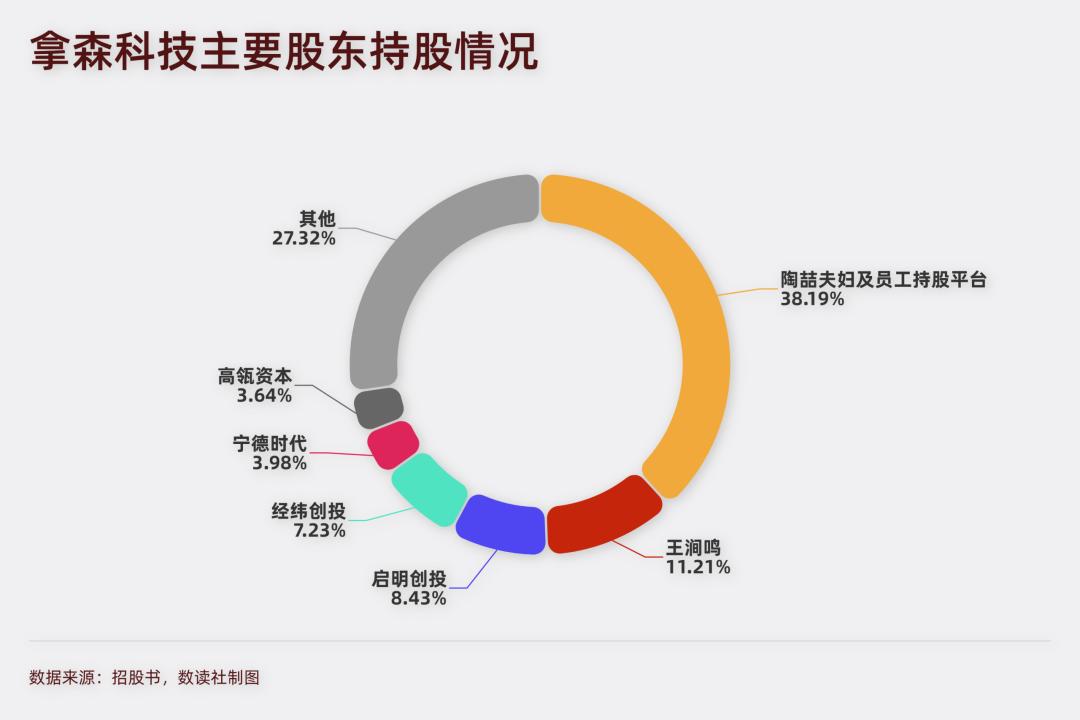
It is worth noting that CATL holds shares through its wholly-owned subsidiary Ningbo Wending Investment. The by-wire chassis is the intersection of the two tracks of new energy vehicles and intelligent vehicles.
CATL has participated in many automobile enterprises such as Chery, IM, and Neta through Wending Investment. Investing in Nasn Technology is equivalent to increasing its presence in the industrial chain of "battery - chassis - complete vehicle".
The prospectus mentions that Nasn Technology has jointly tackled key problems with a global leading battery technology supplier, taking the lead in realizing the landing of brake-by-wire technology on the Cell to Chassis (C2C) architecture — this "global leading battery technology supplier" most likely refers to CATL.
However, CATL's participation is not deep, and the 3.98% shareholding is more of a wide layout move. The real challenge is whether Nasn Technology can continue to obtain more customers and seize more market share through technology.
According to the prospectus, the funds raised by Nasn Technology this time are mainly used to continuously increase R&D investment, expand and upgrade the company's production and manufacturing capacity.
These two directions lead to the same goal, and the ultimate target is to achieve scale. The existing three solutions have not reached the state of being in short supply for the time being, and the company's capacity utilization rate is less than 90%.