SEA: Behind the explosive rally, is e-commerce finally about to take off?
Sea, known as the "Little Tencent of Southeast Asia", released its Q2 2026 financial report on the evening of August 11. Its overall performance in the quarter was solid, with strong growth across all three business segments, exceeding market expectations. On the profit front, the profit margin of its most critical e-commerce segment continued to rise. However, the shortcoming is that the company is still in a high-investment phase, with overall profit growth of just over 10%, meaning revenue growth has not translated to proportional profit growth. The details are as follows:
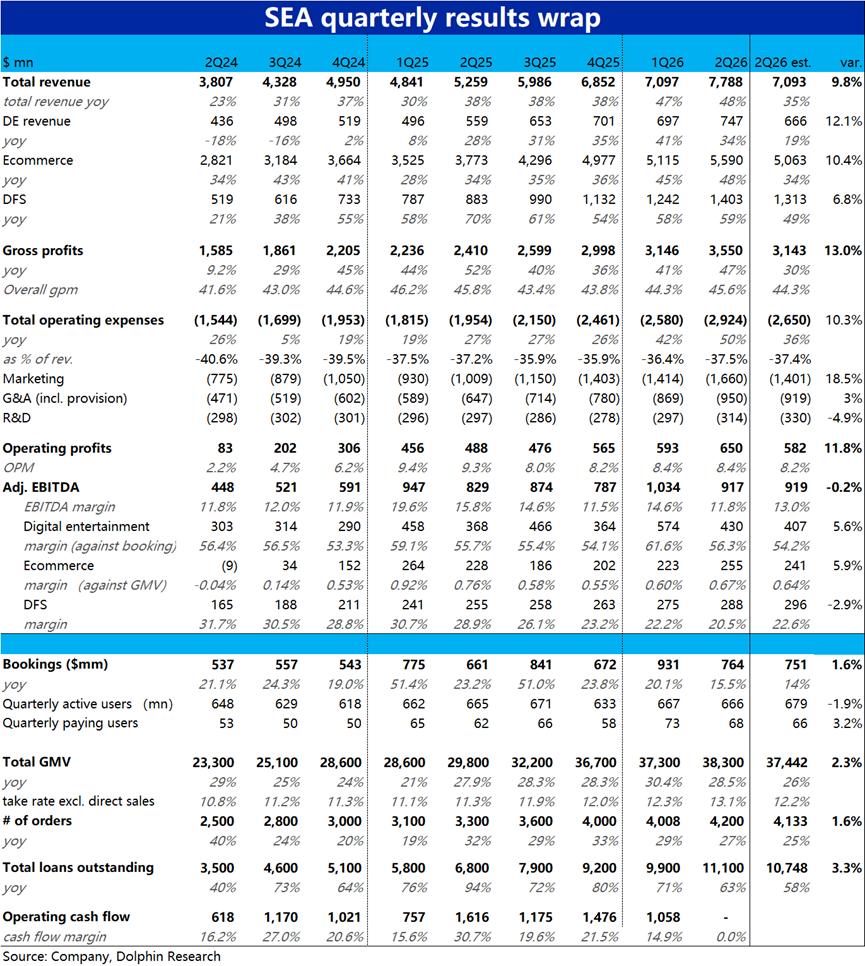
1. Overall Performance: Revenue Outpaces Profit Growth: Sea's total revenue in this quarter reached nearly $7.8 billion, up 48% year-on-year, accelerating from the previous quarter and significantly outperforming Bloomberg's 35% growth estimate. All three segments beat expectations, with no weak spots in performance.
However, on the profit side, the overall adjusted EBITDA reached nearly $920 million, which was slightly below Bloomberg's expectations, with a year-on-year growth rate of less than 11%. There is a notable gap between this figure and the robust revenue growth.
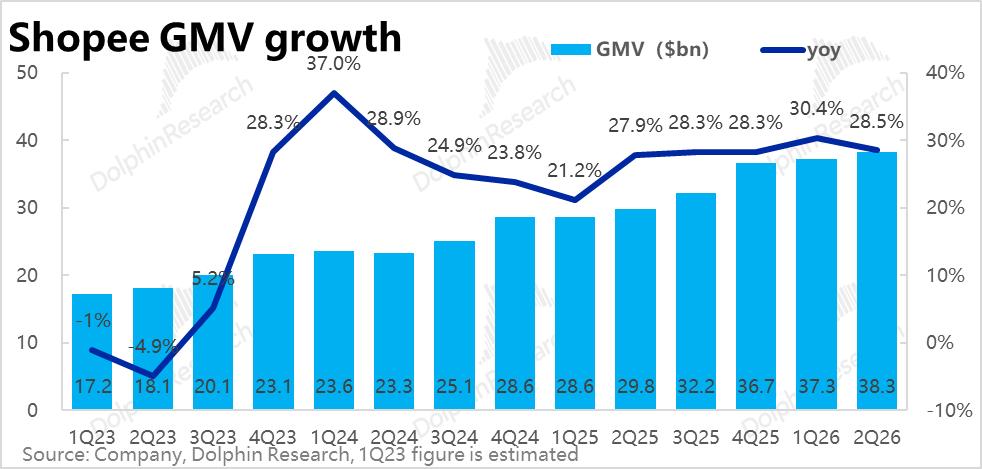
2. E-commerce Profit Confirms Bottoming Out: The e-commerce segment, the core business this quarter, delivered strong performance in both growth and profitability. First, GMV recorded a 28.5% year-on-year growth rate. Although the growth appears to slow sequentially, it still maintained strong momentum against a sharply higher base in the same period last year, beating Bloomberg's 26% growth expectation.
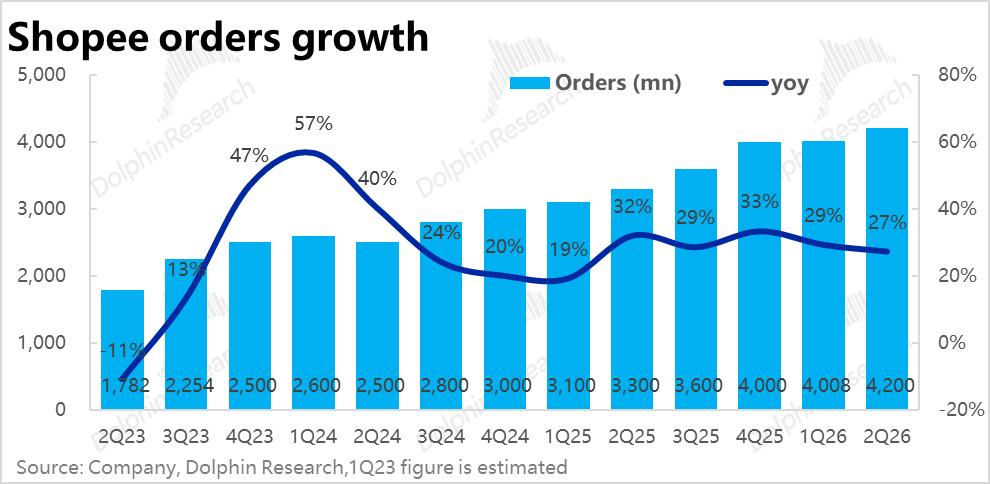
In terms of volume and value drivers, growth in the past two quarters has been almost entirely driven by rising order volume, which further proves that investments in logistics and other infrastructure are effective in boosting shopping frequency.
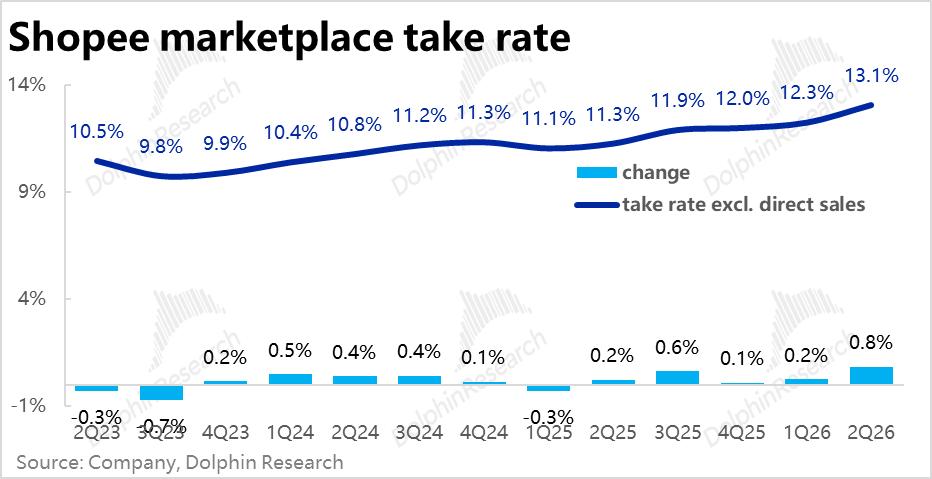
Meanwhile, the monetization rate of Shopee's 3P platform increased significantly by 0.8 percentage points quarter-on-quarter (the largest quarterly increase in nearly 4 years), driving e-commerce revenue to grow by 48% year-on-year, accelerating its growth momentum and outperforming market expectations by more than 10 percentage points. This reflects Shopee's strong capability in optimizing monetization efficiency.
2. Monee Maintains Strong Growth, but Risks Keep Rising? Total loan volume in this quarter reached $11.1 billion (including on-balance-sheet and off-balance-sheet items), about 3% higher than Bloomberg's consensus estimate. The net sequential increase reached $1.2 billion, also accelerating from the previous quarter. Driven by this, the financial segment's revenue grew by 59%, about 7 percentage points higher than expected, indicating its growth remains robust.
However, according to calculations by Dolphin Research, the bad debt loss rate (calculated as credit loss provisions / average loan balance) reached 21%, up about 1.6 percentage points from the previous quarter, indicating risks in the credit market are indeed deteriorating.
Affected by this, the profit margin of the financial segment has declined for the third consecutive quarter (down 1.7 percentage points this time), making it the only major indicator that missed Bloomberg's expectations in this quarter. As a result, the segment's profit grew by less than 13% year-on-year, meaning the rapid expansion of business volume has not brought much incremental profit.
3. Garena Remains Steady: Without major cross-promotion campaigns, the gaming segment still delivered solid performance this quarter. Its core metric, revenue from in-game operations grew by 15.5% year-on-year, slightly exceeding market expectations.
At the same time, the number of active users remained roughly flat year-on-year, while paying users increased by more than 10% year-on-year, pushing the payment rate up by about 0.9 percentage points year-on-year. Both key indicators show that even without cross-promotion campaigns, the stickiness and activity level of Garena's game users remain strong.
Deferred revenue had little impact this quarter, so game revenue was roughly equivalent to in-game revenue, clearly outperforming Bloomberg's expectations.
4. Segment-wise Profit Performance: As mentioned above, the company's overall profit performance this quarter was not ideal, but the e-commerce and gaming segments performed well, while the financial segment was relatively weak.
Among them, the e-commerce segment's profit margin (calculated as adjusted EBITDA / GMV) reached 0.67%, up 0.7 percentage points from the previous quarter and rising for two consecutive quarters, which basically confirms that Shopee has re-entered a profit release cycle. Further analysis shows that this is mainly driven by the significant increase in monetization rate, which pushed the e-commerce gross margin up notably (up 1.2 percentage points year-on-year). However, expenses remained high, rising by nearly 57% year-on-year, so the profit margin still narrowed on a year-on-year basis.
For the financial segment, as mentioned earlier, the profit margin continues to decline due to the rise in bad debt provision rates.
For the gaming segment, driven by solid in-game revenue growth and no special large-scale investment requirements, its actual profit was about 5.6% higher than expected, which is also a strong performance.
5. Solid Gross Profit, High Operating Expenses: As noted above, while revenue growth was strong this quarter, profit growth was muted, with the root cause lying in the still aggressive investment in expenses.
Benefiting from better-than-expected revenue, gross margin performed well, reaching 45.6% overall, up 1.3 percentage points quarter-on-quarter and nearly halting its downward trend on a year-on-year basis. However, total expenses increased by about 50% year-on-year, accelerating further from the previous quarter and outpacing revenue growth. Specifically, the main drivers are still marketing expenses and bad debt provisions, which rose by 64% and 72% year-on-year respectively.
Dolphin Research Insights:
1. Quarterly Performance Review
Overall, the company's performance this quarter is broadly similar to that of previous quarters, maintaining its strategy of trading high investment for high growth, which means profit release is still not satisfactory. This core logic has not seen fundamental changes. The only difference is that only the financial segment's profit metric underperformed this quarter. All other indicators basically beat expectations, and the core e-commerce segment delivered strong growth and profit that exceeded estimates, so the overall performance presents a positive outlook.
Specifically, all three segments posted solid business and revenue growth that beat expectations, the only difference lies in their varying profit performance.
The e-commerce segment's profit margin is still declining year-on-year, but it has confirmed its bottom and started to rebound; the financial segment's profit margin continues to decline due to rising bad debt rates and expansion into new markets; the gaming segment remains relatively stable, with little investment-driven growth, and its profit growth is roughly in line with business growth.
2. Recent Updates and Future Outlook
From a segment-wise perspective, 1) For the core e-commerce business, the two decisive factors at present are the trend of profit margin changes and the evolution of the competitive landscape.
In terms of profit margin, there were initial signs of bottoming out and rebounding last quarter, and this quarter's performance confirms this trend. Although further fluctuations cannot be ruled out, in the medium to long term, as the company's current investments enter the return period (with improved logistics fulfillment efficiency and higher user repurchase rates) and the monetization rate continues to rise, the improvement of the e-commerce business's profit margin is an inevitable event, even if the exact timing is uncertain.
On the other hand, the core theme of the e-commerce industry is competition. The current situation Shopee faces is relatively complex. In the Southeast Asian market, the competitive landscape appears relatively stable. Evidence shows that TikTok Shop is still raising its monetization rate in Southeast Asia recently. Meanwhile, J&T Express's parcel volume in the second quarter was lower than expected (TikTok is one of its key clients), which is partially interpreted as a slowdown in TikTok's growth in the Southeast Asian market.
In contrast, competition in the Brazilian market is more intense. The main reason is that local leader Mercado is also adopting an aggressive investment strategy, and it is still in a phase of rapid order volume growth paired with negative profit. In addition to logistics construction, Mercado has recently lowered commission rates for some categories where Shopee has competitive advantages, with clear competitive intentions. In a multi-player competitive landscape, competition in Brazil and the broader South American market is unlikely to ease significantly in the short term.
Another potential risk point is: as e-commerce platforms have continued to increase monetization from merchants, Thailand has recently established an agency to examine whether commission rates are too high for small and medium-sized merchants, and the Indonesian government has shown similar tendencies. Currently this factor does not pose a substantial impact on the company, as it remains unknown whether the monetization rate will be judged as excessively high and whether the platforms will be forced to lower commissions in the future, so it is necessary to keep tracking this development.
2) For Monee's financial business, the market is currently focusing on the balance between business growth, credit risk and profit margin.
The overall situation is similar to its competitor Meli: Monee's business growth remains strong, but as it needs to make upfront investments to expand into emerging markets and profit margins take time to climb, the credit business's profit margin has narrowed for 3 consecutive quarters, with extremely high loan balance growth but profit growth of less than 20%.
At the same time, the market is generally growing concerned about credit risks in emerging markets (both in South America and Southeast Asia). Once the bad debt rate deteriorates, the already pressured profit margin of the financial business will further decline. This quarter's performance validates the market's concerns. If the credit market environment further deteriorates, the company is more likely to take the initiative to tighten credit approval. Even if the bad debt rate does not rise sharply, the growth of business and revenue will slow down significantly as a trade-off.
3) The Garena gaming segment, which is no longer a major focus of the market but has delivered solid performance recently, maintains strong user stickiness for its games according to recent market research. In the second half of this year, there will be cross-promotion campaigns with popular IPs such as *Naruto*, so it is highly likely that the game's in-game revenue will maintain a growth rate of over 10% for the full year.
However, the long-standing issue remains that Garena has not officially announced plans for major new games, so the growth of in-game revenue in 2027 and beyond can only be viewed conservatively (at a low single-digit percentage, for example).
At present, the company's growth and performance are indeed solid, but some medium-term risk factors cannot be ignored, including competitive risks in e-commerce (especially in Brazil), potential credit deterioration risks in the financial business, and the long-standing risk of the gaming segment lacking new blockbuster titles.
Detailed Interpretation of the Financial Report
I. Shopee E-commerce: Growth Continues to Surge
The core Shopee e-commerce segment maintained strong growth momentum this quarter. Order volume rose 27% year-on-year, with a seemingly 2 percentage point sequential slowdown, but it should be noted that the growth base in the previous year was raised by a full 13 percentage points. This proves that the growth rate is actually very strong, and the driving effect of logistics construction on business volume expansion is very similar to that of its competitor Meli.
As for GMV's 28.5% year-on-year growth rate, which outperforms the market's expectation of 26%, with average order value remaining largely stable (rising 1% year-on-year this quarter), GMV growth is now synchronized with order volume growth.
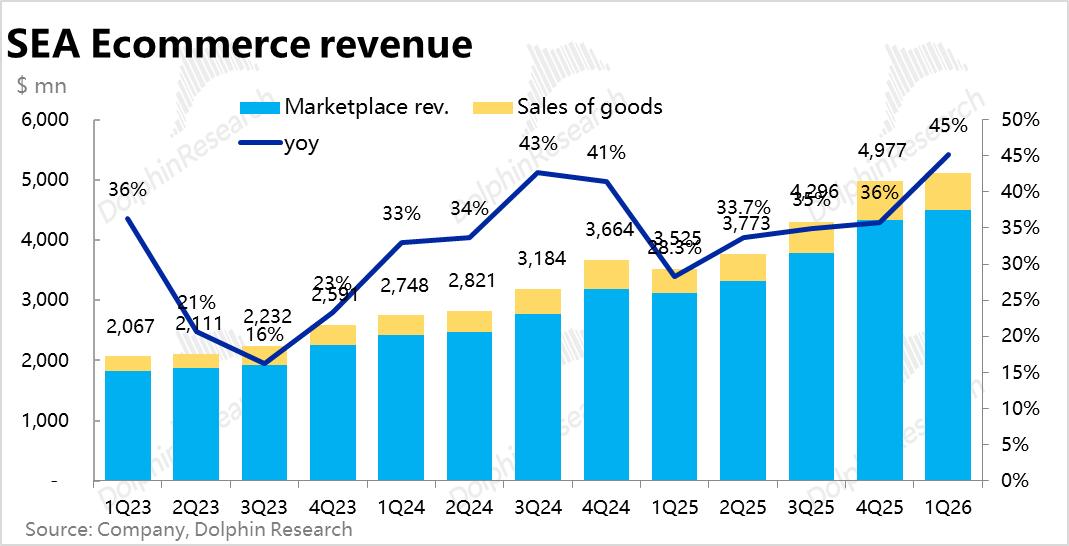
In contrast, Shopee's revenue and monetization beat expectations by a larger margin this quarter. Total revenue grew by 48% year-on-year. While GMV growth slowed down, revenue growth accelerated, outperforming market growth expectations by more than 10 percentage points.
The underlying reason is that the monetization rate of Shopee's 3P platform rose notably, reaching 13.1% this quarter, up 0.8 percentage points quarter-on-quarter, marking the largest single-quarter increase in nearly 4 years.
More specifically, commission-based monetization rate rose by 0.9 percentage points quarter-on-quarter, while logistics-focused VAS monetization rate still declined by 0.1 percentage points. According to public reports, Shopee and TikTok are still jointly raising commission rates "peacefully" in the Southeast Asian market. Different from Meli's commission cut, Shopee also lowered the share for traffic diversion partners in the Brazilian market, which is an implicit measure to raise commission rates.
II. Garena Gaming: Solid Performance
The Garena gaming segment, which has delivered strong performance in recent quarters, remained steady this quarter. Its core metric, in-game revenue, grew by 15.5% year-on-year. Although the growth rate slowed down compared to previous quarters, maintaining such growth without major cross-promotion campaigns slightly exceeded market expectations.
Meanwhile, while the number of active users remained roughly flat this quarter, paying users reached 68 million, up about 10% year-on-year, pushing the payment rate up by about 0.9 percentage points year-on-year. This shows that after cross-promotion campaigns, the stickiness and activity level of Garena's game users remain strong.
Driven by robust in-game revenue growth, the gaming segment's revenue reached $760 million this quarter, roughly equivalent to in-game revenue (meaning deferred revenue adjustments were minimal).
