Competing for talents with Qwen Office and opening up the agent ecosystem, what is Qwen App in such a rush for?
On August 10, Qwen App, Alibaba's personal AI assistant, officially launched paid services.
Just like Doubao a few months ago, Qwen App adopts a model of free daily basic conversations and charges for professional users, and the two parties have similar definitions of "professional users".
The first category is users with high-frequency, heavy office needs. Qwen App targets the "office assistant" scenario for individual users, charging through a membership subscription system. The professional membership fee is divided into three tiers: Advanced, Elite, and Flagship, with monthly fees of 19 yuan, 49 yuan, and 128 yuan respectively, and annual fees of 200 yuan, 568 yuan, and 1499 yuan respectively.
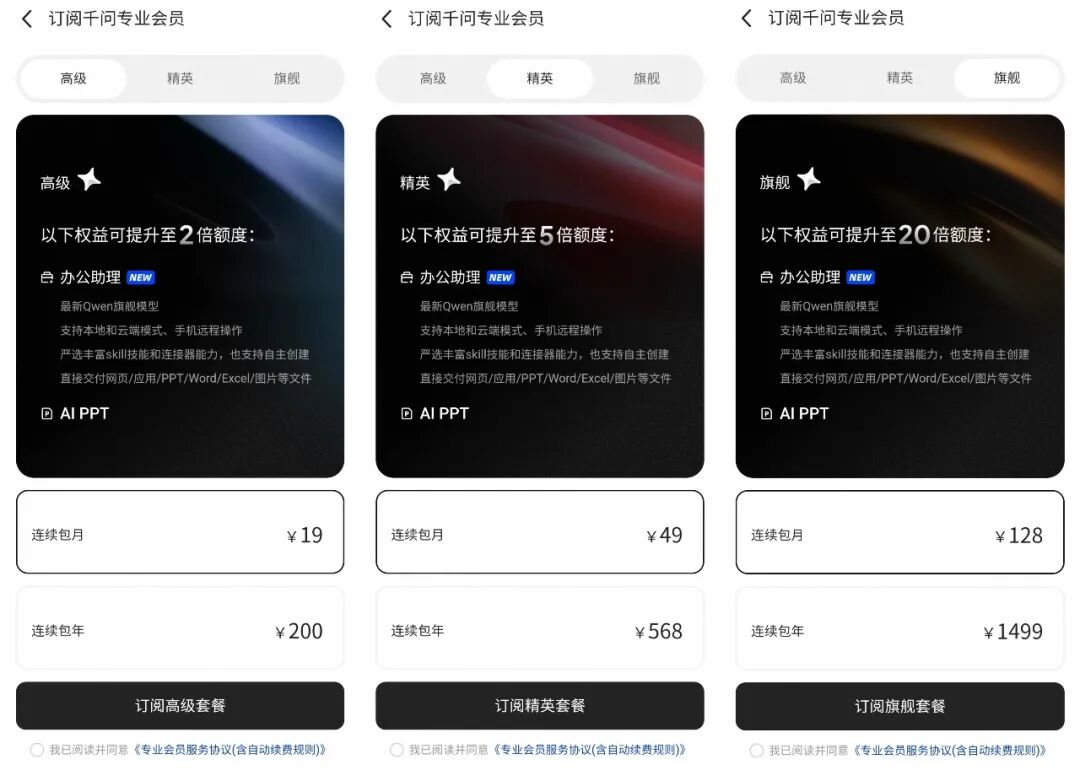
Figure / Qwen App
The other category is professional users with video creation needs. Qwen App charges based on AI video generation quotas, at about 2 yuan per quota. Of course, ordinary users can also use it without recharging, and the system will give 10 quotas for free every day.
What is more worth discussing, and has actually sparked a lot of discussions, is the very fact that Qwen App has started charging around the "office assistant" feature.
On August 3, "Qwen Work", an enterprise-level Agent product integrated by Alibaba from three products QoderWork, MuleRun and Wukong, has just launched public beta, targeting office scenarios. Initially, the web version and independent PC client were opened, and the official stated that the built-in entrances for the mobile terminal, DingTalk PC terminal and mobile terminal will also be opened in the near future.
Just a few days later, on August 7, Qwen App updated its functions and launched a number of new features such as Thinking & Research, Scheduled Tasks, Office Assistant, Voice Call, and Agent Square, and then immediately explored charging in office scenarios.
In addition, Qwen App also officially announced the launch of the "Qwen Open Platform" yesterday, opening up access to three types of terminal services including mobile phones, PCs and AI glasses for ecological partners and developers. The first batch of accessed partners covers more than ten fields such as logistics and transportation, real estate and housing, local life, wealth management, and automobiles.
Connecting these changes together, within just one week, Qwen App has taken major actions from new function launches to opening up the agent ecosystem, and then to entering the office assistant charging track.
What on earth is Qwen App in such a hurry for?
01
"Squeezing the full potential" of Qwen3.8
Alibaba officially released Qwen3.8-Max on August 3, expanding the total number of parameters to 2.4T with 95B activated parameters. It is the second large model in China with a parameter scale exceeding 2 trillion after Kimi K3. Alibaba itself also said that Qwen3.8-Max is its most powerful large model so far.
After the news that Qwen App's office function entered public beta and was connected to Qwen3.8 was released on the same day, Alibaba's Hong Kong stock price rose by 7.01% that day.
Shortly afterwards, when Qwen App launched new features such as "Office Assistant", Qwen3.8-Max was also integrated.
The noteworthy information behind this is that Qwen3.8 has focused on improving its Coding capability and professional office (Cowork) capability.
In addition, Qwen3.8 has also improved its visual understanding capability and agent capability. For example, in the Artificial Analysis list, Qwen3.8-Max ranks first in the world in the agent capability ranking, surpassing Claude Opus5 and GPT5.6.
In this way, Qwen App's several recent major moves — launching the office assistant function and trying to charge for it, opening up the agent ecosystem, and starting to charge for AI-generated videos — seem to be working hard to find applicable scenarios for Qwen3.8.
In other words, Qwen App actually seems to want to squeeze the full potential of Qwen3.8, so that the model's capabilities can be maximized.
02
Qwen App and Qwen Work: Complementary or Competitive?
However, when Qwen App blatantly steps into the office scenario, the situation begins to become complicated.
Within the capability boundary of Qwen App itself, it is reasonable for it to develop office scenarios and build an open agent ecosystem.
This is also the boundary that AI applications need to expand to become a super entry point on the C-end, and Doubao has actually done so already.
However, from the perspective of Alibaba's system, whether it is reasonable or even necessary for Qwen App to develop office business is questionable.
Over the past period of time, from Tencent to Alibaba and then to ByteDance, the main line of promoting the implementation of AI in office scenarios has been clear enough, and all three companies are increasing their efforts through actions such as integrating products and adjusting organizational structures.
For a while, a new round of AI office war for enterprise-level office scenarios is about to break out, and collaborative office is already a product of the previous generation.
Perhaps it is because the significance of this round of entry points around the enterprise-side office scenario is too important, or the pressure from ByteDance and Tencent is too great, Qwen Work's strategic priority in Alibaba has become particularly high.
Citing previous reports from Huxiu, Alibaba has internally regarded "AI Office" as one of the company's strategic directions in the AI field. For "AI Office", Alibaba's decision-makers position it as an enterprise-level AI productivity platform for enterprise organizations, rather than a personal AI office tool only for C-end users.
Another detail is that people familiar with the matter said that senior group executives including Wu Yongming will personally participate in key meetings of Qwen Work. Qwen Work has become one of the most critical strategic-level products in the company.
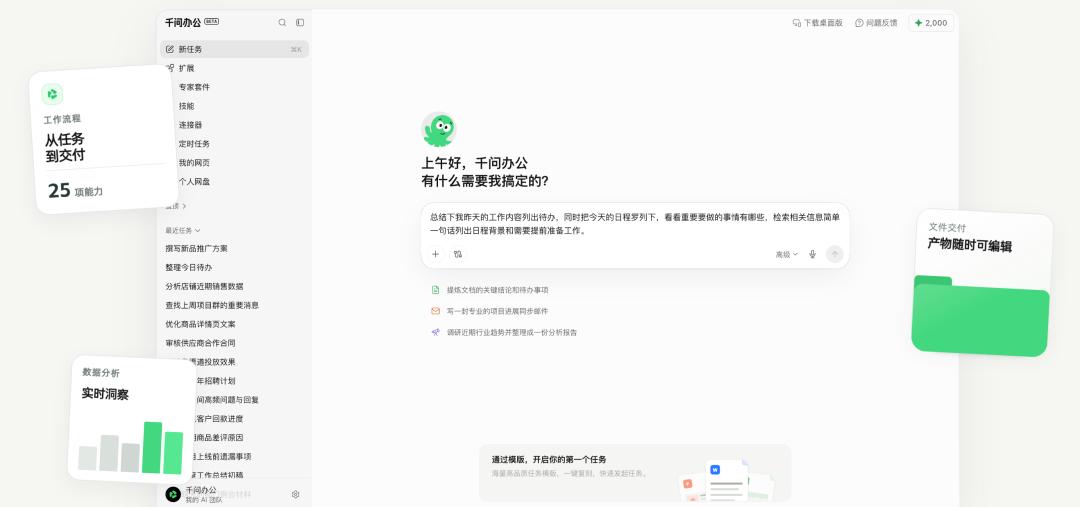
Figure / Qwen Work official website
Against this background, Qwen App suddenly jumped out to do AI office and tried to charge for it, which indeed left a lot of room for discussion.
Theoretically, there is scenario complementarity between Qwen Work and Qwen App in a sense — one is for enterprise-level scenarios, the other is for individual user scenarios, one aims to release enterprise productivity, and the other aims to become user productivity, forming a closed business loop.
But a question that even Qwen App itself can hardly answer clearly is whether in the real office scenario, the boundary between the personal office needs of users and the office needs of users in the enterprise scenario is clear enough.
Regarding this issue, I had a sudden inspiration to ask Qwen yesterday: "I am an employee in an enterprise, and the enterprise has deployed Qwen Work, so why do I need to use Qwen Office Assistant?"
Qwen App's answer to me was: "Work matters belong to the work platform, and personal matters belong to me."
It seems to have said everything, but also seems to have said nothing. The key is that the division of needs is blurred to a certain extent.
To put it aside for a moment, to digress a little, do office workers really need a personal exclusive office assistant? Is light office not office? Qwen, you are so mean to me.
It is also worth noting that Qwen Work also supports individual users, who can use it for free or pay for a subscription to unlock more rights. The subscription price is higher than Qwen's professional membership, as shown in the figure below.
In other words, as long as it touches AI office, Qwen App and Qwen Work will form a competitive relationship.
03
Beyond the Capability Boundary
Next, let's talk about the "Qwen Open Platform".
At present, Qwen has integrated 19 agents including Beike Zhaofang, SF Express, Fliggy Travel, etc., targeting specific life scenarios such as travel, trip planning, and house renting.
What is the specific experience like?
I first tried to send a parcel through the SF Express agent.
After clicking into the "SF Express" agent and agreeing to authorize the binding of my account, the instruction I gave was very simple:
Help me send a parcel — enter the address and recipient information — enter the specific product to be sent.
All I need to do next is to confirm the order information.
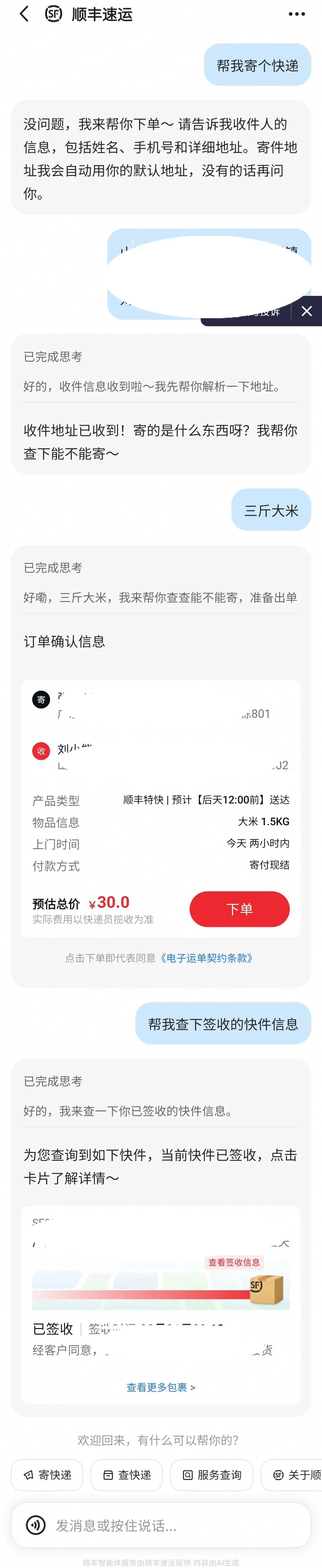
It can be said that the whole process is quite smooth, very efficient, and I am very satisfied.
However, when I wanted to order a cup of coffee through the Taobao Flash Purchase agent, the situation became rather awkward.
Without further ado, let's look at the picture directly.

I have to say, I was a little confused at first. Both are agents that were first accessed to Qwen App, but the historical orders of SF Express can be queried, while the flash purchase orders within Alibaba's own ecosystem cannot be queried. I don't understand what the logic behind this is.
What's more interesting is that after exiting the agent entry, I tried to create a new conversation directly in the Qwen chat box. This time the instruction was simpler and more straightforward: Help me order the coffee I usually drink.
As a result, from the store information to the specific product category, everything is completely correct.
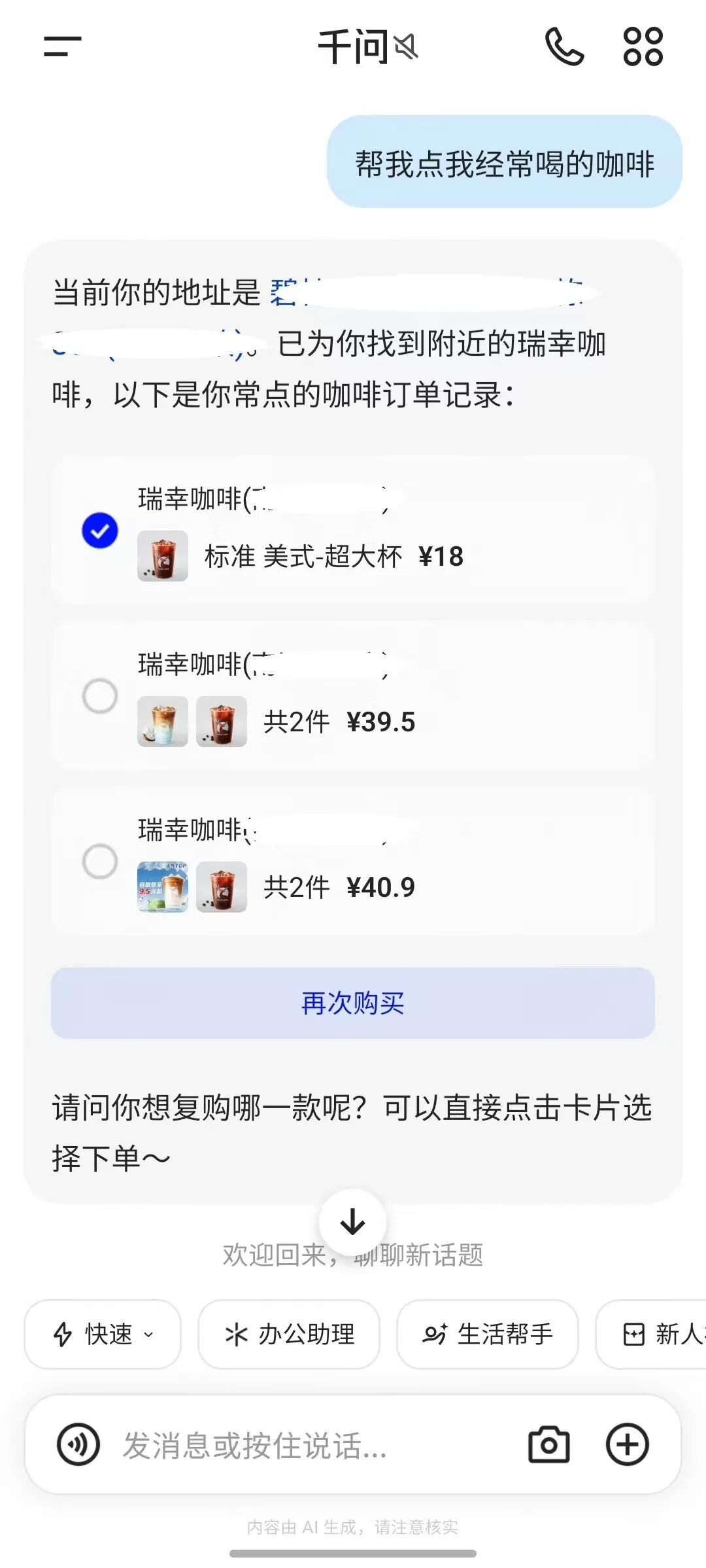
Therefore, I am more inclined to believe that the emergence of this "non-intelligent" Taobao Flash Purchase agent is not a capability problem, but more like an internal collaboration problem.
Of course, since Qwen Open Platform has just been launched, it is still in the cold start stage on the whole, and it is understandable that the initial experience is not perfect.
What is really worth discussing is whether accelerating the construction of a third-party agent ecosystem can really make Qwen the C-end "super entry point" it wants to be.
The capability boundary is not a problem to some extent.
As we mentioned above, Qwen3.8 has fully supported Qwen App in terms of agent capability. In addition, the current Qwen Open Platform allows partners to access agents to Qwen through standardized protocols. Qwen provides infrastructure such as accounts, AI payment, order access, and user authorization, and has built-in front-end development components and templates to support multi-modal interaction.
The most important problem Qwen needs to think about is how to attract more partners to access their agents to its platform next.
At this level, Qwen faces no shortage of challenges.
According to a set of data from QuestMobile, although Qwen had 167 million monthly active users in June this year and its traffic base is not bad, in this month, the average number of uses per user of Qwen App was only 17.4 times, and the average usage time per user was only 22.9 minutes.
By comparison, the average number of uses per user of Doubao in June was 92.7 times, and the average usage time per user reached 183 minutes.
Therefore, what Qwen needs to solve now is not the problem of whether users will come, but the problem of whether users will stay.
This is the basic problem Qwen needs to answer beyond its capability boundary.
04
"The Battle for Succession"
Back to the original question, what on earth is Qwen App in such a hurry for?
If we only look at a series of actions since August, launching the office assistant, launching professional membership, opening the agent platform, and introducing third-party services, it is easy to draw a conclusion: Qwen is accelerating its commercialization.
But if we put these actions in a longer cycle, what Qwen is really anxious about may not be the revenue itself.
At least at the current stage, membership revenue of 19 yuan, 49 yuan or even 128 yuan is hardly important for a company like Alibaba.
Focusing on the Chinese market, the commercialization path of a single comprehensive AI-native application is quite challenging to get through. The discussions on social media before and after Doubao launched its paid plan some time ago have proved this point.
Qwen cannot fail to see these discussions.
But whether it is trying membership subscription, launching office assistant, or opening the agent platform, what Qwen is doing can be summed up in two things:
The first is to expand the capability boundary, and even want to enter the business territory of its senior counterpart Qwen Work;
The second is to seize market mindshare. In short, Qwen must have all the layouts that Doubao has. Take charging as an example, the amount of profit does not matter, the act of charging itself is the key.
Even from this perspective, it is difficult to attribute Qwen's current layout actions to ambition orientation. Instead, it is more like a self-proof of value to the group.
It needs to prove to the group that the C-end AI assistant is worthy of Alibaba's continuous investment.
What it is fighting for is not a group of member users or several charging scenarios, but its position in Alibaba's AI strategy.
The battle for succession is roughly like this.
This article is from WeChat official account "Tingchao TI", written by Shen Rong, edited by Zhang Xiao, and published with authorization from 36Kr.