Is it reasonable for Doubao to charge fees from both ends?
In the past two days, the claim that "Doubao will charge fees for hotel recommendations" has gone viral across social media platforms.
The incident dates back to July 27, when the Douyin Local Life Services Learning Center released a new regulation that listed "Doubao" as a specific transaction channel, which took effect at 00:00 on August 10.
Since that day, orders completed through the Doubao entry redirecting to Douyin Merchant Platform (the official operation platform for merchants provided by Douyin Local Life Services) have been settled at an independent rate. This is also regarded as the first case in China that explicitly charges merchants for transactions separately at the AI dialogue entry link.
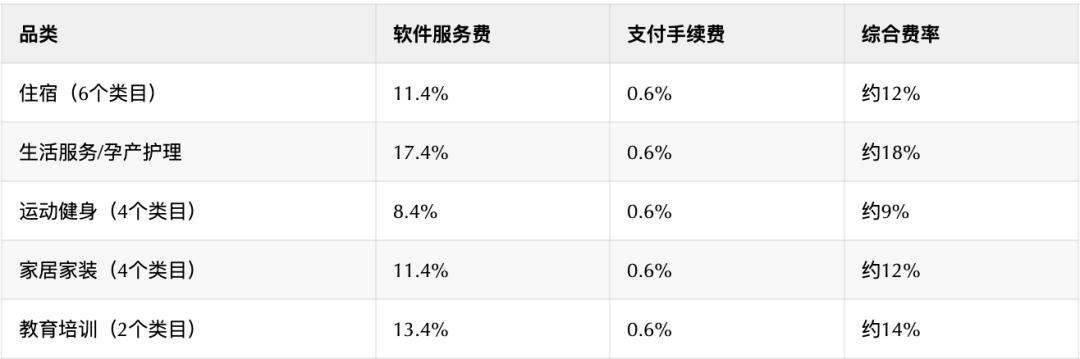
According to the rate table publicly displayed on the back-end of Douyin Merchant Platform, the charge is not only for hotels, and the comprehensive rates for different categories vary: the accommodation category has a 11.4% software service fee plus a 0.6% payment handling fee, with a comprehensive rate of about 12%; the local life service category has the highest comprehensive rate of about 18%.
Source / DouChaCha
The controversy quickly fermented. On the evening of the same day, Liu Xing, head of public relations at Doubao, publicly issued a statement in response, saying that the statement "Doubao will charge fees for hotel recommendations" is inaccurate. He explained two points: First, Doubao currently has no paid promotion, no advertising fee is charged for hotel recommendations, and merchants cannot pay to influence the recommendation ranking; second, the fee charged by Doubao is a "channel service fee", which is deducted only after the order is completed, which is different from platforms that adopt the dual charging model of "commission plus advertising".
The difference between "channel fee" and "advertising fee" is precisely the most delicate part of the whole incident. Doubao indeed does not sell advertising slots, but objectively ties "transaction facilitation" to "platform revenue". Whether this tie will affect the recommendation results is a common concern of both users and merchants.
More than a month ago, Doubao launched three tiers of paid subscriptions for users: the standard version at 68 yuan/month, the enhanced version at 200 yuan/month, and the premium version at 500 yuan/month. While collecting membership fees from the C-end, it draws commissions based on transaction volume at the B-end. ByteDance has built a "two-way charging" structure around Doubao.
This raises several questions: Are the recommendations users get with their paid memberships credible? Merchants have to consider whether the 12% commission is worth paying for Doubao's 345 million monthly active users. And in this "two-way charging" model, how can the platform prove that it is not the party that "acts as both referee and ticket collector".
01. Doubao evolves from a "traffic channel" to a "transaction channel"
Let's first look at the incident itself.
Who is the subject that collects this fee? According to public information, the Douyin Local Life Services platform directly charges the fee, and Doubao only acts as the transaction entry in this process.
On July 27, the Douyin Local Life Services Learning Center released the "2026 Douyin Local Life Services Platform Specific Channel Software Service Fee Policy Statement", which explicitly listed Doubao as a "specific transaction channel" and implemented it from 00:00 on August 10.
This means that Doubao is no longer just a "free channel" that diverts traffic for Douyin, and ByteDance has separately priced this "AI recommendation" link.
How does this logic work in practice? "AIX Finance" called the Douyin merchant customer service in the identity of a merchant who intends to open a hotel group purchase service, and got two key details:
First, the charge for merchants only occurs after the transaction is completed. The customer service clarified that the commission is charged according to the actual completed orders, and no fee is charged for exposure and traffic diversion that do not generate transactions.
Second, there is no overlapping charge between channels, and the fee is attributed according to the actual transaction path of the order. For example, if a user books a room of a Douyin hotel merchant through Doubao, the system will determine the rate according to the specific transaction channel of this order, and only charge the service fee corresponding to the Doubao channel; the original 8% platform commission of Douyin Local Life Services for hotels and homestays will no longer be superimposed.

Source / AI Generated
What level does this proportion of Doubao belong to? From an industry perspective, the comprehensive commission rate of online travel platforms generally ranges from 10% to 15%, and Doubao's 12% rate is at the middle level of the industry. The difference lies in the charging logic: most mainstream OTA platforms adopt the dual-track system of "commission + advertising". In addition to the basic transaction commission, merchants often have to pay separately for exposure slots such as bidding ranking and traffic packages, and fees may be charged when users click or browse; Doubao currently does not have this additional advertising superposition, and only charges a channel service fee once after the actual transaction is completed.
More expensive than the main Douyin app, cheaper than OTAs, ByteDance is betting on users' usage inertia of Doubao. The more users rely on the Doubao entry, the greater the space for the platform to charge channel fees from merchants. The question is, if merchants do not want to bear this service fee, can they request to turn off the recommendations in this scenario and refuse to pay the fee?
The official Douyin customer service explained to "AIX Finance" that this function currently does not support merchants to turn it off on their own, and the fees generated in this scenario cannot be chosen not to be borne by merchants. However, merchants can apply for withdrawal according to the existing process, and the withdrawal will be processed at the store dimension, and separate withdrawal by product/category is not supported. However, submitting an application does not necessarily guarantee a direct withdrawal. The customer service said that not all store backends will fixedly display the withdrawal entry. The platform has its own page opening and verification rules, but there is currently no clear list standard publicly released.
02. User concerns and the business of "Doubao-like AI products"
The focus of the discussion around this charge is not only on the level of the rate. On a deeper level, users already have paid membership subscriptions, and merchants now have an additional channel service fee. Both sums of money ultimately act on the same recommendation result, and the two paying parties have their own expectations.
On June 24, 2026, Doubao officially launched the professional version subscription service, launching three tiers of paid packages: the standard version at 68 yuan/month, the enhanced version at 200 yuan/month, and the premium version at 500 yuan/month.
Users pay to subscribe to the professional version of Doubao for stronger model capabilities and higher usage quotas. But what makes some users uneasy is that when merchants who complete transactions through Doubao also need to pay channel service fees, will the recommendations they get with their paid memberships be mixed with the platform's commercial considerations? If truly high-quality merchants are unwilling to bear this fee and withdraw, how can Doubao ensure that its answers are objective?
There are different views on such concerns. Industrial analyst Zhang Shule believes that this concern may not be valid, "The C-end charge is more focused on office services, and the merchant service fee is for recommendation and diversion, and there is no necessary connection between the two." In his view, judging whether the recommendation is fair depends on a specific question: whether Doubao determines who is recommended through bidding ranking. And for now, Doubao has publicly denied this.
No matter whether this concern is valid or not, "two-way charging" is an unusual move. At the stage when domestic large models are still generally free, why is Doubao in such a hurry to take this step?
The most superficial reason is that computing power is too expensive, and revenue is too thin.

Source / pexels
As of June 2026, the daily average Token call volume of Doubao's large model has reached 180 trillion, an increase of more than 1500 times compared with its launch. In contrast to the huge call volume is the revenue. According to LatePost's report, Doubao has more than 200 million daily active users, but its daily revenue is less than one million yuan. The computing power cost has increased exponentially, and the pure free model has gradually touched the commercial bottom line.
The problem of charging fees is not easy to solve. Third-party data shows that after Doubao announced its paid plan in May 2026, its monthly active users decreased by about 6.07 million that month, a month-on-month decline of 1.81%, which is a rare significant user loss since its launch. Industry data shows that in the following June and July, Doubao's monthly active users decreased by 5.66 million and 6.92 million respectively.
This is not the dilemma only faced by Doubao. Since 2026, the domestic large model track has been experiencing a collective transformation, shifting from "burning money for scale" to "commercial realization".
On August 6, DeepSeek announced in its official API document that it plans to raise the overall pricing of API services in the near future, "with an expected large increase"; after the Qianwen App launched new functions such as office assistant on August 7, it officially launched the paid model on August 10; earlier this year, Zhipu AI has raised its API prices three times in a row, with a cumulative price increase of 83% in the first quarter of 2026; when Moonshot AI released Kimi K3 in mid-July, the new generation API pricing was 3 to 4 times higher than the previous generation.
Zhang Shule is more cautious about Doubao's move: "Relying only on commission drawing to build an OTA form similar to Meituan and Trip.com is not enough to cover Doubao's R&D and operation costs." In his view, this is more like a trial for Doubao to explore monetization in consumer scenarios, "It can be regarded as a larger overall plan, and also a risk test for future commercial use."
Therefore, the deeper reason may lie in the competition for consumer scenarios in the future AI era.
In the past, users opened Doubao, asked a question and got an answer. But when the transaction link is opened, hotels and air tickets can be directly ordered and completed in the dialog box. The chatbot not only provides suggestions, but also facilitates a consumption.
This is essentially the same power as the roles played by search engines and e-commerce platforms in the past Internet era - determining what users can see and what they cannot see at the moment when they make decisions.
Analysts and insiders generally believe that platform commercialization is only a matter of time. "The incubation of large models for ordinary people and the cultivation of usage habits are coming to an end. Screening out users with really high stickiness and high demand through charging is the incubation of a new round of consumption habits. The later you start the charging mode, the more passive you will be." Zhang Shule added.
Following this logic, Doubao's current charging move has little to do with whether the free model is "affordable". The more realistic consideration is the timing: letting users develop the habit of paying as early as possible can reduce the stronger resistance to charging in the future.
03. No advertising slots for sale, but will the recommendations be affected?
The difference between "channel fee" and "advertising fee" is a line drawn by Doubao for itself. But can merchants influence Doubao's recommendation results through other ways?
In Zhao Jie, the founder of Yanlin Yunchuang AI GEO's view, the forms of AI tool commercialization can be divided into several categories:
One is GEM (Generative Engine Marketing), which is essentially paid advertising. Users will see a pop-up advertising card after ending the dialog, and merchants pay by CPM (cost per thousand impressions). ChatGPT has launched a similar backend, which is regarded by the industry as a clear trend signal.
The other is CPS (cost per sale), and the "channel fee" that Doubao now charges merchants is essentially this type, where the platform draws a percentage according to the actual transaction, which is a very mature model in the e-commerce field.
GEO (Generative Engine Optimization) is a different matter. It helps brands sort out correct and structured digital assets to make the model easier to understand the brands. When users ask questions, the model is more likely to mention or recommend the brand in the generated answers through crawling, analysis and reasoning across the whole network. Its effect is "appearing in the Q&A dialog" rather than "buying an advertising slot".
Zhao Jie admitted that merchants can indeed increase the probability of being mentioned and recommended by Doubao through content optimization.
This means that even if there are no clearly priced advertising slots, merchants with the ability to invest in content operation can still get more prominent exposure. As for what counts as normal optimization and what counts as gray industry manipulation such as "mass publishing of articles and poisoning", the boundary is defined by the platform and regulators.
How this impact occurs is related to "source classification by credibility".
When generating answers, large models do not treat all information sources equally, but assign different weights to different sources according to their credibility.
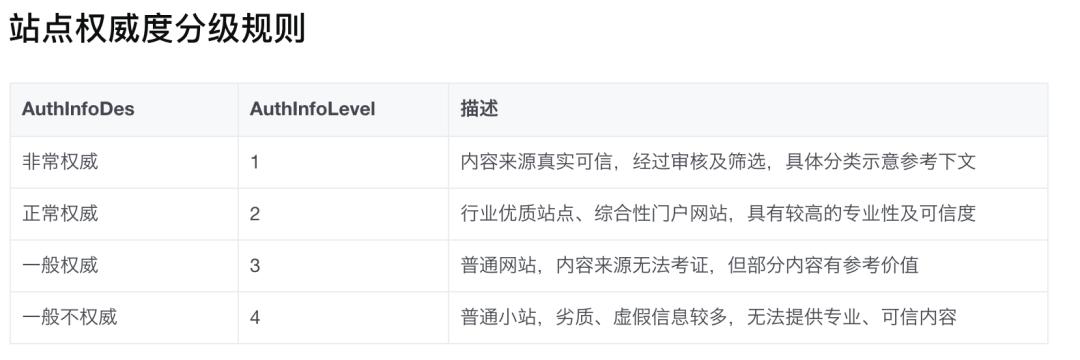
In June this year, Volcano Engine updated a "Site Authority Classification Statement", which divides information sources into four levels: Level 1 is very authoritative, including government websites, central media, official websites of 985/211 universities, official websites of Fortune Global 500 companies, certified accounts of five major news portals, and high-quality ByteDance data sources such as Douyin Encyclopedia; Level 2 is normally authoritative, including high-quality industry sites and comprehensive portal sites; Level 3 is generally authoritative, including regular enterprise official websites and ordinary websites; Level 4 is generally not authoritative, referring to ordinary small sites.
Source / Volcano Engine
The emergence of information source classification has its legitimate side: first, to fight against the pollution of models by gray industry content such as mass publishing of articles and counterfeiting; second, the industry itself is promoting standardization. According to Zhao Jie, institutions including the China Advertising Association and the National Institute of Advertising and Marketing are participating in the formulation of information source classification specifications, which is expected to cover most model platforms in the future.
As for the impact of information source classification on the GEO industry, Zhao Jie said it depends on the situation, it can block gray industry GEO, while formal GEO will not be affected.
What information source classification really cannot avoid is another problem: whether the platform will favor its own content ecosystem.
In Zhao Jie's view, "Under the high weight of authoritative media, large manufacturers' models will also give certain preference to their own content ecosystems from the ecological perspective". For example, Doubao's citations have now largely shifted from text to Douyin video content, with fewer and fewer text citations. Yuanbao prefers official accounts, Qianwen prefers Taobao ecosystem content, and Doubao prefers Douyin content. Each family is building its own moat in its own way, giving certain preference to high-quality content in its own ecosystem.
But whether this is equivalent to "partiality" provides another perspective from Zhang Shule: user needs are diverse, and in a certain segmented scenario, the information source with the highest weight may