Who says instant retail is only left with bubble tea lovers?
Last year at the Start of Autumn, the food delivery war reached its peak. Milk tea priced at 1 yuan per cup and coffee costing just a few yuan flooded social platforms for months.
This year's "autumn milk tea promotion" is nowhere near as massive as last year. A year on, the noise of red envelope subsidies has faded. In June, the State Administration for Market Regulation issued new subsidy regulations, formally drawing a competitive boundary for long-term, large-scale subsidies, and bringing a formal end to this battle in terms of rules. Looking back at the past year, Alibaba and Meituan each spent more than 80 billion yuan, and the food delivery market pattern has shifted from a single dominant player to a two-horse race.
On August 4, QuestMobile released the *2026 China Mobile Internet Semi-Annual Report*, and I went through this report specifically for a set of data on instant retail.
At the height of last year's war, two popular judgments prevailed in the market, questioning that the industry was burning money for nothing: once subsidies were withdrawn, would users churn? Was the so-called incremental user base nothing but bargain hunters? The discussions were so loud that they almost became a default conclusion.
The figures in this QM report happen to be able to verify this. The data gives the opposite answer: After a year of fierce competition, the market has expanded, user habits have been cultivated. More importantly, users have stayed, and they are by no means just "bargain milk tea chasers" who only care about low prices.
Who Stayed?
QM updated the "total deduplicated user count" and rankings of major internet companies. Over the past year, different players have delivered different performances, with some growing and some declining. Alibaba has continued to grow on the basis of its huge existing user base, and JD's user scale has also risen sharply. Although we cannot attribute all the credit to instant retail, it is undoubtedly one of the key drivers for them to acquire and retain users.
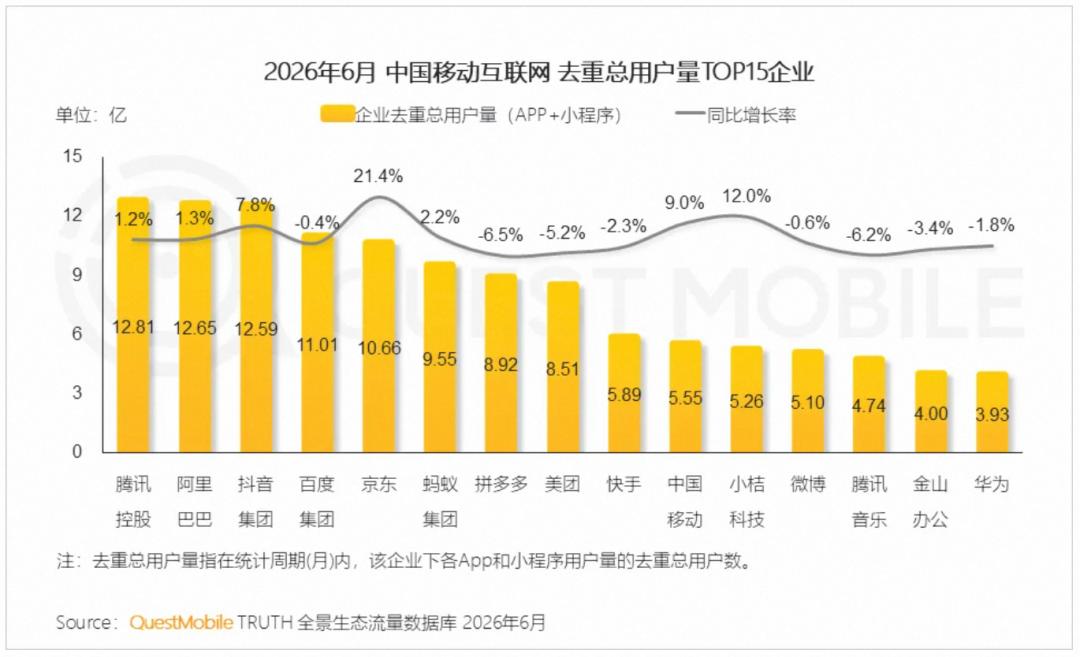
Figure 1: Data of Top 15 Enterprises by Total Deduplicated Mobile Internet Users in China Source: QuestMobile *2026 Local Life Consumption Insight Report*; original image from the official report
Cross-platform data is also very clear. QM's local life report in May this year recorded a complete curve: The overlapping users of Taobao, JD and Meituan apps stood at 331 million in March 2025, rose to 378 million in September at the peak of subsidies; and fell back to 361 million in March 2026, still about 30 million more than before the war.
These 30 million users are real incremental users, and they are also direct evidence of the shift in user habits from a single local life platform to large e-commerce platforms. The statement that "once subsidies stop, user loyalty vanishes" can now be proven false.
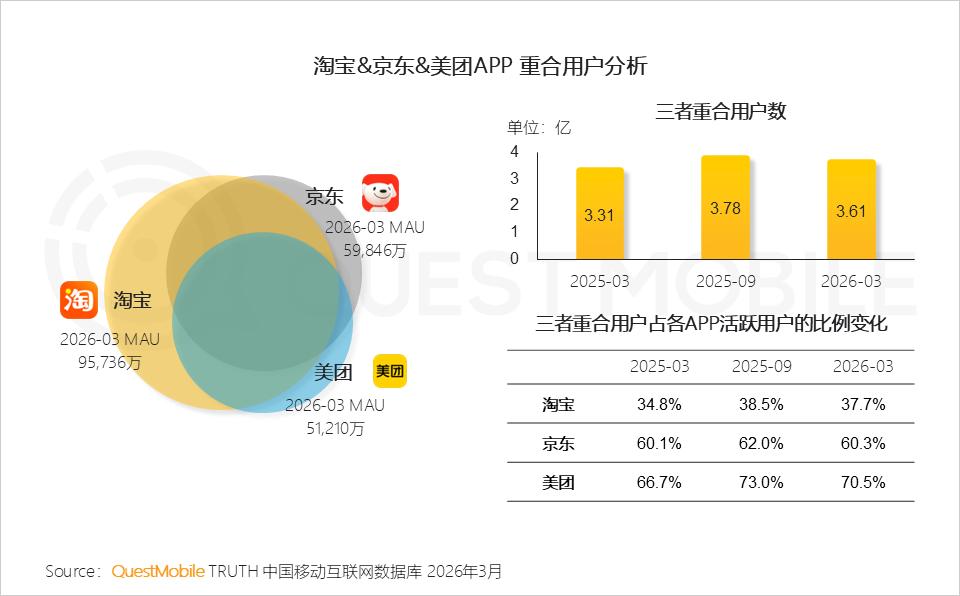
Figure 2: Changes in Overlapping Users of Taobao, JD and Meituan Apps Source: QuestMobile *2026 Local Life Consumption Insight Report*; original image from the official report
What do these retained users look like? QM did not directly track the group of users who received coupons last year, so this is not a ready-made "subsidy user retention report". But it provides several sets of cross-sectional data including user portraits, usage frequency and cross-platform overlap, which can just be used to verify the two aforementioned judgments.
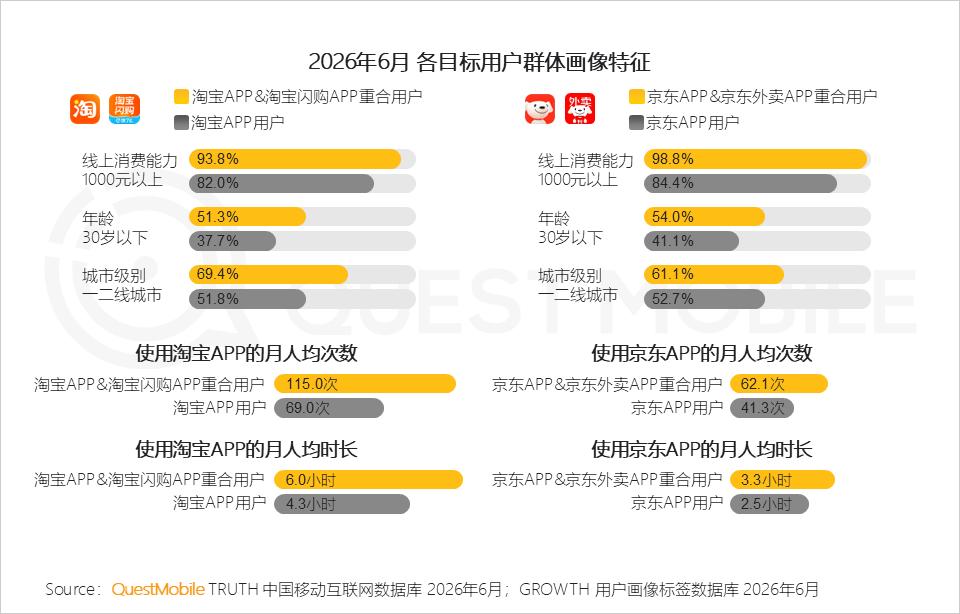
Figure 3: Portrait Features of Target User Groups in June 2026 Source: QuestMobile *2026 Local Life Consumption Insight Report*; original image from the official report
QM did not track instant retail users separately, but counted them based on the combined caliber of instant retail + e-commerce platforms. This actually has an advantage: it can intuitively show the impact of the food delivery war on the platforms themselves.
Take Taobao as an example. The report compares users who use both Taobao and Taobao Flash Purchase with Taobao's overall users. The former group has higher consumption power, nearly 94% of them belong to the group with "online consumption capacity of 1000 yuan or more", nearly 12 percentage points higher than the overall average of ordinary Taobao users; in terms of age and city tier, they are younger and more concentrated in first-tier and new first-tier cities.
Even in June 2026, long after the peak of subsidies, the overlapping users still show the characteristics of higher consumption power, younger age and higher concentration in first-tier and new first-tier cities. At least, the judgment that "all incoming users are low-value users" does not hold water.
Cross-comparison with iResearch's data can provide more perspectives: iResearch's *2025 China Mobile Internet Traffic Report* summarizes the whole year as follows: the user scale of Taobao Flash Purchase increased by more than 60%, driving the user scale of Taobao to increase by 6.9% and the total monthly usage times to increase by 17.2%; by December 2025, the monthly active users of Taobao Flash Purchase still reached 140 million, with stable daily usage of 4 times. By March 2026, QM found that the monthly average usage times per user on the main Taobao app still increased by 10.9% year on year.
These data complete the whole logical chain: at the peak of subsidies, Taobao first obtained incremental monthly active users; after subsidies were reduced, the traffic was converted into stable usage habits.
Why can users possibly stay? Morgan Stanley conducted a consumer survey last year: 41% of instant retail consumption is new demand, 51% is consumption that was originally completed in offline physical stores and later changed to home delivery, and only 8% is diverted from traditional e-commerce. In other words, offline physical stores do not necessarily lose this business, users just changed from going to the store in person to waiting for riders to deliver the goods to their homes.
Subsidies only lowered the threshold for trial, changing the way users enter the instant retail market, rather than the original consumption power of these users. For Taobao, what is retained is not just a food delivery order. Users now have one more reason to open Taobao than last year.
Penetration from Food Delivery to Instant Retail
Users did not churn, and demand did not stop at food delivery.
QM report shows that the year-on-year net increase of users on instant retail apps in first-tier, new first-tier, second-tier, third-tier and fourth-tier cities was 3.883 million, 4.59 million, 3.344 million, 4.74 million and 2.56 million respectively; while the net decrease in fifth-tier and lower cities was 391,000. The sinking market expansion is not a smooth push all the way, but growth is seen from first-tier to fourth-tier cities. At this stage, instant retail can hardly be regarded as a round of promotion only in several core cities.
The differentiation is very clear: after subsidies are reduced, the group most sensitive to subsidies is the first to churn. On the contrary, for these users who stayed in first-tier to fourth-tier cities, their focuses are worth exploring.
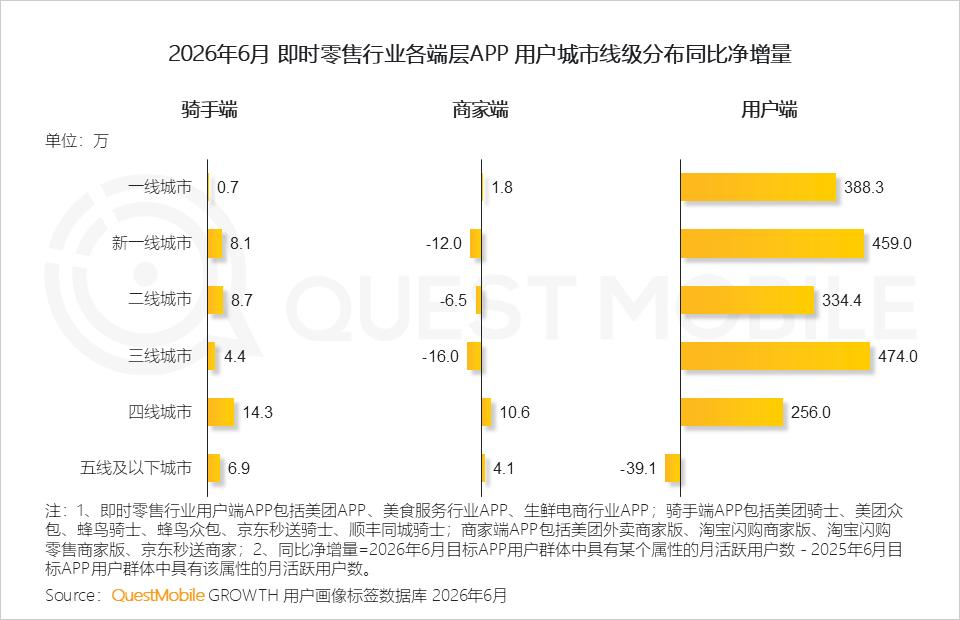
Figure 4: Year-on-Year Net Increase of App Users in Instant Retail by City Tier Source: QuestMobile *2026 Local Life Consumption Insight Report*; original image from the official report
The category attention statistics of QM cover apparel and bags, beauty and personal care, medicine and healthcare, home building materials and household appliances. It is at least clear that what instant retail covers now is not just three meals a day, but more "need it now" local retail demands.
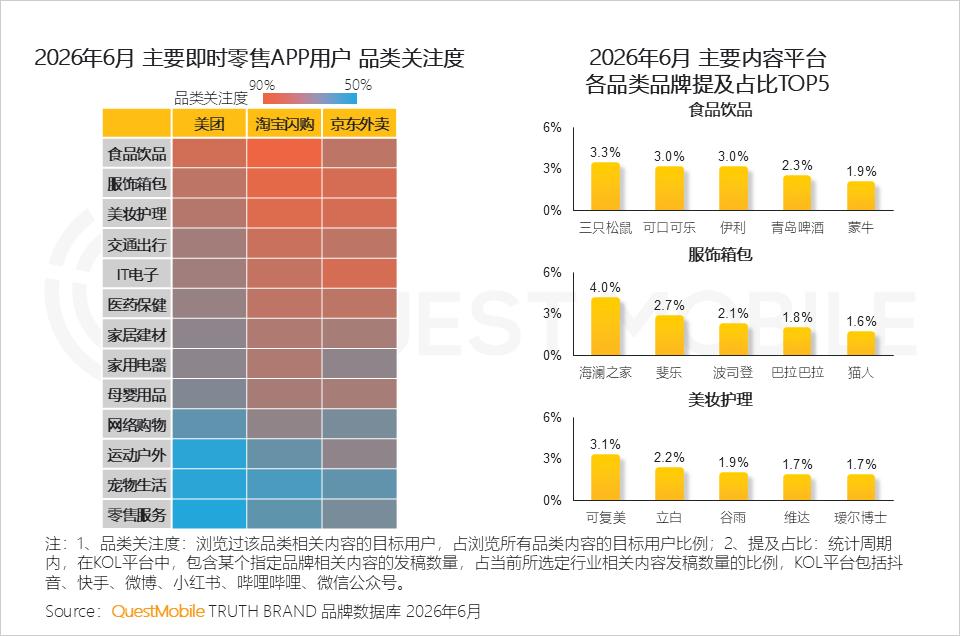
Figure 5: Category Attention of Users on Major Instant Retail Apps Source: QuestMobile *2026 China Mobile Internet Semi-Annual Report*; original image from the official report
Other tracks also saw obvious changes. From June 2025 to June 2026, monthly active users of local life services increased from 566 million to 599 million, and monthly active users of fresh food e-commerce increased from 127 million to 146 million, with the per capita usage times of both sectors increasing significantly. The monthly active users of food services, on the contrary, decreased from 203 million to 180 million, but the per capita usage times still increased by 2.1%.
This is not a neat story where all tracks grow together, but a staged evolutionary transformation: the user scale of local life services and fresh food e-commerce expands, the user scale of food services shrinks, but the remaining users use the services more frequently.
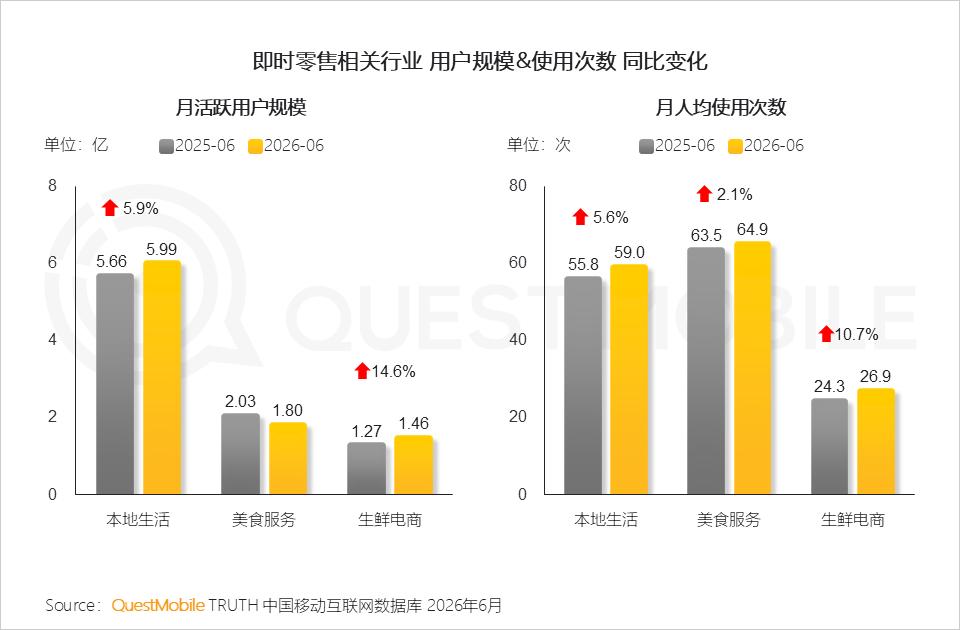
Figure 6: Changes in User Scale and Usage Frequency of Instant Retail Related Industries Source: QuestMobile *2026 China Mobile Internet Semi-Annual Report*; original image from the official report
Food delivery solves the problem of usage frequency, while instant retail also needs to solve the problem of supply. Food and beverage orders make the rider network dense, and medicines, fresh food and daily necessities determine how much business this network can carry. Looking ahead, the competition between platforms will no longer focus on subsidy intensity, but on who can integrate the inventory, merchants and distribution of different categories, and continue to obtain repurchase without large subsidies.
From Subsidy War to Operation War
This time last year, Morgan Stanley summarized the food delivery and instant retail market as shifting from "nearly a single dominant player" to "close to a duopoly". A report released by Goldman Sachs this year said that Meituan's food delivery market share has dropped sharply from 75-80% before the food delivery war, and its long-term forecast stabilizes at the 50%-55% range.
It has become a consensus that the old pattern has been broken. QM's data has shown that after subsidies are reduced, although the user scale has fallen from the peak, it has not returned to the level before the war. What has really precipitated is a group of cultivated instant consumption demands, as well as the opening and transaction opportunities brought by high-frequency consumption to e-commerce platforms.
The battlefield has thus further expanded from food delivery to instant retail.
Food delivery revolves around three meals a day, with a relatively concentrated supply scope and fulfillment scenarios; instant retail needs to extend the same distribution network to medicines, fresh food and daily necessities, and also needs to solve problems including what goods are available in nearby stores, whether the inventory is accurate, whether users can find the goods, and whether the goods can be delivered on time after placing the order.
In its May report, QM clearly explained the paths of the three players: Meituan continues to strengthen its local merchant network and fulfillment network, JD cuts in through self-operated stores and supply chains, while Alibaba connects Taobao's goods, merchants and traffic to local fulfillment.
Although the paths are different, all of them have to face the same problem: whether more complete supply can bring more consumption scenarios, whether more scenarios can increase repurchase and order density, and whether the increased orders can dilute the fulfillment cost. The average order value, the proportion of non-food orders, order density and repurchase rate will eventually fall to the economics of each individual order.
This is also the biggest difference between the operation war and the subsidy war. The subsidy war focuses on order volume and market share, while the operation war focuses on whether the revenue can increase and the cost can decrease with each additional order. Otherwise, no matter how active users are, it is difficult to turn the traffic into profit.
The future competition will be a long-distance race for refined operation.
When subsidies are no longer the only key to breaking the situation, operational efficiency has become a new moat. This is also the only way for the industry to move from savage growth to maturity.
This article is from the WeChat official account "Xianxianzhi", Author: Frank, published with authorization from 36Kr.