Xiaomi's MiMo staged an incredible comeback in just two years, taking the No.1 spot in global invocation volume.
Recently, OpenRouter released data showing that the top 5 global large model call volumes are all occupied by Chinese large models, among which Xiaomi MiMo-V2.5 ranks first with 10.5 trillion Tokens.
In response, Xiaomi stated that the users downloading the model are mainly independent individual developers, start-up teams of 3 to 5 people, as well as a large number of small and medium-sized manufacturers focusing on AI programming and agent tool development. The low inference cost and stable agent operation capability of the MiMo series models precisely match their demands.
It can be said that Xiaomi MiMo has become the most outstanding dark horse in the large model track in 2026, but it is worth noting that compared with mainstream large models such as Tencent Hunyuan, Alibaba Yuanbao and DeepSeek, Xiaomi MiMo has been more of a supporting role since its inception.
From a supporting role in 2023 to the leading role today, Xiaomi's counterattack in the large model field comes from the efforts of the team on the one hand, but more importantly, the strategic process: after the development of the new energy vehicle business, Xiaomi's large model has risen from a backup option to the core of the business, and has obtained a large amount of resource support from the group.
01
A Distinctive AI Large Model
"We will not build general large models like OpenAI, which is a very clear conclusion. But Xiaomi will actively embrace this field and think about how to develop relevant businesses."
At the Q1 2023 analyst performance meeting, in response to media questions about whether Xiaomi will develop large models in the future, Lu Weibing, Partner and President of Xiaomi Group, firmly stated that general large models are not the main track for Xiaomi in the future.

(Source: Sina Finance)
At that time, the AI large model industry exploded completely. In November 2022, ChatGPT was officially launched, and at the end of January of the following year, the number of monthly active users of ChatGPT exceeded 100 million.
Gaining 100 million new users in two months, ChatGPT became the fastest-growing application. More than a dozen Internet manufacturers including Alibaba, Tencent, Huawei and ByteDance successively announced their R&D plans — the "Hundred Models Battle" of China's Internet kicked off.
However, compared with the "fanaticism" of its competitors, Lei Jun was surprisingly indifferent to the AI large model trend, saying "we will not enter the main battlefield of large models". Recalling the decision at that time, Lei Jun said that it was a unanimous decision within Xiaomi, and no more budget would be invested in large models.
At that time, Xiaomi had its own hidden difficulties:
On the one hand, new energy vehicles are like a gold-devouring beast, which has eaten up at least 30 billion yuan of Xiaomi's cash stock. But on the eve of the mass production of Xiaomi SU7, it was uncertain whether the new energy vehicle business would make a profit or a loss.
On the other hand, the cost of large models is incredibly high, and the cost for OpenAI to train a large model has risen to 1 billion US dollars.
New energy vehicles and AI large models are both gold-devouring beasts with bright prospects and extremely high risk of failure. Therefore, Xiaomi did not have enough resources or willingness to support this wave of AI large model development, whether in terms of capital or manpower.
This can be seen from the products: for example, giants including Baidu, Tencent and Alibaba are independently developing their own AI large model products, such as independent apps like Wenxin Yiyan and Hunyuan.
However, the early positioning of Xiaomi's large model Core team was to use AI technology to upgrade Xiaoai on Xiaomi's hardware products such as Xiaomi mobile phones and Xiaomi speakers.
This means that Xiaomi's AI strategy is completely different from other large Internet manufacturers. Inside Xiaomi, AI large model is not an independent product, but more like an auxiliary technical empowerment, providing intelligent services for Xiaomi's hardware products and enhancing the selling points of hardware products.
It can be said that although Xiaomi's large model team was born in the main sect, it did not get the priority treatment of direct disciples within the group.
02
Start to Catch Up in Full Swing
The achievements of an enterprise depend not only on the personal struggle of its members, but also on the progress of history. After doing odd jobs for nearly two years, Xiaomi's large model finally ushered in its historical opportunity.
With 135,000 units of Xiaomi SU7 sold in 2024, Lei Jun ushered in his glorious moment. The innovative business dominated by new energy vehicles brought Xiaomi 32.8 billion yuan of revenue, becoming Xiaomi's third growth curve.
At the same time, as DeepSeek broke the barbaric growth mode of large models relying on more chips, Xiaomi saw the possibility of overtaking on curves: the development of large models is shifting from priority of computing power hardware to priority of algorithm, and the cost is greatly reduced.
Xiaomi's large model Core team began to move from the edge of exploration to the center of the stage.
Lei Jun said in the live broadcast: With the steady advancement of Xiaomi's automobile business, he began to devote more energy to the AI field, which not only stems from his strong personal interest, but also is an important layout for the development of Xiaomi's ecosystem.
Xiaomi even announced in a WeChat post that it would join the competition of general AI large models: "2025 may seem like the second half of the dream-chasing journey for large models, but we firmly believe that the journey to AGI is still long."
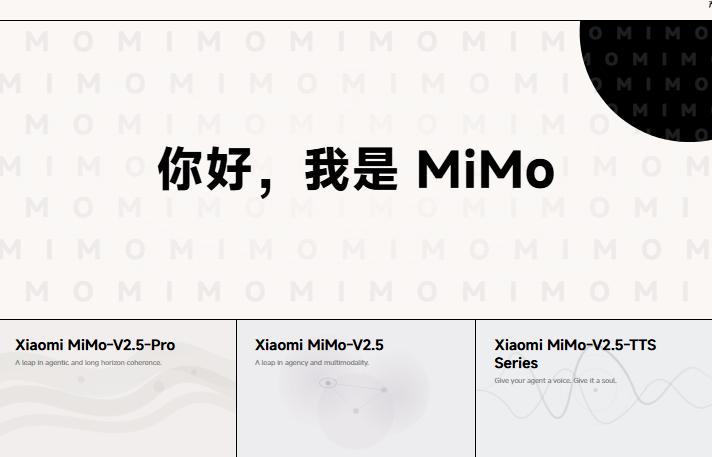
In order to make up for the lost progress, Xiaomi invested 7 billion yuan in AI R&D in 2024, and built a GPU cluster with 10,000 cards, hoping to catch up through later investment. In April 2025, Xiaomi released the large model Xiaomi MiMo-70B, which emphasizes lightweight and easy deployment, hoping to win through differentiation.
(Source: Xiaomi Official Website)
The ideal is beautiful, but the reality is cruel. Whether in terms of industry influence or technical capability, there is a gap between Xiaomi and the mainstream domestic large models:
The parameter scale of this model is only 7 billion, while for the Llama 4 series in the same period, the Scout and Maverick versions have 17 billion parameters, and the total parameters of Maverick even reach 400 billion.
The gap in parameters is directly reflected in the scope of application. Compared with other large models, Xiaomi MiMo-70B is more suitable for benchmarking projects such as mathematical problem solving, code generation and debugging, while Xiaomi MiMo is at a disadvantage in daily tasks such as open-ended chat, creative writing, image and video processing, and ultra-long document analysis.
It can be said that the launch of MiMo-70B is Xiaomi's first step towards general large models, but the dividends of China's AI era are still held by those "old diners".
The report "China GenAI Market Insight: Enterprise-level Large Model Call Panorama Research, 2025" released by Sullivan shows that:
In the first half of 2025, the average daily call volume surged by 363%, exceeding 10 trillion Tokens, of which Alibaba Tongyi accounted for 17.7%, ByteDance's Doubao accounted for 14.1%, DeepSeek accounted for 10.3%, and the top three together accounted for more than 40%.
Xiaomi has entered the market, but there is still a gap between it and the mainstream large models. Lei Jun, who believes in the "trend-driven success theory", seems to be about to miss the hottest technological trend at present.
03
Counterattack to the Top of the Global Ranking
How should Xiaomi, which has sufficient capital and is not afraid of trial and error risks, make up for its shortcomings in large models? This has become the core issue of Xiaomi's AI large model business in 2025. To this end, Xiaomi changed the strategic direction of MiMo:
In the past, the R&D of Xiaomi MiMo emphasized differentiated competition. For example, compared with other large models with increasing parameters, Xiaomi advocated "lightweight" and "local deployment". This strategy did not gain market recognition except for high benchmark scores in individual fields.
After 2025, Xiaomi MiMo changed its strategy to directly compete with mainstream large model products:
On the one hand, it follows the route of "extreme inference efficiency and high performance" like mainstream large models; on the other hand, in the current situation where the use cost of large models remains high, Xiaomi MiMo takes a cost-effective route to provide users with low-cost options.
The change of this route and strategic direction has enabled MiMo to achieve a counterattack from the trough:
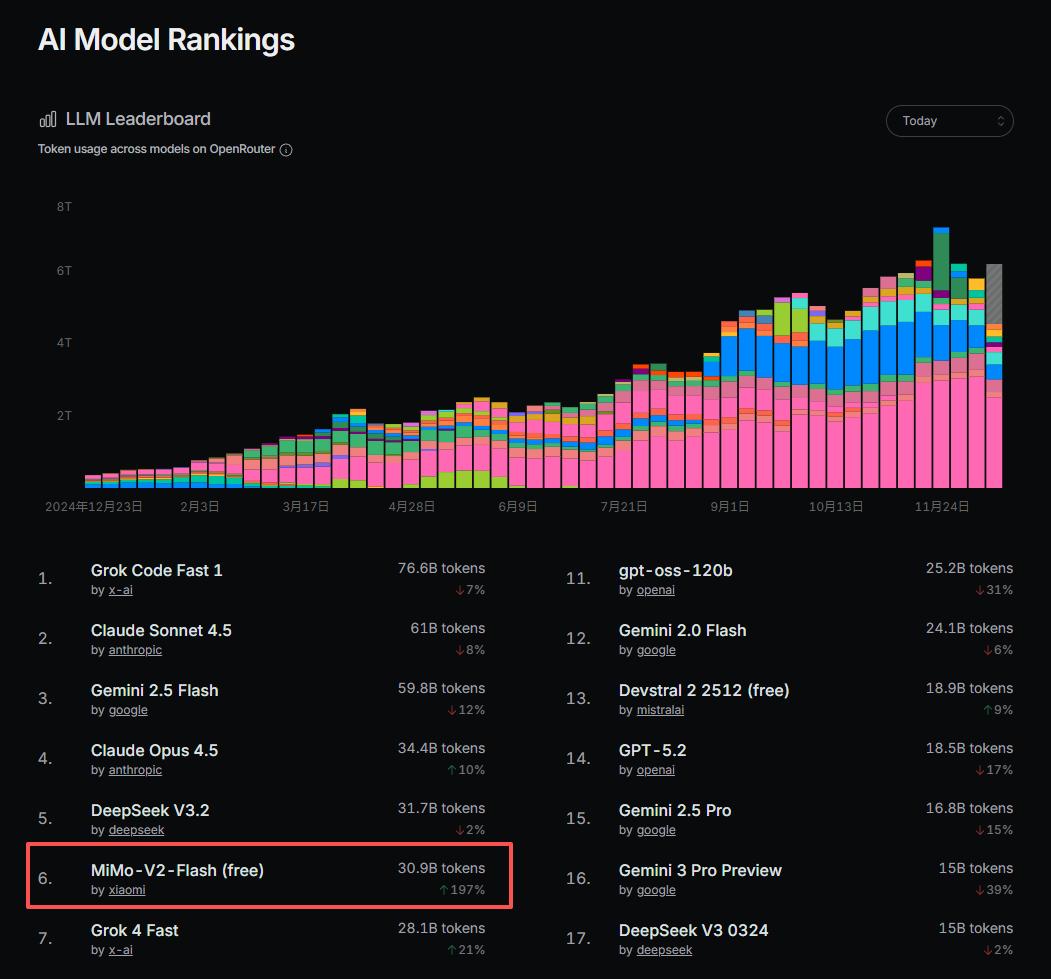
MiMo-V2-Flash, launched in December 2025, has a total parameter of 309 billion, which is 4 times that of MiMo-70B. Its capabilities in mathematical reasoning, programming ability, scientific knowledge and other aspects have caught up with the first echelon of the industry. After its release, its weekly call volume rose to the sixth place in the world.
As for Xiaomi MiMo-V2.5, released in April 2026, its single-week call volume rose all the way from 1.5 trillion tokens to 10.5 trillion tokens, and the total monthly call volume in July reached 31.20 trillion Tokens, ranking first in the global monthly large model call list.
(Source: Internet)
From MiMo-70B in early 2024, to MiMo-V2-Flash in December 2025, and then to MiMo-V2.5 in April 2026, Xiaomi only took two years to complete the counterattack of its large model product, rising from a marginal role in the Hundred Models Battle to the top of the global call volume ranking.
Ranking first in the call volume does not mean the end of the game. With the continuous counterattack of competitors such as DeepSeek, Alibaba Tongyi and ByteDance's Doubao, the competition of large models has just entered the second half — the competition focuses on who can continuously reduce costs, who can go deeper into scenarios, and who can make developers "unable to leave once they use it".
For Xiaomi, it still needs to prove with the next product that the rise of MiMo is not accidental, but a replicable product methodology.
This article is from the WeChat official account "Siku Finance", Author: Vincent, Editor: Jiajia, authorized by 36Kr for release.