AI short dramas are sending shockwaves through Hengdian, "Actors come every day this year to ask if there are any available projects"
From expansion to contraction, then to tranquility, the invisible hand of short dramas has pushed Hengdian through a two-year journey of transformation alternating between prosperity and hardship.
In Hengdian World Studios in April 2026, a set of data was frantically forwarded in industry groups: that seven-story internet-famous studio that once accommodated more than 30 film crews shooting at the same time now has only 1 crew filming; the vacancy rate of sound stages in Hengdian World Studios is close to 80%, while a year ago, it was extremely difficult to book a single stage.
China's film and television industry may never have truly entered a cold winter, but impacted by short dramas and AI, the people and industries connected by Hengdian are indeed in dilemmas of varying degrees.
On April 27, Hengdian Film and Television Co., Ltd. released its 2026 first-quarter report: operating revenue reached 582 million yuan, down 50.36% year on year; net profit attributable to shareholders of listed companies was 40.1224 million yuan, down 88.30% year on year; net profit attributable to shareholders of listed companies after deducting non-recurring gains and losses was 24.4108 million yuan, down 92.50% year on year. On June 11, the share price of Hengdian Film and Television Co., Ltd. hit the limit down, with a drop of 9.77%.
The official data of ongoing film crews released by Hengdian World Studios is equally striking: there are only 33 ongoing vertical-screen short drama crews and 26 horizontal-screen long drama crews. In the first quarter of 2026, the number of short drama start-ups in Hengdian plummeted by three quarters year on year, and the number of filed start-ups was cut by half and then cut by half again.
In the heyday of 2025, there were up to 40 to 50 crews starting filming at the same time on a single day, 140,000 registered "Hengdian drifters" gathered and waited for opportunities, extras queued up for roles before dawn, and there were far more performance notices than they could take. By the end of 2025, a total of 4016 short dramas had been filmed through the Hengdian Vertical-Screen Drama Operation Center. At that time, the legend that Hengdian had become "Vertical Shop" resounded across the film and television industry.
From expansion to contraction, then to tranquility, the invisible hand of short dramas has pushed Hengdian through a two-year journey of transformation alternating between prosperity and hardship. The fate turn of this "No.1 Film and Television City in China" reflects the collective confusion and self-purification of the short drama industry after its reckless rapid expansion.
01
Two Impacts of Short Dramas
Hengdian's "Vertical Shop Era" started from an accurate prediction of industry trends.
In 2023, short dramas, with the "fast, low-cost, quick return" operation mode, precisely catered to capital's desire for quick return on investment. Hengdian keenly caught this wave, established the Vertical-Screen Drama Operation Center, and quickly became the largest distribution center for short drama production across the country. For Hengdian, short dramas filled the vacancy of sound stage usage left by the reduction of long dramas, making idle scenes and the huge group of extras run at high speed again.
The name "Vertical Shop" spread rapidly, and Hengdian ushered in an expansive development. Unfortunately, this prosperity was built on a fragile foundation: short dramas highly rely on platform "traffic investment" to acquire users, most of the profits are taken away by traffic platforms, and producers can only continuously compress offline shooting costs. The venue rent and extras' salaries in Hengdian were the first to be affected, and the production cycle was compressed from 7 days to 5 days, or even 3 days.
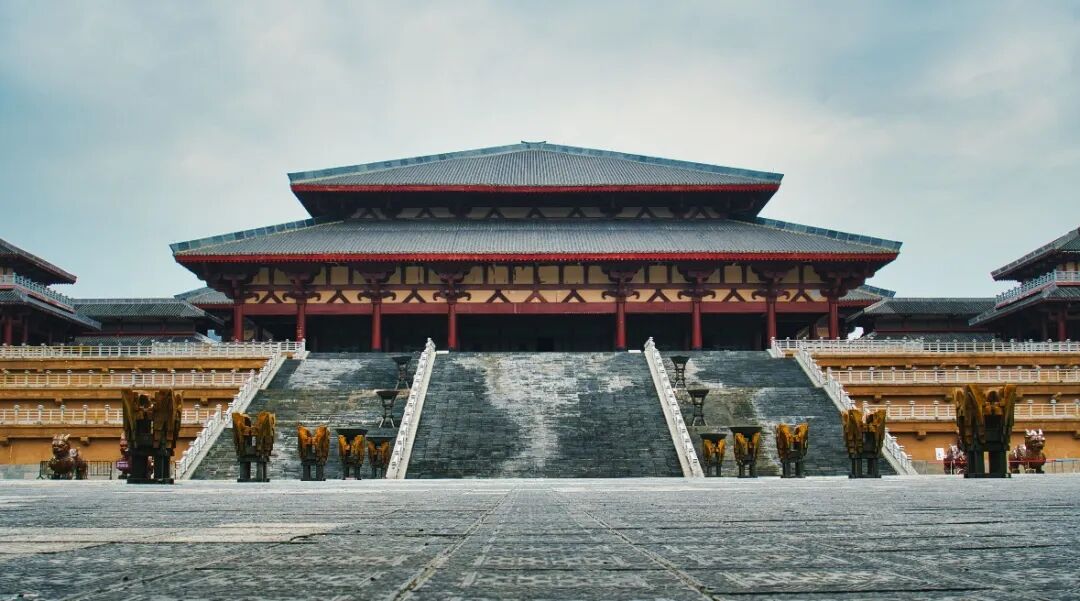
Hengdian. Photo from pexels
At the beginning of 2025, short drama crews in Hengdian already felt the chill: investors calculated accounts more and more carefully, although the number of start-ups did not drop off a cliff, the profit of the entire industrial chain had been squeezed to the extreme. Half a year later, the rise of AI short dramas completely rewrote the rules of the game, and also dealt a real fatal blow to Hengdian.
If the replacement of long dramas by short dramas is an efficiency revolution of fast vs slow, then the replacement of live-action short dramas by AI short dramas is a cost revolution of machine vs human: producing a 100-episode live-action short drama requires a team of dozens of people and at least one week of shooting cycle, while the core production team of AI short dramas only needs 3 to 5 people, with the cost being only one tenth of that of live-action dramas, or even lower. This means that the vast majority of short drama projects no longer need Hengdian's sound stages, real scenes and extras.
Data released by China Netcasting Services Association shows that among the short dramas launched across the industry in the first quarter of 2026, AI short dramas accounted for more than 95%. The impact of this data is devastating for Hengdian, which means that the massive short drama production capacity that once supported the prosperity of "Vertical Shop" has been entirely migrated to cloud servers.
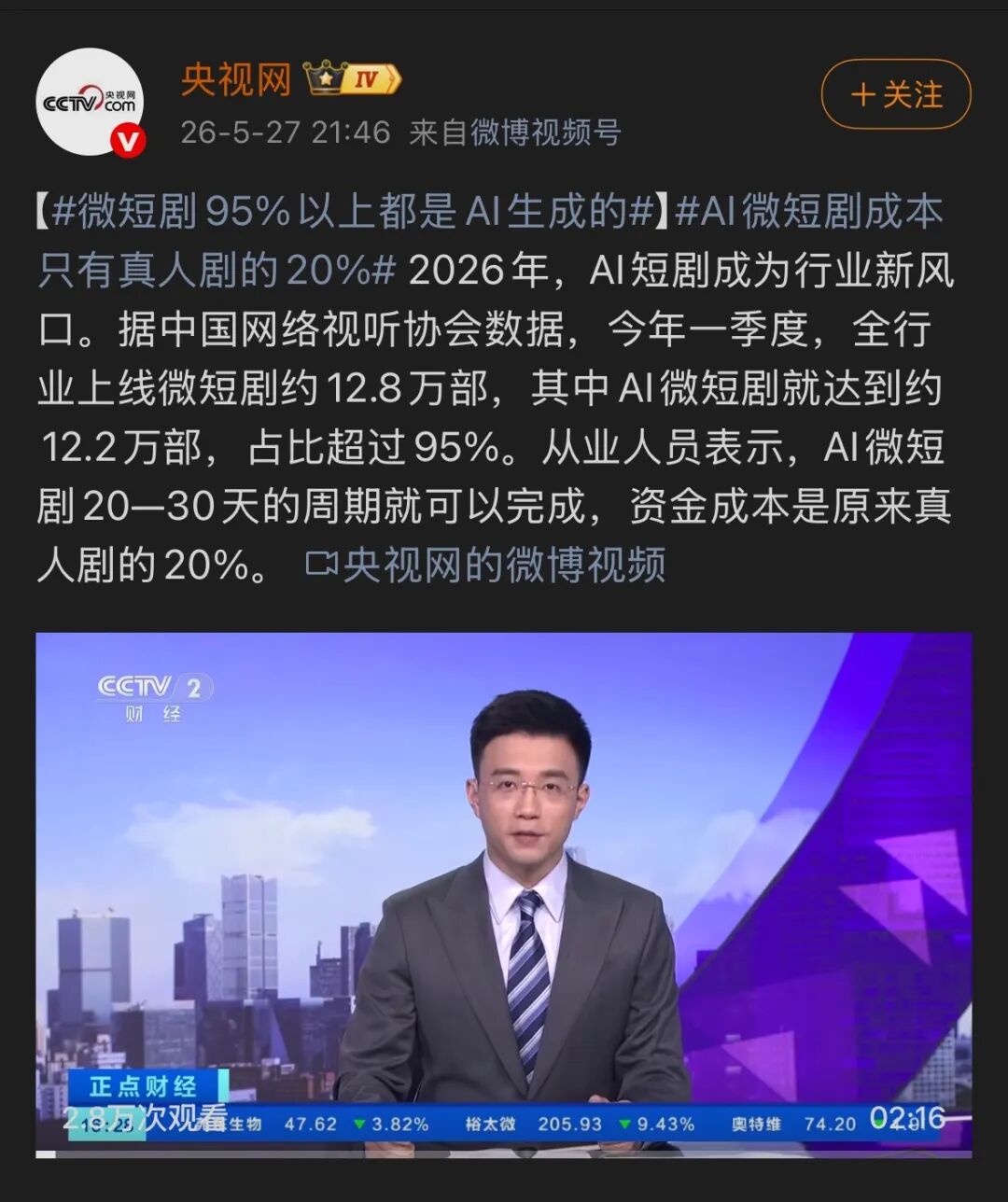
AI short dramas accounted for 95% of all short dramas launched across the industry in the first quarter of 2026. Photo from social media screenshot
When the number of filed live-action short dramas plummeted by 63%, platforms canceled the minimum guarantee mechanism, a large number of small and medium-sized projects were directly canceled, and capital withdrew faster than when it poured in. That seven-story internet-famous studio in Hengdian that once crowded with more than 30 crews had only 1 crew left for shooting in April 2026 — and what they were shooting was "live-action reshoot for AI short dramas", several extras made expressions in front of the green screen for the post-production algorithm to generate the complete plot.
02
"Hengdian Drifters" in the Crack
The cost of technological iteration is ultimately borne by everyone in the industrial chain.
Those at the top are the first to be impacted. "There were nearly a hundred projects in my hands last year, but now the number has dropped sharply to single digits," said Xia Jue who is in charge of casting for multiple crews with deep feelings, "Last year I asked actors every day if they had schedules, but this year actors come to ask me every day if there are projects." The daily salary of top actors has dropped from 50,000-100,000 yuan to about 10,000 yuan.
Short drama companies can't hold on even earlier than actors. When top short drama actors became popular in 2025, various companies signed contracts to "lock in actors", and some companies' actor pools expanded to more than 100 people. But the situation reversed completely this year, quite a number of companies have terminated contracts in batches with the actors they signed in those years. The reason is very simple: short drama companies have collectively transformed to make AI comic dramas, and no longer need live actors.

AI comic drama. Photo from reading platform screenshot
Afeng, an actor who just signed with a top company last year, said: "The company has transformed, keeping us is also a cost, so all contracts are terminated." He said it's good to be able to film one drama a month now, and he has begun to look at recruitment information for scenic spot NPCs.
The chill will continue to spread downwards. According to media reports, among the about 140,000 registered extras in Hengdian, there are only about 800 valid performance notices per day on average, and more than 60% of the actors have almost zero income after the Spring Festival this year. In fact, as early as 2024, the hourly salary of extras was reduced to 13.5 yuan, the agency drew another 10% commission, and the actual income was about 12 yuan per hour. Only about 10% of actors can guarantee a monthly income of 2000 to 3000 yuan.
45-year-old extra Zhang Jingman shared his story in an interview. He came to Hengdian from Huludao, Liaoning in April this year, and went to the actors' agency at 6 a.m. every day to wait for performance notices, but most of the time he only got the reply "no show today". Even if there is an occasional show, it's nothing more than "lying corpse" or "background board", the daily reward is 121 yuan, and most of the time in between is just waiting on the set.
Backstage teams are also shivering in this cold wave. In 2024, a makeup artist with many years of experience worked part-time in 4 short drama crews at the same time, with a monthly income of 25,000 yuan; after the Spring Festival in 2026, she didn't receive a proper crew job for 4 consecutive months. She closed her studio, and now can only teach people makeup on short video platforms, or make a living by taking offline bridal makeup orders.
Fewer people are filming in the film and television city, so there are naturally fewer mouths to feed. The number of crew meal suppliers in the town dropped from 3000 servings per day in 2024 to less than 300 servings per day in April 2026, and the unit price of boxed meals dropped from 30 yuan to 15 yuan, which is still considered expensive.
Obviously, this is not a simple industry cycle change, which is very likely to cause structural damage to the industry. When AI can replace live performances, the labor-intensive industry that practitioners rely on for survival will decline at a speed visible to the naked eye. More cruelly, most of them have no other means of making a living except acting or working with film crews.
As for Hengdian, if we regard it as an individual in the entire film and television industry, we will find that the dilemma it faces is not just a survival problem of a film and television city.
In the first quarter of 2026, the total national box office of movies was 11.879 billion yuan, down 51.29% year on year; the number of moviegoers was 271 million, down 47.88% year on year. A total of 383 new cinemas were built across the country, 47 fewer than the same period in 2025. The overall shrinking of the film market is the general background of the industry's dilemma, but the particularity of Hengdian lies in that its business model is highly dependent on the core scenario of "crew settlement".
In Hengdian, whether it is venue leasing, supporting services, or the derived tourism, catering and accommodation industries, are directly linked to the number of crews. For this industrial structure with single-point dependence, there are too few factors that Hengdian itself can control, and both the benefits and risks are huge. Short dramas once provided another growth curve, but facts have proved that the growth time of this curve is as short as the duration of short dramas.
03
Self-rescue of the "No.1 Film and Television City"
Before the complete transformation of the short drama base, AI has created a new problem: if AI short dramas do not need real-scene shooting, what is the core value of Hengdian as a shooting base? If content production can be separated from physical space, will Hengdian's land, buildings, equipment and other resources turn from assets into burdens?
Fortunately, in the face of this sharp question, Hengdian World Studios, which is 30 years old this year, did not wait for death, but launched all-round self-rescue. On May 15, 2026, in response to the rumor on social platforms that "the crews in Hengdian are almost dying out", the official of Hengdian World Studios released the dynamics of on-site crews, showing that there are currently 33 short drama crews and 26 long drama crews filming in Hengdian, including highly anticipated works such as *Jiangshan Datong*, *Not Giving Up the Country*, and *The Only Daughter of the General's Family*.
The official response conveyed a signal: Hengdian is not "dying". The main reason for the reduction of ongoing crews is that the film and television industry is undergoing profound industrial structure adjustment, and "reduced large-scale dramas, high-quality short dramas" is becoming a new pattern.
In response to the AI impact, Hengdian has also shown its attitude: not to resist or fear, but to embrace. In terms of production, AI comic dramas such as *The Legend of Muyun in Jiuzhou* produced by Hengdian Film Production Co., Ltd. have been broadcast on relevant platforms, and the company is actively promoting AI short drama projects to upgrade its IP strategy.

AI comic drama *The Legend of Muyun in Jiuzhou*. Photo from Weibo
In terms of film and television city, the "Hengdian Film and Television Large Model" was released, the AI Film and Television Ecology Center started construction, and AIGC short-term training courses were launched. Hengdian plans to build the world's largest digital film and television base, and build a high-tech post-production center and digital network center. Hengdian is transforming from "providing real-scene shooting" to "providing digital production capabilities", trying to find a new anchor in the AI era.
In terms of cultural tourism, Hengdian's transformation has delivered an amazing report card: in September 2025, Hengdian launched the "All People's Studio" strategy, the core logic of which is that since crews are not coming, let tourists come to "act". Hengdian packages idle sound stages, scenes, costumes and props resources, and launches the high-unit-price "private producer" service, allowing tourists to pay to become the protagonist of micro films.
With the in-depth interaction of more than 300 scenic spot NPCs, both the revenue and net profit of the cultural tourism sector of Hengdian World Studios have achieved substantial growth against the trend. In the "Qingming Riverside Landscape Garden" that was once only for crews to use, Hengdian actors play roles such as Hua Hua, Bao Zheng, Su Shi, and "act against" tourists for seven or eight hours a day. This move became popular on short video platforms, attracting a large number of tourists to experience it.
Hengdian's exploration of "All People's Studio" proves that when the demand for film and television shooting declines, idle actor resources and scene resources can be transformed into cultural tourism experience products. For those "Hengdian drifters" who lost their jobs from crews, this exploration provides another feasible survival path — to work as NPCs in scenic spots across the country.
