Have concerts started to receive widespread criticism for not giving out free souvenirs to attendees?
What makes a concert a truly good one?
The answer used to be simple enough: whether the singer is in top form, whether the setlist is well-thought-out, whether the stage design matches the ticket price, and whether the on-site experience is smooth. But now, a new item has been added to the evaluation system — complimentary gift sets for attendees.
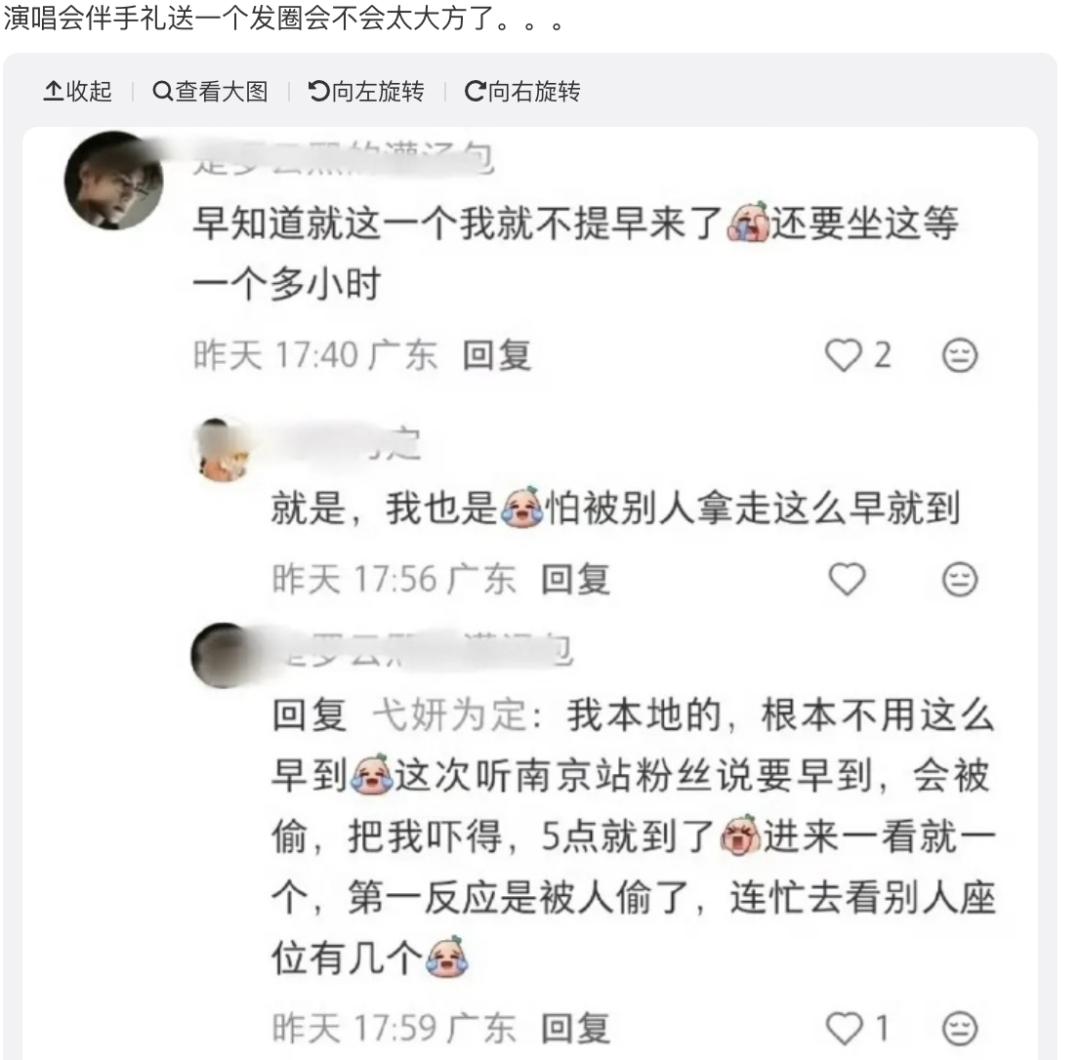
Last weekend, offline performances across the country were still dominated by concerts. However, compared with artists' stage performances, the annual must-have controversy over offline performances on the Internet came as no surprise, that is, whether the complimentary gift sets are shabby. The first one to be targeted was the gift set for Luo Yunxi's "Xijie Infinite Theater" tour concert, which was criticized for containing nothing but a square scarf hair tie.
On the contrary, the Guiyang stop of Zhou Shen's "Deeply Deep" tour and the Sanya stop of BY2's 17th anniversary tour were widely praised for their exquisite and generous gift sets. In particular, BY2's gift set was highly praised as "down-to-earth" on social platforms for the rare inclusion of a whole bag of Qiongzhou fermented vinegar hot pot base.
Interestingly, since artists such as Shiyue Qin Tian and Xue Zhiqian will also hold concerts this week, discussions about complimentary gift sets have long flooded social platforms. After all, last month, Xue Zhiqian's limited birthday show gift set and the single postcard gift set of Shiyue Qin Tian both sparked public debates.
Some get criticized for giving too little, while others go viral for giving too much.
Clearly, nowadays, whether a concert is well-run is no longer limited to the stage performance itself. What the audience carries in their hands when leaving the venue has also begun to affect the reputation of a show.
Concert Complimentary Gift Sets,
The Unprecedentedly Fierce "Involution"
Giving out gift sets at concerts is by no means a new thing.
In the early years, most of the physical souvenirs left by concerts were nothing more than a ticket stub, a ribbon or a postcard. They were low in cost, but closely tied to the on-site experience, serving as proof that "I was there".
However, in recent years, as the offline performance market continues to recover and cross-genre concert performances become increasingly common, the competition of concerts to attract fans and casual audiences has long gone far beyond the stage.
In particular, many non-professional singer artists with huge fan bases have further extended the definition of "a concert that is worth the ticket price". They not only provide free drinks, meals, and limited art installations for fans to check in, but also make complimentary gift sets a standard feature of concerts. From snacks, beverages, personal care products to perfumes, cosmetics, dolls, clothing, and then to brand gift boxes, jewelry vouchers and products from artists' own brands, the categories of gift sets are becoming more and more diverse, and their value is also rising.
For example, on July 18, Ding Yuxi held his "XICREATEftYOU" birthday concert in Chengdu. The luxurious gift set, which included a limited-edition doll designed by himself and a 750-yuan voucher from Laofengxiang, was praised as "worth the ticket". Not only Ding Yuxi, but also artists like Zeng Shunxi and Song Weilong have gone viral for their high-value gift sets. Some popular gift sets have even entered the second-hand market, becoming "hard currency" that can be traded separately. At the same time, many popular artists have also sparked controversies such as being "shabby" and "stingy" over their gift sets.
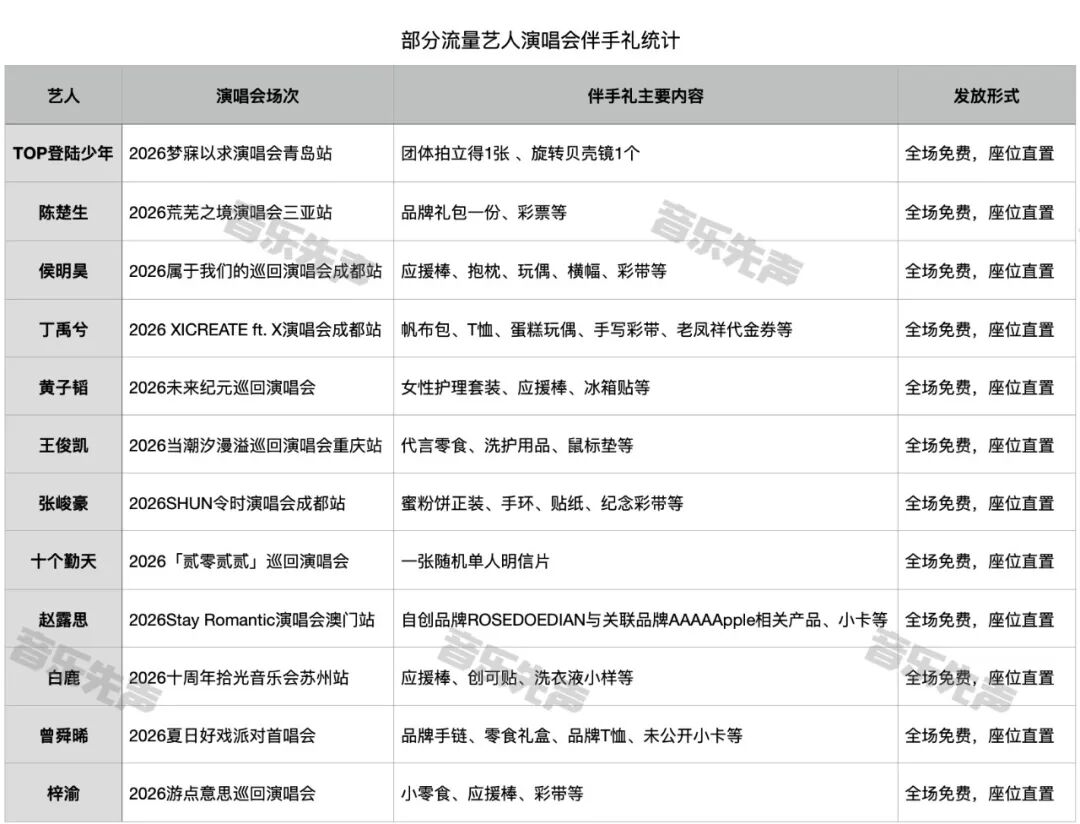
But these seemingly high-value gift sets are not all paid for by the artists. From the current operation model, the gift sets are usually jointly prepared by artists, organizers, endorsed brands, artists' own brands, and even local cultural and tourism authorities. Among them, brand partners are the most important participants.
For brands, concerts gather a large number of young consumers. Instead of carrying out ordinary online advertising, it is better to directly deliver products to tens of thousands of audience members. Fans taking photos, sharing posts, and unboxing the gifts will generate secondary communication on social platforms. For artists, brand sponsorship can not only reduce procurement costs, but also enrich the variety of gift sets, which will eventually translate into a reputation of "being fan-friendly" and "generous".
In other words, the gift sets seem to be free gifts, but behind them is actually a set of commercial cooperation packaged as fan-friendly behavior.
If an artist has multiple endorsements, the gift set is often a collection of endorsed products. For example, the gift set Wang Junkai gave to his fans is basically a collection of products from brands he endorses, such as Tang's Da Ren, Jin Zai, and Bee & Flower. If there are not enough endorsement resources, brand swapping, co-branding, or artists paying out of their own pockets can also be used to supplement the gift sets. For example, the non-endorsement items in the aforementioned gift sets of Song Weilong and Zeng Shunxi are all paid for by the artists themselves.
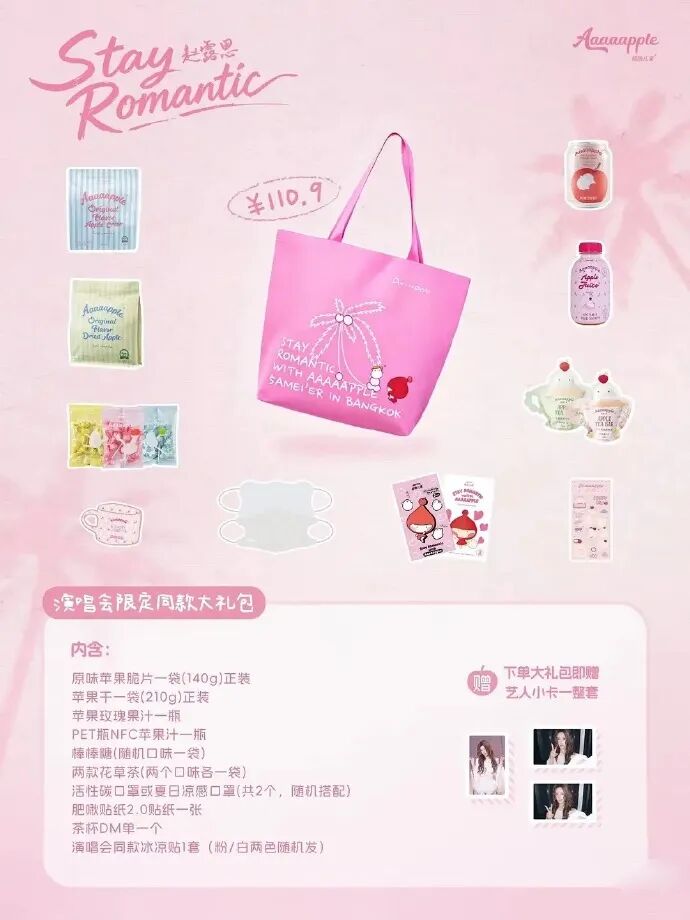
Of course, many artists also choose to use products from their own brands as gift sets. For example, the gift sets at Zhao Lusi's concerts are all from her own brands ROSEDOEDIAN and AAAAApple; while Wang Hedi also gave fans at his Thailand concert last year a shopping list of products from his own streetwear brand.
It is worth noting that this competition over gift sets is now spreading to professional singers.
In the past, professional singers relied mainly on their works, singing skills and on-site performance to build their concert reputation, and free bonus gifts were not that important. But now, performances by singers such as Silence Wang, Hua Chenyu, Jolin Tsai, and Angela Zhang have also successively introduced configurations such as brand gift boxes and limited cultural and creative products.
Local cultural and tourism authorities have also joined the competition, generally offering gifts of cultural and creative products with local characteristics, coupons and so on. For example, the limited fridge magnet at Mao Buyi's Taiyuan concert, the local snack bag at Angela Zhang's Taiyuan concert, and the characteristic snacks and coupons in the gift set of Silence Wang's Taizhou concert are all new attempts to combine performance economy with city marketing.
At this point, gift sets have gradually evolved from a fan-friendly tool for popular artists to a new competitive item in the entire concert market, which is somewhat absurd.
Concert Complimentary Gift Sets,
How Did the "Involution" Start?
From the perspective of cultural origin, the complimentary gift sets at Chinese mainland entertainment concerts largely come from the "reverse support" culture in the K-Pop idol industry.
Traditional support refers to fans giving gifts and placing advertisements for artists; the so-called reverse support means that artists prepare gifts for fans in return for their support.
In the South Korean idol industry, this practice is not limited to concerts. There are many K-Pop artists preparing diverse reverse support gifts for fans attending song recording sessions, fan meetings, and birthday events, which has led to the emergence of a wide variety of gift set packages.
In essence, reverse support is a fan retention behavior for artists to build emotional connections with fans, with the core of strengthening fans' sense of belonging and identity through exclusive physical items. The point is not how much the product itself is worth, but to convey a message to fans: your support has been noticed.
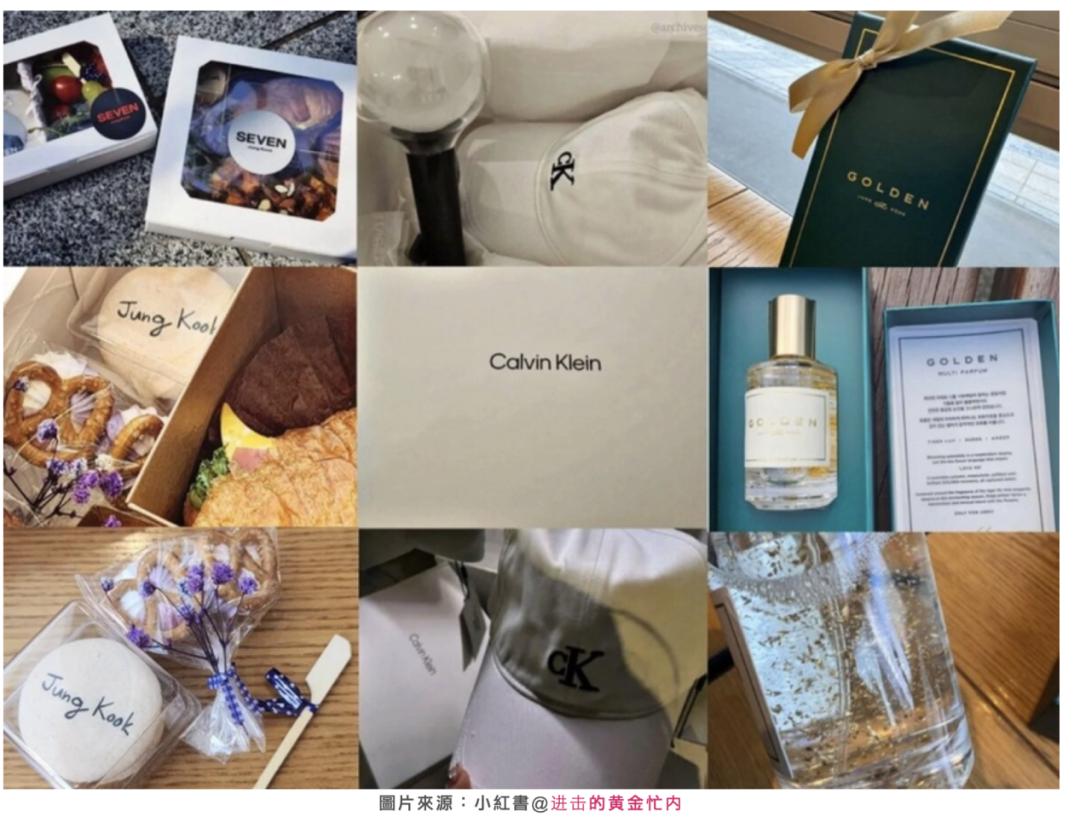
With the arrival of the Chinese mainland idol economy era in 2018, this K-Pop support culture has also become well-known to Chinese mainland artists and fans, forming consumption expectations in fan circles. In particular, the influx of a large number of talent show artists has further made this a standard fan-friendly practice. For example, Gao Qingchen, who debuted from *Produce Camp*, provided nearly 5 kilograms of gift sets for fans at his Changsha concert in July, which was widely praised in fan circles.
Different from most professional singers who build their reputation through the popularity of their works and solid singing skills, popular artists are highly dependent on fan stickiness and fan base size in terms of box office and commercial value, so the "fan-friendly" persona has to a certain extent become a sharp tool to attract fans. Compared with singing one more song, a gift set is sometimes a more perceptible investment, which turns the abstract "loving fans" into a tangible thing that can be seen and touched.
Over time, gift sets have been regarded as a reflection of whether artists value fans' devotion and how much they attach importance to fans.
When more and more people join in, it quickly turns from "being fan-friendly" into an arms race. If one party gives a brand gift box, it is difficult for the next party to only give a card; if one party gives a limited-edition doll, the later ones need to consider more expensive and rarer items.
As a result, the pressure of whether to give gifts and how good the gifts should be is transmitted from top to bottom, and has gradually spread to the concerts of top singers such as Jolin Tsai, Mayday, and Angela Zhang. For example, the gift set for Jolin Tsai's concert is provided by her endorsed brand Lancôme. The standard for gift sets continues to rise, which means that in fact, no artist can easily escape the "gift set battle royale".
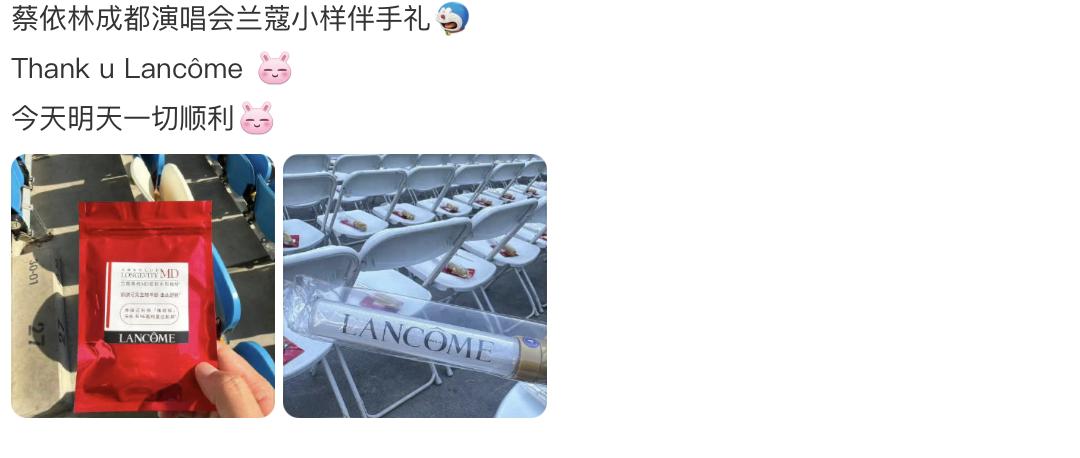
Especially on social media, gift sets are naturally suitable for being made into lists, price lists and even rankings. It is clear at a glance how many gifts there are, what brand they are, and how much they are worth, which is easier to form a simple and crude judgment than stage design aesthetics and singing level.
"Who is the most generous" and "Who is the most stingy" are obviously easier to spread than discussing arrangement, sound quality and on-site scheduling.
Behind this is actually the change in the consumption logic of concerts. Today's audience is no longer just buying a two or three-hour performance, but a complete experience from ticket grabbing, cross-city travel, check-in to sharing photos after the show.
Gift sets just meet the needs of ritual sense, exclusive sense, collection desire and social sharing. It is less and less like an ordinary gift, but more like a physical certificate of the emotional value of the concert.
Are More and More Expensive Concert Gift Sets
A Good Thing?
From the perspective of improving the viewing experience, gift sets are certainly not a bad thing.
A well-designed souvenir closely related to the tour theme can indeed extend the life cycle of a performance. The problem is that when gift sets gradually become an important or even core criterion for evaluating concerts, things start to go wrong.
A concert should first and foremost be a performance. The singer's state, stage production, sound effect, setlist arrangement and on-site organization are the core to judge whether the ticket price is reasonable. No matter how luxurious the gift set is, it cannot make up for lip-syncing, shoddy performances, perfunctory stage arrangements and bad on-site experiences.
But at present, the added value is increasingly overshadowing the core value. Some performances with mediocre stage performances have received "highly praised" reviews because of their luxurious gift sets; on the contrary, some professional singers' performances may be criticized as "not fan-friendly" just because they do not have luxurious gift sets.
Even giving overly special gift sets may create new problems.
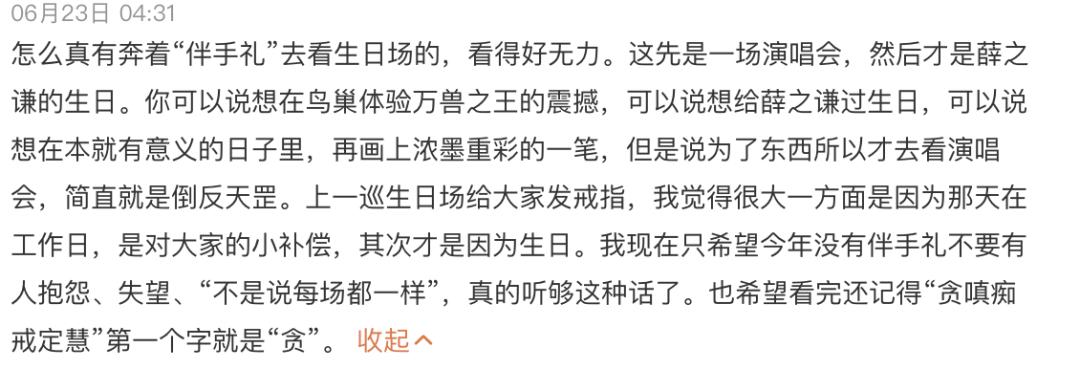
For example, on July 17, Xue Zhiqian's "King of Beasts" concert at the Bird's Nest coincided with his birthday. He also gave fans present a NFC pure silver feather pendant with a unique serial number as a gift set. This special gift, however, caused dissatisfaction among some fans who were not present, and some fans even demanded rights protection from the organizer, requiring the organizer to send the same gift set to audiences who did not attend the July 17 show.
In addition, reselling gift sets to offset part of the concert cost is also the key reason why some audiences are very concerned about whether the gift set is worth the price and whether it is perfunctory. For example, the average price of Zhao Lusi's Macau concert gift set on the second-hand market is around 500 yuan, and the highest transaction price reached 980 yuan on the day of the concert.
This phenomenon of putting the cart before the horse in the evaluation system has also spread to concerts that have to be postponed or canceled due to weather reasons. In the past, if a performance was canceled due to force majeure, completing the refund normally was the basic handling; now, whether to compensate for accommodation, flight and transportation costs, and whether to resend the gift sets have gradually become one of the criteria for the audience to judge whether the organizer is sincere.
It is certainly a good thing that consumers' awareness of rights protection has increased, but for the performance industry, this also means higher and higher service costs.
What is really worth alerting is that this standard is transmitted from the top to the bottom. Top-tier artists have enough endorsements, own brands and business resources, and can make the gift sets dazzling through cooperation swaps. But for mid-tier and lower-tier singers and independent musicians, every additional gift may cost real money. In the end, the cost will still be passed on to the ticket buyers, as the saying goes, the wool comes from the sheep.
In the long run, what the industry competes for will no longer be just works and on-site performance, but who has more business resources and more sufficient budget. The involution of gift sets seems to improve the audience experience, but it may in turn push up performance costs and consumption thresholds, further squeezing the living space of small and medium-sized artists.
When the entire industry is caught in this involution and comparison, and even regards it as the fundamental measure of a performance, it is no different from tying oneself in knots. After all, for the vast majority of audiences, a truly excellent performance and an irreplaceable on-site memory are the best "gift" that a concert should give to the audience.