Self-developed micron-level industrial embodied robot has been deployed in Bosch's production lines, Guao Technology has completed a nearly 100 million yuan Series A+ round of financing | 36Kr Exclusive
The year 2026 is regarded by the industry as the "first year of mass production of humanoid robots". However, quantitative expansion does not equal industrial maturity, as some enterprises are still stuck in the prototype and demonstration stage with no clear commercialization path.
"Currently, major 3C manufacturers basically will not consider using generalized humanoid robots," said Dr. Li Siyang, founder of Guoao Technology.
In his view, the gap between production volume and industrial scenario implementation does not lie in insufficiently powerful large AI models, but in that the motion control capability of the ontology is far from meeting the requirements of industrial scenarios. "It is like a person whose brain has developed to the level of a 20-year-old, but whose body remains at the level of a 3-year-old."
Guoao Technology is working to make up for this shortcoming. Its industrial robots, manufactured based on self-developed multi-degree-of-freedom motors (i.e. dual-degree-of-freedom motors that achieve linear and rotational motion simultaneously), have been sold to Bosch in Germany and have realized pre-operation on the production lines of many leading large manufacturers.
We have learned that Guoao Technology has recently completed a nearly 100 million yuan A+ round of financing, invested by Shenzhen Venture Capital, Capital Capital, and Yueke Financial. Shenzhen Venture Capital is also an old shareholder from the A round of financing in June last year. The funds will be mainly used for the mass production of industrial embodied robots and the establishment of the robot BU.
Founded in 2019, Guoao Technology is a typical sample that opens up the market in the industrial automation industry through technological breakthroughs against the backdrop of domestic substitution trends. It has now secured a leading position in the niche category of "ZR Motors", with its products entering the supply chains of leading customers including a leading domestic chip enterprise, Goertek, and Sunny Optical.
Why did it choose to move from precision motors to complete robot machine solutions? "From the very beginning of our establishment, we set the goal of not selling modules but directly manufacturing complete machines. Because only companies that fully understand precision motors can maximize the motion capability of the ontology and enable robots to actually work in factories," Li Siyang responded.
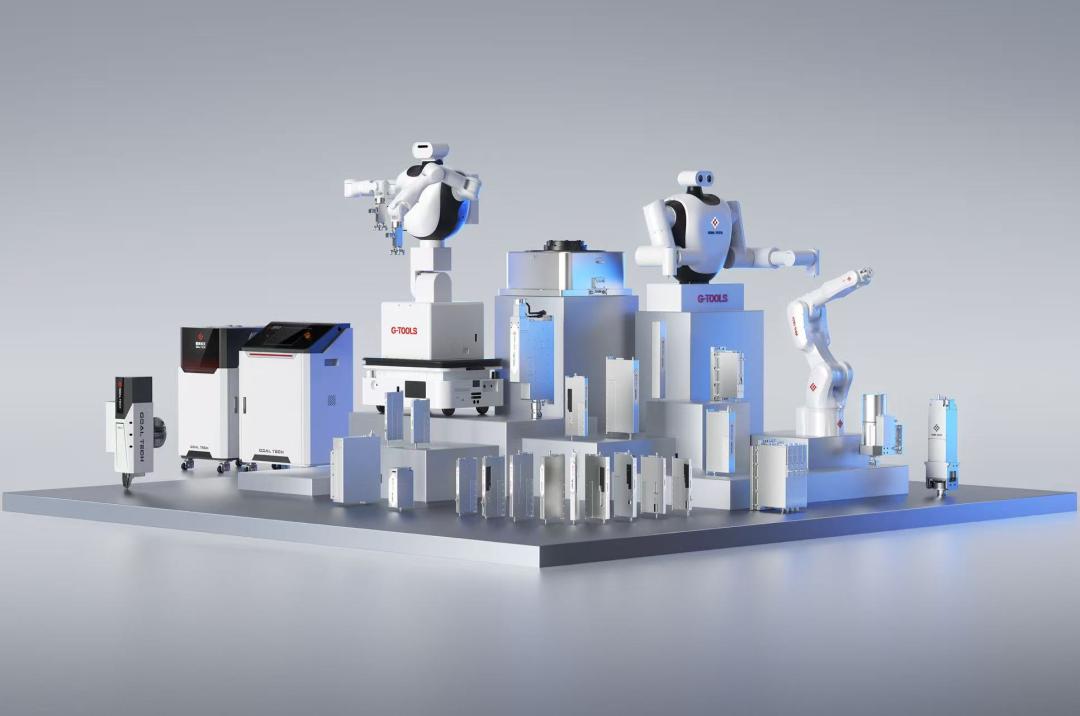
Guoao Technology's product matrix
1. Build a multi-scenario product matrix centered on core ZR motor technology
Precision motors are the "heart" of industrial automation, a field that has long been monopolized by overseas manufacturers. As domestic substitution in the industrial automation industry continues to advance over the past few years, Guoao Technology was founded under this trend.
However, overseas motor manufacturers usually provide a complete closed-loop solution of "motor + driver + control algorithm", selling hardware and algorithms together. As a result, complete machine manufacturers face high costs when replacing motor suppliers and have no inherent incentive to make the switch.
"To get customers to switch to domestic motors, it is impossible to rely only on lower prices or optimized parameters. We must achieve exponential performance improvement." Li Siyang said that this level of exponential improvement means reconstructing the underlying electromagnetic structure of the motor.
Traditional motors can only move in one dimension, either rotation or linear motion. Therefore, two sets of motors plus mechanical transmission are required to achieve Z-axis lifting and R-axis rotation, which not only brings large size and heavy load, but also limits the accuracy of force control. The multi-degree-of-freedom motor developed by Li Siyang's team realizes linear and rotational motion simultaneously through magnetic field changes under the same mover structure, with all direct drive and no mechanical transmission, enabling the motor to achieve key breakthroughs in force control accuracy and ZR axis stability indicators.
Semiconductor die bonders are one of the first verification scenarios where Guoao Technology's ZR motors realize domestic substitution. According to Li Siyang, after the ZR motor is installed in the pick-and-place head of the die bonder, the equipment sees a 3-5 times improvement in accuracy, reliability and efficiency compared with traditional solutions, while the overall manufacturing cost of the equipment is reduced.
In addition to entering the supply chain of Xinyichang, a leading domestic die bonder equipment manufacturer, ZR motor products are also supplied in batches to many well-known domestic packaging and testing equipment factories such as Changyuan Semiconductor, Keri Technology, and Changchuan Technology.
Over the past year, Guoao Technology has extended its products to more high-value industrial scenarios based on the underlying technology of dual-degree-of-freedom motors. At present, its product matrix is divided into two major sectors: core components and integrated solutions. The former is the technical foundation and basic revenue base, while the latter provides new market growth points.
Core components are mainly standard ZR motors, covering semiconductors, 3C and other fields, serving dozens of leading customers including Goertek and Sunny Optical. Li Siyang said that in the current ZR motor niche category, Guoao Technology has become the first supplier that comes to mind in the market's perception.
Integrated solutions are closer to end customers in sectors such as automobile manufacturing and industrial robots. Although their current contribution to total revenue is less than 10%, they are an inevitable path for current product R&D iteration in terms of market growth space.
In April 2026, Guoao Technology released "G-Tools", the world's first industrial-grade embodied robot equipped with dual-degree-of-freedom joints. At the FAIR plus 2026 Full Industry Chain Robot Conference, it successfully grasped a fine needle with a diameter of 0.5mm and accurately passed it through a micropore, achieving micron-level positioning accuracy (±2μm) and high-precision force control (±0.05N).
2. From core motor supplier to the "ABB" in the industrial embodied robot field
From the perspective of commercialization path, Guoao Technology adopts a "top-down expansion" strategy.
"For startups, the industrial automation industry is not easy to enter. Without sufficient industry resources, products must be highly competitive enough from the very beginning," Li Siyang explained.
Therefore, Guoao Technology chose to enter the semiconductor industry first, by developing "semiconductor-grade" products and cooperating with leading customers such as a leading domestic chip enterprise, completing product verification and market education under the requirements of high precision and high reliability, and building brand trust.
However, the market capacity of semiconductor core components is limited, with a clear revenue ceiling. In contrast, the 3C field represented by Apple's supply chain has a huge market volume and relatively loose technical indicator requirements. Therefore, after gaining a firm foothold in the semiconductor industry, Guoao Technology entered the highly competitive 3C field with a dimensionality reduction approach, leveraging scale effects through large-volume deliveries to further dilute overall costs.
Li Siyang introduced that Guoao Technology's motor products have entered the production lines of core enterprises in the supply chains of leading overseas 3C enterprises such as Goertek and Sunny Optical, which are used in the manufacturing and testing equipment of end products.
To better control the mass production delivery quality and project cost in the 3C and other fields, Guoao Technology laid out its first self-owned mechanical processing plant and assembly plant in Ganzhou in 2024, and achieved mass production in mid-2025, with a current production capacity of 1,800-2,000 units per month. Next, Guoao Technology plans to add two new factories in the Pearl River Delta and Yangtze River Delta regions, for the R&D and mass production delivery of industrial robots and precision motors respectively.
Industrial robots are the next key industry that Guoao Technology is tackling. Different from the past, this time Guoao Technology chooses not to be a joint module supplier, but to directly manufacture complete machines. Li Siyang's consideration is that downstream customers do not have sufficient understanding of motors to give full play to all the advantages of dual-degree-of-freedom motors. "If the other party does not know how to use it, our products cannot maximize their value."
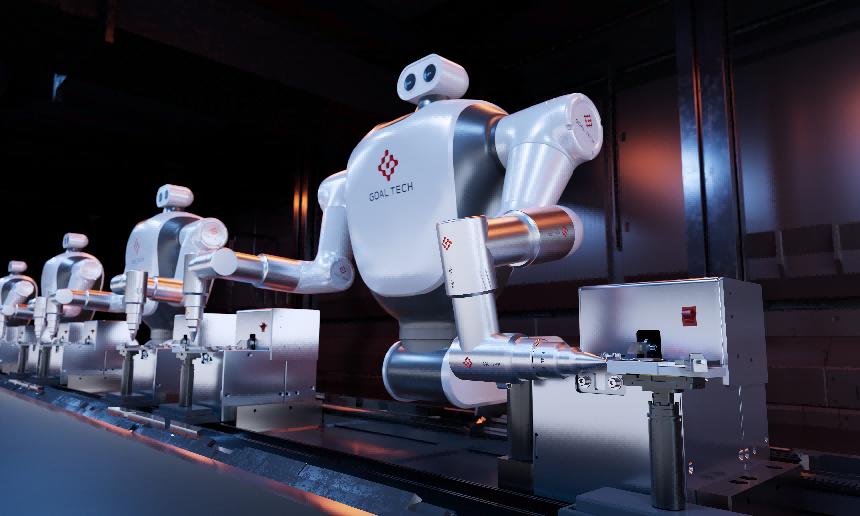
Guoao Technology's industrial robots
In fact, manufacturing complete machines is the goal Li Siyang established from the very beginning of the company's founding. "In the past, the company was too small, with insufficient funds and team to support this goal." By 2026, Guoao Technology expects to achieve an annual revenue of nearly 100 million yuan and turn profitable, with its team size expanding from 60 people last year to 140 people. "The time is ripe to make complete machines."
"Our benchmark is not Optimus, but ABB," Li Siyang said. Although Guoao Technology is also working on the motion control of robots, it takes a different path from the current mainstream embodied robot companies. It does not compete in generalized capabilities such as robot dancing, running, and folding clothes, but aims to meet the requirements of 3C production lines. "It only makes sense to talk about generalization after one capability reaches industrial grade. Otherwise, no matter how powerful the robot's brain is, the ontology cannot support it, and the product can only stay in the demo state."
To maintain its technological competitiveness in multi-degree-of-freedom motors, Guoao Technology has set up an R&D center in Hong Kong and co-built an advanced motor laboratory with The Hong Kong Polytechnic University. Li Siyang also revealed that the team had already made technical reserves for spherical motors when developing dual-degree-of-freedom motors. Spherical motors are not limited to linear or rotational motion, and can realize 270-360 degree spherical motion.
"A single robotic arm can use up to three spherical motors, and its degree of freedom and flexibility can exceed that of current seven-axis manipulators. We believe this will be the ultimate solution for robot joints, and it is expected to enter the market in the next 3-5 years," Li Siyang judged.