Starbucks should properly manage those who occupy seats in the store without making any purchases.
"Can Starbucks do something about this?" Many consumers have raised such questions on social platforms. What they are complaining about is not the coffee, but the "Third Place" that Starbucks has long taken pride in.
There are a large number of complaints on social platforms about people occupying seats in Starbucks without making any purchases. Some people are seen taking off their shoes and stepping on the chairs, bringing in drinks from other brands or free water provided by shopping malls; some customers who sit quietly in the store are suddenly startled by loud music played out loud, and smell strong odor of outside food; others see multiple people occupying an entire table, never ordering any drinks or food throughout their stay, only placing their laptops and books on the table and refusing to share the seat with others.
These behaviors not only undermine the experience of other customers, but also leave many paying customers with no available seats.
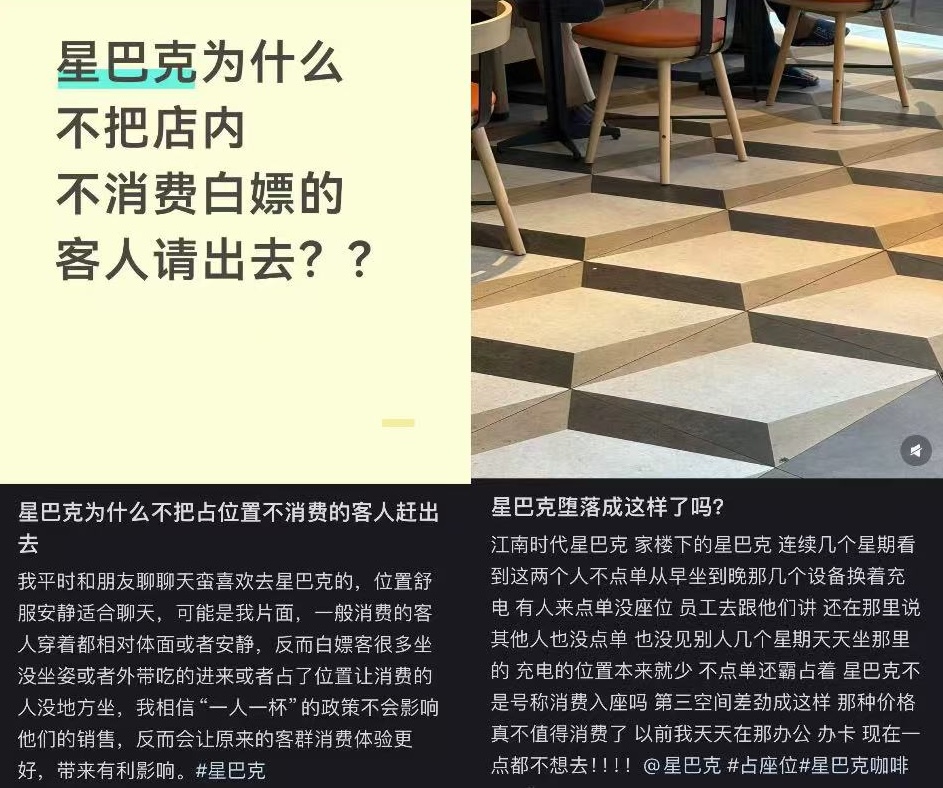
Complaints about in-store experience at Starbucks outlets on Xiaohongshu
01
In fact, this is not the first time Starbucks has faced the dilemma of "who is allowed to sit in its stores".
In May 2024, a round of controversy over "requiring consumption to take a seat" broke out in the Chinese market. At that time, consumers in Xi'an and other regions stated that they were reminded to place an order or even politely asked to leave by store staff after sitting down without consumption, and related topics once topped the trending search lists. Back then, public opinion mostly sided with non-paying customers, with many people questioning whether Starbucks was setting a consumption threshold for its "Third Place" which the brand has always emphasized to be open and friendly, while customers had to buy a cup of coffee first even to sit down. The official response from Starbucks China at that time was "Everyone is welcome at Starbucks."
However, two years later, the direction of public opinion has changed.
Nowadays, more and more consumers are complaining not about insufficient openness, but about insufficient management. For customers who have bought coffee but cannot find a seat, the "consumption required for seating" rule is increasingly regarded as a way to maintain in-store order.
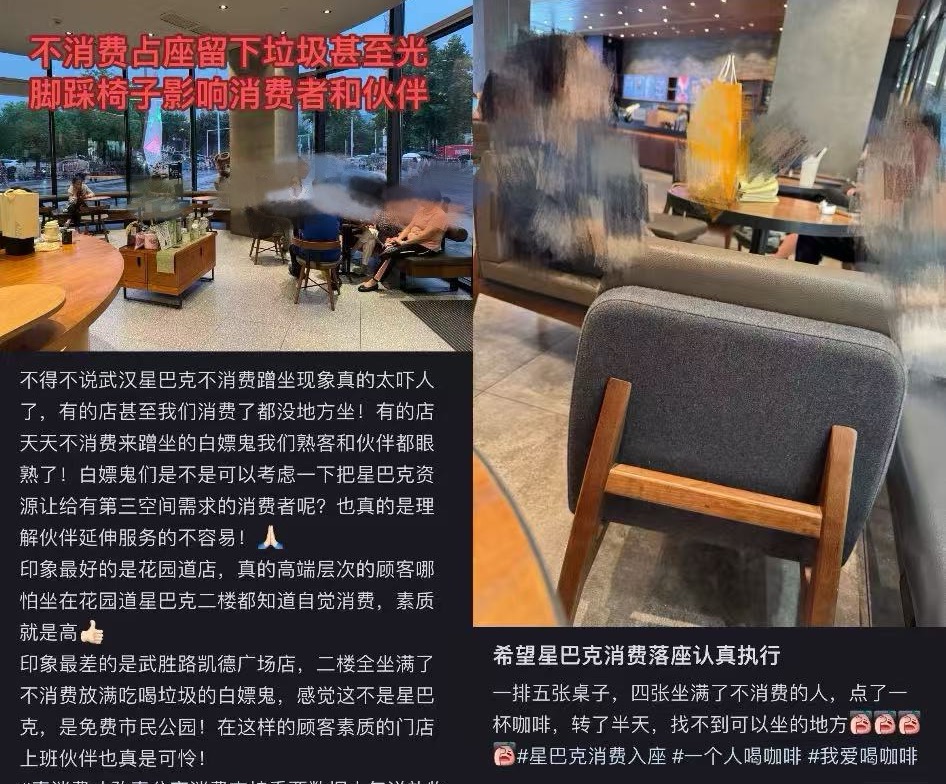
Complaints about in-store experience at Starbucks outlets on Xiaohongshu
02
In response, Starbucks China told Jiemian News in its official response that Starbucks has never enforced a mandatory consumption-to-seat policy. A Starbucks customer service specialist told Jiemian News that consumers can report such situations to store staff, who will communicate with non-paying guests. Starbucks welcomes all customers to experience its stores, and always hopes to provide a comfortable environment for every guest.
Jiemian News learned from multiple Starbucks employees that in fact, there is no clear and strict internal regulation on whether to require consumption for seating. "Internally, we want to guide customers to make purchases as much as possible, but the specific practices and methods are left to the discretion of individual stores," said an employee working in North China. As for uncivilized behaviors, stores will try to guide customers politely and friendly.
Another former early employee told Jiemian News that such phenomena were relatively rare in Starbucks stores in the past. The stores required staff to treat guests kindly, never set a hard rule of consumption required for seating, and most customers who entered the store would make purchases anyway.
Starbucks stores have adopted a relatively tactful way to deal with such situations. "Once I was waiting for someone, the clerk brought over the menu and asked me what I wanted to drink, but there are also stores where no one would come to ask even if you sit there for a very long time," a consumer told Jiemian News.
Generally speaking, Starbucks' current attitude towards handling such situations tends to be mild.
Image source: Jiemian Stock Image Library
03
Behind this change in consumer attitudes, there is actually a more realistic problem that Starbucks is facing.
Against the background of continuous price competition in the coffee industry, where brands such as Luckin Coffee are constantly attracting consumers with lower prices, Starbucks can maintain a higher customer unit price largely not just relying on the coffee itself, but on the added value provided by its store space. Therefore, for many consumers, the extra money they pay buys a relatively comfortable "Third Place" where they can work quietly and rest.
However, when some people occupy seats in the store for a long time without making any purchases, and paying customers cannot find seats instead, the space experience that supports Starbucks' brand premium is challenged.
This puts Starbucks in a delicate dilemma.
If it strictly implements the "consumption required for seating" rule, it needs to actively set a threshold, which will conflict with the friendly and inclusive "Third Place" image that Starbucks has shaped for a long time, and may once again trigger the controversy of "chasing away customers"; but if it continues to maintain a relatively loose management style, the in-store experience will deteriorate.
Given the current market environment, Starbucks has reached a point where it needs to make a clear choice.
Starting from the third fiscal quarter of fiscal year 2026, Starbucks' global financial report will no longer separately disclose the performance of the Chinese market, but classify it into the "franchised business" segment, and disclose it together with other franchised markets around the world.
Looking at the second fiscal quarter, Starbucks China recorded revenue of 799.8 million US dollars, a year-on-year increase of 8%, and same-store sales increased by 0.5%, of which transaction volume increased by 2.1% and customer unit price decreased by 1.6%. This means that more people are coming into Starbucks to consume, but they spend less on each order.
Looking at a longer time horizon, both transaction volume and customer unit price rose in the first fiscal quarter. However, Starbucks' fiscal year starts in October, so the first fiscal quarter covering October to December is exactly the peak season for coffee consumption. Going further back to the fourth fiscal quarter of fiscal year 2025, Starbucks China's same-store transaction volume increased by 9%, but the average customer unit price decreased by 7%.
Overall, rising same-store transaction volume and declining customer unit price have become a challenge for Starbucks in China.
This raises a practical question for Starbucks. When more and more affordable coffee brands compete for consumers with low prices, Starbucks must be clearer about what exactly it will rely on to continue supporting a customer unit price higher than the market average — the answer can hardly be just a cup of coffee.
If it wants to increase the customer unit price and maintain its brand value, Starbucks China may need to adopt a clearer attitude towards the order management of its "Third Place".
Starbucks in the North American market has made the choice first.
Last year, Starbucks there announced that it would overturn the "Open Door Policy" implemented since 2018, clearly stipulating that non-paying customers in the US and Canadian markets cannot stay in the store for a long time, nor can they use facilities such as restrooms; violators will be asked to leave by baristas, and law enforcement assistance can be sought if necessary. The reason Starbucks gave at that time was also very straightforward — to improve the in-store experience and prioritize serving paying customers. The new rule took effect in tens of thousands of stores across North America in January 2025. However, as of now, this policy has not been extended to the Chinese market.
Space and experience remain the key development directions for Starbucks in China.
Starting from this year, Starbucks China has launched the "Thousand Stores, Thousand Faces" initiative to enhance competitiveness through differentiated products and scenario-based services, which is also part of its goal of expanding to 20,000 stores. Under this vision, Starbucks' store formats have become more diverse, ranging from small stores of about 10 square meters, coffee carts, small stores in office buildings, to stores in hospitals, schools, and IP-themed stores.
Although Liu Wenjuan, CEO of Starbucks China, has repeatedly emphasized that the brand will "stay true to its original aspiration", in the long run, increasingly flexible store formats will still reshape consumers' perception of Starbucks. Especially when the proportion of small stores and grab-and-go stores increases, the question of in which stores the "Third Place" should be fully retained will also be redefined.
As expansion accelerates and the audience grows, any brand will face the dilemma of adjustment and balance. Now, the transaction of Boyu Capital acquiring 60% equity of Starbucks China has been officially completed. With the deepening of localization, people are looking forward to more solutions from Starbucks in the Chinese market.
This article is from WeChat official account "Jiemian News", written by Li Ye, edited by YA Hanxiang, and authorized for release by 36Kr.