NVIDIA CDS Skyrockets, the $500 billion off-balance-sheet "debt ghost" detonates
On Monday (August 10), NVIDIA officially reached agreements with a number of top Wall Street financial institutions, aiming to raise huge sums of capital to help its customers secure financing for computing power purchases. This news clearly brought not pleasant surprises, but jitters to the overnight financial markets...
According to the announcement released on Monday, NVIDIA has signed agreements to partner with Apollo Global Management, Blackstone, BlackRock, Brookfield Asset Management, Goldman Sachs and KKR to establish a "Compute Power Financing Platform".
These firms aim to deploy more than $500 billion in external capital over the next few years. NVIDIA will act as the lead coordinating partner in this initiative, rather than a capital contributor.
While the plan has unveiled a staggering total funding amount, there are very few details available about the financing timeline, structure, and the extent to which this plan goes beyond the AI deals that have driven most major Wall Street transactions to date. Executives stated that the plan will focus on debt financing to deliver computing resources to NVIDIA's largest customers, and many ongoing transactions already meet the eligibility criteria for this commitment.
"We are bringing together the world's leading long-term capital providers to jointly underwrite AI infrastructure independently," said NVIDIA CEO Jensen Huang in a statement. "These financing platforms will help customers access scarce computing resources at scale and build AI factories that power every industry and country in the AI era."
However, as NVIDIA has signed agreements worth trillions of dollars with companies across the AI ecosystem, this has rekindled concerns among some investors, who believe the chip giant is artificially inflating industry-wide demand and valuations through the cyclical nature of such agreements.
Renowned media contributor Holger Zschaepitz noted that Wall Street is committing $500 billion in capital to help NVIDIA's customers buy NVIDIA chips. Jensen Huang refers to computing power as an "investable asset". But the following is a chart no one mentioned in the press release — NVIDIA's 5-year credit default swap (CDS) surged nearly 6 basis points after the news broke on Monday.
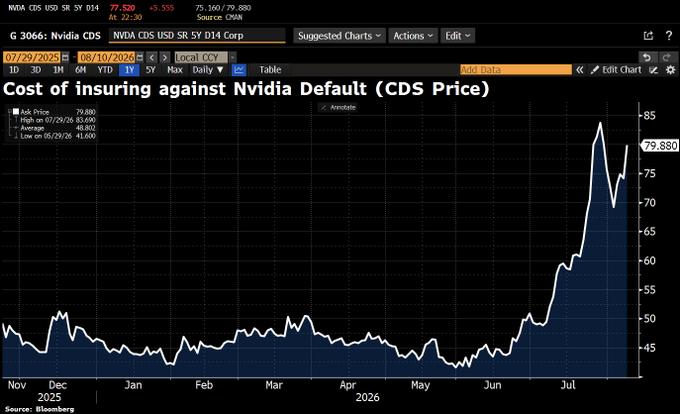
Since late May, the cost of insuring NVIDIA's debt against default has doubled, rising from 41.6 basis points to 77.5 basis points, only slightly below the all-time high of 83.7 basis points set on July 29. This seems somewhat odd, given that NVIDIA is creating an extra $500 billion in demand without tapping its own balance sheet. But it also clearly indicates that leverage levels in AI financing continue to climb.
Wall Street Worries About Circular Transactions Once Again
Well-known financial blog site Zerohedge also stated that in this upcoming record-breaking off-balance-sheet Special Purpose Vehicle (SPV) deal, credit default swap (CDS) and credit asset yields are likely to be pushed to entirely new highs — as the chart below shows, the current levels are already staggering...
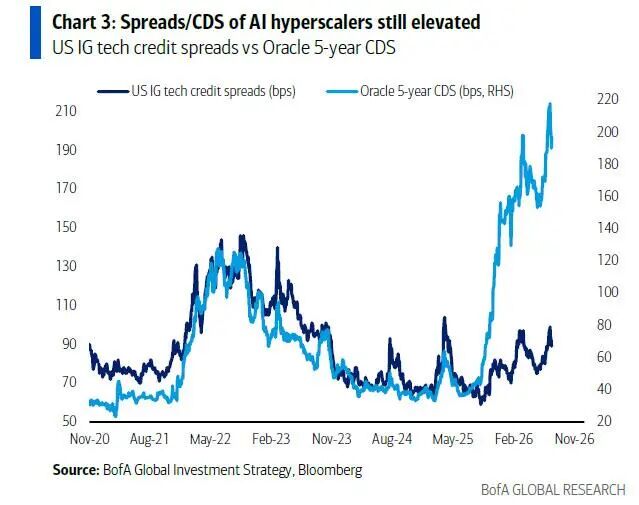
Zerohedge pointed out that although NVIDIA and all parties are calling this a "partnership" because it sounds a bit better than a "desperate off-balance-sheet arrangement", this move highlights that NVIDIA's efforts to raise capital for itself and its customers have become increasingly urgent (as everyone now acknowledges that circular financing is critical to sustaining the AI boom), so that it can continue to assemble the chips, power generation facilities and data centers at the core of the AI prosperity.
The $5.25 trillion market cap company, whose GPUs power most mainstream AI models in the US today, has positioned itself at the heart of the AI boom, providing chips, infrastructure and software to numerous partners developing the technology.
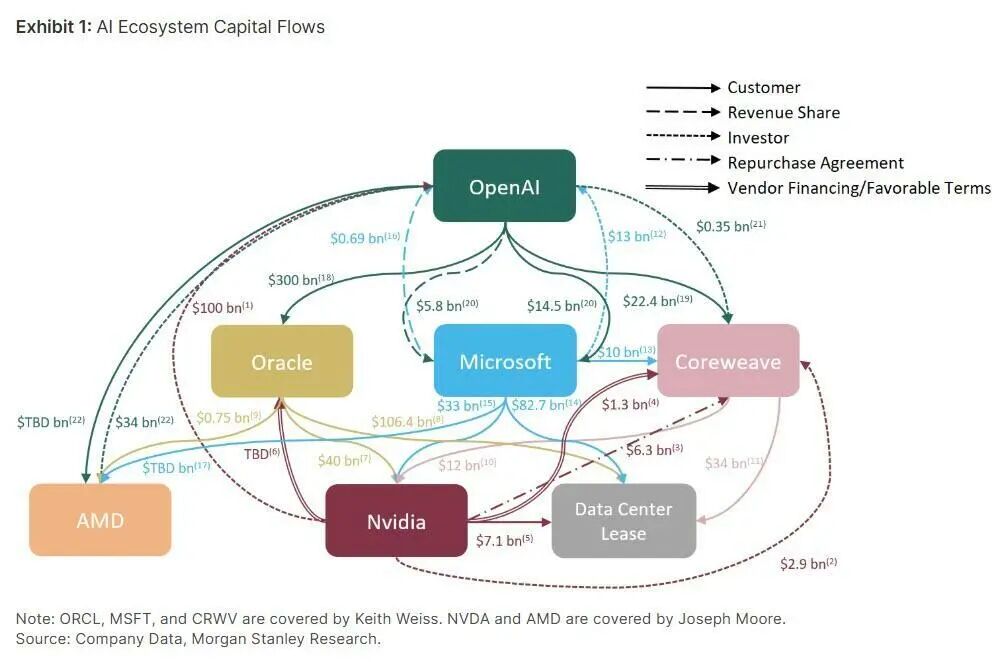
More concerningly, this is reminiscent of the supplier financing models that partially led to the dot-com bubble burst back then: NVIDIA, as always, provides financial support to help its AI partners raise debt in the capital market, which in turn boosts its own revenue — this has become the iconic "self-reinforcing" circular transaction in the AI sector.
As the industry has been discussing over the past year, the cyclical nature of such transactions has raised concerns about risk concentration across the sector. This also explains why NVIDIA's stock slumped immediately after the news broke overnight — NVIDIA closed down about 2.8% on Monday, wiping out more than $70 billion in market value.
People familiar with the matter previously disclosed that NVIDIA is also negotiating to provide massive guarantees for a 10 GW data center project in Ohio that is being leased to OpenAI. This deal shows that NVIDIA is building relationships with giants in the private capital industry, who are preparing to collectively deploy trillions of dollars in assets from their insurance, retail and institutional investors into AI infrastructure.
In recent years, private capital groups such as Apollo and Blackstone have built increasingly large off-balance-sheet SPV transactions to help companies like Anthropic finance their heavy spending on chips and data centers. CLS has conducted in-depth discussions on this as early as the end of last year in its article titled *The $1 Trillion AI Gamble: Off-Balance-Sheet "Ghost Debt" Is Piling Up, Is the Devil Hidden in SPVs?*.
Since OpenAI launched ChatGPT in November 2022, NVIDIA — whose market cap has grown 15 times — is not the only beneficiary of the massive circular transactions that define AI financing: the largest cloud computing companies including Meta, Oracle, Microsoft, Alphabet and Amazon are also dramatically increasing their spending on AI infrastructure to lead the race for this emerging technology. Morgan Stanley predicts that so-called hyperscalers will spend $3.5 trillion between 2026 and 2028.
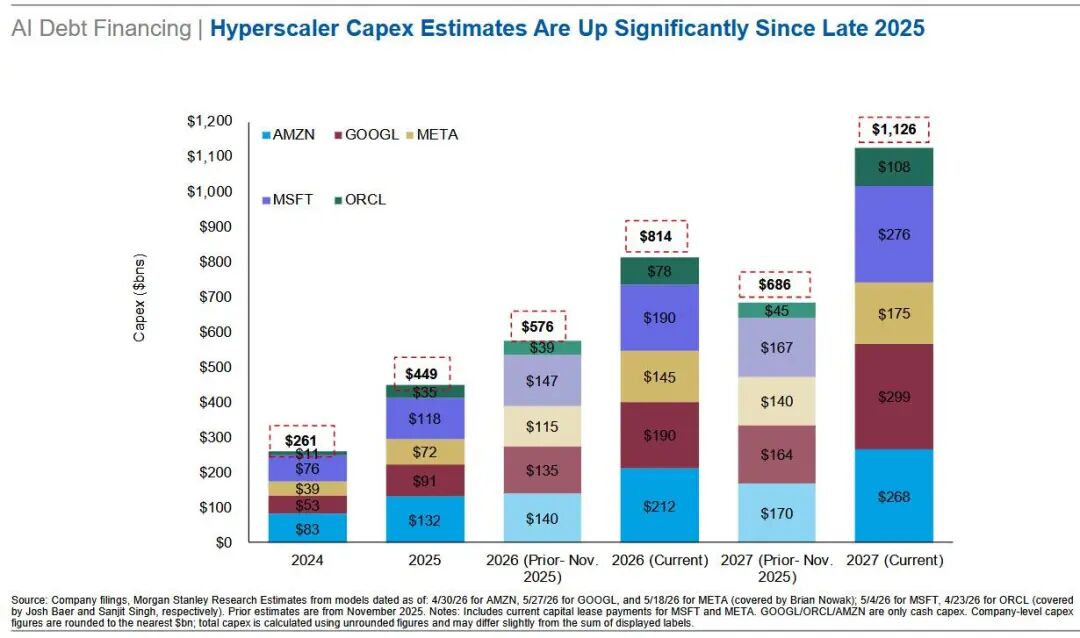
The demand for capital has forced tech groups to tap every available source of cash, including public equity, investment-grade and high-yield bonds, securitized debt, private credit and the project finance market. As Apollo President Jim Zelter elaborated on an earnings call earlier this month, "The unprecedented scale of AI infrastructure construction is expected to draw more than $8 trillion in investment, which is a staggering figure. We see huge opportunities for private and public capital to jointly fund part of this initiative."
While all this sounds promising, no one seems to have carefully calculated what will happen if traditional, expensive frontier models lose out to far cheaper, open-source/open-weight models. One thing is certain: if open-source models win this arms race, the projected "hockey-stick surge" in free cash flow shown in the chart below will never materialize.
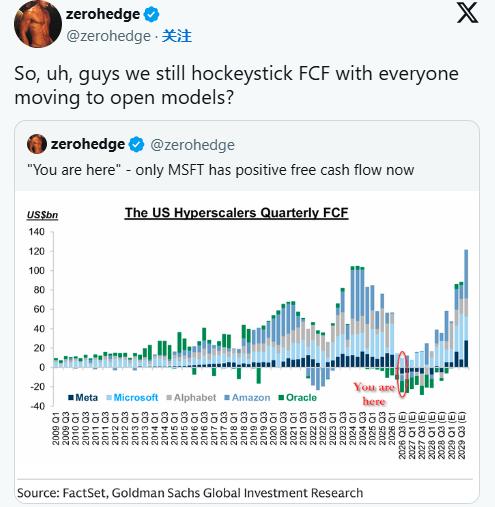
Now people may just need to wait and see how high this record-breaking SPV deal will push the CDS and bond spreads of hyperscalers to unreachable heights...
This article is sourced from the WeChat Official Account "CLS", author: Xiao Xiang, published with authorization from 36Kr.