The new energy vehicle markets in China and the US are decelerating simultaneously. Who is stepping in to fill the gap?
The global new energy vehicle market entered a low-growth phase in the first half of 2026.
From January to June 2026, a total of 9.906 million new energy vehicles were delivered worldwide, representing a 5.5% year-on-year increase. This data was released on August 10 by SNE Research, an institution focused on battery and new energy vehicle research, covering pure electric vehicles, plug-in hybrid electric vehicles, and commercial vehicles. Compared with the approximate 40% annual compound growth rate recorded between 2017 and 2025, the overall market has cooled down significantly.
According to statistics updated by the International Energy Agency (IEA) on August 8, calculated based on databases including EV Volumes, global electric vehicle sales exceeded 9 million units in the first half of 2026, down roughly 1% year-on-year; sales in the second quarter rose 4% year-on-year and 35% quarter-on-quarter from the first quarter, almost offsetting the decline in the first quarter. This statistical caliber excludes commercial vehicles.
However, behind the slowdown in total growth lies a clear divergence across regional markets. Data from SNE Research shows that in the first half of 2026, China delivered 5.308 million units, down 9.5% year-on-year; North America delivered 681,000 units (the vast majority in the United States), down 20.5%. The combined share of China and North America dropped from 71.5% in the same period of the previous year to 60.5%, with Europe, Asia and emerging markets taking over the incremental space. Europe recorded a 29% year-on-year growth to 2.528 million units in the same period, the Asian market excluding China grew 75.8% to 933,000 units, and the rest of the markets saw a 150.6% increase to 456,000 units.
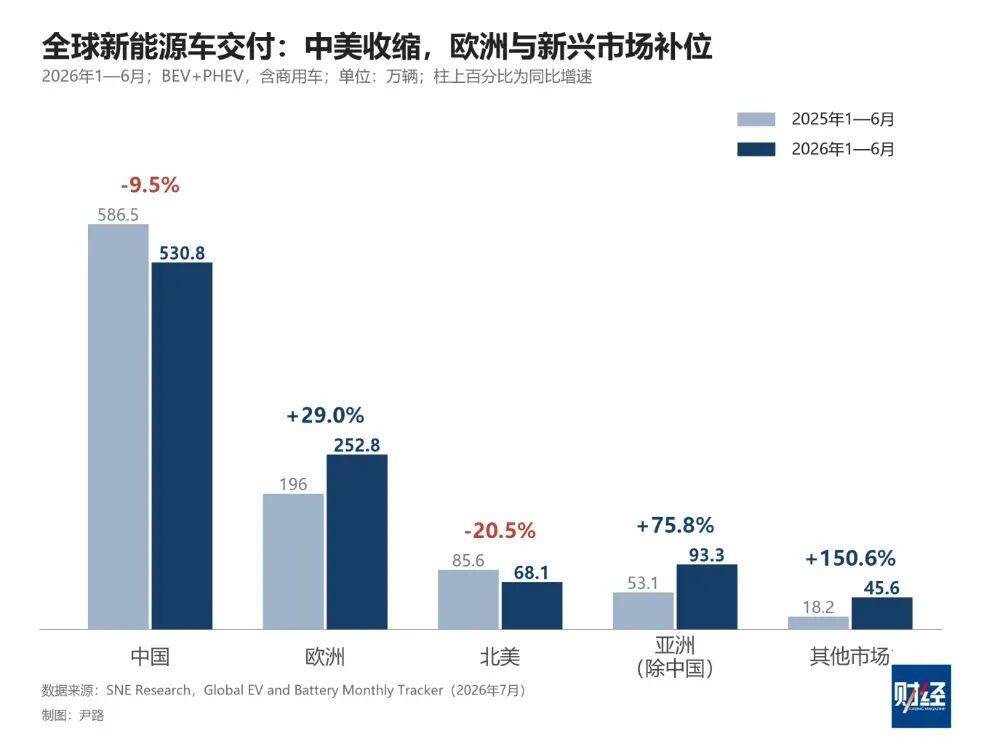
Price factors are the key variable explaining regional divergence. On one hand, subsidies, tax reductions and emission constraints are being adjusted dynamically, changing the actual car purchase cost for consumers; on the other hand, the premium of pure electric vehicles over fuel vehicles is narrowing rapidly in multiple markets. Policies determine short-term fluctuations, while affordability parity determines long-term trends.
The IEA estimates that global electric vehicle sales will remain at around 23 million units in 2026, representing a roughly 10% year-on-year increase and accounting for 29% of total global car sales. Among them, China's full-year sales are expected to be around 13.2 million units, roughly flat with 2025; higher growth rates will come from markets including Europe, Latin America, Australia, New Zealand, India and Southeast Asia.
01
China: Shifting from Policy Preference to "Equal Rights for EVs and Fuel Vehicles"
The changes in China's new energy vehicle market are first reflected in the visible purchase prices for consumers, and at a deeper level, the policy goal has shifted from scale expansion to market-oriented operation and high-quality development.
At the beginning of 2026, two policy changes directly affected car purchase costs: the trade-in subsidy was adjusted from a fixed amount to a proportion calculated based on vehicle price, and the subsidies for low-cost models generally shrank; the purchase tax on new energy vehicles was changed from full exemption to 50% reduction, with eligible vehicles taxed at an actual rate of 5%, which has a greater impact on price-sensitive entry-level models.
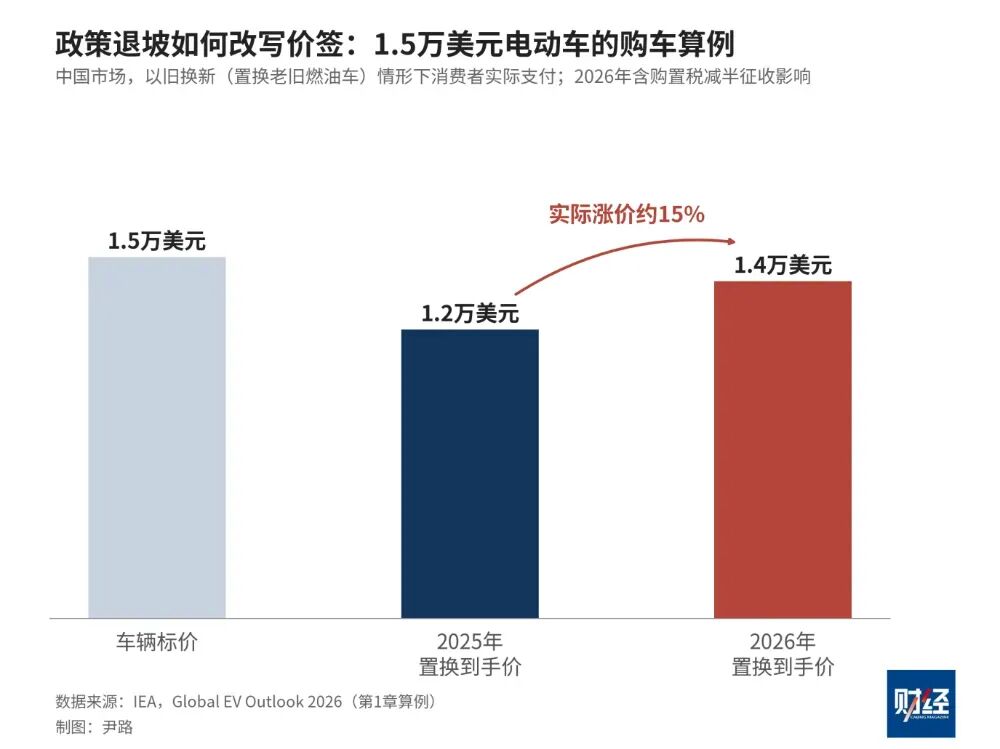
The IEA gives a straightforward calculation example in its *Global Electric Vehicle Outlook 2026*: In China, for an electric vehicle priced at 15,000 US dollars in 2025, consumers could pay as low as roughly 12,000 US dollars by trading in an old fuel vehicle; after the purchase tax halving and subsidy adjustment in 2026, the final price is close to 14,000 US dollars, representing an actual increase of about 15%.
The reduction of policy dividends has extended from the car purchase link to the usage and upstream manufacturing links. In July 2026, the vehicle and vessel tax policy issued by China's Ministry of Finance, State Taxation Administration and Ministry of Industry and Information Technology clearly stipulates that the preferential vehicle and vessel tax policies for energy-saving vehicles and new energy vehicles will be canceled starting from January 1, 2027. For plug-in hybrid passenger cars with 1.0L to 1.6L displacement, the original tax exemption was roughly 300 yuan to 540 yuan per year. The policy interpretation released by China Automotive Technology and Research Center, which is under the State-owned Assets Supervision and Administration Commission of the State Council, believes that this policy involves a small proportion of vehicles in the short term, and the overall market impact is moderate.
Tax incentives at the upstream production end have also started to narrow. Products such as lithium-ion batteries will be changed from consumption tax exemption to 2% taxation starting from September 1, 2026, and the tax rate will rise to 4% from September 1, 2027. Sodium-ion batteries, solid-state batteries and fuel cells will continue to enjoy tax exemption until the end of 2028. The policy research of China Automotive Technology and Research Center believes that phased taxation leaves a buffer for the supply chain to adjust pricing and cost control, but it will still bring upward cost pressure and profit pressure in the short term, and further shift the policy orientation from scale expansion to quality, efficiency and technological upgrading.
The combination of halved purchase tax, withdrawal of vehicle and vessel tax preferences, and resumption of taxation on mature battery technologies means that China's "equal rights for EVs and fuel vehicles" has gradually moved from policy discussion to implementation stage. New energy vehicles still undertake the industrial direction of electrification, but they no longer enjoy long-term comprehensive tax preferences covering purchase, ownership and core component manufacturing.
However, new energy vehicle sales data shows that the withdrawal of policy dividends has not eroded the market penetration advantage of new energy vehicles, but instead has stimulated consumers who are on the fence to make purchases as soon as possible while some policy dividends still exist. According to preliminary data from the Passenger Car Federation of the China Association of Automobile Dealers, from January to July 2026, cumulative retail sales reached 5.675 million units, down 12% year-on-year; among them, the retail sales of new energy passenger vehicles nationwide in July was 970,000 units, down 2% year-on-year. Starting from April 2026, the proportion of new energy vehicles in the new car market has exceeded 60% for four consecutive months, and reached 65% in July.
02
The United States: After the Policy Pillar Is Removed
Different from China's absorption of price adjustments, the decline of the U.S. market is a collapse after the policy pillar is removed.
In 2025, the U.S. federal government continuously weakened support for electric vehicles. At the beginning of 2025, U.S. President Trump signed Executive Order 14154 "Unleashing American Energy", instructing the federal government to terminate all support for electric vehicles; in July, the One Big Beautiful Bill Act (OBBBA) canceled the fines for non-compliance with Corporate Average Fuel Economy (CAFE) standards, eliminating the compliance motivation for automakers to sell electric vehicles; at the end of September, the federal new car (7,500 US dollars per vehicle) and used electric vehicle purchase tax credits officially expired. With the simultaneous disappearance of subsidies and compliance pressure, automakers' promotions, product launches and consumer expectations have changed accordingly.
The policy impact is immediately reflected in the data: in the first three quarters of 2025, U.S. electric vehicle sales rose about 15% year-on-year under the "last subsidy train" effect; after the tax credit expired, fourth-quarter sales plunged 45% year-on-year; entering 2026, first-quarter sales fell one-third year-on-year, of which March sales were about 95,000 units, the highest monthly level since the credit was terminated, but still one-third lower than March 2025.
In the second quarter of 2026, U.S. electric vehicle sales exceeded 275,000 units, up 20% from the first quarter, but still about a quarter lower than the same period in 2025; the average proportion of electric vehicles in U.S. new car sales in the first half of the year was about 7%, lower than 10% in 2025. According to SNE Research's statistical caliber for North America, first-half deliveries fell 20.5% year-on-year to 681,000 units. The sequential rebound indicates that demand has not disappeared, but the year-on-year gap shows that the price vacuum left by policy withdrawal has not yet been filled by products and cost reduction.
Supply chain data reflects the same pressure. In the first half of 2026, the installed capacity of power batteries in non-China markets increased 26.3% year-on-year to 269 GWh, but the combined installed capacity of three South Korean battery companies reached 74.3 GWh, down 6.3% year-on-year, with their share dropping from 37.2% to 27.6%. Among them, LG Energy Solution grew 1.5%, SK On fell 6.7%, and Samsung SDI dropped 29.0%. In addition, although Panasonic recorded a 10.2% growth, it still lags far behind the overall market. The poor performance of Japanese and South Korean battery companies is almost all attributed to the U.S. market.
The IEA predicts that the U.S. auto market may pick up in the second half of the year, but total full-year sales will still be lower than in 2025. For electric vehicles, a 6% to 7% penetration rate is not necessarily a long-term ceiling, but it is the realistic data under the current price structure. In the U.S. policy environment of no subsidies, no penalties and no affordability parity, there is no shortcut to bridging the structural price gap, and it is necessary to wait for battery cost reduction and the launch of parity models.
03
Fundamental Differences Behind Policy Withdrawal
Both China and the United States are experiencing weakening policy support, but the IEA's price data reveals the underlying economic differences.
According to IEA estimates, nearly 70% of the pure electric vehicles sold in China in 2025 were already priced lower than fuel vehicles of the same class after deducting all government subsidies, and this proportion was 50% in 2021. Looking at segmented markets: in the small car market, electric vehicles are about 60% cheaper than fuel vehicles, and fuel vehicles have basically exited; in the Sport Utility Vehicle (SUV) market, pure electric models achieved price parity with fuel vehicles for the first time in 2025, with an electrification rate exceeding 55%; even in the midsize car market, which is the most difficult to electrify, the price premium of electric vehicles has dropped from about 20% in the previous year to below 15%, with a penetration rate exceeding 40%.
In the United States, among the electric vehicle models on sale for two consecutive years in 2024 and 2025, less than 20% have a starting price lower than the average transaction price of fuel vehicles (about 40,000 US dollars); while among fuel vehicle models, more than 40% are below this line. In other words, the U.S. electric vehicle market has not yet reached affordability parity, and subsidies are the only pillar to bridge the price gap.
The difference in the speed of price decline also illustrates the problem. In 2025, the sales-weighted average price of pure electric vehicles in China dropped by more than 10% in net terms. Battery cost reduction, non-battery component cost reduction and automakers' aggressive pricing strategies offset the roughly 3% price increase pressure brought by the rising proportion of SUVs and larger battery packs; the average price in Germany fell by about 6%, mainly driven by the launch of new parity models; while the U.S. average price only dropped by about 2%, almost all from battery price cuts, and the lack of new parity models made the decline far lower than that in China and Germany.
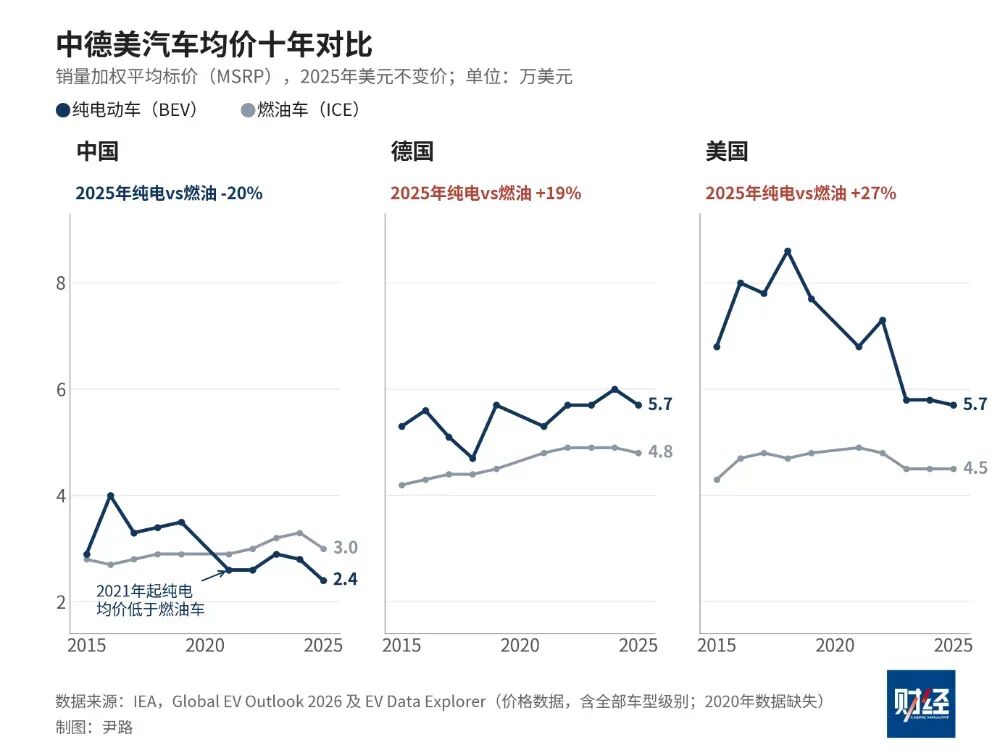
When extending the time horizon to ten years, the divergence is more intuitive. Over the past decade, China has turned "electric vehicles are cheaper than fuel vehicles" into a market reality. The IEA's price database shows that in 2025, the sales-weighted average price of pure electric vehicles in China is 24,000 US dollars, 20% lower than the average price of about 30,000 US dollars for fuel vehicles, and has been lower than fuel vehicles since 2021; the average price of pure electric vehicles in Germany is 57,000 US dollars, still 19% higher than fuel vehicles; the average price of pure electric vehicles in the United States is also 57,000 US dollars, 27% higher than fuel vehicles.
China's policy withdrawal is a minor disturbance after achieving "parity between electric and fuel vehicles", and the market's own pricing capacity can absorb it; when the United States canceled federal subsidies, the structural price gap in the market was far from being bridged, but the only price balancing pillar was removed.
04
Where Does the Growth of the Fill-in Players Come From
The new energy vehicle growth space after the slowdown in China and the United States is being taken over by Europe, Asia and a wider range of emerging markets, and energy security pressure has amplified the usage cost advantage of electric vehicles.
First is Europe. According to SNE Research statistics, in the first half of 2026, a total of 2.528 million new energy vehicles were delivered in Europe, representing a 29% year-on-year increase, and the global share rose from 20.9% to 25.5%. The IEA's auto sales caliber also shows that Europe recorded a roughly 30% growth in the first half of the year, and the proportion of electric vehicles in new car sales in the European Union has exceeded 30%.
Europe's growth comes from the combined effect of regulations, products and policies. The European Union has implemented stricter new car carbon emission standards since 2025. Under the pressure of emission reduction compliance, automakers need to increase pure electric vehicle sales to lower the average emission of new cars sold during the assessment period from 2025 to 2027, forcing automakers to adjust their pricing strategies and intensively launch affordable new energy models.
Germany restarted car purchase subsidies for low- and middle-income families at the beginning of 2026, with the maximum subsidy amounts for pure electric and plug-in hybrid models reaching 6,000 euros and 4,500 euros respectively. As a result, new energy vehicle sales in the first quarter increased 35% year-on-year, and monthly sales in March reached 100,000 units, a record high. The UK's first-quarter sales grew 25%, with March sales exceeding 130,000 units, a new all-time high; Italy's first-quarter sales surged nearly 90% year-on-year.
Chinese brands and Chinese manufacturing are playing an increasingly important role in the European auto market. According to European new car registration data counted by the European Automobile Manufacturers' Association (ACEA), in the second quarter of 2026, BYD, SAIC Motor, Geely, Chery and Leapmotor registered a total of 435,900 units, up 71.8% from the same period in 2025, accounting for about 11.7% of the European new car market, surpassing Japanese brands in total on a quarterly basis for the first time. The UK is one of the markets with the most prominent growth of Chinese brands.