Wildberries is in a critical situation, and Chinese sellers are urgently clearing out their inventory.
Recently, Russian e-commerce platform Wildberries has been pushed to the forefront of public controversy.
Wildberries is known as the "Russian version of Amazon". Just like Amazon, Wildberries also has a huge "shopping entry + logistics network".
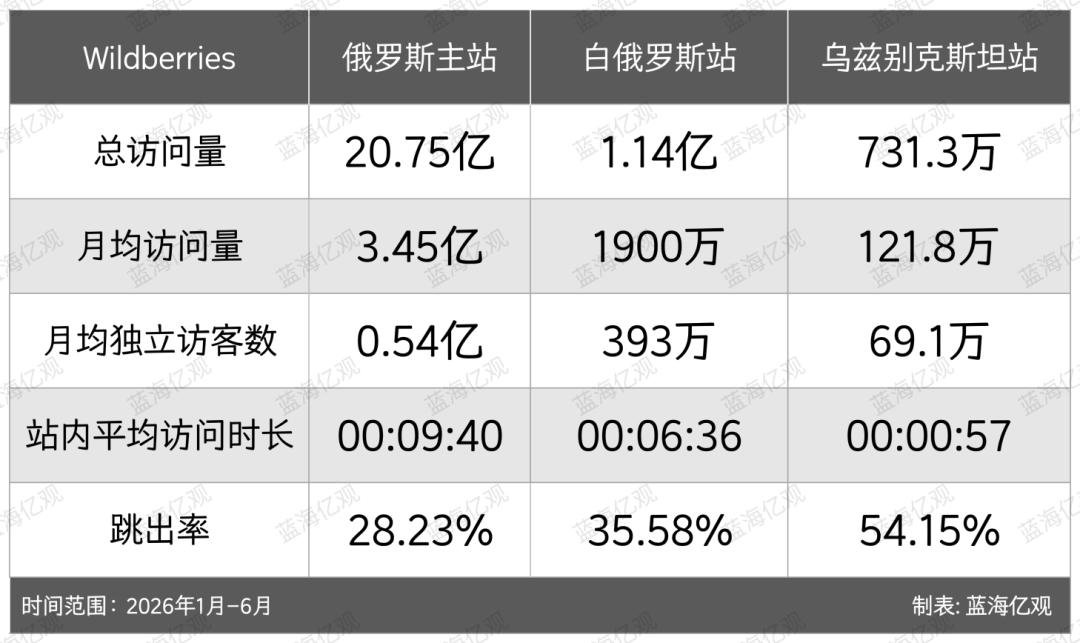
In the first half of 2026, the total traffic of Wildberries' main Russian site reached 2.075 billion, with an average monthly traffic of 345 million. Meanwhile, the total area of its logistics complexes reached 5.2 million square meters, larger than the other two local e-commerce platforms Ozon (5 million square meters) and Yandex Market (800,000-1.2 million square meters).
One of Wildberries' most solid moats is its multi-level distribution network of "central warehouse - urban warehouse - pickup point" covering all across Russia.
However, recently, Wildberries' "moat" has been hit by force majeure: a large number of warehouses have been successively bombed by Ukrainian drones in multiple rounds, resulting in the inventory goods of many third-party sellers being burned down and suffering heavy losses.
Wildberries has been severely weakened, and its logistics network that has been painstakingly built over more than 20 years has been hit hard. It will take a very long time and huge amount of capital to repair in the future. The company's losses may reach as high as 200 billion rubles, and it may bear losses for several years to come.
When the city gate catches fire, the disaster extends to the fish in the moat. A number of sellers' inventory has been damaged, and even face the risk of "zero inventory" and business paralysis.
A children's clothing seller in Zhejiang said that in the past two weeks, its clothing inventory worth millions of yuan distributed in multiple Wildberries warehouses in Russia has experienced 7 warehouse attacks in total, with a direct loss of about 80,000 yuan.
In this situation, a number of sellers have started clearance sales to quickly clear their inventory, while moving part of the goods from Wildberries' official warehouses to third-party warehouses.
While sellers have suffered huge losses, Wildberries has rushed to "exempt itself from liability" and urgently updated its "Seller Service Terms", explicitly defining the drone attack incident as a "force majeure event", and the platform is not liable for compensation for sellers' cargo losses caused by such incidents in principle.
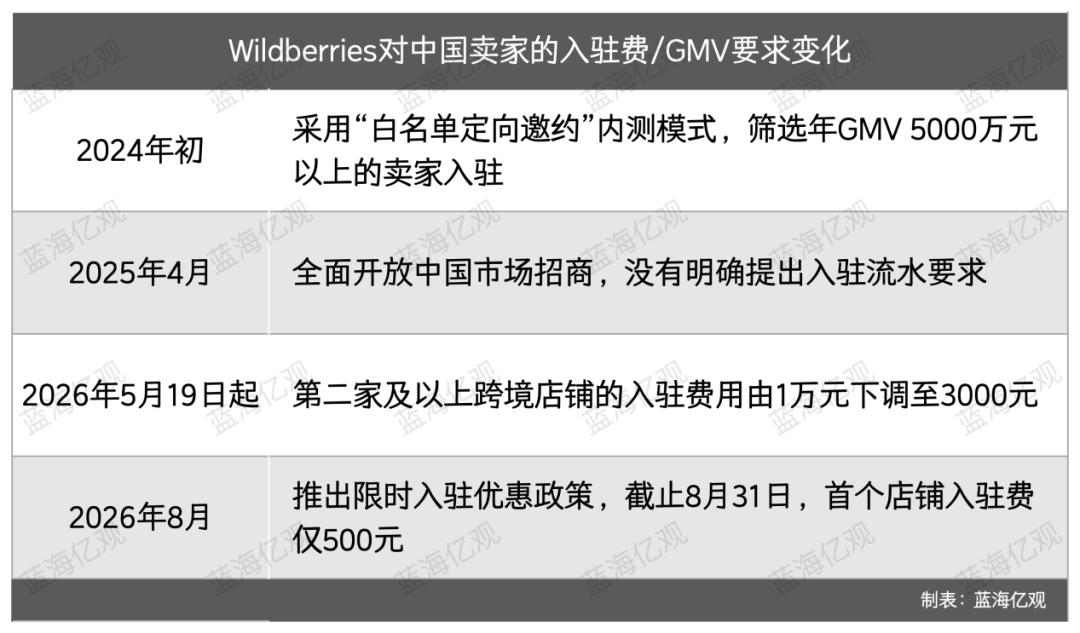
Seller churn, commodity inventory shortage, and even a huge crisis in the entire supply chain. Against this background, Wildberries has changed its previous "high-profile attitude", and has continuously lowered the entry standards for Chinese sellers: from May to August 2026, its entry fee dropped sharply from 10,000 yuan to 3,000 yuan, and then further reduced to 500 yuan.

Fig.: Wildberries entry standards
Risks always coexist with opportunities. As Wildberries loosens its store opening requirements, for Chinese sellers, do opportunities outweigh risks, or do risks outweigh opportunities?
The Crisis of Wildberries
In 2004, Tatiana Kim, a Russian English teacher, founded Wildberries at home. At that time, Wildberries was just an online "clothing purchasing agent" store in an ordinary apartment in Moscow.
In the following two decades, Wildberries continued to grow and eventually occupied half of the Russian e-commerce market. In 2024, Wildberries and Ozon, together accounted for 77% of the order volume and 53% of the sales volume in the Russian e-commerce market.
However, recently, the once-thriving Wildberries has encountered the largest supply chain crisis since its establishment.
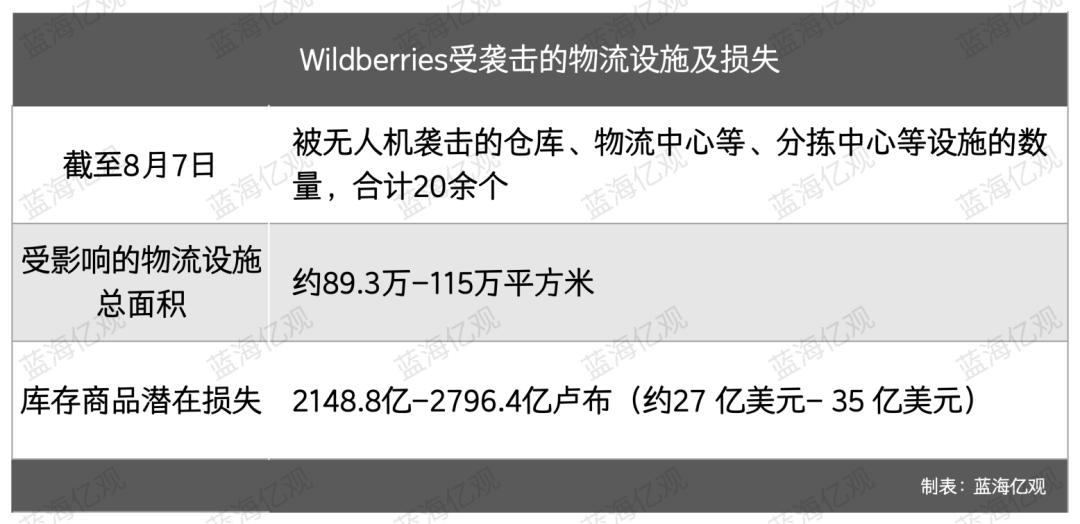
Since July, Ukrainian drones have successively attacked more than 20 warehouses, logistics centers and sorting facilities of Wildberries in multiple regions of Russia, covering Moscow, Tambov, Krasnodar and other regions.
On July 18 alone, two logistics facilities of Wildberries in Moscow Oblast and Tambov Oblast were attacked at the same time. Among them, the Elektrostal warehouse located in Moscow Oblast is one of Wildberries' largest warehousing facilities, covering an area of more than 360,000 square meters, processing about 7.4 million pieces of goods every day.
Third-party data shows that the area of affected logistics facilities exceeds 1 million square meters, accounting for about one fifth of Wildberries' entire logistics system, and the losses caused by the attacks to sellers are about 215 billion to 280 billion rubles.
The logistics network that Wildberries has spent huge sums of money and painstaking efforts to build over the past 20+ years has been torn apart brutally.
According to reports from foreign media The Bell, at present, due to the impact of a large number of damaged logistics infrastructure, Wildberries' overall turnover has dropped by a quarter, and the revenue of pickup points has declined. At the same time, in order to restore the logistics system and rebuild the warehousing network, Wildberries may continue to face great capital pressure in the next few years, and take on new debts on the basis of its existing debts of more than 1.3 trillion rubles.
At the same time, a large number of third-party sellers have also suffered substantial losses, including inventory damage, a sharp drop in sales, and even the risk of zero inventory and corporate bankruptcy.
A children's clothing seller in Zhejiang stored a batch of garments in warehouses in multiple locations, suffering losses every day, up to tens of thousands of yuan on a bad day.
After the warehouse was attacked, the seller urgently moved part of the inventory from the FBO delivery model (sellers stock goods in the platform's official warehouse, and the platform is responsible for delivery), to the FBS model (seller self-delivery), At the same time, the seller started a big clearance sale: best-selling products are sold at cost to clear inventory, and poorly styled products are sold at a loss.
While sellers have suffered losses,
Wildberries updated the "exemption clause" in its seller agreement, explicitly including losses caused by force majeure events such as drone attacks into the scope of exemption, that is, the platform is not liable for compensation for sellers' cargo losses caused by such incidents in principle.
Almost in the same period, Russian e-commerce platforms such as Ozon, Yandex Market, and MegaMarket, have also successively updated similar seller terms to transfer war risks to sellers.
In late July, Wildberries issued the first batch of compensation to affected sellers in the form of "voluntary compensation payments", and successively launched the second round of compensation. The platform later disclosed that more than 88,000 sellers have started to receive the first batch of payments, and the scope of the second round of support has been further expanded to about 100,000 small and medium-sized enterprises.
However, there is a clear gap between the platform's compensation amount and the actual losses of sellers. A seller said that the value of its damaged goods is about 100,000 rubles, but the compensation received within a week is only about 23,000 rubles.
In fact, before the warehouses were attacked, cracks had already appeared in Wildberries' seller ecosystem.
From April to October 2025, the number of sellers on Wildberries decreased by 11% year-on-year, while in the same period, the number of sellers on Ozon only decreased by 4% year-on-year. At the same time, the rising operating costs of Wildberries platform including commission, logistics and warehousing have further increased the operating pressure on sellers.
Now, the successive attacks on Wildberries' warehouses have further accelerated the churn of sellers, and also multiplied the resistance for Chinese sellers who plan to enter the Russian market.
Nevertheless, Wildberries still has a solid foundation, and there are still opportunities.
Wildberries' Solid Foundation Remains
In 2004, in an ordinary apartment on the outskirts of Moscow, 28-year-old English teacher Tatiana Kim (who changed her surname after divorce) observed a phenomenon during her maternity leave:
Many Russian consumers like to browse European mail-order catalogs such as OTTO and Quelle from Germany, hoping to buy European clothing with more styles, but the cross-border ordering process is cumbersome and the waiting time is extremely long, so it is difficult for ordinary consumers to buy these goods directly.
At that time, e-commerce in Russia was in its infancy, its territory spans Eurasia, but the population is highly concentrated in western cities such as Moscow and St. Petersburg. The logistics cost is much higher than that of European and American countries, and most consumers are used to purchasing goods in shopping malls and markets.
Therefore, Tatiana Kim came up with the entrepreneurial idea of "introducing European brand products into Russia", and together with her husband Vladislav Bakalchuk, founded Wildberries in an apartment in Moscow with 20,000 US dollars.
In the initial stage of its establishment, Wildberries' core category was clothing.
Wildberries acted as a "purchasing agent (intermediary)": consumers placed orders online, Tatiana purchased clearance clothing from Germany in bulk, and then personally went to the post office to deliver the goods.
In order to quickly open up the market, Tatiana once spent millions of dollars with her partners to purchase clothing of international brands such as Adidas, and sold them at a price of about 50% of the official selling price.
Wildberries also broke the "regional price difference" model that was commonly implemented in the Russian retail industry at that time, adhered to unified national pricing, and only added about 10% markup on the basis of the commodity procurement cost. In contrast, many competitors added about 15% markup in core cities such as Moscow, and even more than 30% markup in remote areas, and required consumers to pay a deposit in advance.
In order to increase consumers' willingness to buy clothes online, Wildberries launched the "try on first, pay later" model: consumers can try on the clothes on the spot after the courier delivers the goods to their door, return the unsatisfactory ones immediately, and only pay for the goods they finally keep.
Through price advantages and service experience, Wildberries quickly accumulated a group of loyal users.
However, given the characteristics of Russia's east-west span of more than 9,000 kilometers and extremely uneven population density, Wildberries did not rush to expand its categories, but continuously invested the profits it earned in the construction of logistics infrastructure, including continuous construction of warehousing networks, pickup points and distribution systems.
Around 2010, Wildberries began to lay out pickup points in major Russian cities to improve fulfillment efficiency. By 2012, Wildberries had established 134 pickup points. When competitors were still competing for online traffic, Wildberries had taken the lead in spreading its logistics network across the country, which later became the most important moat for surpassing Ozon.
As of around 2013, Wildberries had become one of the fastest-growing online retailers in Russia, and its sales categories have gradually expanded from the original clothing to footwear, children's products, beauty and personal care, home supplies and many other fields, and gradually entered markets such as Belarus and Kazakhstan.
In 2014, Wildberries began to fully open the "local third-party seller" model.
With the help of third-party sellers, Wildberries not only enriched the platform's categories, but also earned a large amount of commission, while the platform is only responsible for traffic distribution, warehousing, logistics and transaction services.
After Wildberries transformed into a platform-based model, it entered a "positive cycle": it continued to invest a large amount of profits into logistics infrastructure, continuously expanded the number of warehousing networks and pickup points, and consolidated its own moat.
Up to now, the total area of Wildberries' logistics complexes has reached 5.2 million square meters, including more than 200 logistics facilities and more than 90,000 pickup points, and its fulfillment network covers multiple markets such as Russia and Central Asia.
In 2025, Wildberries' GMV exceeded 6.1 trillion rubles (about 73.3 billion US dollars), a year-on-year increase of 49%.
However, when Wildberries gradually secured its position as the top e-commerce player in Russia, it has become increasingly difficult to meet the development needs of the platform only relying on local sellers.
A large number of sellers on Wildberries are essentially local Russian traders, with many homogeneous products and limited speed of new product updates.
At the same time, Ozon, another Russian e-commerce giant, has long launched its international business and continuously attracted Chinese sellers to settle in. According to the Financial Times, as of 2024, the number of registered Chinese sellers on Ozon Global has exceeded 100,000, and 80% of cross-border orders come from Chinese sellers.
In addition, after the Russia-Ukraine conflict broke out, a large number of European and American brands such as IKEA, H&M, Zara, and Nike suspended or withdrew from the Russian market, creating a huge gap in commodity supply, and many consumers quickly looked for alternative products.
Against this background, Wildberries had to introduce Chinese sellers with rich supply chains. In China, consumer goods from clothing, home furnishing to consumer electronics, motorcycle accessories, gardening tools and other consumer goods can be quickly developed and mass-produced, which is exactly the capability that the Russian market lacks the most.
In April 2025, Wildberries officially fully opened investment promotion to the Chinese market, no longer explicitly stipulating the previously high sales scale threshold;
However, as the Russia-Ukraine conflict continues to escalate, Wildberries has felt a strong crisis. In order to retain more sellers and stabilize its basic market, it has continuously lowered the entry threshold for Chinese sellers.
Since May 19, 2026, the entry fee for the second and subsequent cross-border stores has been reduced from 10,000 yuan to 3,000 yuan. Now, Wildberries' official website has further launched a limited-time entry preferential policy. As of August 31, the entry fee for the first store is only 500 yuan.
However, low-cost entry does not mean low-threshold operation.
In terms of platform management, Wildberries has the characteristics of "strong platform, weak sellers".
Wildberries firmly controls product ranking, traffic allocation, fulfillment rules and seller penalties in its own hands. For example, the platform stip