ByteDance AI stops pretending: 12% tax collection, no distillation, and places a 5 trillion bet.
Doubao channel has officially launched commission collection.
For the exact same hotel, the same room, and the same settlement system, users accessing via Douyin's feed will be charged an 8% platform commission; while users redirected from the Doubao dialog box will face a 12% platform commission.
The 4 percentage point difference has only one variable: the traffic comes from AI conversations.
This is no ordinary rate adjustment. It is a critical move ByteDance has placed on the global AI large model commercialization chessboard — set pricing first, then scale the volume.
On the same day, Liu Xing, head of public relations for Doubao, responded on Weibo: "There is no paid promotion, no advertising fees charged, and only channel service fees are paid after the order is successfully completed."
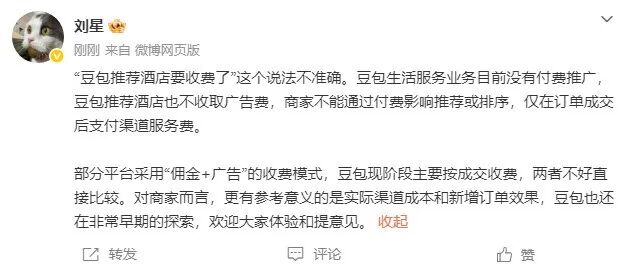
In other words: We do not profit from advertising revenue, but from revenue generated by user intent.
12%: The First Explicit Price Tag for AI Entrance
To understand the significance of this 12% rate, we must first place it in the broader industry context.
The software service fee for in-house Douyin local life service orders originally ranges from 2.5% to 8%. The accommodation category saw its fee rise from 4.5% to 8% in 2024. Meanwhile, JD Travel is still attracting merchants with zero commission. When Douyin first entered the local life sector, its rate was only half of Meituan's.
The old script for platform competition has always been: new channels enter the market, use low prices to acquire supply, and gradually raise rates after gaining sufficient market share.
Doubao has broken this conventional script.
A brand new channel charges the highest industry rate from its very first day of operation. ByteDance dares to do this because it bets that merchants have no choice to "wait and see".
The reality of the travel and hospitality industry is that the Ctrip ecosystem accounts for roughly 70% of the accommodation booking GMV, with commissions ranging from 12% to 20%. Merchants are already highly sensitive to channel rates, yet none of them can truly exit the platforms.
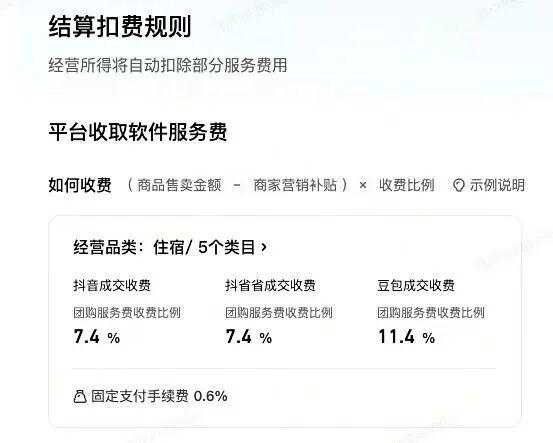
If AI conversations become the primary entrance for user decision-making in the next generation, the cost of absenting from Doubao will far exceed the 12% commission. This is the full basis for ByteDance to set a high price during this window period.
However, there is an even more aggressive detail hidden in the rate table.
According to the policy announced on July 27, the billing base for software service fees is "the actual amount paid by users + the amount of subsidies provided by entities other than merchants". This means that if ByteDance itself issues coupons to users to boost transactions, merchants will also need to pay commissions for this portion of subsidies.
When the platform runs marketing campaigns, part of the cost is passed on to merchants' bills.
This clause is more thought-provoking than the rate figure itself. It shows that ByteDance has no intention of using subsidies to chase scale, but aims to build a positive cash flow cycle from the very first day of commercialization.
Data from QuestMobile shows that as of June this year, Doubao has 382 million monthly active users, Qianwen has 167 million, and DeepSeek has 130 million. Doubao's user base is larger than the sum of the latter two.
But large user volume does not equal strong monetization capability.
According to reports from *LatePost*, Doubao has more than 200 million daily active users, but its daily revenue is less than 1 million RMB, which mainly comes from e-commerce commissions. At the same time, Doubao's daily computing power cost reaches tens of millions of RMB — the cost just to maintain normal operation exceeds the total operating cost of Bilibili.
Doubao's daily e-commerce transaction volume is only around 10 million RMB, with daily commissions less than 1 million RMB, which cannot even cover a tiny fraction of its computing power bill.
Since the revenue collected in the short term is negligible, the significance of the rate adjustment does not lie in the immediate income, but in the price itself.
ByteDance's capital expenditure plan for 2026 has been raised to over 200 billion RMB, equivalent to about 60% of its 2025 profit. This huge sum of money requires a return path that can be clearly explained to both internal teams and external stakeholders.
The significance of an independent commission rate is to reposition Doubao from a cost center to a "priced asset". The order volume can be small today, but once the rate is written into merchant contracts, it becomes a fait accompli. Every subsequent increase in order volume will be settled at this price.
Set pricing first, then scale the volume.
This order shows that what ByteDance truly cares about is not the current several million RMB in commissions, but the time window to establish its pricing power.
No Distillation: Zhang Yiming's "Delayed Gratification" Gamble
A few days before the Doubao commission policy was implemented, Zhang Yiming made a rare public appearance.
At the all-hands meeting of the Seed team, the rarely seen founder made it clear: ByteDance strictly prohibits distilling competitors' models.
"We will not use others' model outputs to chase temporary rankings."
"We should be willing to sacrifice part of our short-term gains for long-term goals."
What is model distillation? It refers to training a smaller self-owned model using advanced large models on the market, to quickly improve its capability at a relatively low cost. This is a well-known "shortcut" in the industry that no one talks about openly.
Giving up this shortcut means ByteDance's model may temporarily lag behind its competitors in the short term.
Zhang Yiming does not care about that.
He believes that distillation can improve model performance in the short term, but essentially it only replicates the existing capabilities of models like Claude. Following this path, the model can at most keep approaching others' level, and it is very difficult to achieve real breakthroughs and surpass them.
ByteDance has strictly prohibited distillation for open-source models internally, and has even strengthened relevant restrictions through methods such as API detection. Zhang Yiming believes that distillation will interfere with genuine long-term technological breakthroughs.
5 Trillion Parameters: A High-Stakes Gamble on "More Power Brings Miracles"
According to an exclusive report from *LatePost*: ByteDance is in discussions to train a large model with a parameter scale exceeding 5 trillion. What does 5 trillion parameters mean?
Alibaba's Qwen 3.8-Max has 2.4 trillion parameters. Moonshot AI's K3 has 2.8 trillion parameters. Elon Musk's xAI expanded the Grok base model from 500 billion to 1.5 trillion parameters, and stated that the next generation will reach 6 trillion parameters.
If this model is launched, it will be the largest known model by parameter scale in China.
The new model will be led by Xiang Liang, head of Seed Foundation, in collaboration with Shen Ke, head of pre-training data for large language models. For this goal, Seed is reorganizing its internal structure, clarifying responsibilities, and allocating resources.
The larger the parameter scale, the higher the upper limit of model capability, and the training cost and technical difficulty will grow exponentially. This is not a gradual improvement, but a high-stakes gamble on the strategy of "more power brings miracles".
This is not the first time ByteDance has made such a gamble.
Seedance 2.0, the video generation model launched in February 2026, is the first video generation model fully adopting the MoE architecture with 200 billion parameters. Right after its launch, it was widely recognized as the world's highest-performance video model, with annualized revenue reaching 2 billion USD, a gross margin of 70%, and monthly revenue exceeding 1 billion RMB.
Seedance's success proved that ByteDance's AI R&D system has the capability to reach world-class advanced levels in specific technical directions.
But language models are a completely different story.
In the first half of this year, the market response to Seed 2.0 was relatively limited. Almost at the same time, GLM-5 open sourced by Zhipu AI was regarded as the first domestic model comparable to Anthropic's Opus series; in July, Moonshot AI released Kimi K3, and multiple third-party evaluations showed that it is close to overseas closed-source flagship models.
The lag in model capability has affected the revenue side. More than half of the token consumption on Volcano Engine comes from the Seedance and Seedream multi-modal generation model series, while language models account for a low proportion.
The token consumption of Doubao's large model was 120 trillion in March and 180 trillion in June, which is lower than the original planned target of 250 trillion to 300 trillion.
Zhang Yiming comforted the team at the Seed all-hands meeting: Training large models is inherently very difficult, and there is no need for excessive anxiety. He made it clear that the company can accept the model lagging behind the industry for a period of time, and hopes everyone will aim for the upper limit of intelligence, expecting Seed's model capability to enter the world's first tier.
He recognized that coding is the current key direction, but reminded that the team should not be completely led by it, "There are more and larger opportunities beyond coding."
He praised Seedance, saying that this model is very unique in the market and has leading technical advantages. Compared with following the existing routes of other leading models, he encourages Seed to develop models with its own unique characteristics.
No distillation, larger parameter scale, and building models with unique characteristics — these three points point to the same conclusion: ByteDance does not want to be China's OpenAI, it wants to build its own Seed.
Three Swords Combined: Strategic Transformation from C-end to B-end
On August 6, ByteDance held its mid-year All Hands meeting.
Liang Rubo stated that the company has summarized the principles for formulating business strategies as "high priority, thick main line, and long-term optimization". Specifically for AI business, it means to fully believe in AGI and adhere to independent R&D.
This seems to be a distant response to Zhang Yiming's "no distillation" principle.
But the more important signal is: Douyin and Doubao are listed side by side as ByteDance's two "thick main lines".

"As a mainline business, Douyin can drive the development of e-commerce and local life services, and we hope Doubao will also become a mainline business in the future."
The meaning of "thick main line" is: this business itself is large and highly important, and it can also drive and support the development of other businesses.
To achieve this vision, ByteDance carried out its most aggressive To B business restructuring since the sectoral reform in 2021 at the end of July —
The entire Feishu product team was merged into Doubao, and the entire commercial sales system was incorporated into Volcano Engine. Xie Xin, head of Feishu, reports to Zhao Qi who leads Doubao, and all Feishu's marketing, sales, and customer teams are under the unified management of Tan Dai from Volcano Engine.
Doubao (AI Brain) + Feishu (Office Scenarios) + Volcano Engine (Computing Power Base) = Three Swords Combined in One.
Why make such an adjustment?
Because ByteDance found that the development of AI in productivity scenarios is faster than expected, making the To B sector more important. In the second quarter of 2026, more than 90% of new Feishu customers have purchased Feishu AI products at the same time. Enterprise customers are willing to pay for AI, but ByteDance's previous To B resources were scattered — Feishu and Volcano Engine had two separate sales teams for customer expansion, leading to business overlap, customer scrambling, and resource waste.
Now the front line is fully unified: one single team, one single system, selling cloud computing, large models, and office SaaS at the same time, providing one-stop services for customer onboarding, delivery, and after-sales support.
Feishu in the future will be the only carrier for Doubao's large model to land in enterprises, and the output port for all workplace AI capabilities. The enterprise version of Doubao has launched internal beta testing, with native integration of all Feishu scenarios including documents, meetings, spreadsheets, and knowledge bases.
ByteDance has gathered three core assets that other large tech companies dream of:
Doubao = ByteDance's Super AI Brain: 382 million monthly active users, 180 trillion daily token calls, with C-end user barriers and data barriers completely locked in.
Feishu = ByteDance's Must-Have Workplace AI Entrance: Years of deep cultivation in enterprise services, holding the most critical resources of organizational architecture, office workflows, and enterprise knowledge bases.
Volcano Engine = ByteDance's Hardcore Computing Power Base: Fully responsible for cloud services, computing power support, agent operation, and private deployment.
Computing power + large model + office scenario + commercial delivery, the full link is connected to form a seamless closed loop.
Alibaba's advantage lies in its commerce and ecosystem, Tencent's advantage lies in social stickiness, but ByteDance's advantage is a closed-loop ecosystem with no obvious weaknesses.
Global Perspective: Finally, Someone Stops Pretending in AI Commercialization
Putting all these events together, ByteDance's AI strategic map is extremely clear —
C-end: With 382 million monthly active users, Doubao uses free access and low-price APIs to acquire users and form scale advantages, then monetizes through 12% hotel commission, tiered professional membership plans (68/200/500 RMB per month), and e-commerce commissions.
B-end: Feishu + Volcano Engine + Doubao Enterprise Edition deliver services to the market in a unified manner, covering all sizes of enterprises, and unlocking the trillion-yuan incremental market for enterprise intelligent transformation.
Technical Base: No model distillation, self-developed 5-trillion-parameter large model, Seedance video model, Seedream image model, using the "more power brings miracles" strategy to bet on leading technological breakthroughs at key nodes.
Organizational Guarantee: Zhang Yiming sets the overall tone, Liang Rubo executes the strategy, Zhao Qi manages all product lines, Tan Dai takes charge of commercialization, shifting from internal competition to combined forces, concentrating resources to fight decisive battles.
This is not just a story about one AI product. It is ByteDance rewriting the entrance rules for local