"Super Brain" and "Super Cerebellum" are interdependent.
DeepSeek has obtained strategic placement from Unitree Robotics with a 3-year lock-up period to forge deep strategic cooperation. On the other side of the ocean, leading AI firm Anthropic was exposed to have planned to acquire embodied robotics startup Physical Intelligence (PI) earlier this year.
One side is strategic equity investment, the other is exploratory acquisition. Large AI model companies are extending into the physical world with a tentative attitude, while embodied intelligence enterprises are also trying to leverage the "intelligence" of large models to fill the most urgently needed puzzle piece of their entire system.
There are also embodied intelligence enterprises such as Galaxy Universal and Qianxun Intelligence, which are valued by capital for their model capabilities due to their bets on the "brain", thus gaining extensive attention from the primary market and even refreshing various industry financing records.
It can be seen that the "brain" is of great value and significance for embodied intelligence enterprises.
Jensen Huang divides the evolution of AI into four stages: Perceptual AI, Generative AI, Agent AI and Physical AI. He has clearly pointed out that the "ChatGPT moment" of Physical AI has arrived.
For a long time, the core bottleneck of Physical AI lies in the "brain". It is an extremely arduous long march to enable AI to understand and predict the laws of the physical world such as gravity, friction and inertia, and realize the leap from virtual intelligence to physical execution.
The two-way integration of the "brain" (large model) and the "body" (embodied robot) obviously cannot be summed up as a random coincidence. It is an inevitable trend for the AI industry to evolve from the virtual world to the physical world.
01
The Paradox
Following Changxin comes Unitree, which is about to create another capital miracle in the history of China's AI technology.
Only 2 months after its IPO application was approved, Unitree Robotics knocked on the door of the Sci-Tech Innovation Board. On August 6, Unitree Robotics determined its issue price, and the post-90s founder Wang Xingxing is expected to become the richest post-90s entrepreneur on the Sci-Tech Innovation Board.
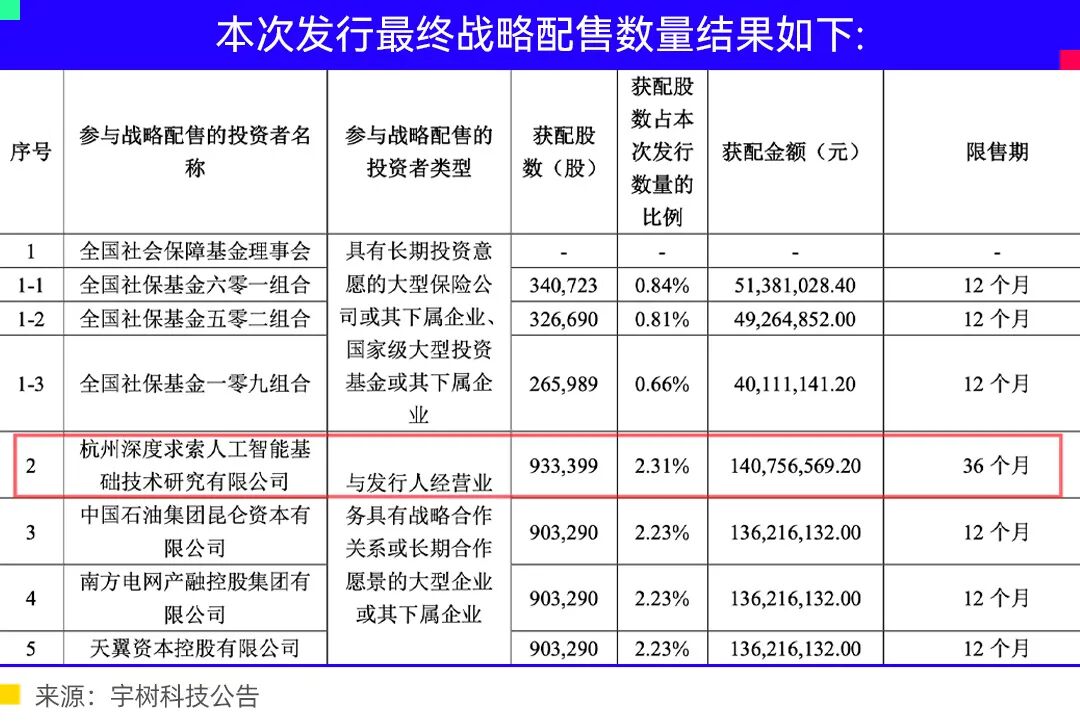
The strategic placement investors behind the deal have also surfaced. Institutions under the National Social Security Fund, China Southern Power Grid, PetroChina, China Unicom, and DeepSeek under Liang Wenfeng obtained almost the same share, being allocated 933,400 shares (141 million yuan).
Different from the 12-month and 24-month lock-up periods of other placement parties, DeepSeek's lock-up period is as long as 36 months (3 years), which is clearly a manifestation of the two parties' pursuit of long-term in-depth cooperation.
During the roadshow on August 7, Wang Xingxing responded that Unitree Robotics and DeepSeek have planned cooperation in three areas: general artificial intelligence R&D, high-performance general robots, and large AI models.
His extreme emphasis on the brain of embodied robots was once reflected in an interview program: "Whoever can develop the large model for robots will become the most powerful AI company and robotics company in the world, which is fully worthy of the Nobel Prize."
In the current robotics industry, although hardware capabilities have been continuously improved, the biggest obstacle limiting its large-scale application, the "AI brain", is still "far from sufficient".
In 1988, Moravec expounded such a view in his work *Mind Children*: tasks that are difficult for humans (such as logical reasoning and playing chess) are easy for AI to complete; while things that are very simple for humans (such as walking and grasping objects) are extremely difficult for AI to achieve.
This problem is known in the industry as "Moravec's paradox". It is easy for robots to play chess and solve problems, but it is extremely difficult for them to perceive the physical world like babies.
Therefore, the core bottleneck of current embodied robots does not lie in hardware. The hardware was ready as early as more than ten years ago and is still developing continuously. The bottleneck that restricts development is the "intelligent system" that endows robots with autonomous decision-making capabilities.
The most difficult part to overcome is the generalization problem, which specifically refers to the model's ability to perform well when facing new problems that did not appear during training. At present, the model generalization capability of the entire embodied intelligence field is still insufficient, and its practicality still has much room for improvement, which is one of the most intractable problems at present.
This time, Unitree Robotics expects to raise a total of 6.099 billion yuan, which is a certain over-subscription compared with the previous 4.202 billion yuan. It plans to invest half of the raised funds in the R&D of intelligent robot models.
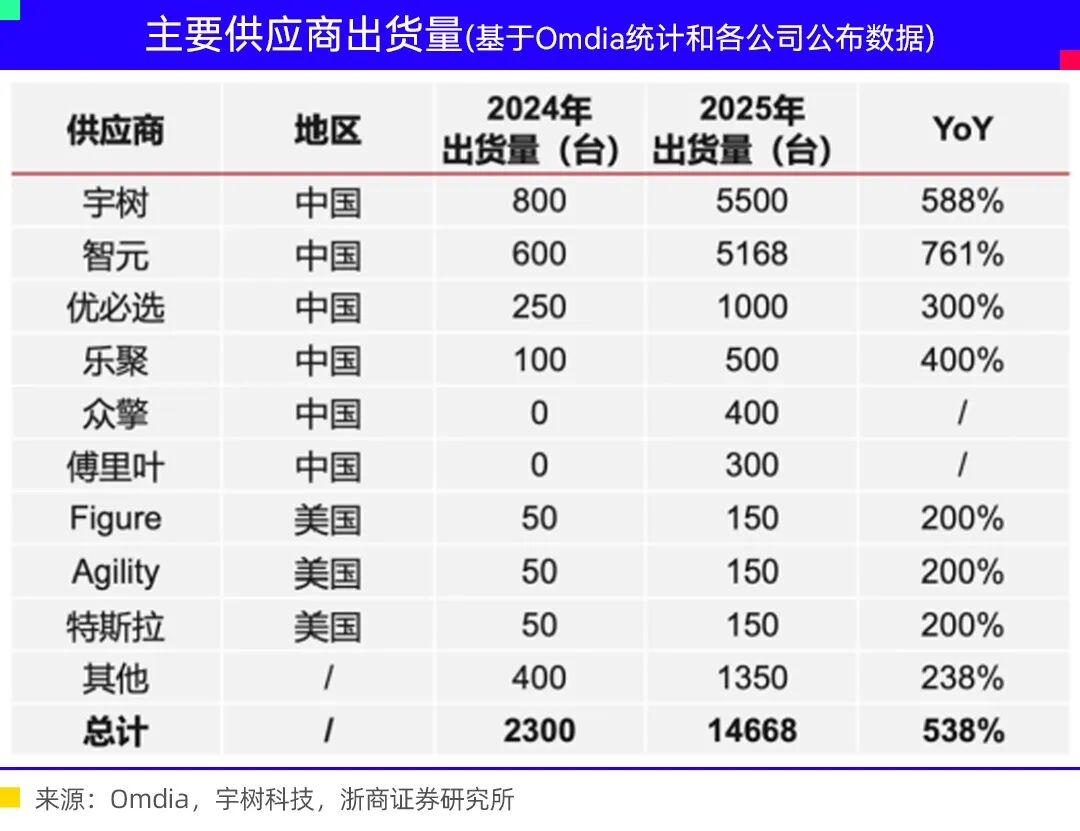
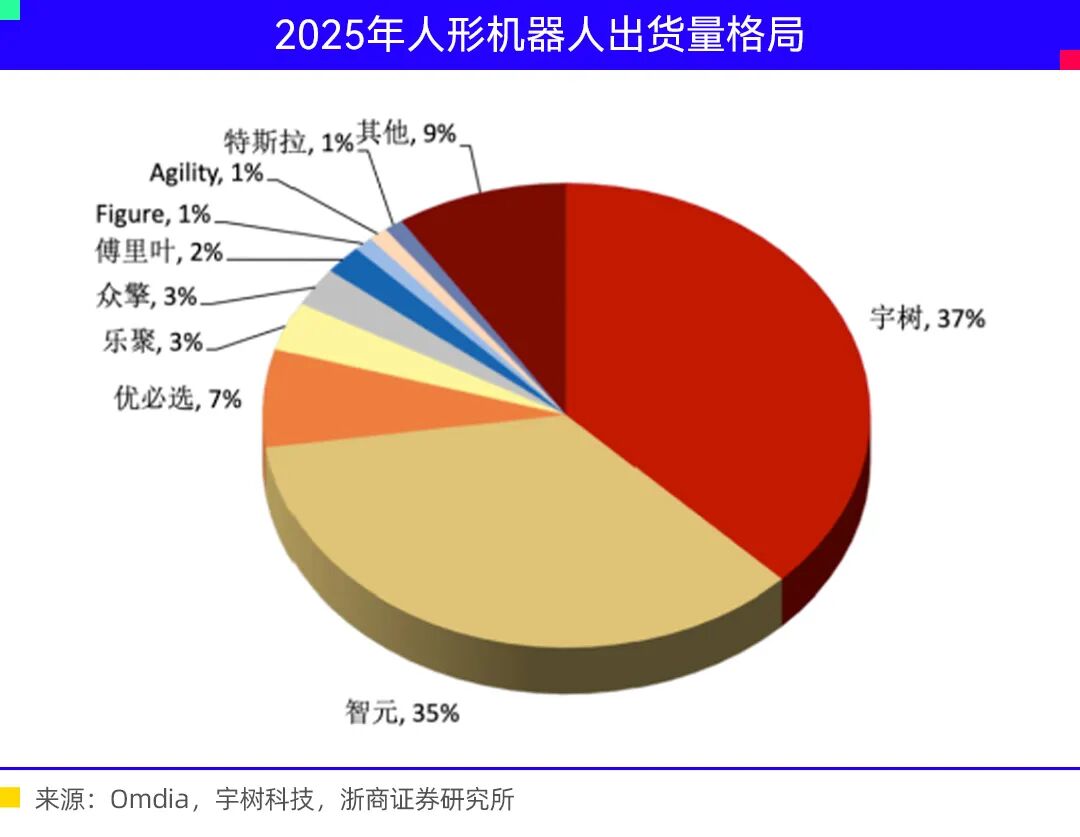
Unitree Robotics is currently the global champion in terms of humanoid robot shipment volume, with shipments exceeding 5,500 units in 2025. However, for a long time, Unitree's R&D at the "brain" level has lagged behind its hardware development.
In the prospectus, Unitree also admitted its strategic deviation of "valuing the body while neglecting the brain": "The company's early R&D focused on the ontology and cerebellum (motion control and limb coordination), with less investment in the brain (embodied large model), and did not carry out large-scale real data collection and factory deployment training."
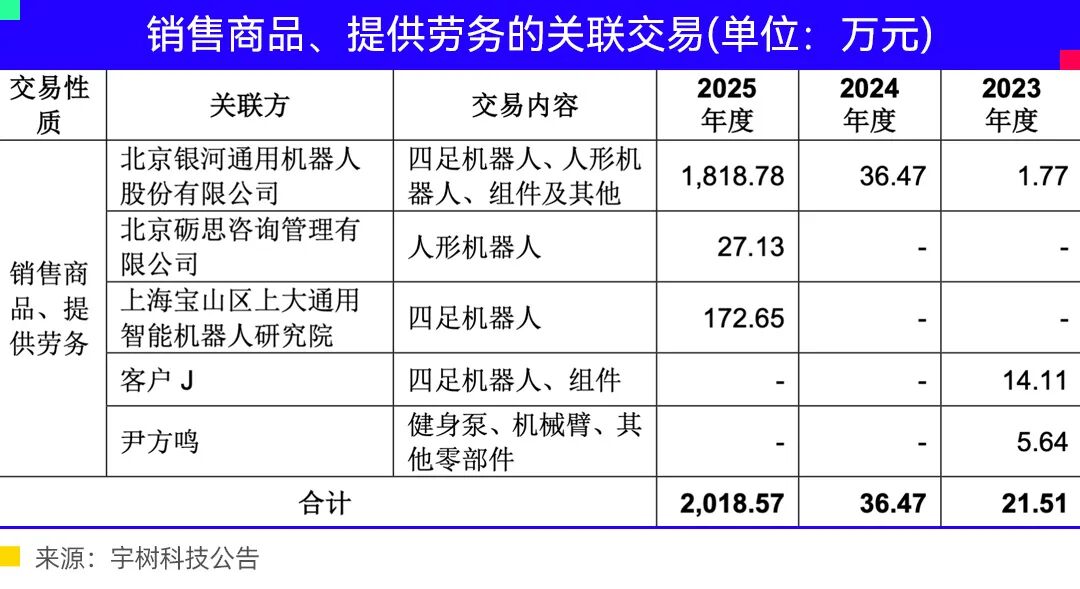
Other robotics companies also purchase Unitree's products to train their own embodied large models. Galaxy Universal has long been a major customer of Unitree, purchasing a large number of Unitree G1 robots to collect real-world data and train its "Galaxy Star Brain" embodied large model.
It can be seen that this listing is a strategic move for Unitree to make up for its shortcomings and focus on the development of the "brain".
02
Closed Loop
Different from traditional robotic arms or robots, embodied intelligence needs to have three capabilities: cognition, collaboration and learning, and the key is to be able to evolve autonomously in work scenarios.
At present, the main technical routes of embodied intelligence include hierarchical large models, end-to-end large models and world models, and the industry has not yet formed a unified and clear route. Although there are differences between various technical routes, the pursuit of higher generalization capabilities has become a consensus.
Wang Xingxing has formulated a two-pronged solution of "self-research + cooperation" for Unitree Robotics.
In terms of self-research, Unitree has laid out both the WMA (World Model-Action) model and the VLA (Vision-Language-Action) model routes.
Earlier this year, the company's self-developed industrial-grade embodied large model UnifoLM-X1-0 has been piloted and tested in its own factory, with the core task of "independently completing the assembly of joint motors".
In May, the company released the WVLA2.0 model, whose innovation lies in integrating the world model with vision-language-action, realizing long-sequence autonomous planning, multi-step physical prediction and anti-interference precise control.
In July, the released embodied large model UnifoLM-OminiA-0.3 focused on various tasks in the home health care scenario, independently completing complex tasks such as handling, sorting and equipment control.
In terms of cooperation, Unitree Robotics has carried out in-depth cooperation with NVIDIA and DeepSeek.
On June 1 this year, at the GTC conference in Taipei, Jensen Huang demonstrated NVIDIA's new breakthroughs in the field of Physical AI.
One of the most notable achievements is the Unitree H2 Plus based on NVIDIA Jetson Thor computing platform and Cosmos 3 model. Unitree provides the robot ontology to undertake motion, machinery and engineering implementation, while NVIDIA provides computing power and the "brain" to form the capabilities of driving the whole body, multi-modal perception and autonomous decision-making.
The cooperation between robotics companies and large model companies has considerable urgency.
The training of large models is gradually approaching the limit of text data. The multi-modal interaction data of the physical world, including vision, touch, force sense, spatial relationship, etc., is the key increment for the breakthrough of Physical AI. Autonomous driving and robots are the best channels for large models to obtain such data.
Unitree Robotics, PI and Agibot have massive amounts of real robot motion data, which cannot be found in libraries or the Internet, and are scarce assets that large model companies cannot generate on their own.
Large models are good at understanding, analyzing and planning, but not at "execution"; robots are good at "execution", but lack the capabilities of "understanding" and "reasoning".
Unitree is the global champion in humanoid robot shipments, accumulating massive amounts of real-scenario data. DeepSeek is a leading Chinese model company that makes overseas AI giants wary. The combination of the two has the opportunity to form a complete intelligent closed loop of "data, model and hardware".
Wang Xingxing is eager to enhance the "brain", while Liang Wenfeng aims at the entry and commercial implementation scenarios of the next AI era. This listing has become an excellent moment for strategic win-win cooperation.
03
Migration
Founded in March 2024, Physical Intelligence (PI) is currently the robotics unicorn with the highest valuation except for Figure AI, and has quietly become one of the most notable AI enterprises in the Bay Area.
Its π-series model is widely regarded by the industry as the "GPT-3 moment" in the robotics field. It can generalize and perform complex tasks across different robot ontologies, marking that embodied intelligence is moving from "specialized narrow domain" to "general-purpose foundation model".
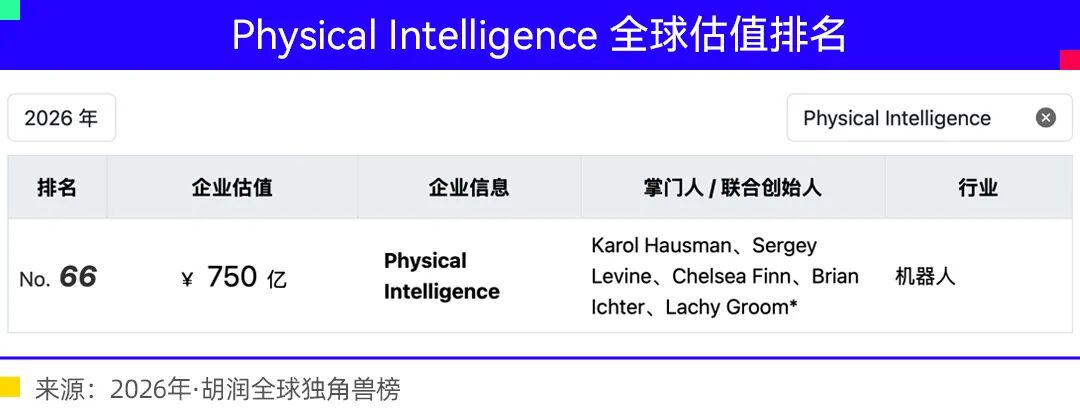
Its newly released π0.7 general-purpose robot foundation model has a total of about 5 billion parameters, which can help robots complete tasks that have never undergone special training. This capability even surprised the company's own researchers, proving that its "combinatorial generalization" capability has achieved a huge breakthrough.
PI has raised more than 1 billion US dollars in total, and was negotiating a new round of 1 billion US dollars financing at a valuation of 11 billion US dollars this spring.
In July, there were reports that Anthropic was in talks to acquire PI, which sparked widespread discussion in the AI community, but Karol Hausman, CEO of PI, denied the relevant reports.
At present, it has become a clear trend that large model companies in the United States are extending their reach into embodied intelligence:
OpenAI invested in Figure AI and 1X Technologies early. However, Figure has terminated its model cooperation with OpenAI and turned to full self-research, and OpenAI itself is also forming a robotics research team. Meta explores the combination of robots and large models through its FAIR department. Google DeepMind has been deeply engaged in embodied intelligence for many years.
Although Anthropic's reputation is growing day by day, it has been "absent" for a long time in the field of embodied intelligence, and PI is one of the top robot "brain" teams that have not been "married" by leading large model companies.
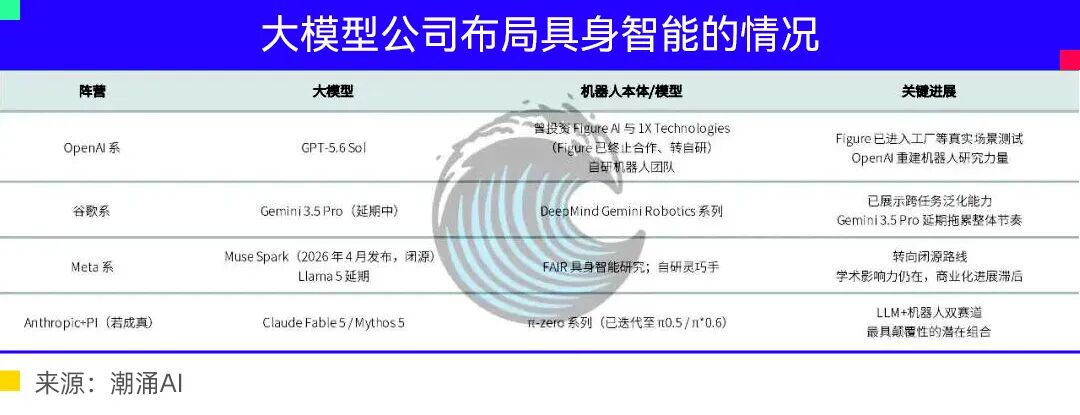
No matter from which perspective, the alliance between Anthropic and PI is a highly imaginative cooperation. Anthropic's model has shown strong dominance in computing power and logic, and Claude is in an absolute leading position in the world in long-text reasoning, complex programming and agent tasks.
PI's π-zero series models have demonstrated generalization capabilities across different robot forms. After the merger of the two companies, the last puzzle piece of "general artificial intelligence" will be filled.
From the perspective of large model companies, what is most lacking at present is the real data of the physical world. The understanding of the physical world is regarded as a necessary condition for building a super-intelligent system, which cannot be made up for only by Internet text data.
Previously, large model companies competed for performance rankings. Entering 2026, no matter Chinese or American companies, whoever can embed the model into the physical world and take the lead in implementation will seize the first-mover dividend of AI commercialization.
If any AI company can truly achieve complete integration, it will evolve from a "text and code model company" or a "robotics company" to a "software and hardware integrated AI platform company", which is a high ground that no one has ever reached.
From the virtual world to the physical world, it is the epitome of technology companies collectively migrating from "digital intelligence" to "physical intelligence".
04
Final Notes
Nowadays, "brain-body collaboration" has become a clear trend in the development of the global AI industry.
As robotics companies such as Unitree and Agibot gradually enter the capital market and their shipments rise sharply, embodied intelligence will also move from a financing-driven startup competition to a deeper stage of industrial implementation. They need the "brain" to break through the bottleneck of insufficient generalization capabilities, and also need to do their utmost to become smarter to complete more and more complex work tasks.
For large model enterprises, they also urgently need the "body" in the physical world to verify and implement their technologies, and improve their business models.
When the "strongest brain" meets the "strongest body", a new era from digital intelligence to physical intelligence is brewing. The enterprise or the partnership that takes the lead will have more opportunities to obtain the biggest dividend of the era.
This article is from the WeChat official account "Tide WAVE", author: Xie Zefeng, editor: Yang Xuran, published with authorization from 36Kr.