GPU has started to be financialized, Jensen Huang joins hands with Wall Street to raise $500 billion in financing, in response to the "circular investment" related remarks.
No wonder people of East Asian ethnicity are known for their pragmatism!
After Jensen Huang's account landed on X, he has posted a total of 5 pieces of content, almost all of which are advertisements.
He posted again today, and it's still an ad! Just now, Jensen Huang subscribed to X Premium and published his first long post, with a straightforward title:
NVIDIA AI Factory Compute Power Is Emerging as an Investable Asset Class.
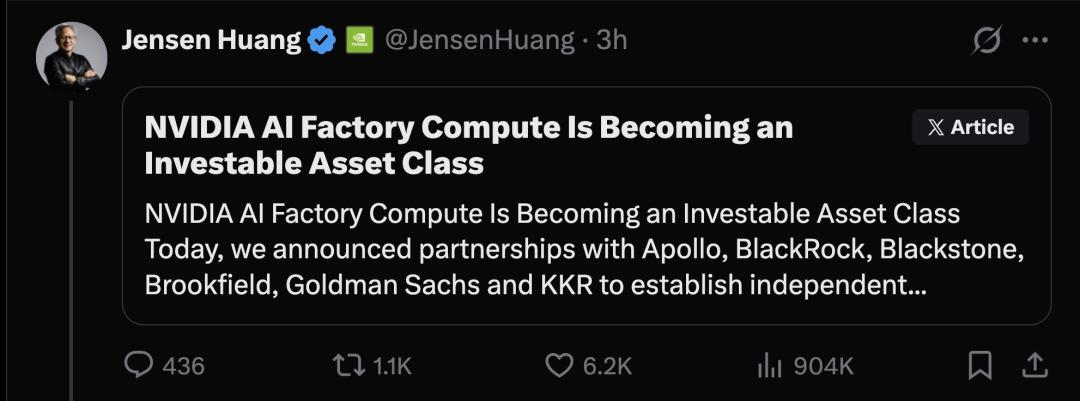
Simply put, Jensen Huang is no longer satisfied with only selling GPUs this time. He is ready to directly package computing power into a type of infrastructure asset that Wall Street can invest in.
Let's go through this article quickly, which mainly talks about three key points:
1. Jensen Huang announced that NVIDIA will cooperate with Apollo Global Management, Blackstone, BlackRock, Brookfield, Goldman Sachs and KKR to build a number of independent financing platforms, planning to mobilize more than $500 billion in third-party capital for the construction of AI infrastructure.
It is worth noting that the figure of $500 billion is exactly the same as the announced investment scale of the Stargate project previously promoted by OpenAI, SoftBank and Oracle.
With this third-party capital, GPUs are truly treated as wealth management products~
2. Jensen Huang launched the new concept of AI Factory, a complete computing platform composed of GPUs, networks, system software, AI frameworks and CUDA, which inputs energy and data and outputs intelligence.
The key point here is that in the past, purchased GPUs were just depreciating servers, but now they can generate revenue, be resold, and their value can be extended through software upgrades. They can already be regarded as infrastructure assets, similar to power plants in the AI era.
3. Jensen Huang responded to the question of circular investment that the model pulls itself up by its bootstraps. Although the establishment of the financing platform is easily interpreted by the outside world as AI companies lacking money to buy GPUs, Wall Street lends money to them to purchase NVIDIA's GPUs, and then AI companies use these GPUs to generate revenue to pay off the debts.
But Jensen Huang believes that these funds come from independent long-term institutional capital. Each project will be independently reviewed by institutions such as BlackRock, Blackstone, and KKR on the client side, demand, utilization rate, cash flow and residual value of equipment. NVIDIA is only responsible for taking the lead and providing the platform.
To put it another way, you provide the funds yourself, you review the projects yourself, and I am responsible for selling GPUs; if the GPUs really lose their value in the end, I can help cover part of the loss.
Finally, in the comment section, Jensen Huang is very well-aware of the situation, and directly posted a group photo of himself with a group of Wall Street giants including Larry Fink, Jon Gray, Bruce Flatt, David Solomon, Jim Zelter and Waldemar Szlezak.
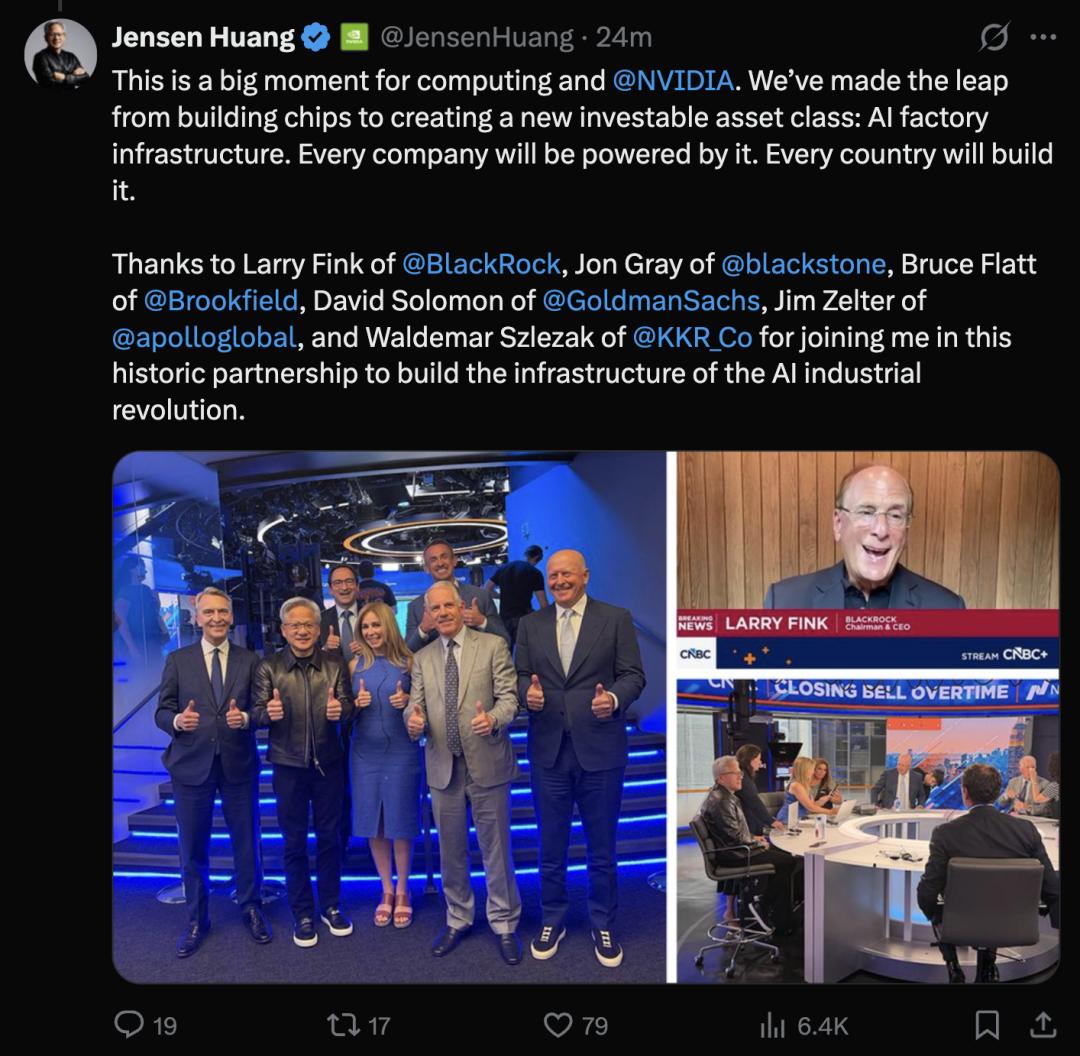
He also attached the caption:
"We have completed the leap from manufacturing chips to creating a brand new investable asset class, AI factory infrastructure. In the future, every company will be powered by it, and every country will build it."
So here comes the question:
Is Jensen Huang going to bring you huge returns, or is he forcing a nonsensical gimmick to make you take over the semiconductor assets that no one wants?
The following is the original post from Jensen Huang:
NVIDIA AI Factory Compute Power Is Emerging as an Investable Asset Class
Today, we announced partnerships with Apollo, BlackRock, Blackstone, Brookfield, Goldman Sachs and KKR to establish independent financing platforms designed to mobilize more than $500 billion in third-party capital over time to support AI infrastructure construction.
This is a major milestone for NVIDIA and the entire AI industry.
We are moving from an era where companies purchased chips and built data centers on a per-project basis, to an era where AI factories can be financed like productive infrastructure — with repeatable platforms, long-term institutional capital, and a diversified base of customers that use compute to generate revenue.
AI has reached an inflection point. It is moving from research to production.
AI is creating real value, and the infrastructure that powers AI is becoming one of the most productive asset classes in the world.
In the AI era, compute is revenue.
A New Infrastructure Asset Class
NVIDIA compute is far more than a chip.
It is a complete AI factory platform, including accelerated computing, networking, system software, AI frameworks, and a global ecosystem of developers.
The NVIDIA DSX AI Factory can run the widest range of AI models, modalities and algorithms in the world — spanning language, vision, speech, biology, physics AI, and robotics.
A single NVIDIA AI factory can serve multiple customers and run many different workloads.
This gives it flexibility and fungibility.
At the same time, it is built on an architecture that is already widely adopted across the globe. This architecture is used by all major cloud providers, as well as system vendors and enterprises worldwide.
When demand shifts, the factory can be transferred to another customer, another cloud provider, or another operator.
This broad ecosystem creates a deep market of potential users and off-takers for NVIDIA compute, which helps preserve its residual value.
CUDA makes the factory better over time.
Each generation of NVIDIA software improves the performance, efficiency, and total cost of ownership of already deployed infrastructure.
The hardware does not stand still after deployment: software innovation allows an AI factory to produce more intelligence at lower cost over its entire lifetime, extending its effective economic value.
The NVIDIA A100 is a compelling example.
NVIDIA launched the A100 based on the Ampere architecture in 2020. Six years later, it is still widely used in commercial scenarios such as AI training, fine-tuning, inference and high-performance computing.
Customers continue to lock in A100 compute for multi-year deployments, extending the economic life of the A100 toward 10 years.
The market is proving the durability of NVIDIA compute economics.
The one-year lease price for H100 rose from roughly $1.70 per GPU-hour in October 2025 to approximately $2.35 per GPU-hour in March 2026.
The median on-demand lease price across vendors also increased from roughly $2.00 per GPU-hour in October 2025 to $2.70 per GPU-hour in June 2026.
Blackwell compute commands an even higher premium, with B200 cloud pricing reported at roughly $5.30 to $7.05 per GPU-hour.
This is what makes the NVIDIA AI factory different.
Its value is not fixed the moment it is deployed: CUDA continuously improves its output; deployed equipment remains productive long after the initial depreciation cycle; and the same standard architecture serves a deep, growing global market of AI workloads.
These are the characteristics that define an investable infrastructure asset:
It generates revenue, serves a broad market, improves over time, and can be redeployed.
Bringing Capital to AI Factories
The market demand for AI infrastructure is enormous.
But access to capital is not evenly distributed.
Many great AI companies, enterprises, and AI cloud providers have compute needs, but currently cannot access financing at sufficient scale or low enough cost to build infrastructure rapidly.
This is why we are partnering with the world's leading long-term capital providers.
Apollo, BlackRock, Blackstone, Brookfield, Goldman Sachs, and KKR are also the world's leading infrastructure investors, with deep expertise in evaluating and underwriting long-term, productive assets.
Together, we are building repeatable financing platforms to help the AI ecosystem build the factories it needs.
These platforms are designed to help qualified AI labs, enterprises, and AI cloud providers access AI factory infrastructure at scale.
The $500 billion+ figure refers to the total third-party capital these platforms are projected to mobilize over time — it is not NVIDIA's revenue, not a single fund, and not a funding commitment to any single customer.
Financial institutions will independently evaluate each opportunity — including the customer, demand, utilization, cash flow, and residual value.
NVIDIA provides the AI factory platform.
Financial institutions provide long-term capital and financing expertise.
Key Questions
Is this circular financing?
The program is designed to address this exact concern.
We are bringing independent, long-term institutional capital into the AI infrastructure market.
The demand is real: it comes from cutting-edge AI labs, AI-native startups, enterprises, cloud providers, and countries building AI services.
Capital providers will independently evaluate and underwrite each project — including the customer, demand, utilization, cash flow, and residual value.
NVIDIA provides the platform; investors make independent financing decisions. This is the beginning of an open AI infrastructure capital market.
Why is NVIDIA supporting financing?
In selected cases, NVIDIA may provide a residual value support mechanism, capped at up to 25% of a given project opportunity. This mechanism will be prudently assessed on a project-by-project basis.
This support is limited, residual-value based, and designed to complement — not replace — independent underwriting judgment.
This percentage is significantly lower than other compute financing arrangements.
NVIDIA is able to provide this support because of the unique nature of NVIDIA compute: it is fungible, widely adopted globally, upgradable via software, and redeployable across a large ecosystem of customers.
Our role is to help unlock a very large pool of independent capital while maintaining disciplined exposure.
Can the market absorb all this compute?
The question is not whether we are building data centers.
The real question is whether we are building productive AI factories.
An AI factory converts energy and data into valuable intelligence. Its customer base is broad: cutting-edge AI labs, AI cloud providers, enterprises, and nations. They are building AI because AI has become useful — it is doing valuable work in every industry.
The model itself has discipline. Each financing partner will independently evaluate demand, utilization, cash flow, and residual value. New compute capacity will be built around real customer economics.
Where is the return on investment?
The return lies in the usefulness of AI.
Enterprises are using AI to write software, discover drugs, design products, serve customers, automate operations, and build new services. AI factories make all of this possible.
More compute creates better AI; better AI creates more usage; more usage creates more revenue; and more revenue drives more compute investment. This is the virtuous cycle of the AI industrial revolution.
Infrastructure of the Intelligent Age
Every industrial revolution is built on infrastructure: power, transportation, communications, and computing. And every large-scale infrastructure buildout relies on external financing.
AI factories are the infrastructure of the intelligent age. Through these partnerships, NVIDIA and the world's leading financial institutions are creating a new way to finance the infrastructure that powers this industrial revolution.
We will make AI factories more accessible so that the companies, industries, and nations that are building the future can use them.
The AI era is here. Together, we will build the infrastructure that powers it.
3 More Things
To be fair, Jensen Huang's statement that "GPUs not only retain their value, but also continuously generate cash flow" more or less coincides with a judgment Dwarkesh Patel talked about a few days ago:
Compute power may not become cheaper over time, but instead maintain a long-term premium.
Dwarkesh's logic is actually very simple: suppose the revenue of AI labs can maintain rapid growth in the future, but in the real world, the supply of computing power can only grow several times a year. What will happen?
For example, if the revenue of a top AI company grows 10 times a year, but the computing power only grows 3 times a year.
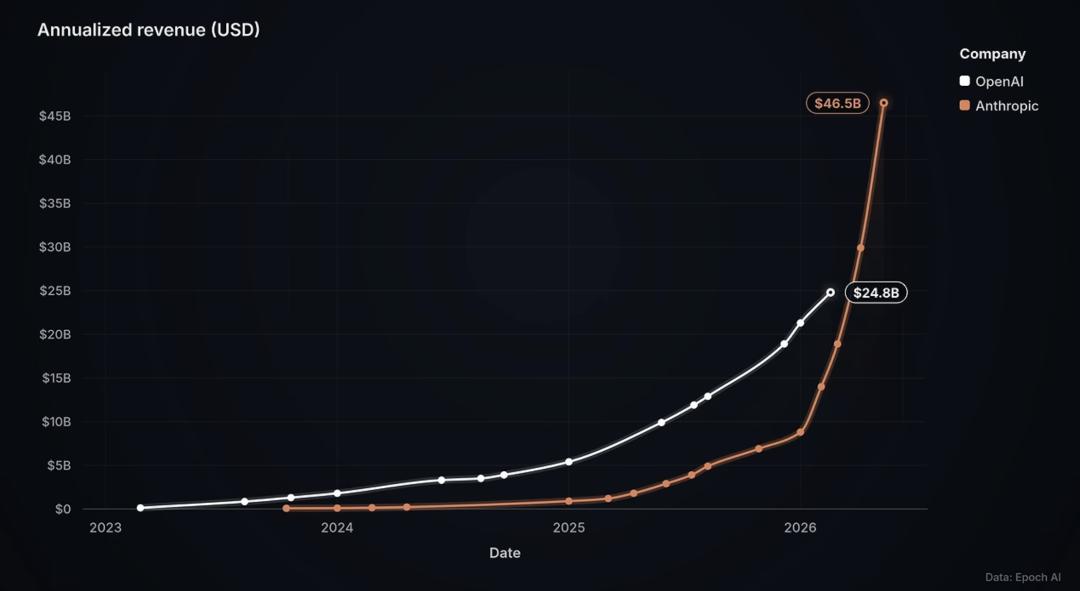
The answer is: the speed at which AI creates value begins to outpace the speed of computing power expansion.
And these values will eventually flow to only two places — either become super high profits for model companies (such as OpenAI's 90% profit margin in the past), or continue to push up the price of computing power.
Dwarkesh leans more towards the latter, and the price of computing power has already started to rise, just as Jensen Huang said.
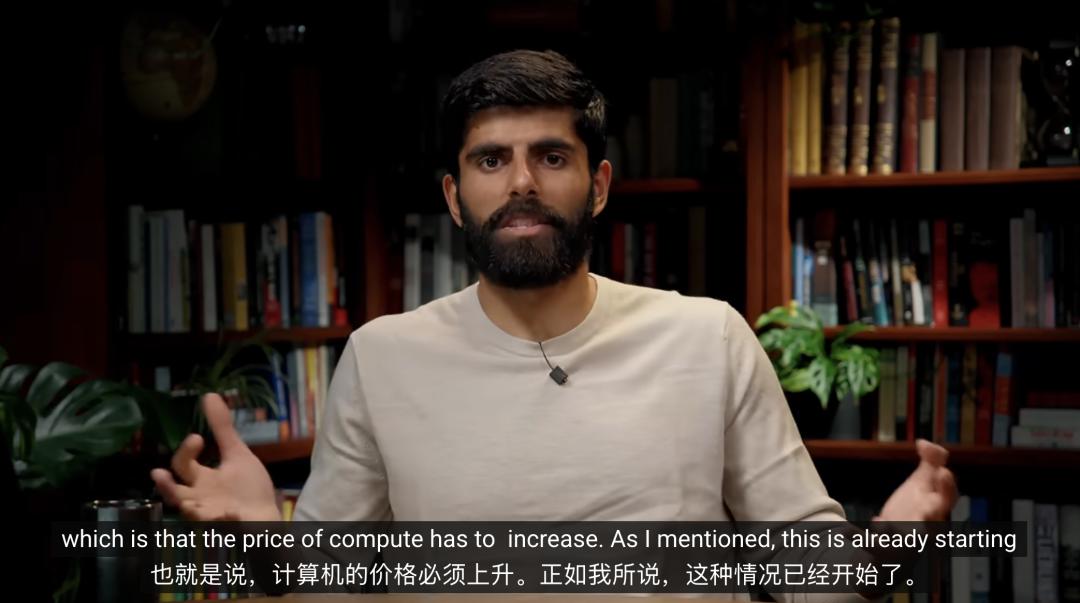
In the future, if models can really match the productivity of a top researcher, the cost of GPUs will be further aligned with human salaries, which will add another layer of premium.
Of course, this is the view of the bulls. On the other side, in the eyes of short sellers, it is a completely different story:
For example, some people have targeted this financing structure. Simply put, if a dedicated company is established for a specific AI infrastructure project, it borrows money, buys GPUs, builds data centers, and then repays the debt with future revenue from computing power.
This means that the GPU story is no longer just a tech stock story, it has entered the credit market, and NVIDIA's CDS (Credit Default Swap) has recently hit an all-time high.
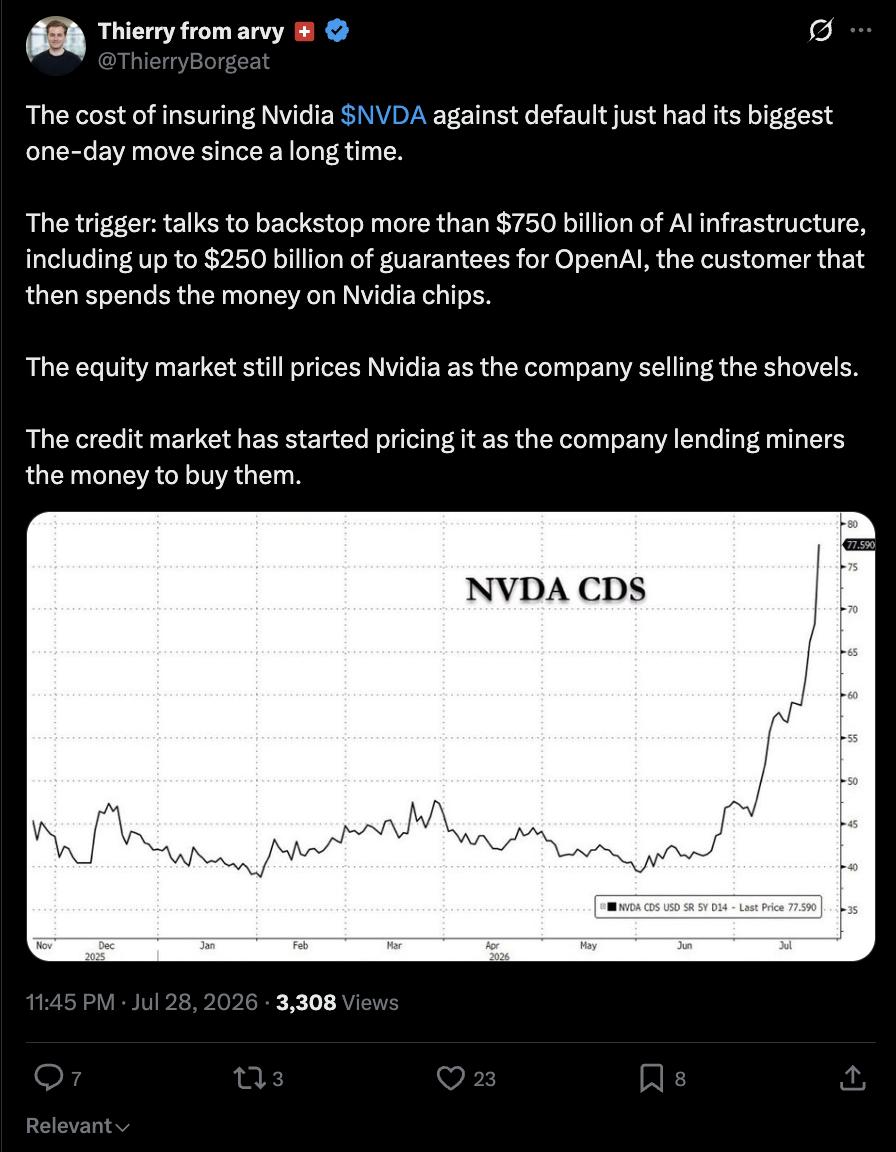
It can be said that the more AI infrastructure relies on debt financing, the more risks will be transmitted to the financial market through these debts once demand falls short of expectations.
If we turn the clock back more than 20 years, this scene is not completely unfamiliar. During the dot-com bubble, telecommunications equipment vendors such as Lucent and Nortel widely used so-called vendor financing:
Customers don't have money to buy equipment? No problem, I lend you money, and you use that money to buy my equipment.
Equipment vendors get orders, customers get networks, and Wall Street continues to provide financing. As long as demand keeps growing, this flywheel can keep spinning.
But as everyone knows, once real demand fails to keep up, customers can't pay back the money, equipment can't be sold, and the demand propped up by financing before will disappear along with it.
Lucent even had to