36Kr Exclusive | Deploys the combined "visual-tactile + piezoresistive" solution, a robot tactile sensing enterprise has completed financing of tens of millions of yuan.
Author | QIAO Yujie
Editor | YUAN Silai
Hard Krypton learned that Shenzhen Mofi Technology Co., Ltd. (hereinafter referred to as "Mofi Technology") has recently completed a tens of millions of yuan Pre-A round of financing invested by Falcon Investment and Yihua Capital, with Pointstone Capital serving as the financial advisor. The funds raised in this round will be used for the expansion of the R&D team and production lines, as well as global business development.
As embodied intelligence enters the stage of industrial implementation, tactile sensors have gradually become a key link to improve the perception capability of robots. Founded at the end of 2024, Mofi Technology is a company committed to building tactile infrastructure, with full-link R&D capabilities for tactile sensing modules, tactile data collection and tactile models, focusing on two major tracks: humanoid robots/dexterous hands and industrial intelligent manufacturing.
Previously, Mofi Technology started from tactile materials, independently developed high-sensitivity sensitive materials and micro-structure processes, and realized dual-mode perception of pressure and temperature through material formula optimization and multi-scale micro-structure design. At the same time, the company combines high-pressure resistant elastomers with micro-nano structure design to improve the range, accuracy and sensitivity of sensors, and explores low-cost and large-scale manufacturing paths through "micro-nano 3D printing technology".
Based on the R&D of materials and devices, Mofi Technology further integrates the sensing capability into data sensor modules and acquisition systems, and launches a series of products for scenarios such as robots and industrial manufacturing. In addition, the company plans to deploy a "tactile brain" model to form a data flywheel of "visuo-tactile sensor - data collection - tactile model".
In the robotics field, the company is simultaneously deploying piezoresistive tactile modules and 6-DOF force visuo-tactile modules. Among them, the MoFi piezoresistive tactile module integrates flexible micro-nano sensing technology and 3D force sensing algorithm to realize real-time perception of grasping force, contact posture and surface state. The MoVi visuo-tactile 6-DOF force module is based on the principle of optical imaging, which can obtain 3D morphology, sliding trend, force and torque information in a single contact process, providing high-resolution tactile feedback for applications such as precision assembly and dynamic grasping.
In practical applications, the tactile scheme requirements of robot hand structures in different areas are not the same: the fingertip area needs to complete fine operations such as grasping, slip detection and deformation recognition, and the visuo-tactile scheme can provide higher resolution perception capability; while areas such as the finger pulp and palm are limited by space and structural design, which are more suitable for adopting thin and flexible piezoresistive electronic skin. Through the coordination of the two types of technologies, the robot can obtain both fine perception capability and large-area tactile coverage capability. At present, the company's "visuo-tactile + piezoresistive" coordinated solution has realized small-batch order delivery.
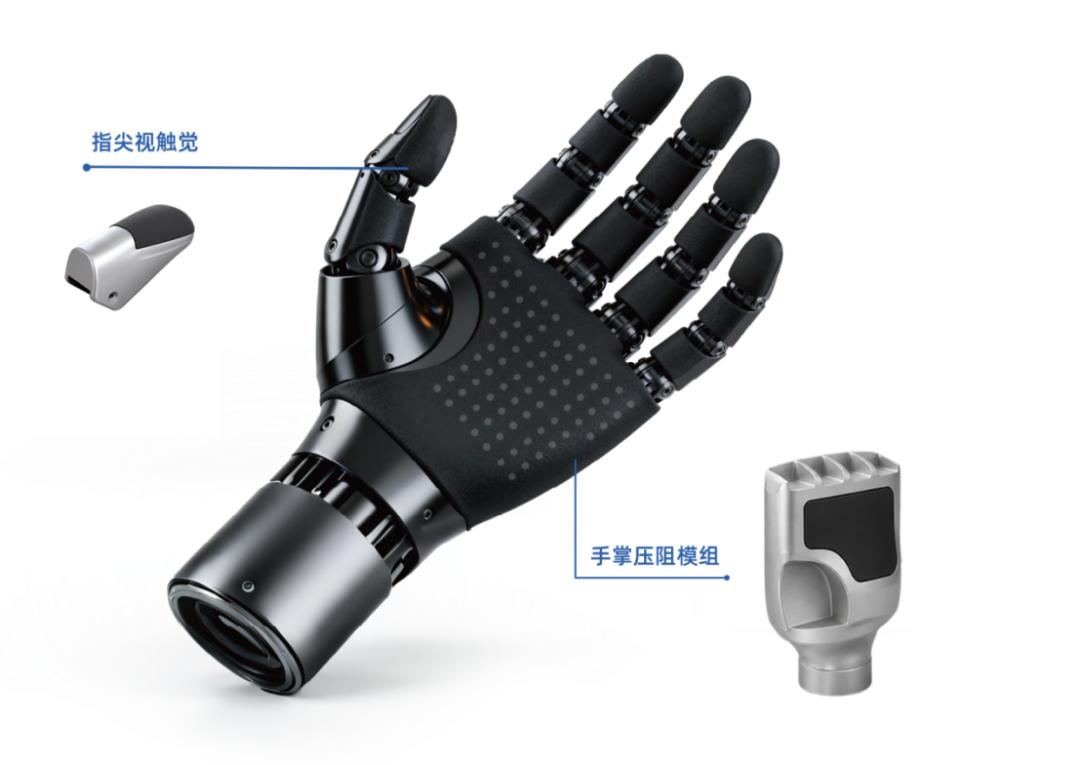
"Visuo-tactile + piezoresistive" coordinated solution (Source from the enterprise)
According to ZHOU Jianlin, co-founder of the company, there are not many enterprises in the industry that can simultaneously deploy piezoresistive tactile and visuo-tactile solutions and integrate them into dexterous hands. With the increasing demand for fine operation of robots, combined solutions integrating different tactile technology routes are becoming the exploration direction of the industry.
In addition to sensor modules, the company has also deployed tactile data collection products and launched a wearable tactile data collection glove. This product adopts a fabric base integrated with tactile and attitude sensors, which can support natural grasping action collection. Compared with the traditional data collection method of "clamp + camera", it can obtain richer human-computer interaction data.
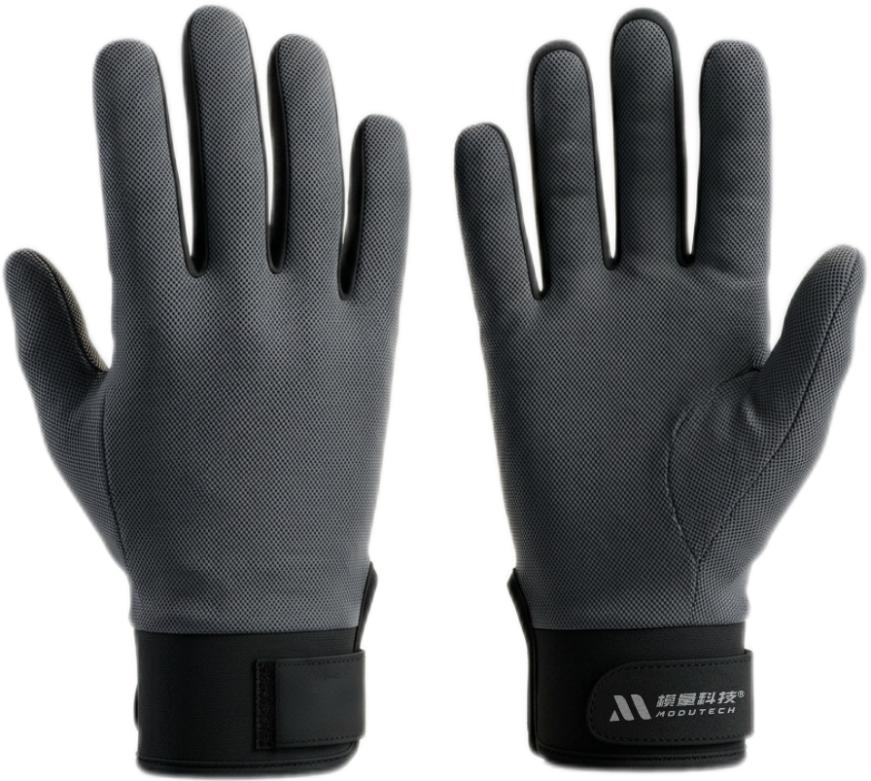
Tactile data collection glove (Source from the enterprise)
In terms of algorithms, Mofi Technology has developed a neural network-based calibration algorithm to solve the problem of accuracy consistency after sensor modularization. Traditional sensor calibration methods are prone to errors under multi-point and multi-range conditions, while the company can improve the full-range calibration accuracy through the MLP neural network algorithm. At the same time, in the visuo-tactile direction, the company uses neural networks for AI reasoning fitting, whose accuracy is significantly better than traditional image algorithms.
In addition to the robotics field, the company is also promoting applications in industrial manufacturing scenarios. The industrial product MoTe pressure distribution test module can be used in new energy battery testing, industrial automation, 3C manufacturing, auto parts and other fields. Through multi-dimensional pressure data collection and analysis, it realizes the visualization of pressure distribution status, serving scenarios such as battery bulge testing and automatic production line testing.
It is introduced that the company has cumulatively served more than ten leading robotics and dexterous hand enterprises, formed in-depth cooperation with core industry players, provided complete tactile perception solutions for two leading customers, and the million-level large-scale orders are about to be delivered. On the industrial side, the company has completed commercial delivery with more than three industry leaders, and entered scenarios such as new energy battery testing, industrial automation, 3C manufacturing and auto parts.
In terms of the team, GUAN Hua, founder of Mofi Technology, once worked for a NYSE-listed smart wearable company, and has long participated in strategic cooperation and investment in the fields of supply chain, chips, sensors and smart hardware, with rich experience in hardware products and industrial chain resource integration. ZHOU Jianlin, co-founder, has a master's degree in engineering, once served as vice president of a 3D printing enterprise, responsible for product introduction, business expansion and marketing. GAO Libo, co-founder, graduated from City University of Hong Kong with a doctorate, is currently a professor at Xiamen University, a national young talent and doctoral supervisor, with more than ten years of experience in flexible sensor research and application.
The following is an excerpt of the exchange between Hard Krypton and ZHOU Jianlin, co-founder of Mofi Technology:
Hard Krypton: Last year, the application of robot tactile was still relatively rare. What kind of growth expectation will the industry have this year?
ZHOU Jianlin: One reason for the few tactile applications last year is that the tactile technology itself is not yet mature, and the other is that the robot hand solution has not been fully finalized. Last year, many enterprises were still exploring different routes such as connecting rod, direct drive and rope drive, and the hand shape was not determined, so most tactile sensors were only applied to the fingertips, and the overall penetration rate was not high.
The biggest change this year is that the robot hand solutions are gradually clear, and many manufacturers have released dexterous hand solutions of direct drive or hybrid drive this year. With hand products accelerating to enter the mass production stage, tactile sensors will also increase in volume. Taking leading dexterous hand manufacturers as an example, they may produce about 10,000 hands a year. If the tactile penetration rate reaches 50%-60%, 5000 hands will need to be equipped with tactile modules. A hand usually requires at least 6 modules, and a complex solution may require more than 10. The demand for tactile sensors will have very obvious growth space in the future.
Hard Krypton: At present, more and more enterprises are entering the tactile sensor field. What is the differentiated advantage of Mofi Technology?
ZHOU Jianlin: Our advantage first comes from technical accumulation. We did not enter this field from scratch, and we have many years of accumulation in materials, sensors and solution R&D, so when facing customer needs, we can enter the R&D and verification stage faster and provide feasible solutions.
The second is the engineering capability. The real implementation of tactile sensors is not just to make a sensor, but to complete the full delivery of materials, structures, algorithms, modules and supply chains. After customers give us a design requirement, we can complete the transformation from the solution to the product.
The third is supply chain capability. Tactile sensors involve multiple key links, including sensor materials, polymer elastic materials, chips, circuit boards, connecting wires, structural parts, etc. At present, the industry supply chain is not as mature as the mobile phone and smart hardware industries, and many links require enterprises to participate in construction and running-in by themselves. For example, in the field of polymer elastic materials, there is no fully mature standardized solution at present, which relies on our own R&D capability to optimize. In terms of chips, the industry is still in the stage of using general-purpose chips to meet demands, and special chips for tactile scenarios may appear in the future. Links such as circuit boards and connecting wires also require long-term running-in with suppliers to ensure service life and stability.
We have been cooperating with upstream and downstream supply chain partners for more than a year, and have built our own R&D and pilot production lines to support product verification and small-batch delivery. The robotics industry is rapidly entering the mass production stage, and supply chain enterprises not only need technical capabilities, but also need to have rapid delivery capabilities. Compared with new entrants, we have completed certain accumulation in R&D, supply chain and engineering in advance, and have stronger competitiveness in R&D solution design and delivery.
Investor Views
Falcon Investment said: "We are optimistic about the potential of the tactile sensor & electronic skin track and the industrialization implementation capability of the Mofi team. The founding team of the company is a combination of "senior practitioners from leading enterprises + professor of flexible tactile sensing". The team has had several successful industrial implementation experiences in the fields of smart hardware and 3C manufacturing in the past. There are many technical routes in the tactile sensing industry, and the company has accumulated several technical solutions to provide solutions according to the demands of downstream customers in specific scenarios. The company's products have achieved representative customer introduction and application in application scenarios such as embodied intelligence, industrial testing and consumer electronics."
Yihua Capital believes: As an essential option for robots to perceive the world, tactile sensors are in a development window period where three growth opportunities overlap: the volume increase of end effectors such as dexterous hands, the improvement of tactile penetration rate and the expansion of coverage. At the same time, tactile sensors have broad application scenarios in fields such as automobiles, intelligent manufacturing and consumer electronics. The Mofi Technology team has an interdisciplinary professional background, covering full-stack capabilities from underlying materials to sensor design to back-end software algorithms, and has rich experience in product engineering mass production. It has completed the introduction of leading customers and the delivery of large-scale commercial orders in a short period of time, which fully reflects the full recognition of downstream customers for the team's capabilities, product performance and consistency.