Reclaim the title of the fourth-largest city by GDP! Guangzhou, your opportunity has arrived.
There is no doubt that Guangzhou and Chongqing are the most tightly matched pair in the urban competition arena over the past decade.
In 2017, Chongqing overtook Guangzhou for the first time since the new century, but this leading edge only lasted for two years.
In 2019, Guangzhou overtook Chongqing. In 2018, Chongqing still led Guangzhou by 44.304 billion yuan, while in 2019, Guangzhou led Chongqing by 59.214 billion yuan, which means that Guangzhou's GDP increment in 2019 was more than 110 billion yuan higher than that of Chongqing.
After maintaining the lead for five years, Chongqing overtook Guangzhou again in 2024, and expanded the gap between the two to more than 100 billion yuan. In 2025, Chongqing expanded its leading edge to 171.847 billion yuan.
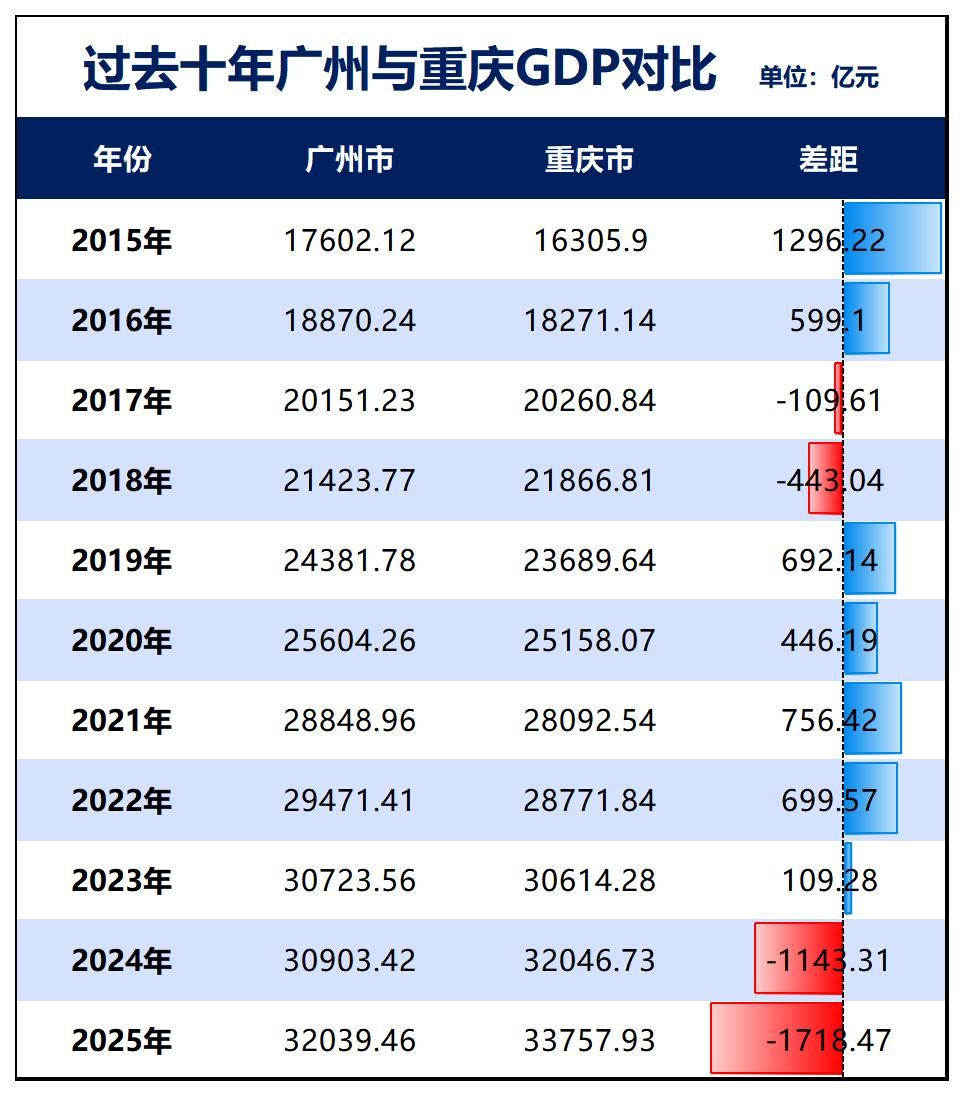
Illustration: Urban Finance; Data: Chongqing Municipal Bureau of Statistics, Guangzhou Municipal Bureau of Statistics
The fundamental reason why Chongqing overtook Guangzhou and widened the gap in the past two years is that the two have shown a K-shaped divergence, with Chongqing growing faster and Guangzhou growing slower.
In 2024, Chongqing's GDP growth rate reached 5.7%, while Guangzhou's was only 2.1%, ranking last among the top 10 cities by GDP. In 2025, Chongqing's GDP growth rate was 5.3%, while Guangzhou's was only 4%, still ranking last among the top 10 cities by GDP, which gave Chongqing the opportunity to overtake.
Of course, the root of the gap in growth rate between the two lies in the obvious divergence of their automotive industries.
Both cities are strong in the automotive industry. In particular, Guangzhou's automotive industry accounts for a quarter of its total industrial output.
In 2024, the added value of industries above designated size in Guangzhou decreased by 3%, of which the added value of the automobile manufacturing industry decreased by 18.2%. In 2025, the growth rate of the added value of industries above designated size in Guangzhou turned positive, increasing by 1.2%, of which the automobile manufacturing industry still decreased by 1.6%.
Chongqing's automotive industry entered the adjustment period earlier than Guangzhou.
From 2014 to 2016, Chongqing ranked first in national automobile output for three consecutive years, reaching a historical peak of 3.16 million units in 2016, and won the title of "China's No.1 Automobile City".
However, impacted by the downward market and the new energy wave after 2017, its output dropped to 1.38 million units in 2019, falling into the transformation pain period, and the title of China's No.1 Automobile City was taken away by Guangzhou.
Facing the difficulties, Chongqing listed the intelligent connected new energy vehicles as the top priority of the "33618" modern manufacturing cluster system, and issued special development plans.
Changan Automobile launched the "Third Entrepreneurship" strategy, launched two new energy brands Deepal and Avita, greatly improving the product value. Seres carried out in-depth cooperation with Huawei, and launched the AITO series of new energy vehicles which became a dark horse in the market, greatly boosting Chongqing's industrial momentum.
In 2024, Chongqing's automobile output reached 2.5401 million units, of which 953,200 units were new energy vehicles, a year-on-year increase of 90.5%, almost doubling. The output of fuel vehicles was 1.5869 million units, 230,700 units less than the 1.8176 million units in 2023.
In 2025, Chongqing's automotive industry further grew, and its automobile output finally returned to the first place in the country after many years, but there is still a certain gap compared with its own peak period.
Guangzhou's Opportunity Has Come
As the saying goes, fortune rotates, and now it is Guangzhou's turn to grow faster while Chongqing slows down. This is the best time for Guangzhou to overtake Chongqing again.
Entering 2026, the development momentum of Guangzhou and Chongqing has reversed.
In the first quarter, Guangzhou achieved an actual growth rate of 6%, 1 percentage point higher than the national average growth rate, leading among the top 10 cities by GDP. Chongqing's growth rate was only 4.5%, ranking last among the top 10 cities, 0.5 percentage points lower than the national average growth rate.
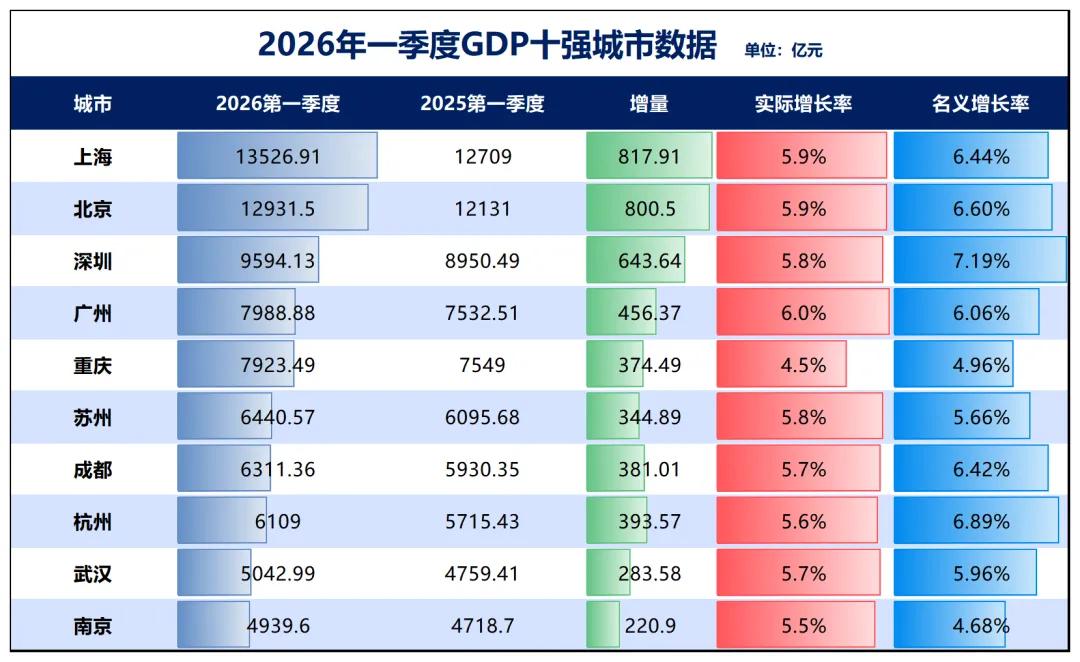
Illustration: Urban Finance; Data: Statistical bureaus of various cities
In the first half of the year, Guangzhou's GDP growth rate reached 5.8%, 1.1 percentage points higher than the national average growth rate, ranking tied for first with Shenzhen among the top 10 cities by GDP.
Chongqing's growth rate was only 4.2%, still 0.5 percentage points lower than the national average growth rate, and ranked last among the top 10 cities by GDP. It is the only one among the four municipalities directly under the Central Government whose growth rate is lower than the national average.
Interestingly, the main factor leading to the momentum shift between the two cities is still the automotive industry.
For Chongqing: Compared with the rapid growth in the past two years, Chongqing's automotive industry has slowed down significantly this year. A set of data can prove that: in 2024, the added value of Chongqing's automotive industry increased by 26.7% year on year. In 2025, the added value of Chongqing's automotive industry increased by 12.6% year on year. In the first half of this year, the year-on-year growth rate of the added value of the automotive industry dropped to 3.4%.
In addition, Chongqing's automobile output in the first half of the year was 1.1089 million units, down 9% year on year. The output of other major industrial products such as notebook computers and mobile phones declined even more sharply.
The performance of Chongqing's two major automobile brands, Changan and Seres, was not satisfactory in the first half of the year.
For Changan Automobile, its total automobile sales in the first half of the year reached 1.1189 million units, 1.3553 million units in the same period of last year, with nearly 240,000 units less sold. The sales of its self-owned brand vehicles and new energy vehicles under Changan Automobile both decreased significantly year on year.
According to the full-caliber cumulative sales data disclosed in Changan Automobile's production and sales express, the corresponding total revenue in the first half of 2026 is about 113.949 billion yuan, about 14.551 billion yuan less than the same period of last year. It is estimated that the net profit in the first half of the year will drop to 740 million to 970 million yuan, a year-on-year decrease of 57.66% to 67.70%.
For Seres, in the first half of 2026, the net loss after deducting non-recurring gains and losses was 2.2 billion to 2.5 billion yuan. In the first half of 2025, Seres' net profit after deducting non-recurring gains and losses was 2.47 billion yuan. On the evening of July 12, Seres released its performance forecast, disclosing the above changes.
For Guangzhou: The automotive industry has recovered.
In the first quarter of this year, the added value of industries above designated size in the whole city increased by 6.5% year on year, and the growth rate was 5.3 percentage points higher than that of the whole year of last year. Among the three pillar industries, the automobile manufacturing industry accelerated its growth by 5.5%.
Therefore, Guangzhou's GDP growth rate reached 6% in the first quarter of this year, firmly ranking first among the top 10 cities by GDP. In the first half of this year, the added value of industries above designated size in the whole city increased by 6.6% year on year, and the growth rate of the added value of the automobile industry reached 9.1%.
Therefore, in the first half of this year, Guangzhou's GDP growth rate continued to lead among the top 10 cities by GDP.
More importantly, behind the return of Guangzhou's economic growth rate, it is not only the recovery of the automotive industry, but also the explosion of almost the entire industrial chain.
Among them, the three pillar industries have fully recovered: the automobile manufacturing industry increased by 9.1%, the electronic product manufacturing industry increased by 11.2%, and the petrochemical manufacturing industry increased by 5.2%.
The three major driving forces for economic growth are all making efforts: in the first half of the year, the total retail sales of consumer goods in Guangzhou reached 577.478 billion yuan, up 2.9% year on year. In the first half of the year, the fixed asset investment in Guangzhou increased by 6.1% year on year. In the first half of the year, the total import and export volume of Guangzhou reached 637.19 billion yuan, up 5.5% year on year, of which exports were 416.83 billion yuan, up 5.2%.
Guangzhou and Chongqing Will Still Develop Alternately in the Future
Of course, even if Guangzhou takes the opportunity to overtake Chongqing again at this time, the future trend of the two cities will most likely still be alternate growth.
Because the emerging industries of both cities have taken shape.
Although Chongqing is affected by the automotive industry this year, its emerging industries are growing strongly: in the first half of the year, the leading industrial clusters achieved overall growth, with the added value of the intelligent connected new energy vehicles, the new generation of electronic information manufacturing, and the advanced material industrial clusters increasing by 5.8%, 7.4% and 3.4% respectively year on year; the pillar industrial clusters operated steadily, with the intelligent equipment and intelligent manufacturing industry, and the food and agricultural product processing industry increasing by 10.5% and 1.4% respectively; among the characteristic advantageous industrial clusters, new energy and new energy storage, and high-end motorcycles all maintained double-digit growth, increasing by 23.7% and 14.3% respectively;
The "rising star" industrial clusters are growing at an accelerated pace, with AI and robotics, power semiconductors and integrated circuits increasing by 34.9% and 24.7% respectively, and intelligent manufacturing equipment, power equipment, and agricultural machinery equipment increasing by 7.2%, 19.4% and 27.1% respectively.
Under the positive growth of Guangzhou's three traditional pillar industries, emerging industries have also entered the harvest period: in the first half of the year, the cultivation of new growth drivers was accelerated, the output of new energy vehicles increased by 53.2%, driving the output of lithium-ion power batteries for vehicles to increase by 53.9%, and the added value of the intelligent on-board equipment manufacturing industry increased by 40.6%; the pharmaceutical manufacturing industry achieved new breakthroughs, with the added value of biopharmaceuticals, and medical instrument equipment and instrument manufacturing industry increasing by 21.9% and 17.3% respectively; the production capacity of the new generation of information technology was released, the added value of the integrated circuit manufacturing industry increased by 73.9%, and the output of analog chips, displays, and service robots increased by 20.9%, 18.5% and 13.5% respectively.
The future belongs to emerging industries. Which of the two cities can outperform the other depends on who can do better in the field of emerging industries.
In comparison, Chongqing faces much greater pressure.
First, although Guangzhou and Chongqing are at the same GDP level, Chongqing's per capita GDP is only 63% of Guangzhou's. In 2025, Chongqing's per capita GDP is 105,874 yuan per capita, while Guangzhou's is 168,279 yuan per capita.
Second, Chongqing's population competitiveness is far less than that of Guangzhou. Last year, Guangzhou's permanent resident population increased by 123,000, ranking third in the country. Chongqing's permanent resident population decreased by 32,100.
Third, in terms of per capita income, there is a big gap between Chongqing and Guangzhou, and Chongqing's per capita income is only about half of Guangzhou's.
In 2025, the per capita disposable income of Guangzhou residents is 80,591 yuan, of which the per capita disposable income of urban residents is 86,069 yuan, and that of rural residents is 43,145 yuan. In the same period, the per capita disposable income of Chongqing residents is 41,580 yuan, of which the per capita disposable income of urban residents is 51,854 yuan, and that of rural residents is 23,448 yuan.
Fourth, in terms of the more valuable total amount of funds (the balance of local and foreign currency deposits of financial institutions), Chongqing's total amount of funds is only 63% of Guangzhou's. In 2025, Guangzhou's total amount of funds reached 9,667.269 billion yuan, ranking fourth in the country. Chongqing's total amount of funds reached 6,129.118 billion yuan, ranking eighth in the country.
In summary, although Chongqing's GDP, that is, the overall economic output of the city, is slightly higher at present, its advantage lies in its larger population size, and its per capita output is still far lower than that of Guangzhou.
At the same time, in terms of people's affluence and well-being, Chongqing still has a long way to go to catch up with Guangzhou. Making people rich and happy is the ultimate goal of urban development.
This article is from the WeChat official account "Urban Finance", Author: Urban Finance, published with authorization from 36Kr.