The Development Path of Huawei's AI Chips
From the "Tao's Law" in May to the Atlas 950 Supernode in July, Huawei has taken frequent actions in the chip and computing power industry in 2026.
The "Tao's Law" is derived from Huawei's summary of the design and mass production methodology for 381 chips over the 6-year period from 2020 to 2026. The mass-produced Ascend 950 and the upcoming Kirin 2026 chip are all implementations of the "Tao's Law".
It can be said that the path Huawei's chips have taken is a path with no retreat.
In 2016, Ren Zhengfei repeatedly emphasized the "Van Fleet's ammunition load" within Huawei — concentrating superior resources to launch saturation attacks at strategic breakthrough points. In 2017, He Tingbo, known as the "Queen of Huawei's Chips", together with Liao Heng, Huawei Fellow, 2012 Lab and HiSilicon Chief Scientist, and others proposed to Xu Zhijun, then Rotating Chairman of Huawei, to "make a dedicated chip for AI". After fierce debates between two factions, the AI chip officially entered the development phase. Subsequent experiences proved that this path was far more difficult than anyone had expected.
The "May 16" ban in 2019 and the full blockade on August 17, 2020 — the US's suppression of Huawei became increasingly fierce in successive rounds: TSMC cut off supply, EDA tools were restricted, and international standard organizations revoked Huawei's membership permissions.
When asked "Can Huawei still survive?", He Tingbo responded calmly: "Yes, and we have all made them out."
During the 2025 Spring Festival, the explosion of DeepSeek made Ren Zhengfei "for the first time truly feel that Chinese enterprises are expected to achieve genuine software and hardware coordination". Huawei's Yungui'an Data Center urgently activated 1024 Ascend 910B chips on New Year's Eve, and completed the deployment of more than 3000 chips within three days.
Two lines of text are printed on the DeepSeek V4 technical report: NVIDIA GPU, Huawei Ascend NPU. Liang Wenfeng, who once silently sat at the edge of the conference room with a backpack on his back, finally decided to take Ascend as one of his computing power bases.
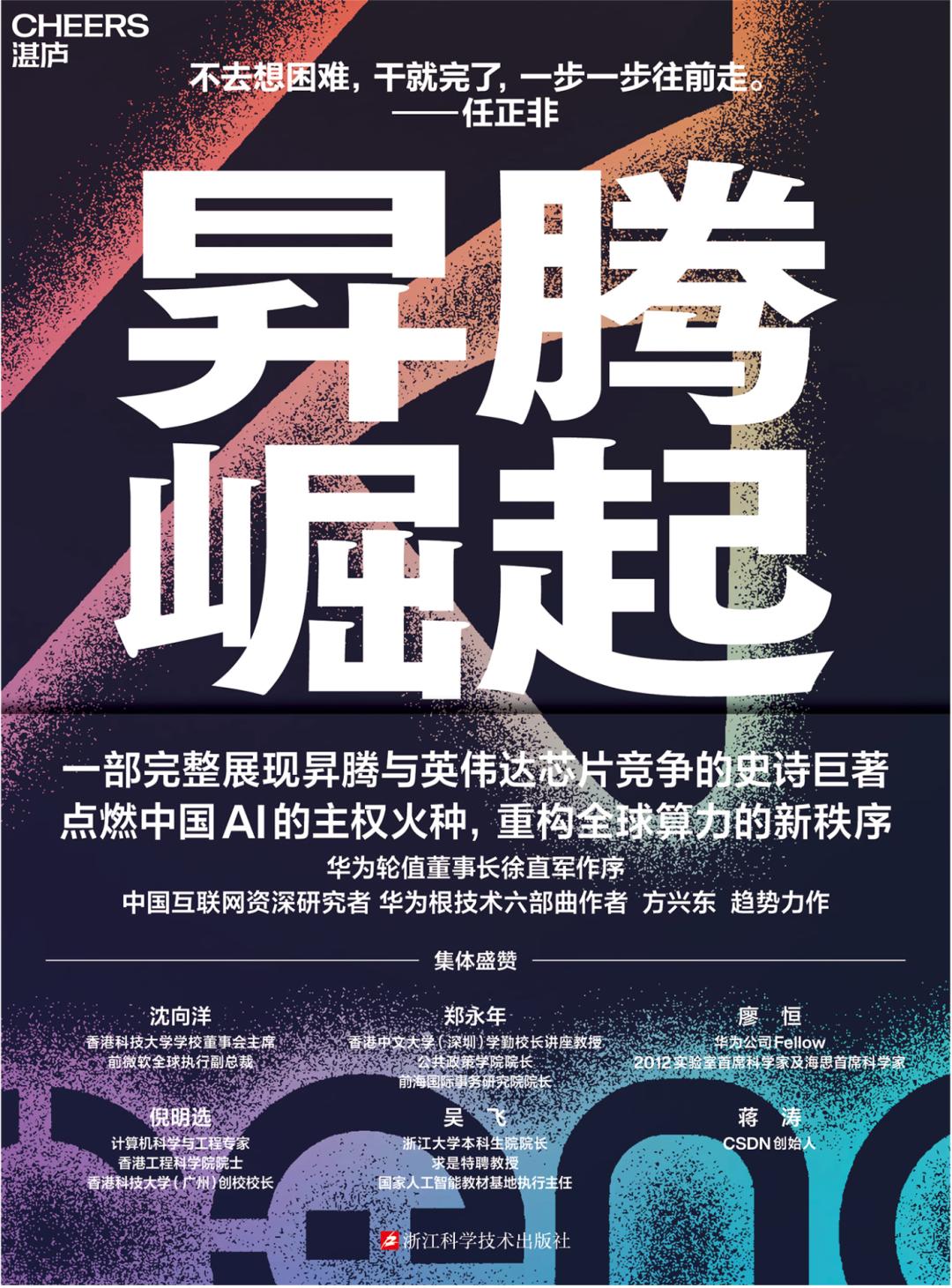
The Rise of Ascend, Fang Xingdong, Cheers Publishing / Zhejiang Science and Technology Publishing House, August 2026.
All the above details are recorded in the book The Rise of Ascend. To help readers quickly understand this period of history, "Wanyou Island" has sorted out 100 relevant details based on the content of the book. The main contents are as follows:
01
Strategic Awakening
1. In December 2002, Cisco's global vice president met Huawei's senior management at the Shangri-La Hotel in Shenzhen, claiming that Huawei had infringed Cisco's intellectual property rights and demanding that Huawei withdraw its products from the market within 10 days. This was probably the first time Huawei deeply realized that "technology knows no borders".
2. At the CES conference in January 2016, He Tingbo once proposed to Jensen Huang that NVIDIA authorize its mobile phone-related technologies to Huawei, which was rejected on the spot. Jensen Huang said: "I am only good at making GPUs, and I will only focus on making GPUs well." This made He Tingbo fully wake up — core technologies "cannot be begged for, cannot be obtained, and cannot be waited for".
3. On August 9, 2016, Xu Zhijun (editor's note: then Rotating Chairman of Huawei) exchanged views with Professor Yoshua Bengio of the University of Montreal at Huawei's Ottawa Research Institute. Bengio believed that deep learning would trigger the next industrial revolution, which would enhance and extend human's mental power and cognitive ability. Xu Zhijun agreed deeply and decided to establish the Montreal Research Institute to carry out AI research.
4. He Tingbo first judged that the AI computing power should be placed on the mobile phone side.
5. In 2016, AlphaGo defeated Lee Sedol. In the same year, NVIDIA found that almost all deep learning computations could be decomposed into matrix multiply-add operations. But at that time, Huawei's internal understanding of AI was extremely limited, and the biggest resistance came from the concern that "AI will reduce the after-sales service income of network equipment".
6. Ren Zhengfei (editor's note: Huawei Director and CEO) often used the "Van Fleet's ammunition load" to guide strategy — under the condition of material scarcity, concentrate superior resources to precisely break through gaps. Xu Zhijun was thoroughly familiar with this concept, and judged: Since AI is an industrial trend and can create customer value, we should concentrate all our strength to invest fully.
7. The logic for Huawei to enter the computing industry is: technological transformation must be worthy of investment, and once decided, it requires a large amount of real money. The computing industry was then undergoing two major transformations of cloud computing and AI.
8. On June 5, 2017, at the Shanghai Research Institute, He Tingbo, Liao Heng and Xu Zhijun discussed whether to make a dedicated chip for AI. Opponents believed that the application demand was not obvious; Liao Heng advocated that "in the future, all kinds of computer applications can be transformed to be implemented based on neural networks", and Xu Zhijun supported this judgment.
9. From October 11 to 12, 2017, Xu Zhijun organized Huawei's AI strategy seminar in Vancouver, with the participation of main senior leaders as well as people from the North American industry and academia. Two and a half days of discussion reached two consensuses: AI is a general-purpose technology that will change every industry; AI is a thinking mode that all Huawei R&D personnel must learn.
10. On October 10, 2017, Xu Zhijun had lunch with Professor Richard Sutton, the father of reinforcement learning, in Vancouver, expecting to apply reinforcement learning to network intelligence.
11. After the Vancouver conference, Huawei's AI R&D switched from centralized to decentralized — all departments must carry out AI R&D, and all employees must learn AI technology. Dang Wenshuan (editor's note: Huawei Chief Strategic Architect, head of the Blue Army) personally wrote the popular science article What is the AI Algorithm to popularize AI principles to the senior management.
12. In October 2018, at Huawei Connect, Xu Zhijun officially released Huawei's AI development strategy and full-stack, full-scenario AI solutions on behalf of the company, and displayed the first Ascend 310 chip — the AI chip was officially given the brand name "Ascend".
02
The Technical High-Stakes Gamble Starting from Scratch
13. Huawei launched the internal pre-research of AI chips, with only 20 to 30 people in the team in the initial stage, and the pre-research code name was NPU. In the second half of 2017, it was officially named "Da Vinci" (Project D). Xu Zhijun was the team leader, and all team members were presidents of various business systems, with an extremely high specification.
14. Liao Heng innovatively proposed the 3D Cube Da Vinci architecture, where the computing unit is made into a three-dimensional structure to directly complete matrix operations. Different from the traditional 2D structure, the 3D Cube only needs a 16×16×16 three-dimensional structure to complete all calculations in one cycle.
15. In the dispute over the Da Vinci architecture plan, the chief architect of the Kirin series led the design goal of making it as similar to NVIDIA as possible; while Liao Heng put forward a completely different design principle — not pursuing the smallest area, not pursuing the ultimate power consumption, and focusing on maximizing AI computing power per unit of power consumption. After the plan was deadlocked for more than a month, He Tingbo chose the latter.
16. Huawei chose to build its own instruction set instead of following NVIDIA's CUDA path or ARM/RISC-V. Jin Xi (editor's note: head of Huawei's chip solution development team) believed that if we relied on the North American instruction set at the beginning, although we could start quickly, once we encountered an explosive application with a user scale of 1 billion levels, the subsequent optimization space would be completely exhausted.
17. Liao Heng proposed a broad-spectrum architecture design — one set of architecture covers products ranging from less than 5 US dollars to 500 million US dollars, with a span of 10 million times. The Ascend architecture finally chose the general-purpose computing mode.
18. The compiler is the "holy grail-level goal" in the R&D of the Da Vinci architecture. In the first year, all the software tools developed by dozens or even hundreds of people were overthrown and remade. He Tingbo quickly integrated multiple internal forces of Huawei, and the compiler team finally gathered two to three hundred experts to build an independent instruction set system.
19. The naming of the Ascend brand: He Tingbo proposed to use the Chinese name "Ascend", which is derived from "the sun rises and the moon soars", implying a positive attitude and continuous breakthroughs.
20. The independent R&D of MindSpore caused huge controversy: Opponents believed that PyTorch and TensorFlow already existed globally, and Huawei should focus on hardware. But Xu Zhijun judged: "TensorFlow and PyTorch only started five or six years earlier than us. As long as we take action within ten years, it will not be too late."
21. From August to December 2018, Wu Yuxian (editor's note: former Huawei employee who had taken internal retirement, and was invited by He Tingbo in 2018 to lead the CANN design), head of the Turing Lab, led the team to carry out closed-door system design in Shanghai, and backbones from all Huawei research institutes gathered in Shanghai. His schedule was filled with five or six discussion sessions every day.
22. In August 2019, Xu Zhijun released the Ascend 910 AI processor at the Shenzhen headquarters. Liao Heng sighed that after years of deep cultivation in the chip industry, he never thought that a brand-new architecture could be implemented and usable within 11 months — "this is a record-breaking speed". 1000 Ascend 910 chips form a cluster, and the system's linear performance ratio reaches about 90%, nearly 15 percentage points higher than products on the market in the same period.
23. The Da Vinci architecture eventually became the NPU architecture with the largest deployment volume in the world. In the field of video surveillance, more than 90% of the global devices are from China, and leading enterprises such as Hikvision and Dahua cannot do without Huawei's NPU technical support.
03
"Re-inventing Everything" Amid Supply Cutoffs
24. Meng Wanzhou returned to Shenzhen on a Chinese airliner, stepping down the gangway in a red dress. He Tingbo described this moment: "It was like when the water was about to be drained at the bottom of a deep mountain lake, it started raining again." In the same year, multiple product lines of Huawei began to recover.
25. On May 16, 2019, the US Department of Commerce added Huawei to the export control entity list — this is the famous "May 16" ban. The Ascend 910A was manufactured by TSMC using the 7-nanometer EUV process, and its production was directly blocked after the ban. In December 2019, He Tingbo made her last trip to Taiwan, where clear signals of restrictions on the manufacturing side had already appeared.
26. On August 17, 2020, the US added 38 Huawei subsidiaries to the "Entity List", and the "de minimis rule" was upgraded to the "Foreign Direct Product Rule (FDPR)" — even products originating from Europe but containing US-rooted technologies cannot be used, imposing a 100% blockade on Huawei. The strategic differences that originally existed within Huawei completely dissipated.
27. Under the sanctions, the Kunpeng 920 and Kirin 9000 were "frozen forever": The Kunpeng 920 outperformed IBM, Dell, and Cisco by 25%, which was enough to threaten Intel's position; the Kirin 9000 was the peak of the 5-nanometer process. But neither of them could continue to iterate — "Overnight, the situation changed drastically, R&D was forced to suspend, and product shipments stopped".
28. Facing the supply cutoff of high-end testing instruments, He Tingbo made the decision: "Don't wait and don't rely on others, make them by ourselves."
29. EDA tools are known as the "mother of chips", and the global market has long been monopolized by giants such as Synopsys. After the ban, outsiders questioned: "How can Huawei survive without EDA?" He Tingbo responded: "This is not a difficult task!" Huawei not only survived, but also created new types of EDA tools that do not exist in the US.
30. The core R&D of the UnifiedBus (Lingqu Protocol) began after the "May 16" ban in 2019 — the direct motivation was that international standard organizations such as PCI and SIG revoked Huawei's membership permissions. Lingqu is a large-scale cluster interconnection technology fully independently designed by Huawei, which matches and surpasses NVIDIA's NVLink. Liao Heng metaphorized: This is not just a patchwork of various buses, but "Qin Shi Huang's unification of the six states".
31. The sanctions accidentally gave birth to the world's first cluster system of its kind: The chip originally used for the interconnection of 4 Ascend 910 chips could not be purchased from the US, so the team used a brand-new self-developed technology to realize chip interconnection.
32. During the most severe period of sanctions from 2021 to 2022, He Tingbo devoted nearly half of her energy to domestic supply chain coordination, promoting the breakthrough of wafer manufacturing processes, the improvement of yield, and the localization of packaging and testing. She found that many partners cooperated closely when Huawei was in good times, but under the background of sanctions, they worried about their own risks, had changeable attitudes and even vacillated, and the coordination difficulty was far beyond expectations.
33. Under the sanctions, Huawei's persistence in compliance shocked Liao Heng: The HiSilicon compliance department had long been thoroughly familiar with every clause of US export control before the suppression; every employee in Huawei's US development team would voluntarily apply to the US Department of Commerce for an export license for every development action, even if the technology was not on the control list.
34. Liao Heng lived in North America for many years and understood the local legal system — if Huawei had really violated the regulations, the most professional approach for the US side would have been to file a lawsuit in court. But the US side never went through the formal legal procedure from beginning to end, did not put forward any formal court charges, and directly imposed restrictions through administrative means. Liao Heng described this as "the lion eating the lamb" — "striking hard at a compliant lamb, the truth may be that a lion wants to eat this lamb".
35. During the sanctions, Liao Heng once said to He Tingbo: "Let's buy the Mary Hill campus where Shannon and Shockley worked, and turn it into a museum. Let the Americans feel ashamed." However, this proposal with engineer idealism was not finally implemented, but it also reflects Huawei's respect for the spirit of science — the lion only wants to eat meat, no matter how well the lamb abides by the rules, it is useless.
36. The ban backfired on NVIDIA: After more than a year of implementation, Huawei was not crushed, but NVIDIA's revenue decreased by 400 million US dollars. About 80% of NVIDIA's shipments go to China and the US, each accounting for half.
37. He Tingbo said the widely circulated sentence later: "We are in our own 1946 right now. If we strive for success, we will welcome our own 1947 and 1948, and open another era." She said to her US counterparts: "Now, apart from the periodic table of elements, quantum mechanics, Schrödinger's equation, and Maxwell's equation, which we share a common language with you, one day you will find that all other technical systems no longer share a common language with us."
38. On May 21, 2019, Ren Zhengfei gave his first public response after the "May 16" ban: "Sooner or later, we will