60% of the stores have been closed over three years, and the pay-by-weight fast food sector has embarked on "course correction".
Around 2023, weight-based self-service fast food became a nationwide hit. Most of such restaurants are located around office buildings, where office workers can get a lunch with meat, vegetables, rice and porridge drinks for only about 30 yuan.
More importantly, customers can pick any combination of meat and vegetables as they like with flexible total cost, and usually get to taste more than a dozen dishes for a single lunch. It turns out that "lunch freedom" can be achieved at such a low cost.
However, a wave of store closures soon swept the industry.
Statistics show that by the end of 2025, there were only 32,000 weight-based fast food stores left across China. Compared with the peak of more than 80,000 stores in 2023, nearly 60% of the stores have closed down.
What on earth went wrong with weight-based self-service fast food? Interestingly, the weight-based self-service model that has seen massive store closures has not been abandoned by industry players.
01
Three models, each with its own advantages and disadvantages
At the end of June 2026, the first freshly-cooked self-service restaurant of Lao Jiu Jiu opened to the public on Fengqi Road in the downtown area of Hangzhou.
This restaurant is part of the "old city renovation" project. A field visit by Brand Prism found that the brand's storefront slogan has changed from "Rice Matters, Eat at Lao Jiu Jiu" to "Freshly Cooked Self-Service Restaurant", and there is also a slogan hanging above the door that reads "New Dishes Every Week, Taste Over 30 Dishes in One Meal".
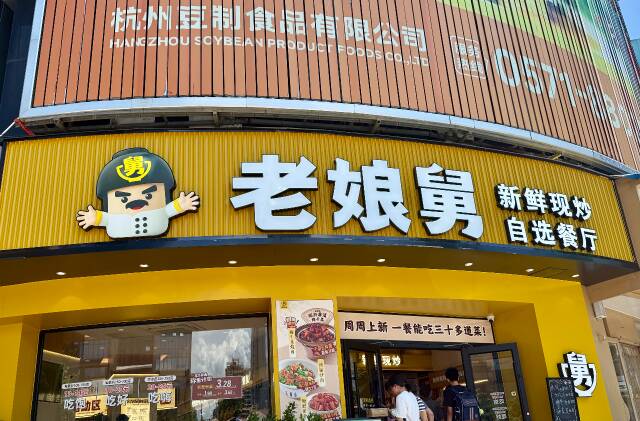
Lao Jiu Jiu's first freshly-cooked self-service restaurant. (Photo by: LI Xinyu)
The restaurant is equipped with an open kitchen and ingredient display counter. In the self-service area, more than 30 kinds of dishes are placed on the counter, and customers can take the food as they need and pay by weight.
Lao Jiu Jiu is a local dominant Chinese fast food brand in Jiangsu, Zhejiang and Shanghai, with more than 400 stores. Its standardized set meal model of "central kitchen + unified distribution" has been adhered to for 26 years. This time it transformed into the freshly-cooked weight-based track, which is by no means a small trial.
Lao Jiu Jiu's test of freshly-cooked self-service restaurants is a self-rescue attempt under the dual pressure of underperforming results and blocked IPO process.
Statistics show that in 2025, Lao Jiu Jiu achieved an operating revenue of 1.31 billion yuan, a year-on-year decrease of 11.53%; the net profit attributable to owners of the parent was 61.4904 million yuan in loss, turning from profit to loss year on year. Meanwhile, Lao Jiu Jiu failed in two IPO applications within four years. This time-honored Chinese fast food brand founded in 2000 is in urgent need of a new growth story.
"Freshly cooking" is the first puzzle of this story.
At present, consumers' sentiment against pre-made food is rising, and "freshly cooking" has become a common trend in the Chinese fast food industry. As early as 2024, Country Style Cooking Group closed its central kitchen and fully implemented fresh food freshly-cooking in all stores. According to Li Hong, the founder of Country Style Cooking, in public events, from January to July 2025, the total cost of Country Style Cooking Group increased by 46 million yuan, which is directly related to the model transformation.
If there were still disputes among Chinese fast food chain brands one or two years ago about whether to stick to "fresh food freshly-cooking", this concept has now increasingly become the consensus of practitioners. In 2025, Nanchengxiang invested more than 20 million yuan to build the 3.0 version of freshly-cooked self-service model. In 2026, it plans to invest another 100 million yuan to upgrade nearly 200 stores across the country.
"Weight-based self-service" is the second puzzle.
On the day when Lao Jiu Jiu's first freshly-cooked self-service restaurant opened, there was a person named Cai Yuxuan in the ribbon-cutting crowd. Not long ago, he was the general manager of the Daozhuangyuan brand. Daozhuangyuan opened more than 400 self-service freshly-cooking stores in 4 years (272 stores are currently in operation). Now Cai Yuxuan has a new identity, who will help Lao Jiu Jiu operate the model upgrading of freshly-cooked self-service.
However, as mentioned at the beginning of this article, the weight-based fast food industry is experiencing a major downturn.
Looking at the Chinese rice fast food track, there are roughly three self-service models.
The first is the small bowl dish model, represented by Laoxiangji. Dishes are served in small bowls with clear price tags, and customers pay after selecting all dishes. The advantages of this model are transparent pricing and fair trading for all customers. Its shortcomings are also obvious: office workers always want to try a little of every dish, but their budget does not allow it, and picking two or three dishes casually can easily cost more than 30 yuan.
The second is the weight-based model, represented by Xiaonv Dangjia, Nanchengxiang 3.0 and others. This model is highly flexible, customers can take food as they need, and they can taste multiple dishes in one meal. However, this model not only leads to long queues during peak dining hours, but also makes it very easy for customers to take more food than they need.
The third is the serving line model, where customers order dishes and staff serve the food, with experience similar to that in company canteens, represented by Chaoyixing.
According to communications between Brand Prism and multiple Chinese rice fast food practitioners, among the three self-service models, the weight-based model usually has the highest store operating cost. Lao Jiu Jiu is still new to the freshly-cooked self-service fast food track, but it chose to take on the most difficult challenge. Why is that?
02
The major downturn of weight-based self-service fast food
Weight-based self-service fast food is not a new concept.
In 2011, catering entrepreneur Luo Hongyong opened a fast food restaurant called "Xiaonv Dangjia" in Nanchang, focusing on freshly-cooked fast food. In 2017, Luo Hongyong led his team to Shenzhen, and upgraded the model to open-kitchen freshly-cooking and weight-based self-service.
A dozen woks are arranged in a line in front of customers, and chefs cook right in front of you — the visible wok hei and tangible aroma, plus the free choice brought by the weight-based model, made white-collar workers in Shenzhen prefer to queue up for fast food to eat freshly cooked dishes. Xiaonv Dangjia became famous overnight as the founder of the weight-based freshly-cooked fast food model, and attracted a large number of catering peers to visit and learn from it.
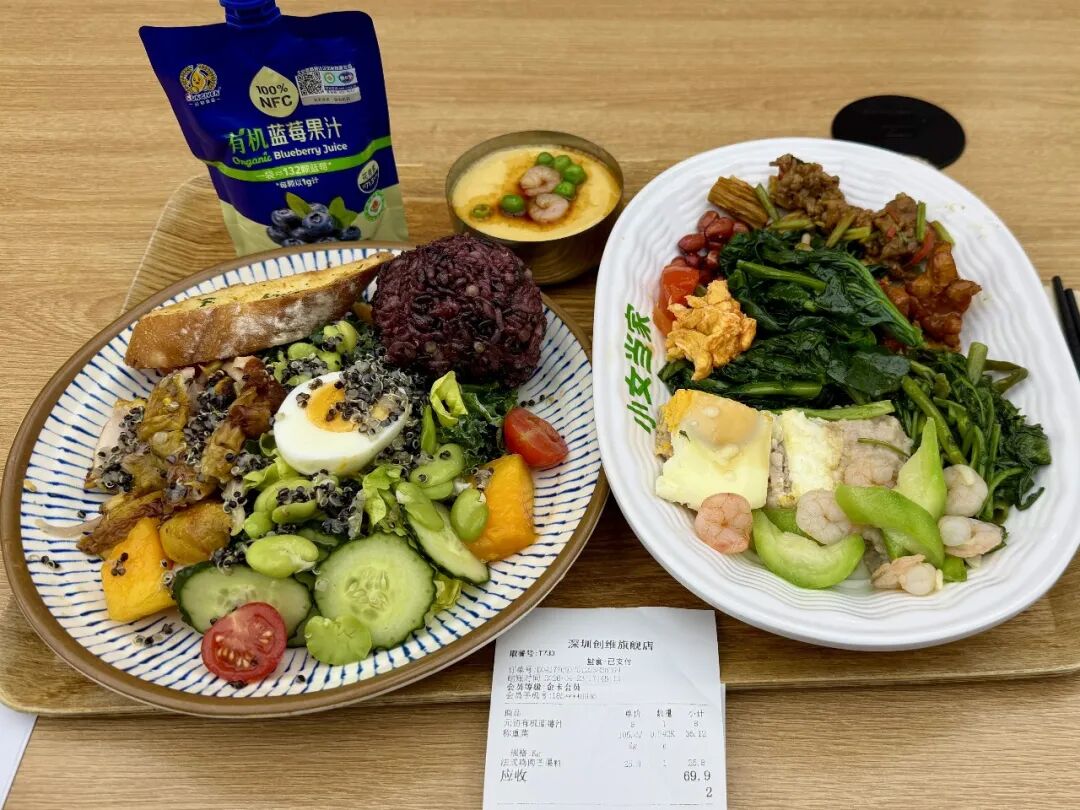
Dishes at Xiaonv Dangjia. (Source: Xiaohongshu @Leo)
At that time, Jia Guolong from Xibei was also exploring the freshly-cooked fast food business. In June 2020, Xibei announced its stake in Xiaonv Dangjia in a high-profile manner. Xibei just withdrew its investment from Xiaonv Dangjia this July, but at that time, Xibei's investment undoubtedly brought greater development space to Xiaonv Dangjia, and made the weight-based self-service model known to a wider audience.
In fact, after 2020, the weight-based self-service model has gradually become the mainstream model in the Chinese rice fast food track.
For example, in July 2020, Mr. Rice under Country Style Cooking Group implemented weight-based pricing in some of its stores; in July 2022, Laoxiangji opened its first self-service weight-based store in Shanghai Zhongjun Plaza, adding a weight-based self-service area while retaining the small bowl dish area. In 2023, the number of weight-based self-service fast food stores reached its peak, with the total number of stores across the country exceeding 80,000.
It is worth noting that pursuing both the "wok hei" of freshly cooking and the rich dish selection for office workers comes at a cost.
Take Xiaonv Dangjia as an example. Until 2023, the number of its stores did not exceed 30, mainly concentrated in Jiangxi and Guangdong; the number of its currently operating stores is only 60.
Since 2024, the weight-based self-service fast food industry has faced a major reshuffle.
For office workers, the biggest pain point of weight-based self-service fast food is opaque pricing and unclear consumption expectation.
Neican of Catering Entrepreneurs once counted the per-liang pricing of weight-based self-service fast food of different brands: 2.98 yuan per liang in some Laoxiangji weight-based stores, 1.98 yuan per liang in Yonghui Canteen, 3.75 yuan per liang in Xiaonv Dangjia, 2.88 yuan per liang in Jinxiaoyue Canteen, 2.98 yuan per liang in Country Style Cooking, 3.68 yuan per liang in Daozhuangyuan...
In other words, all these brands adopt the same pricing for meat dishes and vegetarian dishes. This will create a psychological hint: customers will feel that they are at a loss if they take too few meat dishes. But if they take more, the total price will exceed their expectation, and dishes with soup will add extra weight to the bill. In addition, office workers always want balanced nutrition and try a little of every dish, so they can easily take more food by accident.
The more critical problem is that weight-based self-service fast food brands have their own unspeakable difficulties. On the one hand, consumers are complaining, on the other hand, the brands themselves barely make profits.
First of all, customers come to weight-based self-service fast food stores for "rich dish selection", so 20 to 30 SKUs are the standard configuration. But this also leads to huge food waste. Since the dining time is concentrated at noon on workdays, the unfinished dishes can only be thrown away.
In addition, since most brands adopt the same pricing for meat and vegetarian dishes, many customers only pick meat dishes, leaving the rest of the dishes untouched. According to a former owner of a weight-based fast food store, the ingredient loss rate of his store was as high as over 10%.
Secondly, the store investment cost and labor cost of weight-based fast food are not low at all. The store needs to set aside a large area as the self-service zone. If you have queued in a weight-based fast food store during lunch peak on workdays two years ago, you must have a deep impression of the crowded self-service zone where office workers move at a snail's pace. In terms of labor allocation, every link including food preparation in the back kitchen, food distribution and weight-based settlement requires labor support.
In addition, around 2023, when the weight-based self-service fast food was at the industry boom, a large number of outsiders flooded into the track, leading to uneven quality of the category in a short period of time. Once a consumer has a bad dining experience, he may avoid the whole category.
Many brands began to raise prices quietly after their store business declined and ingredient loss cost increased. "A few pieces of braised pork, two spoons of tomato scrambled eggs, and a little vegetable, the bill is 46.8 yuan", similar complaints appear on social platforms from time to time. Weight-based fast food was thus nicknamed "price assassin", and the topic of "people with 20,000 yuan monthly salary can't afford weight-based fast food" once became a hot topic. As a result, weight-based self-service fast food lost consumer trust, and the situation of these stores became even more difficult.
It is worth sympathy that after the reputation of the category was damaged, some small and medium-sized brands and independent stores that could have run a profitable model were also affected, and eventually had to close down.
03
There is no standard answer for self-service fast food
So, is weight-based self-service fast food no longer worth doing? It is 2026 now, why does Lao Jiu Jiu still choose the weight-based model?
According to communications between Brand Prism and industry practitioners, there is no standard answer for which model is the best in the Chinese rice fast food track, and the weight-based model does not necessarily have more obvious disadvantages than other models, the key lies in scenario adaptation.
The strategy of Mr. Rice is worth reference.
In mature markets with a large number of stores, Mr. Rice usually operates both the weight-based model and the small bowl dish model. Which model a store chooses mainly depends on its customer group and scenario.
If the store is located near office buildings and the customer group is mainly office workers, it will choose the weight-based model to meet the demand of office workers to "taste multiple dishes in one meal"; if the store is located in shopping malls and the customer group is mainly for family dinner and friend gathering, it will choose the small bowl dish model, since for group dining, each person orders 2 to 3 dishes, so there will be multiple dishes to share, and small bowl dishes also look more delicate.
Country Style Cooking Group also mentioned the operational advantages of the weight-based model in its prospectus: in 2021, the table turnover rate of Mr. Rice's weight-based stores was 4.7 times, higher than the average table turnover rate of 4.3 times of all other brand stores in the same year.
From the perspective of consumption trend, the weight-based model is also suitable for the "one-person meal" consumption scenario.
It can be seen that the demand for weight-based self-service fast food exists for a long time. The current wave of store closures is essentially caused by poor store cost control, insufficient refined operation capability, even selling inferior dishes as high-quality ones, or raising prices secretly, which leads to consumers losing trust in the brand and even the whole category.
In response to the problems of weight-based self-service fast food, some brands have taken the initiative to "correct deviations", providing valuable reference samples.
For example, the 3.0 version of Xiaonv Dangjia stores introduced intelligent cooking machines, the cooking process can be controlled by intelligent programs, and oil and seasonings are sprayed automatically. No professional chef is required, ordinary employees can operate the wok after simple training. In addition, different types of dishes are sold at separate serving counters, which greatly solves the problems of long queues and low transaction efficiency in self-service fast food.
This time, Lao Jiu Jiu's first freshly-cooked self-service restaurant implemented separate pricing for meat and vegetarian dishes: 3.68 yuan per 50g for pure meat dishes, 1.98 yuan per 50g for pure vegetarian dishes, and 3.28 yuan per 50g for dishes with both meat and vegetables.
Many other brands have also deployed smart kitchen systems in their stores. When customers pick dishes, the screen will display the weight and amount in real time, each type of dish can be weighed separately, and the total price and its composition are clear at a glance. For consumers, the price becomes "controllable", and their trust and experience are greatly improved.
Although these "correction" actions may not solve all the problems, the actions of various brands are enough to prove that the demand for weight-based self-service fast food exists objectively, and practitioners are working hard to improve their business.
This article is from WeChat Official Account "BrandPrism", written by LI Xinyu, edited by TIAN Tian, authorized by 36Kr for release.