Toyota is accelerating desperately, while China is determined to step on the brakes — the Chinese and Japanese automotive industries have embarked on a path of two-way mutual development.
"I believe we are losing to China."
In the documentary *Inside Toyota* broadcast by Japan's NHK on July 19, 2026, a Toyota development engineer stated his frank judgment in front of the camera.
After pausing for a moment, the engineer added: Chinese automakers can take a vehicle from blueprint to mass production in only about two years, while Toyota still follows a five-year or even six-year pace. "By the time the vehicle is rolled out, the market has long changed."
At that time, the camera was allowed into Toyota's R&D base classified as "top secret", capturing the internal meeting of the next-generation Corolla development team, and showing the real dilemma of the world's top-selling automaker in promoting new-generation products.
The lens returns to the development site of the next-generation Corolla. This Toyota iconic model with cumulative sales exceeding 57 million units has its latest generation platform designed to support multiple powertrains including gasoline, hybrid and pure electric, with an expected service life of 10 years. But when the body team was ready to hand over the new platform drawings to the factory and start mold manufacturing, the manufacturing technology department rejected them on the spot: the front side member structure and welding spot spacing had not been finalized. Once the mold is produced, the cost of subsequent rework will be unbearable. The R&D side is pushing for speed, while the manufacturing side insists on waiting for complete data, and the schedule pressure cannot be automatically converted into release approval.
The drawing that was temporarily stopped at the factory gate is exactly the epitome of Toyota at present: it wants to catch up with China's speed, but strictly adheres to the bottom line of verification.
In the same documentary, Toyota Chairman Akio Toyoda admitted: "There seems to be a strong sense of crisis within the company." More than a month ago, in an interview in the UK, he put it more bluntly: "When I see everyone is shifting to electrification... I feel very lonely."
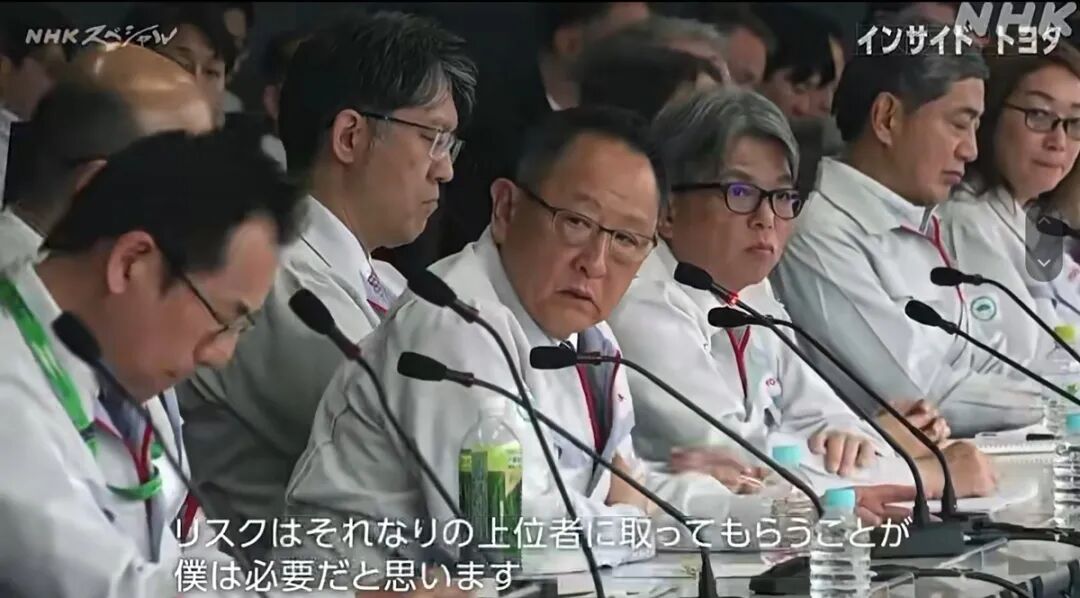
Figure丨Screenshot of the documentary, the subtitle means: I believe the corresponding senior personnel should bear the risks
But while Toyota is anxious about "how to run faster", on this side of the ocean, Chinese regulatory authorities are preparing to add a "speed bump" to the industry targeting the problem of excessively fast new car iteration of domestic independent brands. In July this year, the Ministry of Industry and Information Technology proposed to raise the reliability test mileage of new energy vehicles to 30,000 kilometers, which is in line with that of gasoline vehicles. At the same time, officials visited the production bases of major automakers twice within a week, randomly selected and sealed vehicles from the sold inventory for testing without prior notice.
On one side, Toyota wants to run faster, on the other side, China is working to squeeze out the moisture of "pseudo-speed". These seemingly opposite demands are, to a certain extent, an exceptionally firm two-way effort towards the same goal.
01
Toyota's Anxiety: How to Catch Up with "China Speed" While Adhering to the Bottom Line
Toyota's Anxiety: How to Catch Up with "China Speed" While Adhering to the Bottom Line
Since its founding, Toyota Motor has never been as urgent and awkward as it has been in the past two years.
On the one hand, since 2020, this Japanese auto giant has ranked first in global vehicle sales for 5 consecutive years, and its profit margin is also far ahead of many competitors. On the other hand, due to the rapid rise of Chinese competitors relying on new energy and intelligent technology, the entire enterprise has been shrouded in an unprecedented sense of crisis in the past two years.
As a representative of Japanese automakers worldwide, this giant is used to moving at its own fixed pace: first determine the chassis framework, then design the body details, step by step.
In the late 1980s, this Japanese giant, with its Lean Product Development model, set a record of compressing the R&D cycle of a brand-new automobile product to less than 40 months. The all-new Crown Sport, unveiled in 2023, has an R&D cycle of only 21 months, more than half shorter than the conventional 4-year period of the industry at the same time. For a long time, it was the efficiency benchmark among traditional automakers.
However, as Toyota's iconic model and a global vehicle, the Corolla needs to coordinate factories located in 16 regions, and it has always been difficult to speed up its development and iteration process.
So this time, in front of NHK's camera, we witnessed how "unconventional" the next-generation Corolla is — the platform architecture and upper body development are advanced simultaneously.
Before the chassis design is finalized, the body development is already in progress. Even to save time, engineers directly cut part of the body of the Prius engineering vehicle, welded it to the next-generation Corolla platform, and built a prototype that looks like a "patchwork monster", and took it to the test track to explore chassis characteristics in advance.
There is no need to wait for the final mold or the final styling approval, the data can be collected and verified first. This method, called "Concurrent Engineering" by Chinese peers, is exactly a silent revolutionary hurricane that is blowing inside Toyota now.
But this "silent revolution" was firmly stopped by the calloused hands of Toyota's manufacturing department this time.
The manufacturing technology department rejected the drawings on the spot. Not only did they not accept it, but they also sent it back, and the reason is obvious — the front side member is the core structure for frontal collision safety. If the welding spot arrangement deviates by a few millimeters, the offset collision result will drop from excellent to below the pass line.
According to Toyota's strict rules, for such core safety parts, a large number of collision tests must be carried out in the trial production stage. If the data is not fully verified, the mold must never be produced, otherwise the sunk cost of hundreds of millions of yen will be locked, and modification after problems occur is absolutely infeasible. The commercial impact caused by recalls is almost unbearable for an enterprise like Toyota.
What Toyota wants to learn is never how to weld parts more economically, but how to cut all meaningless consumption from its own processes.
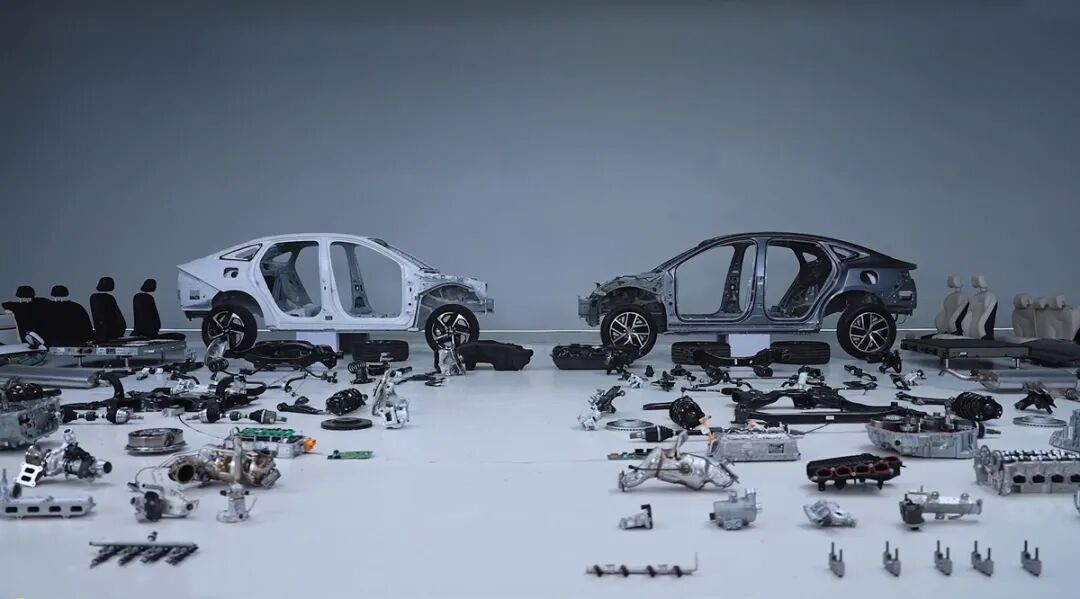
To figure out how Chinese automakers achieve iteration every two years, Toyota engineers disassembled the ZEEKR 007 and BYD Qin L. They found that the electrical and electronic architecture of some latest models has crossed the domain centralized stage, and directly entered the stage of central computing combined with regional control — the number of vehicle controllers has dropped sharply from hundreds to more than 20, and software and hardware are completely decoupled. This means that there is no need to redraw the entire vehicle circuit during facelift, upper-layer applications can be iterated independently, and some function upgrades no longer rely on re-development of underlying hardware.
However, more acceleration cannot be understood only through vehicle disassembly. In the past 6 or 7 years, Chinese enterprises have moved a considerable part of verification and testing links to the cloud: completing 100,000 kilometers of virtual durability test in one day, using simulation to avoid all possible problems first, and the real vehicle is only used for final confirmation.
What makes Toyota most aggrieved is that decisions do not need to fly back to Tokyo for approval. The R&D centers in Shanghai and Shenzhen can make decisions on their own, and complete closed-loop verification for styling, chassis and intelligent driving schemes locally. After modifying the drawings at night, suppliers in the Yangtze River Delta can produce digital models the next morning. This model combining software and hardware, supported by a highly flat decision-making system, is the key to cutting the development cycle to 24 months.
Therefore, Akio Toyoda placed Lexus' pure electric vehicle factory in Shanghai, and handed over the R&D rights of the next-generation Corolla to the Chinese team, essentially wanting to get rid of the old model that "any modification needs to go through cross-border approval processes".
02
China Establishes Rules: Take Precautions and Move the Bottom Line Forward
While Toyota is learning to improve efficiency, Chinese regulators are doing another thing, putting "speed" into the cage of the system.
In January 2026, the Ministry of Industry and Information Technology issued the No.1 Announcement, revising the "Access Review Requirements for Road Motor Vehicle Manufacturers" and "Access Review Requirements for Road Motor Vehicle Products", and for the first time included "reliability verification" in the regulatory documents as a mandatory access requirement. This means that "whether to carry out reliability verification" is no longer just an internal quality management issue of enterprises, but an important basis for judging whether an enterprise has the ability to continuously manufacture vehicles.
Shortly afterwards, in July 2026, the National Automobile Standardization Technical Committee publicly solicited opinions on three finalization test procedures for new energy vehicles, proposing to unify the total reliability driving test mileage of pure electric, plug-in hybrid and fuel cell vehicles to 30,000 kilometers, which is consistent with that of gasoline vehicles. Among them, the cumulative mileage proportion of DC charging for pure electric models shall not be less than 90%, and plug-in hybrid models need to additionally complete no less than 10,000 kilometers of driving test in pure electric mode.
This means that the long-standing "50% discount" treatment enjoyed by new energy vehicles in the reliability verification link — the original standard only required 15,000 kilometers, half of that of gasoline vehicles — will be completely cancelled.
It needs to be clarified that the essence of this regulatory measure is not a post-incident remedy after problems occur, but the competent authority actively moves the supervision forward, and brakes on overheated behaviors with the attitude of taking precautions before they happen.
On the other level, after 4 to 5 consecutive years of rapid growth of new energy vehicles, as new energy vehicles continue to expand and take root, "equal rights for gasoline and electric vehicles" will be implemented from slogans to the practical level of quality verification. 30,000 kilometers is not a simple mileage accumulation on ordinary roads. The test may also cover working conditions such as enhanced rough roads and high-speed loop tracks. Long-term reliability problems such as air suspension failures and air conditioner odors can only be exposed through full verification.
What is more breakthrough is the upgrade of regulatory methods. In July 2026, the First Equipment Industry Department of the Ministry of Industry and Information Technology conducted production consistency supervision and inspection visits to automakers twice within a week — visiting GAC Aion and XPeng on July 24, and visiting Chery, NIO and JAC from July 30 to 31.
This inspection broke the conventional mode of prior notification and then enterprise delivery for testing. The randomly selected sample vehicles were directly extracted from the circulating sales channel, and core components such as power batteries were sealed and tested at the same time. This fundamentally avoids the operation space for enterprises to adjust parameters and optimize sample vehicles in advance. For automakers whose related products fail to meet the national standards and production consistency management requirements after inspection, penalties such as public notification, suspension of the "Announcement" for related products, and suspension of new product declaration by enterprises will be imposed.
From establishing standards in advance to strengthening verification during the process, and finally forming a strict post-incident accountability mechanism, a full life cycle supervision framework is taking shape.
Of course, it needs to be emphasized that the starting point of this series of regulatory measures is not to confirm that there is widespread cutting corners in the industry, but the competent authority actively takes precautions during the period of rapid industrial iteration. As pointed out by industry comments, in the era of software-defined vehicles, many automakers use computer-aided design, virtual simulation, digital twin and other technologies to replace part of the traditional testing and verification links, which greatly shortens the R&D cycle. This in itself is a highlight of the advantages of China's entire automotive industry chain.
If you run too fast, you may hide hidden risks and break through the safety bottom line. Not long ago, the "blowing wind tunnel with mouth" advertisement released by BMW was mocking the perfunctory behavior of omitting necessary physical experiments. The intention of the regulatory authorities is also very clear — to lock the verification links that should not be cut with standards, so that enterprises with real technical strength can run more securely, and leave no room for enterprises that attempt to make arbitrage through "pseudo-speed".
This also coincides with Toyota's manufacturing department's rejection of the drawings from a certain perspective. The only difference is that Toyota essentially pursues speed under controllable quality, while we aim to ensure quality while maintaining speed.
In the past few decades, Toyota relied on people. Not only the professionalism and sense of responsibility of senior engineers who have worked for decades, but also the long-standing barriers between departments in Japanese enterprises.
To put it bluntly, this is "shirking-responsibility-oriented quality control" — as long as our department does not sign, the problem will not fall on us. It sounds bureaucratic, but it accidentally holds the last safety door. Chinese enterprises have removed the department walls, making decision-making smoother and speed much faster, but there is also an occasional risk that all relevant personnel will reach a consensus to quietly reduce the required verification mileage.
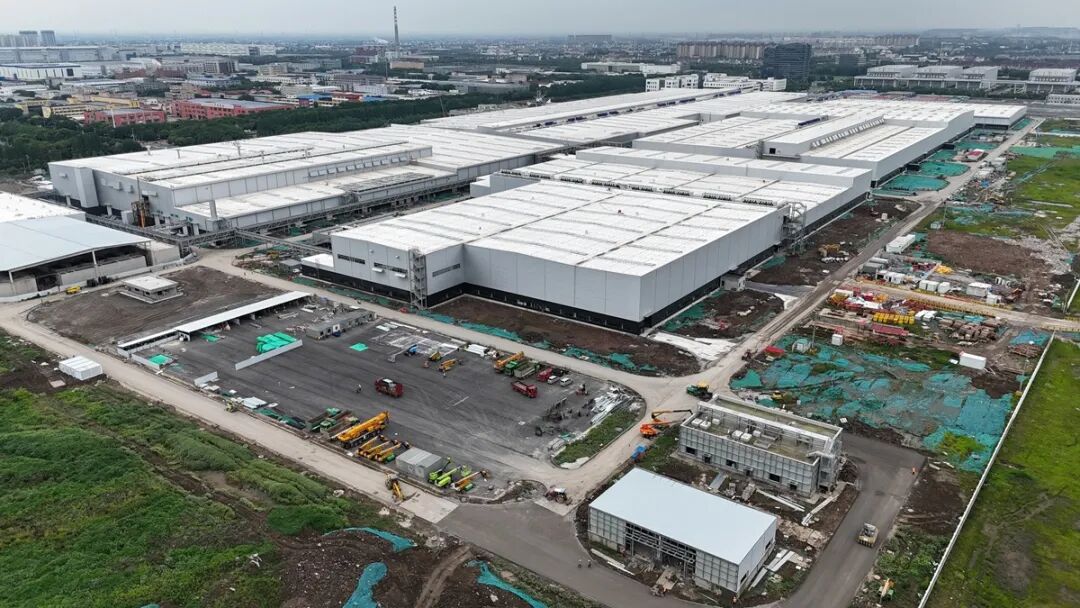
Figure丨Toyota's hope — the wholly-owned Lexus factory in Jinshan, Shanghai
So there is no need to argue now. The state has set the 30,000-kilometer rule as a mandatory standard, and no one can break the standard through internal consensus. Toyota has also moved its R&D center to Shanghai, and finally does not need to fly to Tokyo for approval for a single drawing.
One side removes the walls and installs a public lock. The other side still keeps the walls, but has opened a window for smooth communication.
This is the most simple two-way effort in the industry: you make up for your slowness, I restrain my recklessness, and finally both are locked in the same narrow path — the car must not only perform well in the press conference, but also work reliably beyond the warranty period.
There has never been a magic car, only the honesty of being strict with yourself. The past 40 years was when Toyota taught the world what durability is, and the real contest in the next decade is to see who can combine quality and iteration firmly together.
This article is from the WeChat Official Account "Auto Community" (ID: iAUTO2010), Author: Lin Dengwan, Editor: He Zengrong, published by 36Kr with authorization.