250 billion yuan of financing was raised within half a year, but the dexterous hand industry has not yet produced a widely recognized "standard hand".
The core body of humanoid robots is rapidly maturing, yet the "hand" has become the last and most intractable short board.
The significance of this hand can be directly reflected in its cost proportion. Morgan Stanley once estimated that dexterous hands account for about 17.3% of the bill of materials cost of Tesla Optimus. Practitioners generally believe that the hardware cost of dexterous hands accounts for 10%-20% of the total cost of the entire robot body, and some high-end configurations may even exceed 20%. High technical difficulty and heavy cost burden make it a critical link that determines whether a robot can truly "perform practical tasks".
Various capitals have placed their bets early. According to incomplete statistics from IT Juzi, the total financing in China's dexterous hand track reached about 168.77 billion yuan in 2025, and it exceeded 250 billion yuan only in the first half of 2026, surpassing the total value of last year. The upstream component suppliers (Zhaowei Electromechanical, Paxini Perception), midstream full-hand manufacturers (Lingxin Qiaoshou, Wujin Technology, sharpa), and downstream self-developed robot body camps (Unitree, Tesla) are all making layouts simultaneously.
The valuations of these projects are also rising all the way. Lingxin Qiaoshou, which focuses on dexterous hands, has a target valuation of about 6 billion US dollars (about 424 billion yuan) in its latest round, higher than most robot body companies. Cidianxing, spun off from Zhiyuan, completed 4 rounds of financing within 5 months with a post-investment valuation exceeding 1 billion US dollars, making it the fastest-growing unicorn in the track so far.
However, it is precisely on this most critical component that the industry is still in the early stage with no established standards. Different technical routes are developed independently; the shipment volume of various manufacturers ranges from hundreds to 100,000 units; the unit price ranges from more than 3,000 yuan to hundreds of thousands of yuan, with a huge gap; the degree of freedom (the number of directions in which fingers can move independently) ranges from 6 to 42, and the calculation methods are not unified.
Su Jiuyu, CEO of Xuanxiang Robotics, uses the term "out of focus" to describe the current industry pattern: there is no particularly core and mainstream technical direction at present, and the application scenarios are still being explored, which are currently mainly concentrated in the scientific research field. In his view, this year "can be regarded as the first year of mass production of dexterous hands, and also the early stage of the foam".
An intuitive manifestation is that the manufacturer with the largest shipment volume may not be the one with the highest revenue and valuation. The boom of capital and the chaos of the industry coexist. The dexterous hand industry is in a stage where standards have not yet been established, but the window period is shrinking.
01. Three Routes, Three Types of Business
What is called "dexterous hand" on the market may not necessarily refer to the same thing. Different technical routes determine who this hand is sold to, how much it sells for, and whether it can make a profit.
Dexterous hands are composed of both software and hardware, but no obvious gap has been formed among various manufacturers at the software level.
An engineer engaged in dexterous hand algorithm development pointed out that the software is mainly divided into two main routes: VLA (Vision-Language-Action model) and world model, and the overall progress lags far behind that of hardware. Su Jiuyu added that most of the current mainstream open-source solutions treat the hand as a "grasping tool", which is essentially two-dimensional and extensive grasping. VLA oriented to fine operation is extremely rare, and only a few companies try to develop models for dexterous hands on their own.
The real watershed at present lies in hardware. The mainstream hardware routes can be classified into three categories: full direct drive (each joint has an independent motor), tendon drive (the motor is placed at the end of the wrist and pulled by ropes), and connecting rod (the motor is placed near the fingers and driven by a structure similar to a parallel connecting rod). However, the three routes can also be combined to form "hybrid drive" (for example, tendon drive + direct drive).
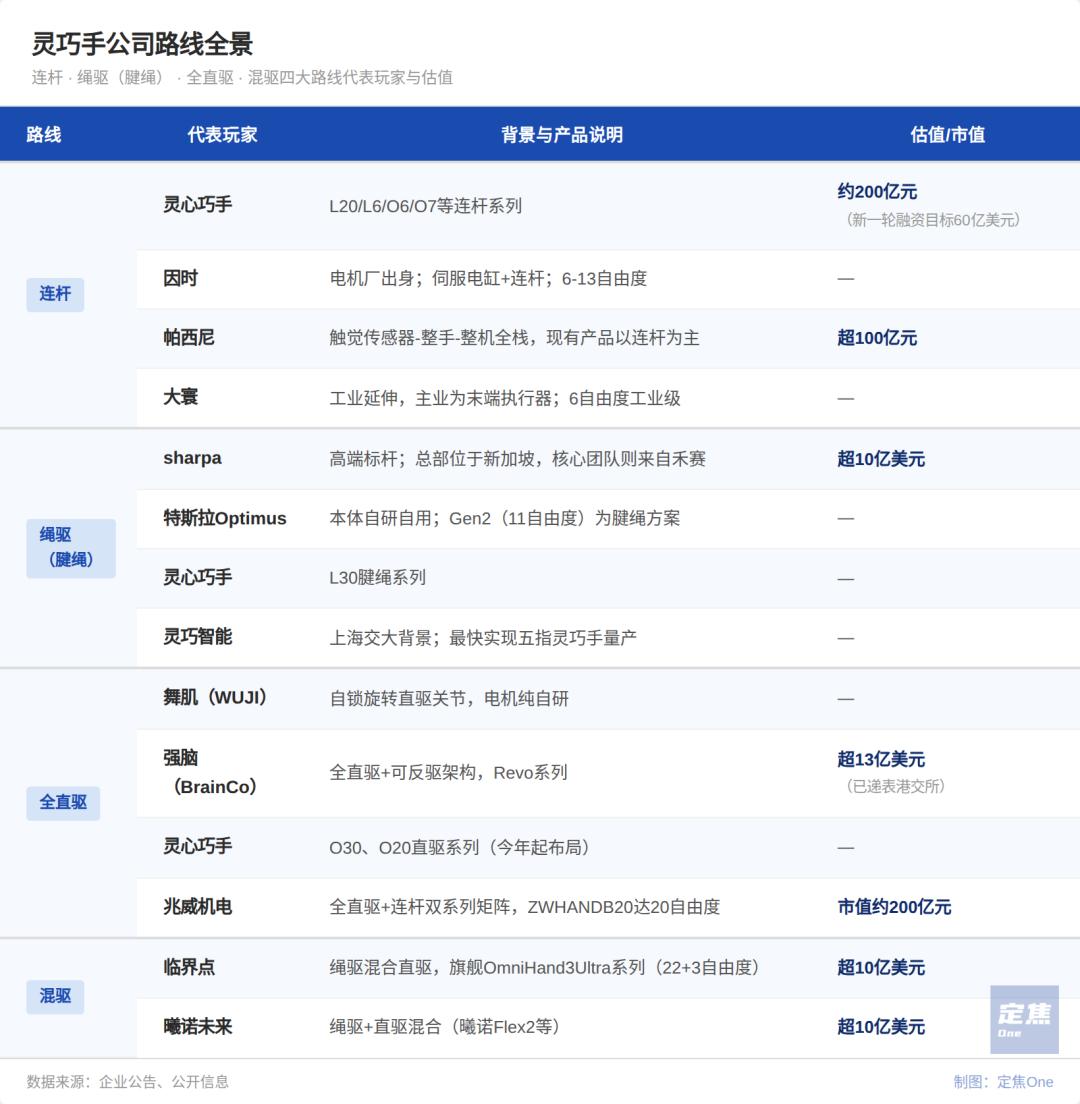
The flexibility and cost of different routes vary greatly.
The cost of the connecting rod and tendon drive routes is relatively low. Some companies have reduced the bill of materials cost of the three-finger tendon drive prototype to less than 1000 yuan, while the average cost of the connecting rod route ranges from 10,000 to 50,000 yuan. The common short board of the two is that they have strong load capacity but limited degrees of freedom, making it difficult to complete high-precision human-like operations. For example, they can carry boxes but cannot pick up mobile phones, can grasp oranges but cannot peel them.
The full direct drive route has the highest performance ceiling, but cost and technology are major obstacles. The average price of this type of dexterous hand starts at 100,000 yuan, and the technology bottleneck lies in the motor, which is also the most expensive hardware of the dexterous hand. According to the calculation of China Renaissance Securities, the cost of the motor used in a single dexterous hand can reach 26,000 to 65,000 yuan. What is more tricky is the upstream supply chain: the "motor-lead screw-encoder" chain has long been highly dependent on imports. A hardware practitioner introduced that to make a high-quality full direct drive dexterous hand, manufacturers almost have to develop motors independently, which is not easy. For example, the motors of Wujin Technology are fully self-developed. The first-generation products had problems of high heat generation and high repair rate, which were significantly improved in the second generation, with the temperature controlled below 50 degrees Celsius. Full direct drive also has a counterintuitive weakness - load capacity. A small motor is embedded in each joint, resulting in limited torque, which makes it impossible to lift heavy objects.
It should be noted that manufacturers do not only focus on one route, and full direct drive is almost a direction that all manufacturers are exploring.
Different technical routes also determine the valuation and business model.
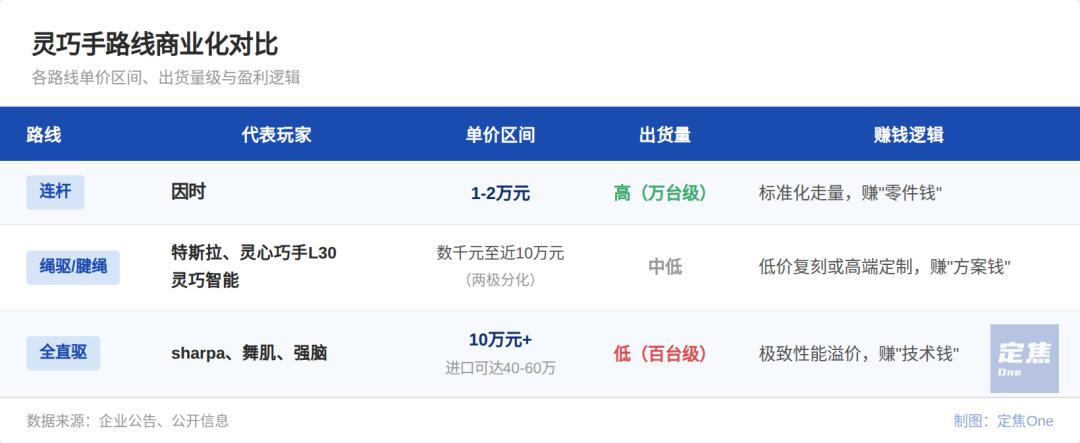
The tendon drive route is an entry-level route for scientific research reproduction, which is mainly sold to universities and laboratories; the connecting rod route is more suitable for current industrial production, and its customers are mostly automation production line enterprises. However, Su Jiuyu reminded that dexterous hands are not the optimal choice in industrial scenarios. Many tasks can be completed with three-finger grippers or even suction cups at a lower cost. The full direct drive solution is currently mainly oriented to scientific research and laboratories for cutting-edge R&D, but in the long run, it is considered to be the most likely to "enter thousands of households" with the largest commercial imagination space.
The difference in routes is finally reflected in valuation. The price offered by capital for the high-degree-of-freedom full direct drive route is significantly higher than that of the mass-production route. Lingxin Qiaoshou covers multiple routes, with a target valuation of about 6 billion US dollars in the latest round, making it the most expensive company in the track; Cidianxing, spun off from Zhiyuan and adopting the dual-line layout of direct drive and tendon drive, has reached a valuation of 1 billion US dollars. In contrast, the valuations of manufacturers that adopt connecting rod and tendon drive routes and focus on industrial mass production are much more pragmatic.
02. Dexterous Hands Are Popular, Why Is It Difficult to Judge Their Real Value?
Different routes and different business models are normal market choices. But when various manufacturers announce "being the first" with their own statistical standards, the industry loses its unified benchmark.
Since 2025, China's dexterous hand market has ushered in explosive growth. According to the data from GGII (High-tech Industry Research), the annual shipment volume in 2025 skyrocketed by 236% year-on-year to 19,200 units. Entering 2026, many manufacturers are announcing their achievements.
Yinshi Robotics ranks first in GGII's shipment volume list with a delivery volume of over 10,000 units in 2025, claiming that its "market share is far ahead", which is the shipment volume standard; Lingxin Qiaoshou claims to occupy "more than 80% of the global high-degree-of-freedom dexterous hand market", which is the segment share standard, and plans with 15 degrees of freedom or less and under-actuated solutions are not counted; Dahuan Robotics disclosed last year that it had cumulatively delivered more than 200,000 sets of electric end effectors in eight years, ranking first in the domestic sales of electric end effector products, which is the total category standard, including electric grippers, servo electric cylinders, humanoid dexterous hands and other products, and dexterous hands are only a small part of them. The three figures and three calculation methods are all correct in their own right, but they cannot be compared on the same dimension.
The difference between these three standards actually corresponds to the three routes mentioned above: manufacturers that adopt the full direct drive, high-degree-of-freedom and high-unit-price route naturally have small shipment volumes and are more willing to highlight their "segment share"; manufacturers that adopt the connecting rod, tendon drive and low-price route are more inclined to announce their "shipment volume" and "total delivery volume".
It is more noteworthy that some important players have not participated in this "shipment volume ranking".
Tesla Optimus developed dexterous hands independently as early as 2022 but does not sell them externally; the Dex5 series launched by Unitree last year is mainly used for its own ecosystem and also does not disclose relevant data externally. The so-called "largest shipment volume" at present is actually only a partial market that excludes robot body manufacturers and core upstream players.
A practitioner from a leading domestic dexterous hand manufacturer admitted that most dexterous hand companies are not listed at present, and few third-party organizations verify their sales data, which is basically in a state of "each talking for its own sake". He also pointed out that some large shipment volumes may come from a single project, such as centralized procurement by local governments, and such data cannot represent the real market recognition of the products.
What is more complicated than the shipment volume standard is the definition of "degree of freedom".
The degree of freedom determines the flexibility of the hand, which is realized by motors, connecting rods or tendons. Different realization methods lead to huge differences in cost. However, the calculation methods of "degree of freedom" are not unified among various manufacturers, and the confusion comes from two levels.
The first level is different algorithms. A joint may have multiple movement directions. For example, the root of a finger can not only bend up and down but also swing left and right. Some manufacturers count it as 1 degree of freedom, while others count it as 2.
The second level is more critical: the number of "degrees of freedom" is not equal to the number of "motors".
For example, a technical article published by Yinshi Robotics at the end of 2024 claimed "12 degrees of freedom", but in fact, only 6 motors were used, and the other joints were driven by connecting rods and tendons, belonging to the under-actuated solution of "6 active + 6 passive". The 22 degrees of freedom of Tesla's new generation Optimus are all driven by independent motors at each joint, belonging to the fully actuated solution. As mentioned earlier, the motor is the most expensive hardware cost of the dexterous hand. The cost difference between 6 motors and 22 motors is three to four times, and the flexibility is completely different.
Su Jiuyu gave an example that a hand with 6 motors can usually only complete basic actions such as thumb side swing, thumb bending and four-finger bending. If the four fingers cannot swing left and right, many daily actions cannot be done, and even a mobile phone cannot be picked up. In his view, a pure 6-degree-of-freedom hand "has no practical application significance" and can only be used for simple grasping display in exhibition halls.
The difference between hands with side swing function and those without side swing function Source / Provided by the interviewee
The price range between products is also extremely wide.
The price of Lingxin Qiaoshou O6Lite is 3999 yuan after subsidy, while the price of its scientific-grade products such as L30 is close to 100,000 yuan, with a price difference of more than 25 times; the price of dexterous hands from BrainCo ranges from 100,000 to 200,000 yuan; overseas high-end full direct drive hands can even reach 400,000 to 600,000 yuan.
Practitioners said frankly that the manufacturer with the largest shipment volume may not be the one with the highest revenue. Assuming that one manufacturer sells 10,000 units of entry-level products priced at 3999 yuan, its revenue is about 40 million yuan; another manufacturer sells 2000 units of high-end products priced at 100,000 yuan, its revenue is 200 million yuan.
The capital market does not price products according to shipment volume. Yinshi Robotics, which has achieved large-scale shipment volume, does not have an advantage in valuation; Lingxin Qiaoshou has pushed its valuation to the highest level in the current track with the story of high degree of freedom. Capital is betting on its future potential.
The fact that the three standards of shipment, degree of freedom and price have not been unified is a typical feature of the early stage of the industry, and the standards are still being formed.
03. The Next Battlefield: From Parameter Competition to Application Landing Competition
At present, the three routes have their own positioning, but two external forces are breaking the balance. One is the independent R&D process of leading robot body manufacturers, and the other is the outbreak of tactile perception technology. Both factors may force dexterous hand companies and technical routes to accelerate reshuffling in the next 3 to 5 years.
The first force comes from robot body manufacturers. Tesla and Unitree have long developed dexterous hands independently. Zhiyuan also spun off its dexterous hand business into an independent entity "Cidianxing" for operation in January 2026. The latter completed 4 rounds of financing within 5 months with a post-investment valuation exceeding 1 billion US dollars, and the cumulative delivery of its OmniHand series exceeded 8000 units.
The second force comes from technological progress. The tactile system is changing from an "optional accessory" to an important configuration of dexterous hands, and even becoming a new technical watershed.
In simple terms, the tactile sensor is the "artificial skin" attached to the fingertips and palm of the dexterous hand, which is full of tiny sensing points, allowing the robot to perceive the contact force, slip trend and object texture in real time. A dexterous hand without tactile function operates like a blindfolded person: it may crush an egg when grasping it, and cannot feel the slipping of a glass when holding it.
The data shows that the assembly rate of tactile sensors on dexterous hands has increased rapidly from more than 10% at the end of 2024 to more than 50% at the end of 2025. At this year's WAIC, Lingxin Qiaoshou, BrainCo and other manufacturers demonstrated fine operations relying on tactile feedback at their booths.
Driven by these two external forces, practitioners have gradually formed a judgment on the future development path of the industry.
In the short term of 1 to 2 years, the window period for external procurement still exists, and multiple routes coexist.
The reason is very simple. At present, most small and medium-sized manufacturers and scientific research customers do not have the ability to develop dexterous hands independently, and external procurement is still the mainstream. The connecting rod camp takes the industrial and commercial basic market by mass production with standardized products, the tendon drive camp serves the demonstration and entry-level scenarios with low prices, and the full direct drive camp locks the scientific research and future home scenarios with extreme performance. All routes do not conflict with each other, and each has its own market.
But in the medium term, about 3 to