Doubao charges an extra 4% commission: What makes AI traffic so expensive?
Starting from August 10, some local service orders completed via redirecting from the Doubao entry to Douyin Local Merchant Platform have begun to implement independent commission rates. Screenshots provided by merchants show that the comprehensive commission rates for categories including accommodation, sports and fitness, home decoration, education and training, and some maternal and infant care categories range from 9% to 18%. On the same day, the Qwen Open Platform was officially launched, with service providers including SF Express, Ziroom, Hello Bike Car Rental, and Yingmi Fund accessing the Qwen App.
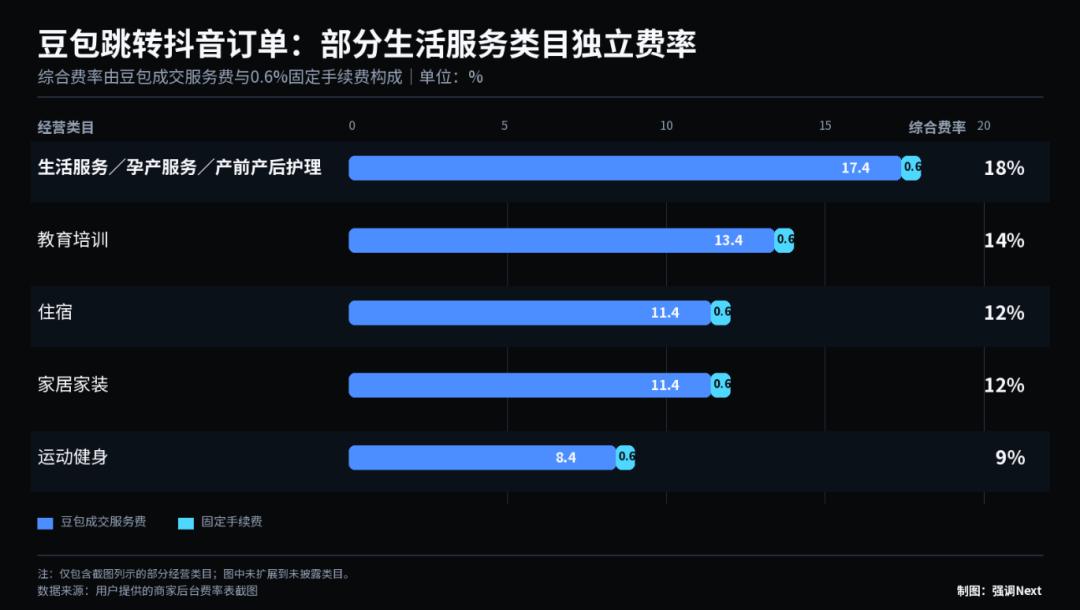
One has started to collect revenue, the other has opened up its platform for ecological expansion. These two pieces of news have once again sparked discussions on "the accelerated commercialization of AI". But this statement is far from sufficient. It cannot explain why ByteDance and Alibaba are heading in two completely different directions, let alone answer the most critical figure: 12%.
1
The unstated detail hidden in the commission rate table
To understand the meaning of 12%, we need to put it back into the whole context first.
For local service orders within Douyin, the software service fee originally ranges from 2.5% to 8%, and the commission rate for the accommodation category was raised from 4.5% to 8% in 2024. That means, for the same hotel order, if a user completes the transaction by clicking into it from Douyin's information feed, the platform will draw a commission of 8%; if the user completes the transaction by redirecting from the Doubao chat interface, the platform will draw a commission of 12%.
For the same merchant, the same hotel room, and the same settlement system, there is a 4-percentage-point difference, and the only difference is that the traffic comes from AI conversations.
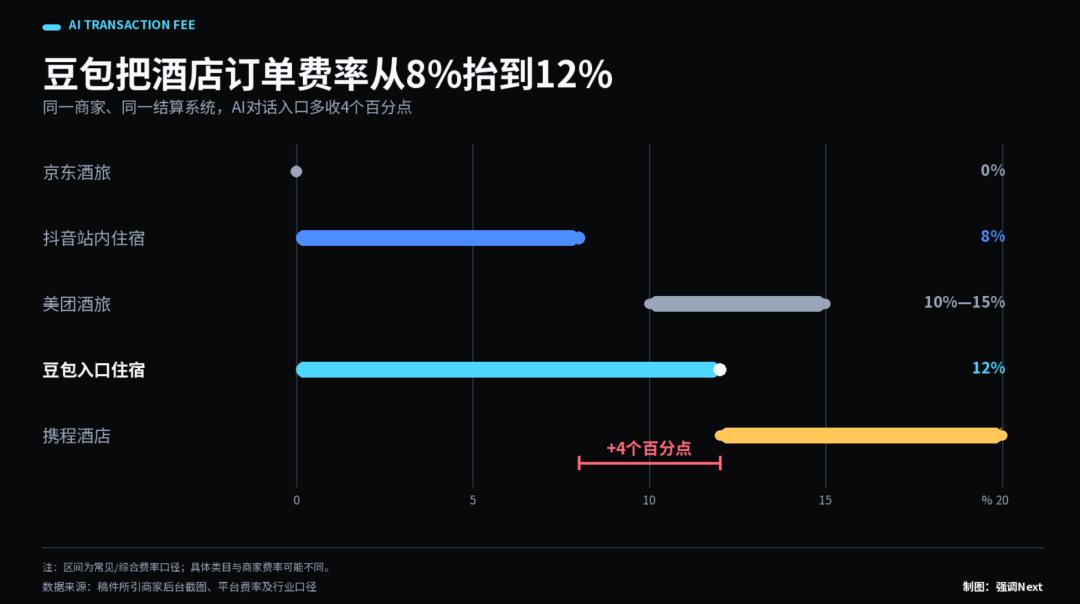
These 4 percentage points are exactly the price ByteDance sets for the "AI recommendation" link. Its reference system is not Meituan's 10% to 15%, but directly aligns with Ctrip's 12% to 20%. With this commission rate, Ctrip has achieved a gross profit margin of around 80%, making it one of the most profitable companies among all internet giants.
ByteDance's pricing logic can only be understood from the nature of the traffic.
Recommendations in the information feed are generated by algorithms guessing user demands, while demands in conversations are explicitly stated by users themselves: "Help me book a hotel with a gym near Guomao this Saturday". This sentence contains clear information about time, location, preference, and explicit willingness to trade.
In the advertising system, the former is called impression, while the latter is called intent. That's why search ads can be an order of magnitude more expensive than display ads. The commission rate table of Doubao is essentially an announcement: ByteDance believes that AI conversation is another traffic form with higher intent density after search, and it refuses to exchange low prices for scale.
There is another detail in the commission rate table. According to the policy publicly released on July 27, the calculation base of the software service fee is "the actual amount paid by users + the amount of subsidies provided by other entities except merchants (such as platform universal coupons)". This means that if ByteDance pays out of its own pocket to issue coupons to users to boost transactions, merchants also need to pay commissions for this part of the subsidy: When the platform carries out marketing activities, part of the cost is transferred to the merchants' bills. This clause is more aggressive than the specific commission rate figure.
2
ByteDance can no longer afford to wait
Pushing the timeline two months forward, the urgency of this rate adjustment can be seen more clearly.
According to a report from *LatePost* in June, Doubao has more than 200 million daily active users, but its daily revenue is less than 1 million yuan, which mainly comes from e-commerce commissions. At the same time, the daily computing power cost consumed by Doubao is as high as tens of millions of yuan.
The cost of only maintaining the normal operation of Doubao exceeds the total operating cost of Bilibili, while the total usage duration of Doubao users is less than one-eighth of that of Bilibili. The daily e-commerce transaction volume generated by Doubao is only around 10 million yuan, and the daily commission revenue is less than 1 million yuan, which cannot even cover a tiny fraction of the computing power bill.
Since the revenue collected in the short term is negligible, the significance of the rate adjustment does not lie in the revenue itself, but in the price setting. ByteDance's capital expenditure plan for 2026 has been raised to more than 200 billion yuan, which is equivalent to about 60% of its 2025 profit. This huge sum of money requires a return path that can be explained to both internal teams and external stakeholders.
There is another widely circulated detail: After ByteDance's senior management visited Anthropic this spring, the company began to adjust its AI resource allocation, shifting the focus from mass consumer products like Doubao to enterprise services. Anthropic has achieved an annualized revenue of 2.5 billion US dollars with 30 million daily active users (as of February), while ByteDance's own video generation model Seedance has reached an annualized revenue of 2 billion US dollars with a gross profit margin of 70%, and its monthly revenue exceeds 1 billion yuan, which almost exactly offsets Doubao's computing power cost.
In this accounting system, Doubao is in an awkward position: it is the segment with the largest user scale in ByteDance's AI strategy, and also the only segment that "spends much but earns little". The significance of the independent commission rate is to reclassify Doubao from a cost center to a "priced asset". The order volume can be small for now, but once the commission rate is written into the merchant contract, it becomes a fait accompli. Every subsequent increase in order volume will be settled at this price.
Pricing first, then waiting for scale. This sequence shows that what ByteDance really cares about is not the current several million yuan of commissions, but the time window for establishing pricing power.
3
Alibaba has to take the opposite path
The Qwen Open Platform launched on the same day takes a completely opposite route: free access, and build the ecosystem first.
This difference has nothing to do with strategic vision, but mainly depends on the resources held by the two companies. ByteDance's local life service supply is ready-made. Behind Douyin Local Merchant Platform are millions of merchants who have already been educated by short videos and live broadcasts. What Doubao needs to do is to connect the traffic to these merchants, and the monetization path only requires one single redirect.
Alibaba's service supply is scattered in separate apps of Ele.me, Fliggy, Amap, Freshippo, and Cainiao. Qwen does not have a ready-made, integrated service pool that can be invoked as a whole. Data from QuestMobile in early August shows that as of June this year, Doubao has 382 million monthly active users, while Qwen has 167 million.
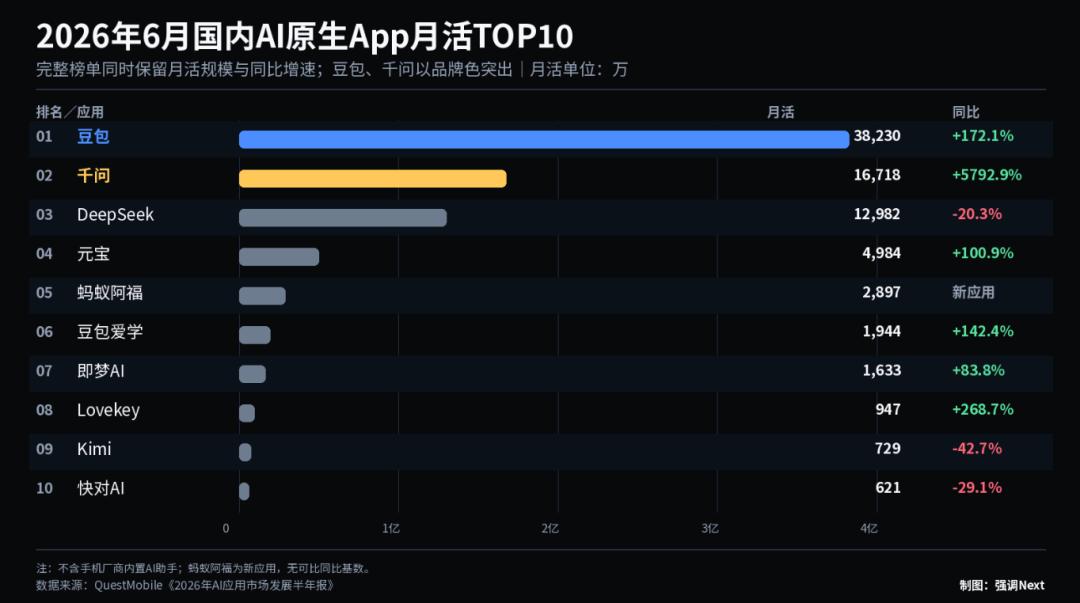
Qwen's traffic lags behind by more than half, and its service supply is not systematic. Under such circumstances, there is no basis to charge fees, and the only feasible strategy is to lower the access threshold to the minimum, and attract third-party service providers first through the infrastructure of "accounts, AI payment, and order access".
What Qwen opened this time is actually a set of brand self-operation tools. It can accommodate multiple service providers in the same field at the same time, reducing the cost for brands to build their own conversation, login, payment and order systems. Brands gain greater operational autonomy, and Qwen also temporarily avoids the conflict of "why the platform recommends A instead of B".
This does not mean that Qwen can only provide low-margin "cloud services", nor does it mean that it will never draw commissions. It just needs these brand merchants to bring user traffic for it for now.
It is worth mentioning WeChat. In June, Meituan and Ctrip have accessed WeChat AI as the first batch of beta testers, and some users began to test functions such as ordering food and checking express delivery with one sentence. The actions of the three major internet giants have been implemented intensively within two months, indicating that the industry has reached a consensus that "AI entry must be connected to transactions", and the only divergence is who will be the first to start charging.
4
Who is paying for this price
The old script of platform competition is: When a new channel enters the market, it uses low commission or even zero commission to attract merchant supply first, and then gradually raises the commission rate after its market share expands. Since entering the travel and hospitality sector, JD has been using a 0% commission policy for three years to attract merchants. When Douyin first entered the local life service sector, its commission rate was only half of that of Meituan. Doubao has broken this script: a brand new channel starts to charge at the highest industry rate from the very first day.
The confidence for ByteDance to do so is that it bets that merchants have no option to "wait and see".
The reality of the travel and hospitality industry is that Ctrip's ecosystem accounts for about 70% of the accommodation booking GMV, with commissions ranging from 12% to 20%. Merchants have long been highly sensitive to channel commission rates, but no one can really withdraw from these platforms.
If AI conversation becomes the primary entry for users to make decisions in the next generation (travel is exactly one of the typical high-frequency scenarios for using AI assistants), the cost of being absent from Doubao will be far higher than the 12% commission, which is the entire basis for ByteDance to set a high price in this time window.
But the real risk also lies here. Doubao's current daily transaction volume is only about 10 million yuan. Converted by its 200 million daily active users, the per capita daily transaction volume is less than 0.05 yuan. If the commission rate is set in advance while merchants remain on the sidelines, and merchants raise prices on the Doubao channel or hide low-cost inventories because of the 12% to 18% commission rate, users will return to Meituan and Ctrip after price comparison, and the experience of the AI entry will be damaged instead.
ByteDance is betting on conversion rate. According to its internal statistics, the conversion rate of Doubao's product cards has exceeded 3%, which is close to the level of ordinary e-commerce websites, but users' affordability for this commission rate still needs to be verified by the subsequent transaction volume.
Looking further ahead, what this round of pricing squeezes may not be Meituan's current orders, but the future profit margins of all intermediaries. When users' consumption intentions are captured in advance in conversations, the roles of Meituan and Ctrip will be gradually pushed to "fulfillment parties", just like how brands gradually gave up their pricing power to Taobao in the past. Where the user intention is captured, the commission right belongs there. This is the real underlying logic behind the 12% figure.
From this perspective, after Qwen, WeChat and other platforms complete their ecological layout, charging commissions will only be a matter of time.
The criteria for measuring the value of AI entry should also be updated.
Monthly active users, daily active users, and invocation volume are all indicators on the cost side. What really determines the profitability of this business is the annualized commissionable transaction volume per user. Doubao's current per capita daily transaction volume is less than 0.05 yuan, and the 12% to 18% commission rate on Doubao's rate table is ByteDance's public bet on how much this figure will rise in the future.
The price has been made public, and the only thing left is to see if there are parties willing to pay at this price continuously.
This article is from the WeChat Official Account "Emphasis Next", Author: Yi Xiu, Editor: Xiao Bai, published with authorization from 36Kr.