Are Chinese AI firms about to usher in a wave of IPOs? Surging by 15 billion USD in two weeks: How did Kimi K3 push the valuation of Moonshot AI to 50 billion USD?
On July 26, the full weights of K3 were released on Hugging Face. Today, the pre-IPO valuation of Moonshot AI has skyrocketed from 35 billion USD to 500 billion USD. This is not a new round of financing, but a re-pricing by the market. However, 5 companies, a 12-month window, and the lingering shadow of Chapter 18A — this drama is far more complex than the $15 billion valuation jump.
On the evening of July 26, Moonshot AI uploaded the full weights of Kimi K3 with 2.8 trillion parameters to Hugging Face. 14 days later, its pre-IPO valuation surged from 35 billion USD to 500 billion USD.
It is not 3.5 billion USD, but 150 billion USD. In 14 days, the valuation increased by 150 billion USD.
But this growth is not exclusive to Moonshot AI — many competitors are crowded on the same track, and there are also many eager, ready-to-advance contenders, with K3 being the most dramatic move. K3 has shown the market the ceiling of open-source large models, and at the same time, it has raised a common exam question for the 5 companies:
"A 12-month window, a $500 billion valuation, the lingering shadow of Chapter 18A — multiple powers vying for supremacy, undercurrents surging, who will have the last laugh?"
I. Valuation rose by 15 billion USD in 14 days, who is the next?
14 DAYS, $15B
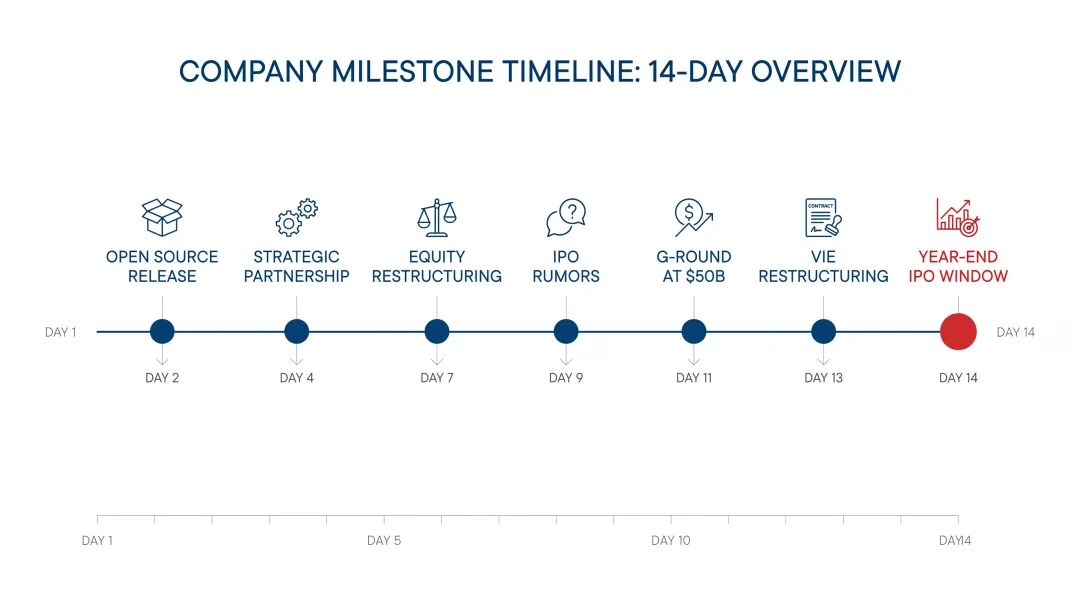
Figure 02|7 events in 14 days — a series of coordinated punches that land one after another
7 events took place in 14 days — when you put them together, they hardly look like a coincidence.
7/26 Full weights of K3 are open-sourced, with 2.8 trillion parameters
7/28 Microsoft officially announced: Access to Microsoft Foundry via Fireworks AI
7/29 Shareholding restructuring (limited liability company → joint stock limited company) + $3.5 billion Series F round, valuation hits 350 billion USD
8/3 Rumors say it will submit its Hong Kong stock listing application as soon as this month; insiders denied the "within this month" claim
August Series G round (Pre-IPO) is launched ahead of schedule, pre-money valuation is 500 billion USD
August Dismantle the offshore VIE structure to pave the way for Hong Kong stock listing
Potential IPO window before the end of the year
Every step paves the way for the next: Open source to earn developer reputation → Cooperate with Microsoft to access North American enterprise clients → Complete shareholding restructuring to fill compliance gaps → Negotiate Series G round to set a new valuation anchor → Wait for the submission window. This is a set of pre-arranged, packaged coordinated operations.
Two curves are galloping in parallel:
▸ Valuation curve: $100 billion at the end of 2025 → Exceed 200 billion in May 2026 → 315 billion in June → 350 billion in July → 500 billion in August — quadrupled in less than a year.
▸ Revenue curve: ARR hit $100 million in Q1 this year → 200 million in May → 300 million in June — the slope is rising simultaneously.
The valuation has risen so sharply not because of empty storytelling, there is an equally accelerating revenue curve supporting it behind the scenes.
The move of K3 not only increased Moonshot AI's valuation by 15 billion USD in 14 days, but also turned the "listing of Chinese AI large model companies" from news into a phenomenon — will the other 4 companies copy Moonshot AI's script next?
II. Why is K3 re-priced by the market?
To justify the $500 billion valuation, K3 has prepared a stack of evidence:
Evidence 1: 4.6x price difference
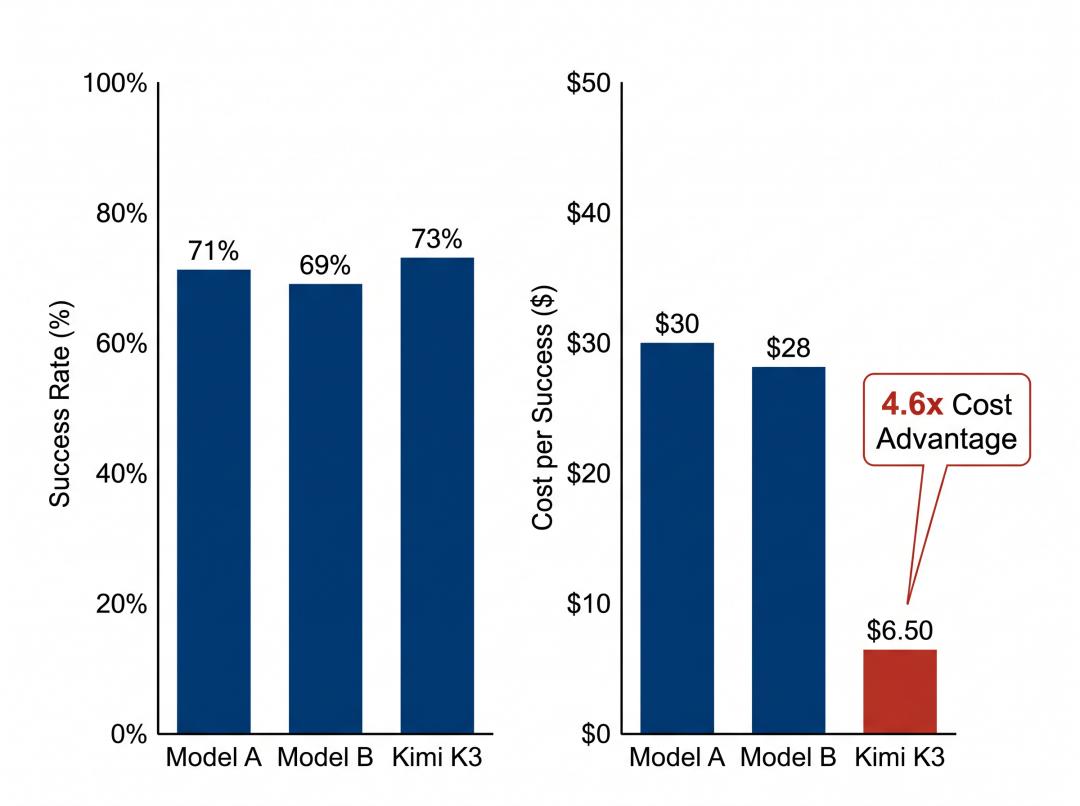
Figure 03|K3 vs GPT vs Claude: 4 percentage points difference in success rate, 4.6x difference in unit cost
Kimi K3 DeepSWE success rate 69% Unit success cost $6.74
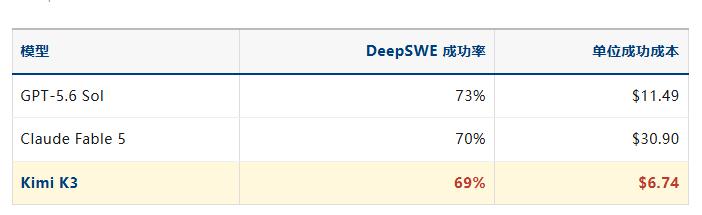
The success rate differs by 4 percentage points, and the unit cost differs by 4.6 times. K3 costs $3 for input, $15 for output, and $0.30 after hitting the cache.
"The question for enterprise users is: For the sake of these last few percentage points, are you willing to pay three or five times more?"
Evidence 2: 2.5x architecture scaling
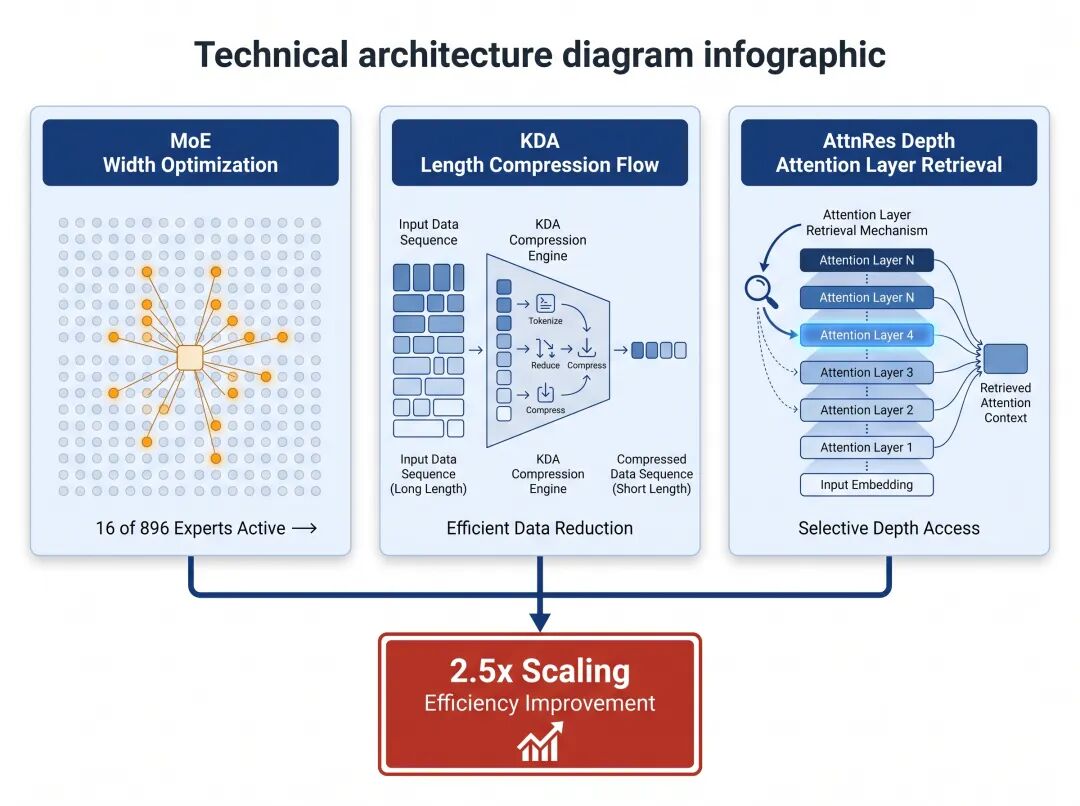
Figure 04|MoE × KDA × AttnRes — The three-piece set brings 2.5x scaling efficiency
The low cost does not come from burning subsidies, but from the architecture:
- MoE expands width
: 896 routing experts, only 16 are selected to work for each token;
- KDA expands length
: Compress history into a fixed state, saving 75% of cache for million-level tokens;
- AttnRes expands depth
: Retrieve historical information every 12 layers, spend 2% more latency in exchange for 1.25x returns.
Combined, the scaling efficiency is 2.5 times higher than the previous generation K2 — the same computing power brings 2.5 times more intelligence.
This low cost cannot be easily reversed in the short term, and OpenAI and Anthropic cannot simply catch up by offering discounts — they have to completely redesign their architectures first.Evidence 3: The "credibility endorsement" of voluntarily exposing shortcomings
K3 did not exaggerate its numbers. It voluntarily wrote in its technical blog: "Our overall capability ranks third" — on the Artificial Analysis intelligence index, Fable 5 is close to 60, Sol is about 59, and K3 is 57; K3's answer accuracy rose from 33% to 46%, but the hallucination rate also rose from 39% to 51%.
A company preparing for secondary market financing is willing to take the initiative to reveal its own flaws at its launch event — this in itself is a "credibility endorsement" for investors.
Evidence 4: The business model sets boundaries for cloud vendors
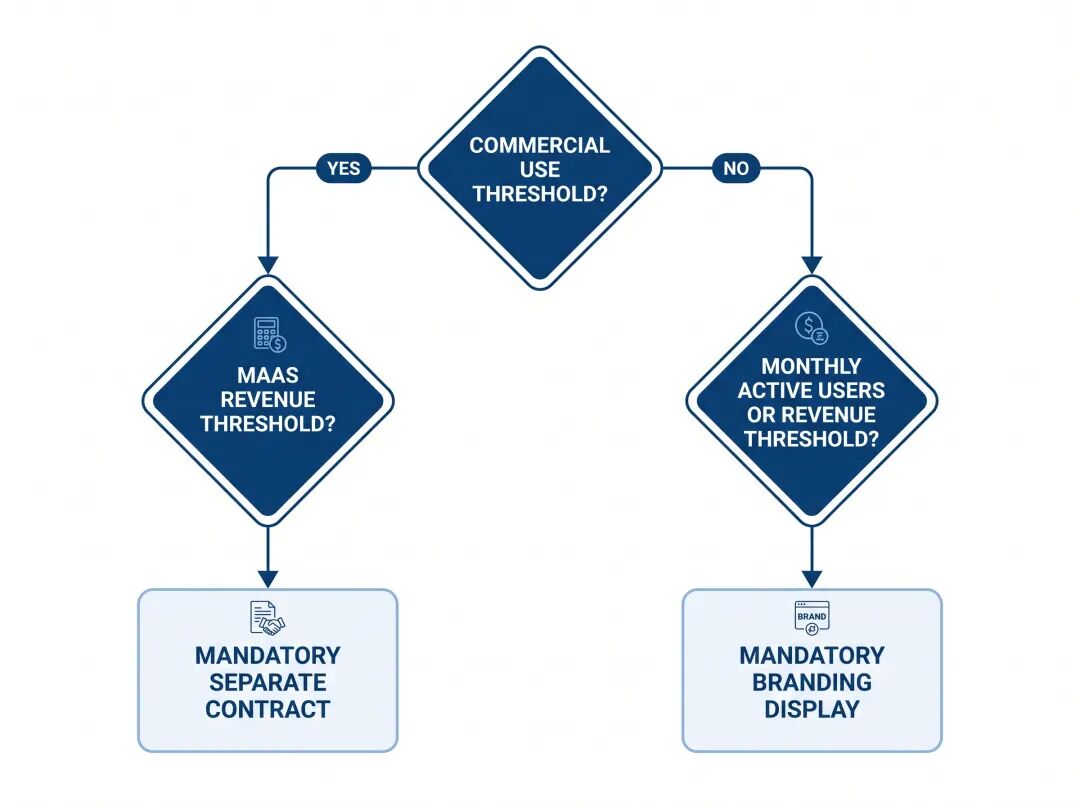
Figure 05|Weights are free, but revenue comes from contracts
MaaS operators with revenue over 20 million USD in the past 12 months must sign a separate contract before commercial use;
Monthly active users exceed 100 million or monthly revenue exceeds 20 million USD — the "Kimi K3" logo must be displayed on the interface.
"Weights are free, but revenue comes from contracts."
Just one week after K3 was released, Alibaba Qwen3.8-Max also followed up and open-sourced its weights — with 2.4 trillion parameters, it is Alibaba's first open-source flagship model at the Max level. Open source is changing from Moonshot AI's single choice to the general strategy of China's large model camp.
Evidence 5: Related party transaction inquiry (the only hidden concern)
However, there is one unvalidated premise in this explanation: Alibaba is not only Moonshot AI's largest shareholder, but also its main computing power supplier — if the computing power pricing is lower than the fair market price, part of the gross margin improvement shown in the prospectus may be profit indirectly transferred by major shareholders through computing power subsidies. The details of this related party transaction can only be verified after the official prospectus is disclosed.
Zhu Xiaohu together with 5 old shareholders including GSR Ventures, Wanjia Capital, Jingya Capital, Boyu Capital and Huashan Capital filed arbitration at HKIAC in November 2024, on the grounds that they did not get the investor exemption letter when Circular Intelligence was spun off — Moonshot AI responded that this claim "lacks legal basis". At the same time, media also reported that Yang Zhilin cashed out tens of millions of dollars after financing, and the company responded that it was part of the "employee incentive plan". The superposition of the two incidents made the market pay more attention to Moonshot AI's corporate governance.
K3 is not the strongest model — but by putting the 5 pieces of evidence together, it tells the market a new narrative that "open source can support a convincing growth story". The question is, can these 5 pieces of evidence justify the $500 billion figure?
III. K3 is just the opening: 4 more companies are queuing up for listing
5 COMPANIES, 1 WINDOW
K3 is a card in Moonshot AI's hand
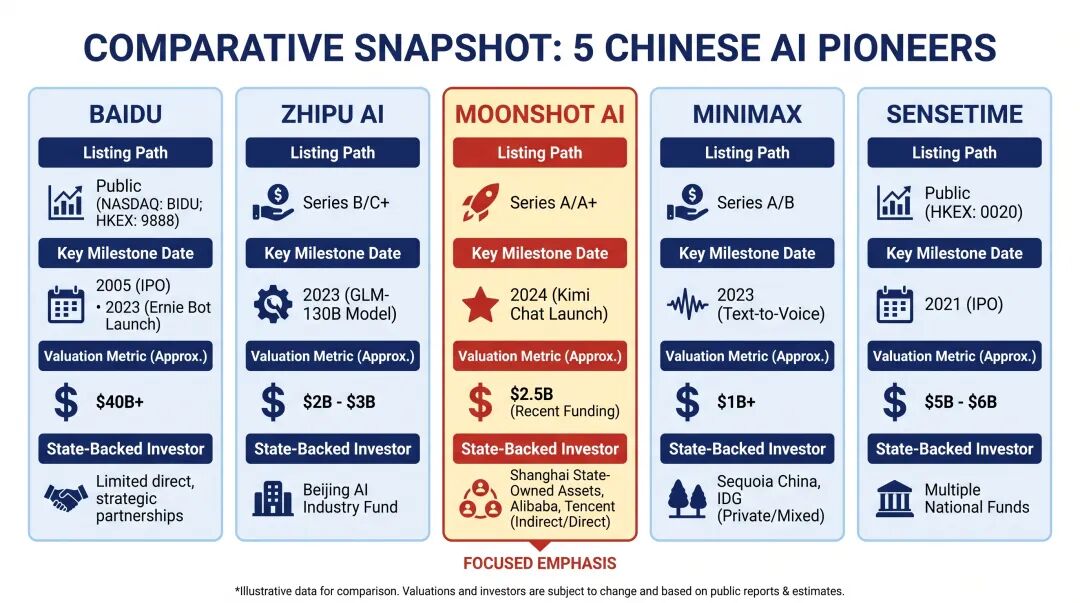
Figure 06|Horizontal comparison of 5 companies — Moonshot AI is highlighted
The entire market is watching 5 companies enter the market at the same time.
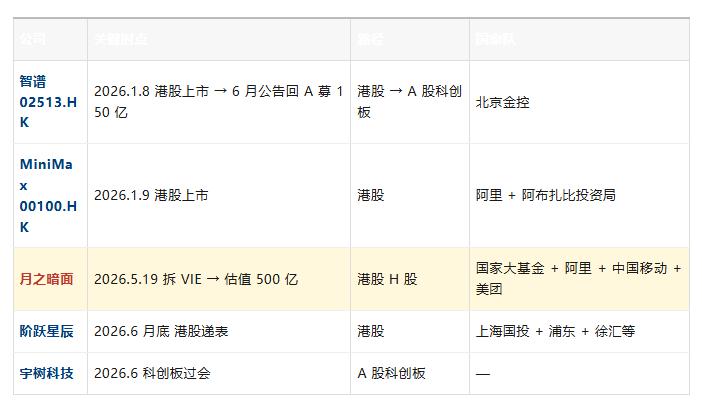
Every company has state-backed capital standing behind it
Zhipu AI is backed by Beijing Financial Holdings Group, Moonshot AI is backed by China Integrated Circuit Industry Investment Fund, StepFun is backed by Shanghai state-owned capital cluster, and MiniMax is backed by Alibaba and ADIA.
What really determines whether a company can go public may no longer be the revenue scale, but who is standing behind it.
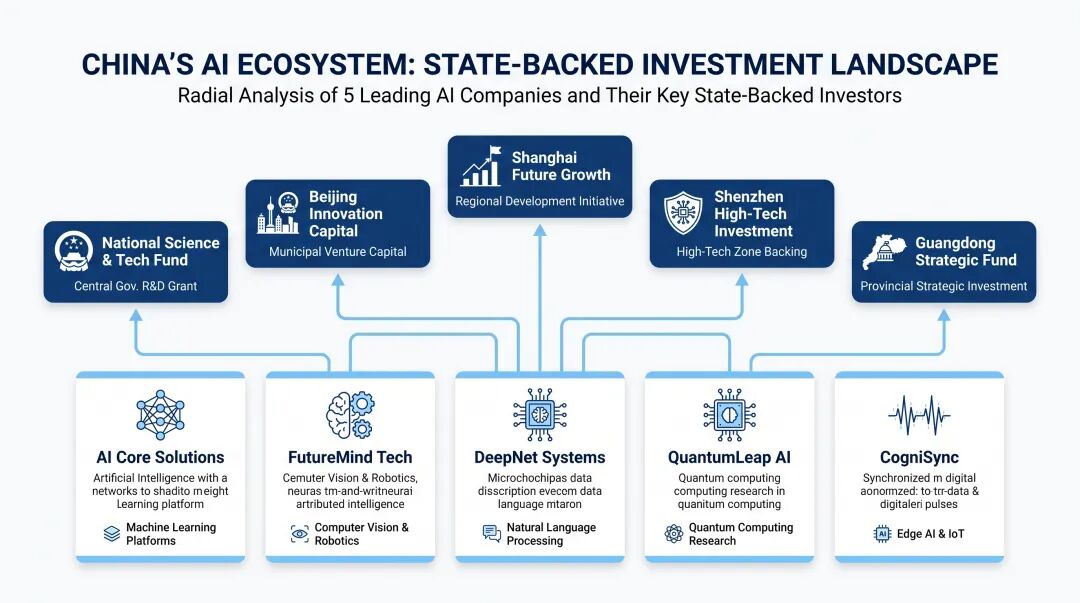
Figure 07|Panoramic view of 5 companies with state-backed capital endorsement
If you break down the moat, the 5 companies are telling 5 completely different stories:
- Zhipu AI
: Has the strongest state-owned capital background, its business model focuses on B/G end clients;
- MiniMax
: Bets on overseas markets and content generation, 70% of its revenue comes from overseas — its moat lies in globalization;
- Moonshot AI
: Uses K3 to play two cards: "cutting-edge capability + open source", breaking through by cost performance;
- StepFun
: Bets on "AI + terminals", deeply cooperates with mobile phone manufacturers and automotive manufacturers;
- Unitree
: Starts from robot ontology, bets on embodied intelligence — it is on a completely different track from the other 4 companies.
5 companies, 5 ways to survive. But they are facing the same exam question: Can the valuation multiple hold up?
Zhipu AI reached a peak of HK$1 trillion in June, then plummeted 70% in July; MiniMax reached a peak of HK$390 billion in March, and has now retreated by 50% — the two already listed companies have provided real samples that "high multiples are unsustainable".
Who will be the next? Moonshot AI, StepFun, Unitree — who will replicate this script?
IV. 12-month window: Why must it be these two years?
5 companies are rushing to go public together,
