AI entertainer, do you think you have a choice?
Recently, three developments in the entertainment and cultural industry are worth observing side by side.
Qi Wei officially announced the launch of her personal digital avatar Han Qingxia, becoming the first active artist in China's entertainment industry to standardize and open AI image authorization. Earlier, Joey Wong authorized NetEase's game World the AI usage right of her portrait during her peak years from 20 to 30, and the short film Qian Ying credited "Joey Wong (AI)" at the end; Ng Kai Wah authorized his 20-year-old portrait right to an AI film for a considerable remuneration reaching the million-yuan level; 93-year-old You Benchang could not support high-intensity shooting due to his advanced age, so he authorized his portrait and voice for the AI micro-short drama Jigong: The Fake Dragon Subduing and served as the art director in person.
Meanwhile, Fang Taozi, the leading actress of the AI short drama The Laid-off Girl, gained more than 400,000 fans 30 days after her debut, and the quotation for video ads longer than 60 seconds reached 258,000 yuan, surpassing a large number of real-life internet celebrities with millions of fans. Duan Yan, the leading actor of the AI comic drama Give You Deep Affection to Invade the Rest of Life, sold bracelets through livestreaming, and the sales of a single product exceeded one million yuan.
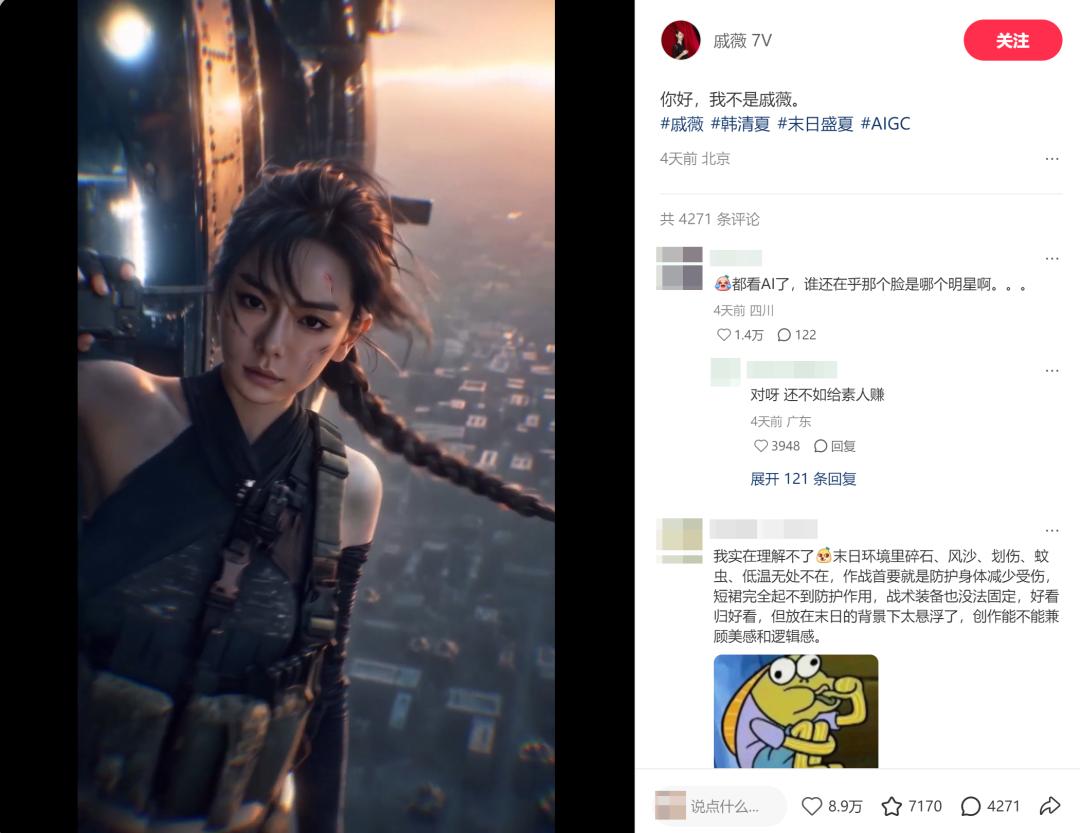
Source: Qi Wei 7V
Whether it is the realistic modeling and digital avatar based on real actors, or completely original virtual characters (AI singers, AI actors, AI virtual idols, AI virtual internet celebrities, AI talk show actors, etc.), Zhixie Island uniformly refers to all of them as AI entertainers in the following content, which points to the same fact: AI entertainers are no longer a concept, they have officially stepped out of the laboratory into the business world and become a proven profitable business.
At present, there are already two completely opposite distinct narratives in the public opinion field. One voice believes that AI will completely end the career of real actors, while the other judges that AI entertainers are just a short-lived boom after all.
Essentially, both of these judgments share the same cognitive framework, that is, regarding AI entertainers as a "to be or not to be" choice, but this framework itself is wrong.
The emergence of AI entertainers is not a choice made by a certain subject, but an inevitable overflow of capital under the three variables of cost, risk and efficiency, and it is a solution that has already been executed.
The real problem of AI entertainers has never been whether to adopt them, but how to deal with them. What is really worth asking is how practitioners can find their own positions as soon as possible in this round of reconstruction? How to delineate the boundaries of industry rules to make competition orderly rather than disorderly? How can the law fill the legal vacuum as soon as possible to ensure that the rapidly developing technology operates on a compliant track?
I. Why are AI entertainers an inevitable result?
There is a fundamental problem in the cost structure of real-person short dramas, that is, each one needs to be built from scratch.
What does that mean? Real-person short dramas involve at least a dozen cost links including pre-planning, script writing, casting, site selection, equipment, crew members, full post-production process, traffic promotion and distribution, and company operation, all of which are indispensable, and each link is a rigid expenditure.
A high-quality 60-episode real-person short drama with 2 minutes per episode costs about 500,000 to 1 million yuan in total. While the overall cost of a high-quality AI short drama of the same scale can be controlled within 200,000 yuan.
This gap means that with the same capital investment, the real-person model can support one project, while the AI model can launch dozens of projects at the same time. If the real-person project fails, 1.5 million yuan will be wasted; but if the AI project fails, the loss is only a few thousand yuan, and you can just change direction and start over.
Rigid expenditure is the first layer of cost, and risk cost is the real leverage. The scandal of real idols is a systematic risk that brands and producers cannot eliminate.
Any unforeseen event such as cheating, tax evasion, drunk driving, or improper remarks may cause tens of millions of yuan of investment to return to zero instantly, and even damage the brand reputation. This kind of risk cannot be priced or hedged, and can only be borne.
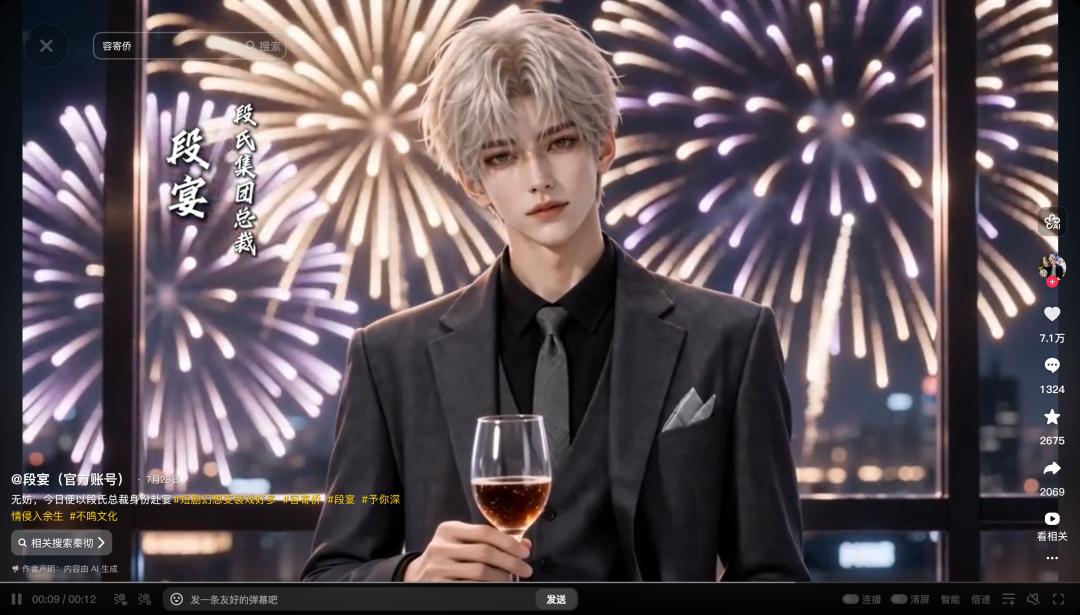
Source: Duan Yan (Official Account)
AI entertainers have no private life, no mood swings, no fatigue, no lateness, let alone posting social media updates at 3 a.m. that evaporate the stock price. For advertisers, this is an almost ideal cooperation target, a 100% controllable asset, rather than a person who may have problems at any time.
Furthermore, even if real actors reduce their own pay and ensure that they are high-quality artists with excellent professional ability and noble ethics, they cannot avoid the capacity constraint.
A 30-40 episode TV series usually takes about 100-130 days to shoot, and the shooting cycle of ordinary TV series is generally 3-4 months. These are usually the time for the cast to join the group. Before joining the group, there are still processes such as costume fitting and script reading, and after the shooting is finished, there are dubbing and reshoots. The production cycle of elaborately made projects is even longer. Therefore, it is already high intensity for real actors to take on 2 to 3 dramas a year, but once an AI character is generated, it can appear in hundreds of dramas at the same time, operate 24 hours a day, 365 days a year without rest.
Therefore, AI entertainers are not replacing real people, but filling the gaps in content production in the time, space and frequency that real people cannot cover. This capacity gap is not at the same level at all, and real people have no power to fight back from the dimensional perspective.
The market has also given a response. According to the Data Report of AI Dramas and Comic Dramas in the First Half of 2026 released by industry research institution DataEye, in the first five months of 2026, the domestic AI short drama market size has exceeded 220 billion yuan, the full-year figure is expected to hit 400 billion yuan, and the user scale has exceeded 600 million in half a year. 62% of paying users are new incremental audiences who did not consume short dramas before.
In other words, AI is not dividing the existing market, but expanding the market boundary.
The capital market also sent synchronized signals. On July 31, the AI application sector of A-share market rose across the board, and many stocks including Kunlun Wanwei, Chinese Online, and Epoint Tech hit the daily limit. Money never lies, it just flows to the place with the highest rate of return after accurately calculating the return on investment.
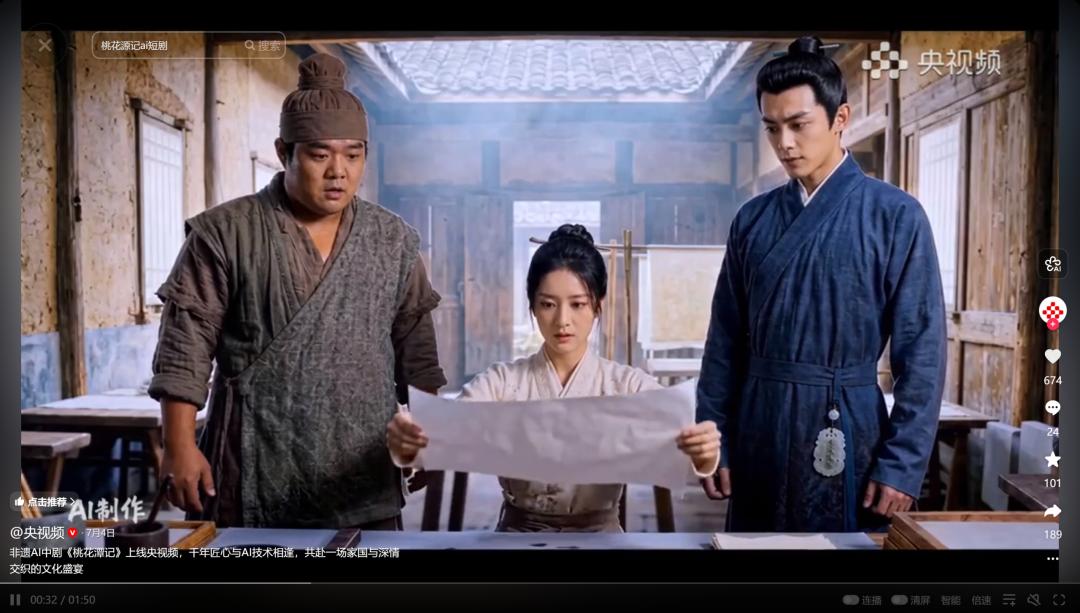
Source: Yangshi Shipin
What is most noteworthy is actually the change on the channel side. On July 22, Anhui TV broadcast the full-AI produced drama The Story of Taohuatan in the prime time at night, which is the first AI-generated drama broadcast on a satellite TV in China.
The so-called "satellite TV broadcast" means that the content is transmitted to TV stations across the country through satellite signals for broadcast. In the past, this channel was only open to traditional film and television production content. The move of Anhui TV means that AI-generated audio-visual content has obtained the same broadcast qualification and communication channels as real-person film and television for the first time, stepping from online platforms to mainstream TV media, and the non-mainstream traffic product has completed its identity transition to a mainstream official communication carrier.
According to Coolyun Data, the premiere rating of The Story of Taohuatan was 0.0349%, ranking 33rd nationwide; three days later, after five episodes were broadcast consecutively, the rating rose to 0.1067%, ranking 10th nationwide in the post-prime time slot. In the local Anhui market, the drama had an average rating of 0.669% and a market share of 9.855%, ranking first among all channels in Anhui in the same time period.
The decision-making logic of TV stations is completely consistent with that of capital. Advertising revenue has been declining year after year, and the procurement cost of top dramas remains high. AI dramas provide an acceptable alternative at a very low price.
This is reflected in the specific business model as the completion of a closed commercial loop.
The path of Fang Taozi fully presents the monetization chain of AI entertainers: the drama becomes popular, the character gains wide recognition, social accounts are cultivated, and advertising cooperation is implemented. According to the data of Juliang Xingtu, the quotation of Fang Taozi's 1-20 second video is 168,000 yuan, 21-60 second video is 208,000 yuan, and video longer than 60 seconds is 258,000 yuan. This price has surpassed a large number of real-life internet celebrities with millions of fans.
After all, what brands buy is the reach efficiency and the attention behind the playback volume. It does not matter whether the character is real or not, as long as the numbers on the data dashboard are real.
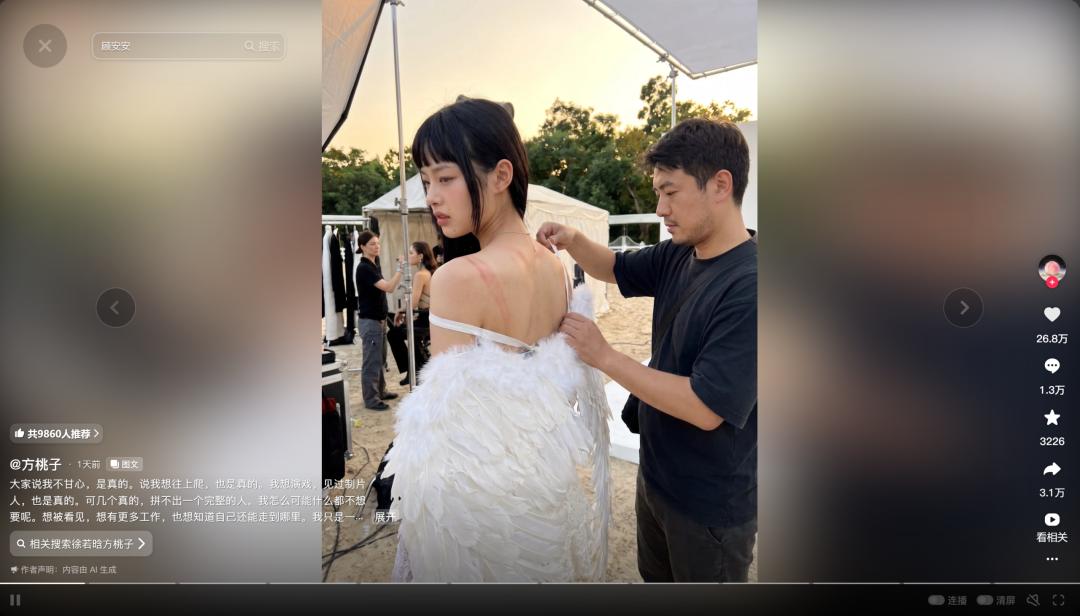
Source: Fang Taozi
Therefore, AI entertainers are an inevitable product of development, and the logical chain is clearly visible: the cost drops sharply, the risk is almost zero, and the production capacity tends to be infinite. After the three factors are superimposed, market verification, capital inflow, channel opening, and commercial closed loop are formed in sequence.
This is the optimal solution for all rational decision-makers under the current constraints, which has nothing to do with who chooses AI, nor does it consider who does not choose AI.
When the cost of a technology is 1% of that of its competitors, the risk approaches zero, and the production capacity is 100 times higher, its existence no longer needs anyone's approval.
II. The problem of AI entertainers is not AI at all
The most concentrated criticism of AI entertainers in the public opinion field eventually points to the same problem: serious homogenization.
Specifically, it is concentrated in two aspects: homogenized plots and similar character images. These two criticisms seem powerful, but they cannot stand scrutiny in fact.
First of all, for the plots, open any short video platform, and the themes of AI short dramas are highly concentrated. The "counterattack" theme ranks as the most popular type, followed by realistic themes such as urban daily life and modern life. Rebirth, overbearing president, revenge, and cultivating immortality constitute the main narrative themes of current AI short dramas.
But a basic fact is ignored: plot homogenization has never been a problem of AI, but an inevitable product of market efficiency.
The real-person film and television industry has repeatedly verified the same rule for 20 years. When ancient costume idol dramas become a hit, the whole industry rushes to shoot ancient costume idol dramas; when realistic themes win awards, the whole industry crowds into realistic themes. When a drama becomes popular, similar themes will be launched in clusters in the next three years, which is the normal state of the industry, and has nothing to do with whether AI is used or not.
The theme selection direction of real-person short dramas and AI short dramas is highly convergent. AI dramas still mainly copy the popular themes in the real-person track, and what AI does is just to repeat the 20-year path of the real-person industry at a faster speed.
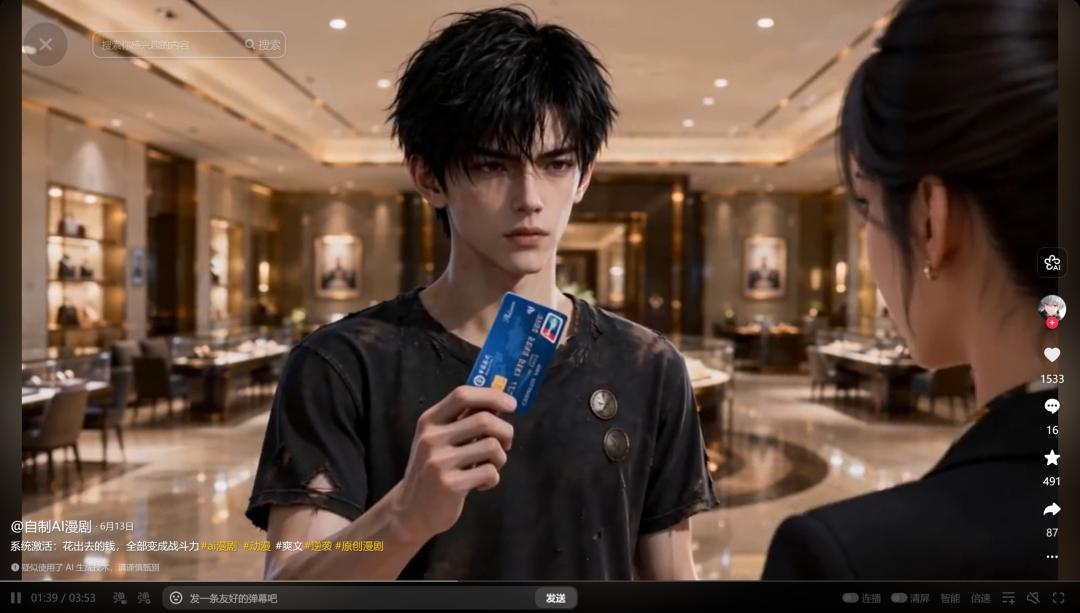
Source: Self-made AI comic drama
The root of the problem is not AI, but traffic. The algorithm identifies what kind of content can get high clicks, high completion rate and high conversion, and capital will flow to that type accordingly.
The Creation Guidelines for Micro Short Dramas released by China Netcast Association in the second quarter of 2026 pointed out that "the unique advantages of AI dramas in surreal setting, theme expansion and narrative innovation need to be further released". Translated, this sentence means that it is not that AI can only make these types of content, but that the market currently only rewards these types of content.
However, some changes are taking place in the market. Since male audiences account for 73% of AI short drama viewers, which forms a differentiated layout from the traditional short drama audience structure dominated by women, types that have not been fully developed for a long time due to the high cost of real-person special effects, such as cultivating immortality, post-apocalyptic, science fiction, and rule mystery, have gained the possibility of low-cost implementation with AI generation technology.
The director of The Laid-off Girl integrated his own modeling experience from 20 to 27 years old into the script, choosing a rare realistic workplace theme in AI short dramas, and the proportion of female audiences rose to 78%. The differentiation of themes has already begun, but the public's attention is still focused on the top hits.
Then for the character images, open any AI short drama, the male and female protagonists almost share the same set of facial templates: sharp jawline, thin lips, awe-inspiring eyes; oval face, big eyes, glowing skin. Between different dramas, the characters look like the same person just changing clothes. The related entry of "physiological disgust towards AI faces" once became a hot search on Weibo.
Critics say all AI faces look the same. But why? The root lies in three levels: data, algorithm and cost.
At the data level, AI's aesthetic is not innate, but trained by data.
At present, the most widely spread content on the Internet is mainly heavily edited internet celebrity portraits and Korean drama shots. A large amount of homogenized beauty materials are repeatedly fed to the model. When generating human faces, the AI model plays a probability game, which moves closer to the statistical average of all human faces, smoothing out the niche and extreme facial features. For example, drooping eye corners are gentler and less aggressive than upturned eye corners; blurred jawline is less error-prone than sharp jaw angle.
Many AI video models have absorbed a large number of Korean film and television materials during the training process, resulting in the generated characters naturally carrying a certain regional aesthetic mark. It is not that AI does not want to generate different faces, but that it has only learned these features.