Alibaba and Meituan are locked in a fierce head-to-head battle over the front-warehouse track.
Dark stores are simultaneously "oversupplied" and "undersupplied".
Dark stores in busy commercial districts are opening at an increasingly dense pace, and operators have unsurprisingly fallen into low-price and homogenized cutthroat competition. Even so, Alibaba and Meituan are still continuously expanding their store networks to compete for stable, controllable near-field supply capacity.
This competition is not only about store network density and delivery speed, but also about the dominance of the next generation of urban retail infrastructure.
#01
Franchisees Pour In As Platforms Accelerate Dark Store Expansion
Since renting the underground floor of a residential community to become a flash dark store owner four months ago, Xiao Yu has barely had a full good night's sleep.
What wakes her up every morning is the notification tone of "You have a new order". She needs to quickly locate goods from more than 5,000 SKUs, finish packing within 3 to 5 minutes, and wait for the delivery rider to pick up the parcel.
She is reluctant to hire extra staff, and only occasionally gets help from family members in the store. She has invested hundreds of thousands of yuan, but the average daily order volume is only over 100, with profits barely covering normal operating costs. To boost order volume and get more traffic, she can only use 1-cent Red Bull and Coca-Cola to attract customers, and the more she sells, the more she loses.
Xiao Yu has done some research on dark stores. With the help of a friend, she once identified a fraudulent investment scheme posing as JD and withdrew her investment in time. But during her project selection process, all kinds of pitches like "platform endorsement, traffic support, limited quota, seize the trend the earlier you enter" still made her act on impulse and put in hundreds of thousands of yuan.
The warehouse is rented, the shelves are full, the system is launched, and the nightmare begins. "I thought I was smart back then and didn't pay that over 20,000 yuan fee. Later I found out that the tuition I paid was not less at all." Xiao Yu said.
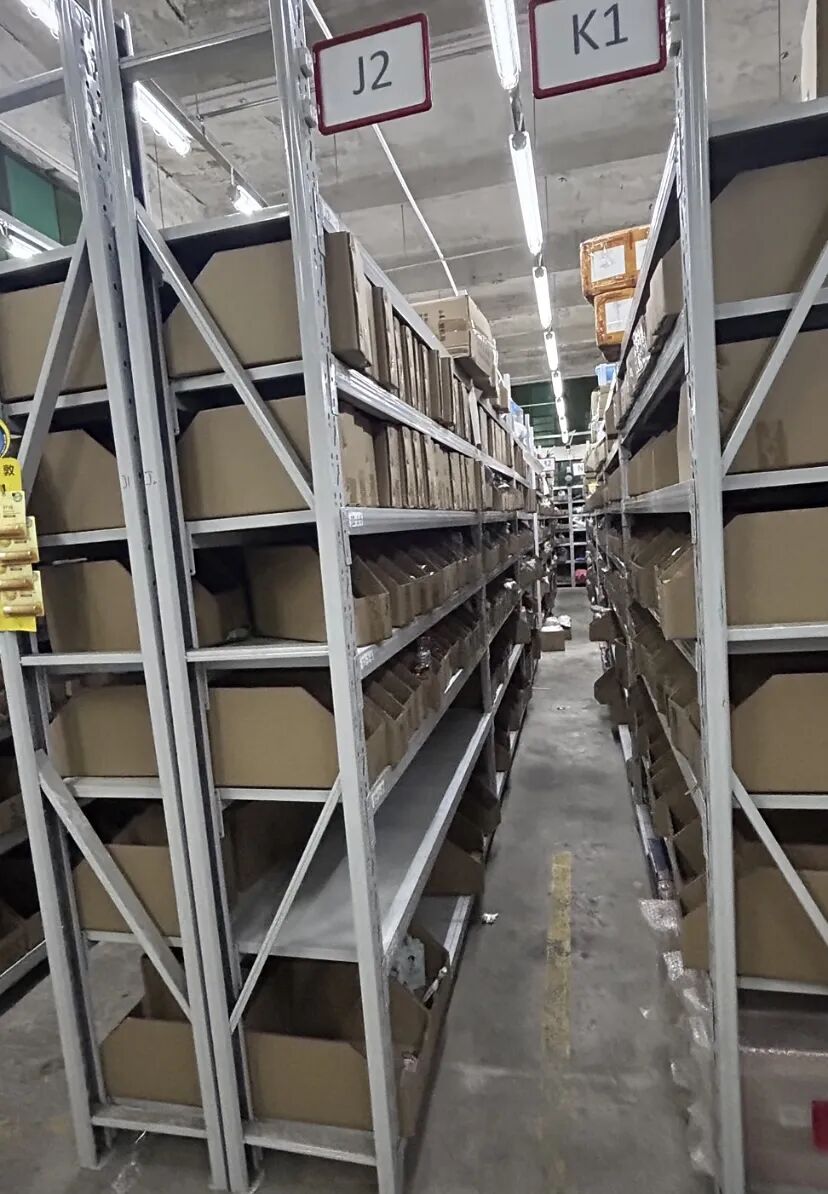
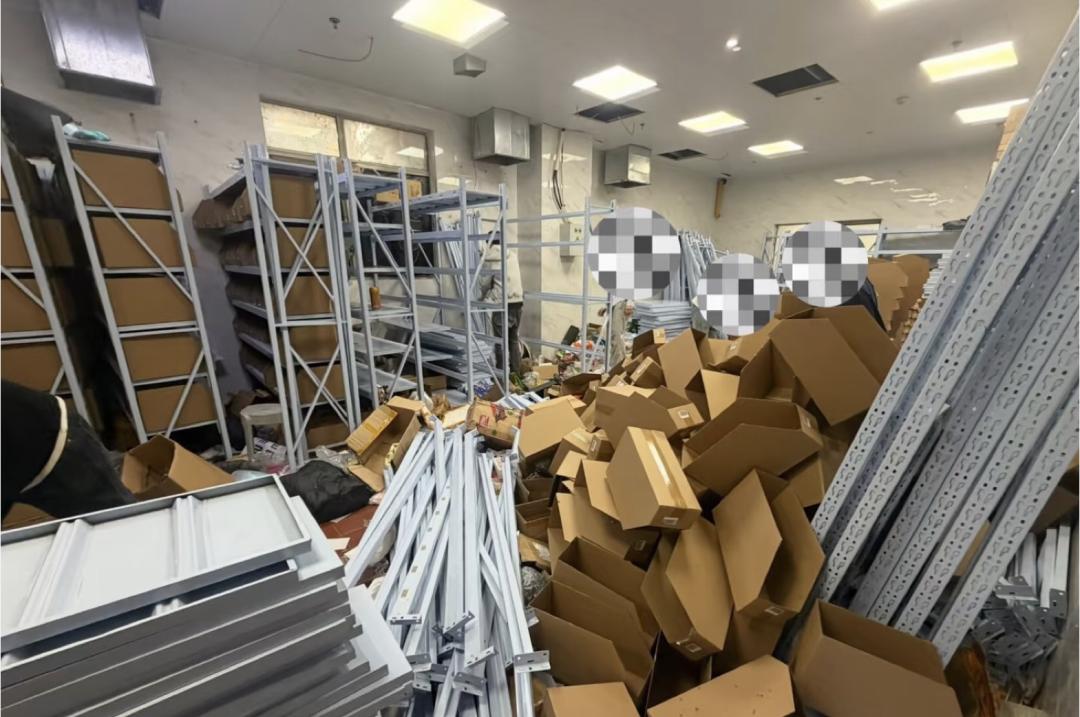
Figure | A corner of a flash dark store
What Xiao Yu operates is a flash dark store, a new type of dark store. The platform provides traffic, transaction system and instant delivery, while merchants are responsible for investing in store construction, purchasing goods and daily operation.
As both e-commerce and food delivery have entered a high-penetration stage, instant retail has become a new growth space that Alibaba and Meituan must fight for. Instant retail requires goods to be placed in advance near consumers. The denser the dark store network is, the closer the goods are to consumers, and the more instant consumption scenarios the platform can cover.
However, a dense store network requires a large amount of capital. If relying entirely on self-operation, the platform will not only bear rent, labor and inventory costs, but also face commodity loss and a long payback period for each single store. Franchise, brand authorization and socialized flash dark stores have thus become important fulcrums for platforms to achieve rapid expansion.
In less than two years, the number of flash dark stores on Meituan has increased from about 5,000 to tens of thousands, and the platform plans to exceed 100,000 stores by 2027. Taobao Flash Purchase and JD are also accelerating their layout, attracting more operators to enter the market with brands, traffic and subsidies.
The expansion story of platforms is also attracting batches of entrepreneurs.
A Ming is a post-2000s generation young person, who joined a flash dark store brand last July. The brand side advertised that monthly income could exceed 10,000 yuan, the cost could be recovered immediately after opening, and the headquarters would provide full-process agency operation. The other party also showed her cases of other people, claiming low cost, high return and easy to be a boss.
After the official opening, she found that the so-called headquarters agency operation barely existed. She had to figure out how to put goods on shelves by herself, pay for brushing orders for traffic promotion, and the full-process responsibility promised by the brand side became a dead letter.
She alone needs to take charge of picking goods, inventory management, after-sales service, and changes of platform rules. The number of staff in the store, which was originally standard 6 to 7 people, has been reduced to 3 people. Pickers have to walk 20,000 to 30,000 steps per day, work 12-hour shifts, with no fixed off-duty time.
The initial investment only calculated water and electricity fees, rent, franchise fees and purchase fees, but the invisible costs are the majority under the iceberg: the platform charges 15% to 20% commission, 0.1-yuan drainage products are everywhere, promotion fees are spent like running water, but the order volume does not rise accordingly. Sometimes the gross profit of a single order cannot even cover the rider's delivery fee.
The store has been operating for nearly a year, 700,000 yuan has been invested, and 300,000 yuan has not been recovered yet.
The dilemma of franchisees is not caused by a single factor. The operator's own judgment, the investment promotion and service capabilities of the franchised brand, as well as the platform's traffic rules and expansion mechanisms all play a role. It is not caused by any single party, but it is a cost that must be faced in the process of rapid expansion of instant retail infrastructure.
#02
Meituan and Alibaba, Reaching the Same Goal via Different Paths
Meituan and Alibaba are still continuously expanding their dark store networks.
From the perspective of operators, flash dark stores in some busy commercial districts have been over-dense, and low-price competition and product homogenization are becoming increasingly serious; but from the perspective of platforms, dark stores that can truly provide stable and differentiated supply are still insufficient.
A large number of warehouses does not mean sufficient effective supply. What the platform needs is a near-field retail network with wider coverage, more accurate inventory, richer categories, and certain supply control capabilities.
Frequent store closures are not the result that platforms are willing to see. It will lead to unstable supply, affect inventory accuracy and consumer experience, and also increase investment promotion and operating costs.
Therefore, on the one hand, Alibaba and Meituan use socialized flash dark stores to expand coverage, on the other hand, they establish model stores through self-operated businesses and platform brands, supplement product categories and raise supply standards.
Take Meituan first. At present, the daily order volume of Meituan's non-catering instant retail has exceeded 18 million orders. Some analysts say that the number of flash dark stores has reached about 60,000, and the rider network has covered nearly 3,000 counties and cities across the country.
What Meituan is doing is not just "delivering goods to homes", but increasingly deeply participating in "what goods are delivered to homes", and stacking more controllable supply on the platform.
At the innermost layer, Xiaoxiang Supermarket is the core carrier of Meituan's self-operated fresh food and grocery retail. In the past three months, Xiaoxiang Supermarket has newly opened in 14 cities, mainly covering the third-tier prefecture-level city market. It is reported that Xiaoxiang Supermarket's target total number of warehouses will reach about 2,000 by the end of 2026.
At the same time, Meituan plans to acquire Dingdong Maicai. The transaction is still pending for the completion of closing conditions such as anti-monopoly review. Dingdong operates more than 1,000 dark stores in China, has more than 7 million monthly purchasing users, and has origin direct procurement, private brand and mature fresh food supply chain capabilities.
In the middle layer is Songshu Convenience, which focuses on daily convenience, urgent night use and travel scenarios. Meituan provides unified brand, product standards and after-sales service, and cooperative merchants bear the store investment. At present, it has more than 1,000 stores in 100 cities, and is testing the integrated model of store and warehouse.
In addition, there are other vertical category dark stores led by Meituan, such as Waima Wine Delivery which focuses on alcohol products, covering party, banquet and urgent night use scenarios with a small number of SKUs. According to media reports, Meituan is also testing the adult products instant retail brand LOVELAB in some cities to further explore vertical scenarios.
At the outermost layer are socialized flash dark stores, which are operated by retailers, brand owners and entrepreneurs, responsible for rapidly expanding coverage. Meituan provides traffic, site selection, digital system, product analysis and delivery capabilities. According to the previously announced "Fanxing Plan", Meituan expects the number of flash dark stores to exceed 100,000 by 2027.
Meituan does not need to turn all stores into self-operated ones, but it must have a number of controllable model stores, so that it can figure out what products are most suitable in what commercial districts, at what time periods, and with what inventory depth, and export this operation knowledge back to platform merchants.
If Meituan is moving towards the product side along the delivery chain, Alibaba is moving the originally distant e-commerce product inventory to the side of consumers.
Traditional Taobao and Tmall are built on express networks and national large warehouses. Merchants do not need to prepare inventory in every city, and consumers are willing to wait two or three days. Instant retail has changed this logic. The shareholder letter from Joseph Tsai and CEO Wu Yongming has officially positioned instant retail as "the core strategic pillar for the comprehensive upgrading of Taobao and Tmall platforms".
Taobao Convenience Store is the most concentrated embodiment of Alibaba's platform-oriented path. In October 2025, Taobao Flash Purchase launched "Taobao Convenience Store", adopting the brand authorization model: store assets are owned and operated by cooperative merchants, and the platform provides brand, traffic, supply chain, digital system, product selection suggestions and delivery support.
The advantage of this model is fast expansion, which can connect the huge traffic pool with socialized flash dark stores and offline stores. Alibaba can also import the product supply of 1688 and Taotian into local warehouses, so that the "far-field e-commerce" which originally takes several days to arrive can obtain near-field fulfillment capabilities.
Hema and Tmall Supermarket have also become Alibaba's self-operated anchors for near-field retail. Hema has both physical stores and the capability of integrated store and warehouse, and is now supplementing independent dark stores to improve coverage density and delivery efficiency. When it entered Taiyuan recently, it chose to open stores and warehouses at the same time. Tmall Supermarket is also opening dark stores to realize 4-hour delivery, and developing the private brand of "Tmall Supermarket Selection".
Recently, rumors of Alibaba's acquisition of Pupu have continued to ferment. Pupu has high-density dark stores and regional supply chains in markets such as Fujian and Guangdong, with strengths in fresh food, daily consumption and localized operation. At present, some stores of Pupu in Fuzhou have begun to pilot entry into Taobao Flash Purchase. However, products, warehousing and delivery are still undertaken by Pupu's existing system.
Meituan starts from instant delivery and controls goods upward along the fulfillment chain; Alibaba starts from e-commerce product inventory and builds local inventory downward along the transaction chain. The two paths seem opposite, but the end points are getting closer and closer: both need to build supply nodes around consumers that are dense enough, with visible inventory and capable of minute-level fulfillment.
#03
Instant Retail Has Determined Demand, But Uncertain Return
The last retail format that big companies bet heavily on was community group buying. Now that platforms are betting heavily on instant retail, will it repeat the mistakes of community group buying? The two are different.
Lao Zhang, author of The History of Instant Retail, believes that community group buying is essentially closer to discount retail, and was later replaced by more efficient formats such as snack discount stores. Instant retail is not a specific format, but a long-term demand of consumers for fast and convenient purchase of goods. A certain dark store model may fail, but the direction of instant retail will not disappear because of this.
The Instant Retail Industry Development Report (2025) released by the Ministry of Commerce Institute of Commerce predicts that the scale of China's instant retail market will exceed 1 trillion yuan in 2026 and reach 2 trillion yuan by 2030. However, the determined market space does not mean that the platform's return is determined, let alone that the franchisee's return is determined.
Meituan emphasizes supply control more, so in self-operated businesses such as Xiaoxiang Supermarket, it needs to bear higher costs of store network construction, inventory and operation. Once the order density is insufficient or the expansion is too fast, the payback period of heavy assets will be extended. At the same time, self-operated businesses and platform merchants are in the same traffic field. How to ensure the fairness of traffic distribution, commission rules and business data usage will directly affect merchant trust.
Alibaba's risks mainly come from the open ecosystem. Different merchants have different levels of products, services and in-warehouse management, which easily leads to uneven quality control, inaccurate inventory data and out-of-stock problems after placing orders. At the same time, different businesses under Alibaba have their own goals, organizational systems and benefit distribution mechanisms. If collaboration cannot be truly implemented, the scale of the ecosystem may not be able to translate into a stable consumer experience.
What platforms face is whether the entire dark store model can work, while what franchisees face is whether a single store can survive. The pressure falls more directly on rent, inventory and cash flow.
For franchisees, one store can usually only cover 3 to 5 kilometers around, the demand does not multiply, but more and more stores are opening. Products are mostly similar, merchants can only grab orders by price reduction, subsidies and investment in traffic, and finally fall into the cycle of "no orders without promotion, losing money after promotion". Rising delivery fees, thousands of yuan more spent on promotion, or several batches of expired goods may eat up all profits.
In the peer WeChat group where A Ming is, someone quits the group every day. From more than 100 people at the peak, there are only a dozen people left now.
Some people transfer inventory at a 15% discount, and even give away shelves for free but no one takes over; some people invested 800,000 yuan but the store only operated for two months; some people changed three brands, lost 600,000 yuan, and finally only left a warehouse full of unsalable expired goods.
Zhang Bo has worked in a warehousing leasing company for more than three years, specializing in the rental business of community warehouses. After flash dark stores became popular, the company's occupancy rate once rose to over 90%. But now the last thing he wants to receive is a rent surrender call.
"Since the second half of last year, almost every week there are flash dark store tenants saying they want to surrender their rent." Zhang Bo flipped through the rental records on his mobile phone, "Some stores couldn't hold on for less than three months after opening, and some closed directly before recovering the first batch of payment for goods."
What makes Zhang Bo more headache are people who disappear without even saying hello: their phones are turned off, WeChat messages are not replied, and there are still tens of thousands of yuan worth of goods piled up in the warehouse. Once, a tenant ran away after owing three months of rent, and the company spent two weeks just cleaning up the warehouse.
Zhang Bo's company is recently considering adjusting the leasing policy, shortening the lease term, increasing the deposit, and adding credit review. He said: "It's not that we want to make things difficult for customers, but the elimination rate of flash dark stores is too high. The risk of tenants running away eventually becomes our cost."
Now every time Zhang Bo shows a new customer the warehouse, he will ask an extra question: "Do you know how fast stores close in this industry?"
After operators exit, the losses do not disappear, but flow along the chain to landlords, suppliers and employees. The store network density obtained by platforms is partially built on the continuous trial and error and exit of a large number of small and medium-sized operators.