Shanghai is taking follow-up actions, and the renewal of industrial and commercial land use rights is expected to be accelerated!
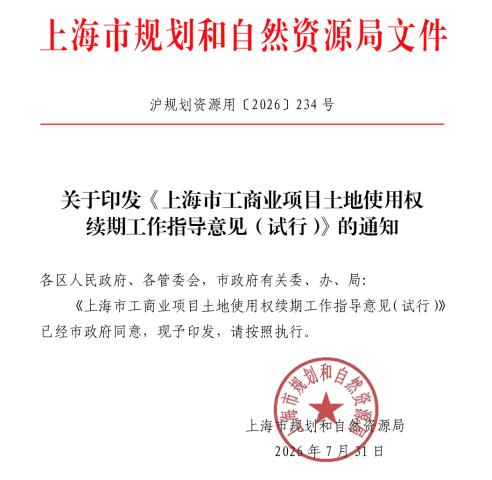
On July 31, 2026, the Shanghai Municipal Planning and Natural Resources Bureau issued the Guiding Opinions on the Renewal of Land Use Rights for Industrial and Commercial Projects in Shanghai (Trial), making Shanghai the second first-tier city after Guangzhou to systematically implement the industrial and commercial land renewal policy.
In July 2024, the Third Plenary Session of the 20th Central Committee of the Communist Party of China reviewed and adopted the Decision of the Central Committee of the Communist Party of China on Further Deepening Reform Comprehensively to Advance Chinese Modernization, explicitly proposing to "formulate policies for the extension and post-expiry renewal of industrial and commercial land use rights". In March 2026, the Outline of the 15th Five-Year Plan further emphasized "improving laws and regulations on the renewal of industrial and commercial land use rights, and steadily promoting renewal work in accordance with the law". After the central government made clear arrangements for relevant work, many regions accelerated the exploration and implementation of industrial and commercial land use rights renewal policies.
In April 2026, Guangzhou issued the Guiding Opinions on Further Promoting the Market-oriented Allocation Reform of Industrial and Commercial Land, and publicly released the Pilot Scheme for the Renewal Management of Industrial and Commercial Land Use Rights in Guangzhou on May 12, becoming the first first-tier city in China to implement systematic and refined rules for the renewal of industrial and commercial land use rights. This time, Shanghai followed up and issued the Guiding Opinions on the Renewal of Land Use Rights for Industrial and Commercial Projects in Shanghai (Trial) (hereinafter referred to as the "Guiding Opinions"), and the institutional framework for the renewal of industrial and commercial land use rights in the two major first-tier cities has been initially established.
Different from the operation manual positioning of Guangzhou's "Pilot Scheme", Shanghai's Guiding Opinions adopts a more flexible institutional design path, taking "taking renewal as the norm, non-renewal as the exception, and fully renewing according to the needs of enterprises" as the working principle, emphasizing district-level overall planning and performance orientation, and reserving space for the subsequent improvement of detailed rules.
Specifically, the innovations and highlights of Shanghai's Guiding Opinions are mainly reflected in three aspects:
The policy is more proactive, and Shanghai explicitly puts forward "taking renewal as the norm, non-renewal as the exception" and "fully renewing where eligible". The scope of application is wide (including public welfare land such as education, science and technology, culture, and health). In terms of pricing mechanism, Shanghai chooses a flexible model of "bottom line control + district-level decision-making", clarifying that the renewal price shall not be less than 70% of the benchmark land price as a rigid bottom line, requiring all districts to make good use of the "performance linked to land price" mechanism, and make collective decisions on renewal prices, taking into account both institutional rigidity and policy implementation accuracy.
In terms of capital synergy, Shanghai has opened a green channel for projects planning to issue REITs, which can simplify the verification of high-quality projects and complete the renewal before registration after REITs declaration, breaking the land tenure bottleneck in REITs issuance.
The operation and implementation are more flexible, Shanghai continues the "flexible tenure system" for industrial land (generally 20 years, 50 years for major projects), and at the same time allows different right holders of the same land parcel to set different renewal tenures, and arrangements such as full payment within one year without interest for industrial storage land, leaving greater flexible space for enterprises in terms of renewal tenure and payment rhythm.
Table: Comparison of core points of industrial and commercial land use rights renewal policies in Shanghai and Guangzhou
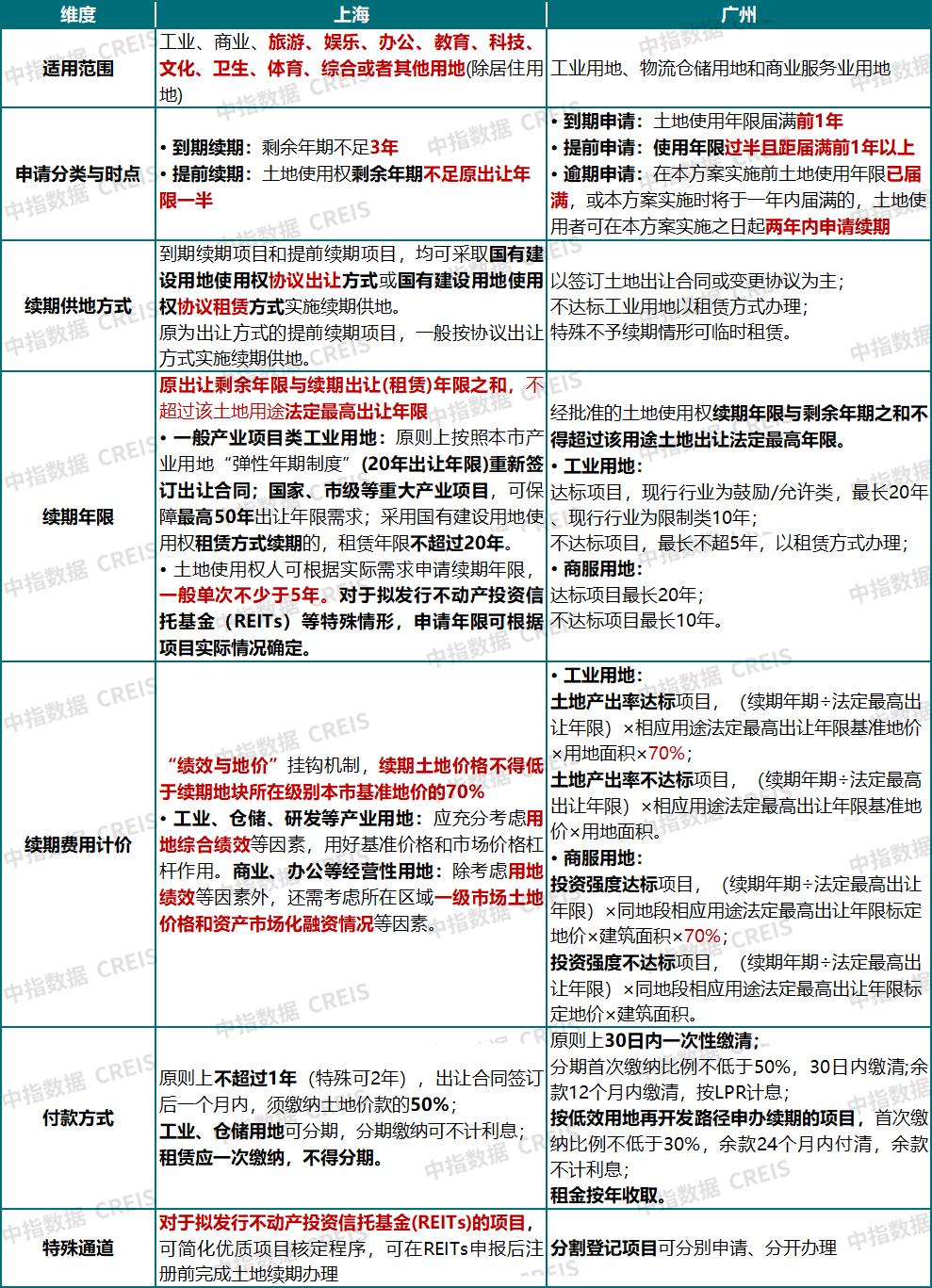
Source: Comprehensive collation by China Index Academy
The current Shanghai policy and Guangzhou policy mainly have the following similarities and differences:
First, the scope of application of the renewal policy is broader, the Guiding Opinions defines the scope of application as "the renewal of state-owned construction land use rights for industrial, commercial, tourism, entertainment, office, education, science and technology, culture, health, sports, comprehensive or other land (excluding residential land) in this municipality, collectively referred to as the renewal of land use rights for industrial and commercial projects". This scope covers all types of state-owned construction land except residential land, which is wider than that of Guangzhou (limited to three categories: industry, logistics storage, and commercial service industry);
Second, the Guiding Opinions divides renewal projects into two categories: expiry renewal projects and advance renewal projects. Compared with the three categories of Guangzhou (application upon expiry, application in advance, overdue application), Shanghai relaxes the application window for expiry renewal to "less than 3 years remaining", which is more lenient than Guangzhou's "1 year before expiry". At the same time, Shanghai sets a "high-quality project" threshold for advance renewal, and the support for high-quality projects is more obvious. However, Shanghai has not stipulated on overdue renewal projects this time, which remains to be further clarified by policies in the future;
Third, the renewal tenure is basically consistent with that of Guangzhou, which clearly stipulates that a single renewal shall not be less than 5 years. The Guiding Opinions clarifies that "the sum of the remaining tenure of the original transfer and the renewal transfer (lease) tenure shall not exceed the legal maximum transfer tenure for the land use purpose", which is basically consistent with the requirements of Guangzhou's policy. At the same time, it clarifies the lower limit of renewal tenure, pointing out that a single renewal shall not be less than 5 years; in addition, Shanghai points out that "for special circumstances such as planning to issue Real Estate Investment Trust Funds (REITs), the application tenure can be determined according to the actual situation of the project", providing more flexible support for REITs projects. It is worth noting that Guangzhou's policy has detailed division of renewal tenure for different situations, and the specific implementation method in Shanghai remains to be clarified by subsequent detailed rules;
Fourth, the renewal price is determined by each district according to local conditions. Different from Guangzhou's method of clearly defining the pricing formula by layers and categories, Shanghai adopts the "bottom line control + district-level decision-making" model, taking the renewal price not less than 70% of the benchmark land price as a rigid constraint, and the specific pricing is determined by each district according to local conditions to establish the work rule of "performance linked to land price".
Fifth, negotiated lease is an important land supply method for renewal. Shanghai sets up two land supply methods for renewal: negotiated transfer and negotiated lease, which enterprises can choose independently. Guangzhou mainly adopts negotiated transfer, and lease is used as the handling method for substandard industrial projects or non-renewal, while the renewal tenure of the lease method is shorter (maximum no more than 5 years).
Sixth, clearly support REITs issuance. The Guiding Opinions points out that "projects planning to issue REITs can simplify the verification procedure of high-quality projects, and complete the land renewal procedures before registration after REITs declaration", which means that renewal can be carried out in parallel with REITs review, will not constitute a pre-issuance obstacle, and also help to break the land tenure bottleneck in REITs issuance.
On the whole, Shanghai and Guangzhou represent two different policy implementation paths. Guangzhou's "Pilot Scheme" is biased towards operation manual-style refined arrangements, providing detailed provisions on renewal tenure, renewal cost calculation and other aspects; Shanghai is more biased towards the principled framework, and the specific implementation is still dominated by district-level regulations, providing more flexible operation space. In terms of fee concessions, Guangzhou adopts the differentiation method of "70% of the price for qualified projects, full price for unqualified projects", while Shanghai adopts a flexible mechanism of "no less than 70% of the benchmark land price" bottom line linked to performance, emphasizing more precise policy implementation for each enterprise. In terms of payment arrangements, Shanghai is relatively lenient (up to 2 years, interest-free installment for industrial land), which is more friendly to enterprise cash flow.
From the perspective of policy impact, through the institutional arrangement of "fully renewing where eligible", Shanghai's policy is conducive to eliminating the expectation of asset depreciation caused by uncertain ownership after the expiration of industrial and commercial land, and the valuation dilemma that the shorter the remaining tenure, the greater the depreciation is expected to be broken, which will directly benefit the valuation of core assets, help revitalize existing assets, and also help improve the activity of bulk transactions; at the same time, for REITs projects, allowing land renewal to be completed before registration after declaration solves the pain point of underlying asset tenure in REITs issuance, making high-quality assets that were originally difficult to be included in the pool due to insufficient tenure re-qualified for securitization. Combined with the more flexible renewal tenure policy given to projects planning to issue REITs this time, all will benefit the projects planning to issue REITs.
In addition, this industrial and commercial land use rights renewal policy in Shanghai will also bring benefits to urban renewal. Financial institutions will relax the mortgage assessment and credit approval for renewal projects, which is conducive to reducing the capital cost of renewal projects, providing support for projects planning to issue REITs, and also conducive to further attracting social capital to participate in urban renewal.
With the two major first-tier cities of Shanghai and Guangzhou successively implementing systematic industrial and commercial land renewal policies, the industrial and commercial land renewal policy is expected to be accelerated across the country in the future.
This article is from the WeChat Official Account "China Index Academy", author: China Index Research, published with authorization by 36Kr.