The month-on-month rise in residential rents across 50 cities has widened, with first-tier cities registering a 0.38% increase.
In July, rental demand surges amid the college graduation season, pushing the national housing rental market into its traditional peak season. The average residential rent across 50 key cities continues to rise, with the month-on-month growth further expanding. First-tier cities keep leading the rent growth, among which Shanghai has topped the 50 cities in month-on-month increase for 4 consecutive months; representative second-tier, third-tier and fourth-tier cities also begin to show a trend of halting decline and stabilizing.
Expanded Month-on-Month Growth of Residential Rents in 50 Cities
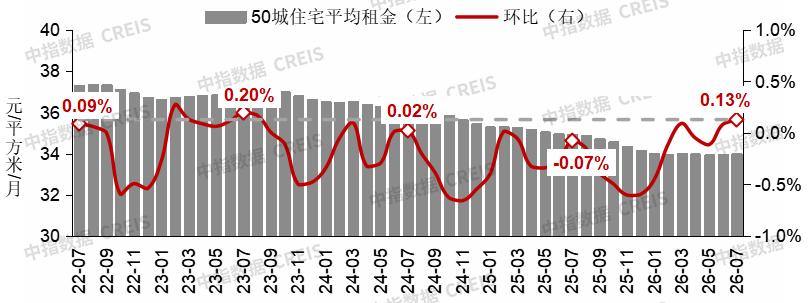
According to the 50-city residential rental price index released by the China Index Academy, in July, the average residential rent of the 50 cities reached 34.01 yuan/square meter per month, with the month-on-month growth expanding to 0.13%; it dropped by 2.62% year-on-year, narrowing the decline by 0.20 percentage points compared with June. As the core month when rental demand is concentratedly released during the graduation season, a large number of college graduates enter the rental market, continuously driving up the activity of the housing rental market in key cities and boosting the listing confidence of property owners.
After continuous adjustments over the past few years, the downward space for rents in key cities has narrowed significantly, with upward momentum accumulating. Driven by seasonal effects in the short term, the rent rebound in July is at a relatively high level in the same period of recent years, only slightly lower than the level in July 2023 (the month-on-month rent increase in July 2023 was 0.20%).
Figure: Average Residential Rent and Its Month-on-Month Change in 50 Cities
Data Source: CREIS by China Index Academy
First-tier Cities Continue to Lead Rent Growth, While Other Representative Cities Show Stabilizing Rent Trend
In July, the average month-on-month rent trend of cities at all tiers is steadily improving. According to the monitoring data of China Index Academy, in July, the average rent of ordinary residential properties in first-tier cities continued to rise, up 0.38% month-on-month, with the growth rate remaining the same as that in June. The average rent of representative second-tier, third-tier and fourth-tier cities gradually stabilized. Specifically, the average residential rent in second-tier cities dipped slightly by 0.01% month-on-month, with the decline narrowing for two consecutive months; the average rent of representative third-tier and fourth-tier cities ended the 24-month consecutive adjustment trend, turning to a 0.02% increase.
Figure: Monthly Month-on-Month Fluctuation Trend of Average Residential Rent in Cities at All Tiers
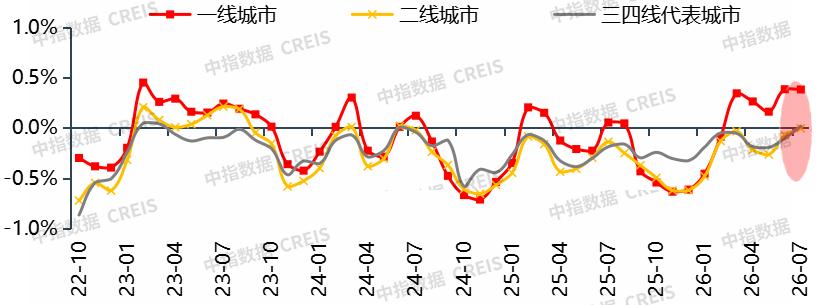
From the perspective of cumulative rent change since the start of this year, the rent recovery momentum in first-tier cities continues to strengthen. From January to July 2026, the average rent in first-tier cities increased by 0.98% cumulatively, that in second-tier cities decreased by 1.21% cumulatively, and that in representative third-tier and fourth-tier cities decreased by 0.77% cumulatively. On the whole, the rent changes of cities at all tiers are better than the same period last year. Among them, the rent recovery signal in first-tier cities is the most obvious, with the average rent turning from decline to rise; the rent decline of representative second-tier, third-tier and fourth-tier cities has narrowed compared with the same period in 2025. The effect of the college graduation season is actively released in the short term, and the rent recovery momentum of first-tier cities with strong attractiveness to highly educated talents continues to strengthen.
The Consecutive Rising Trend of Rents in Core Cities Is Further Clarified
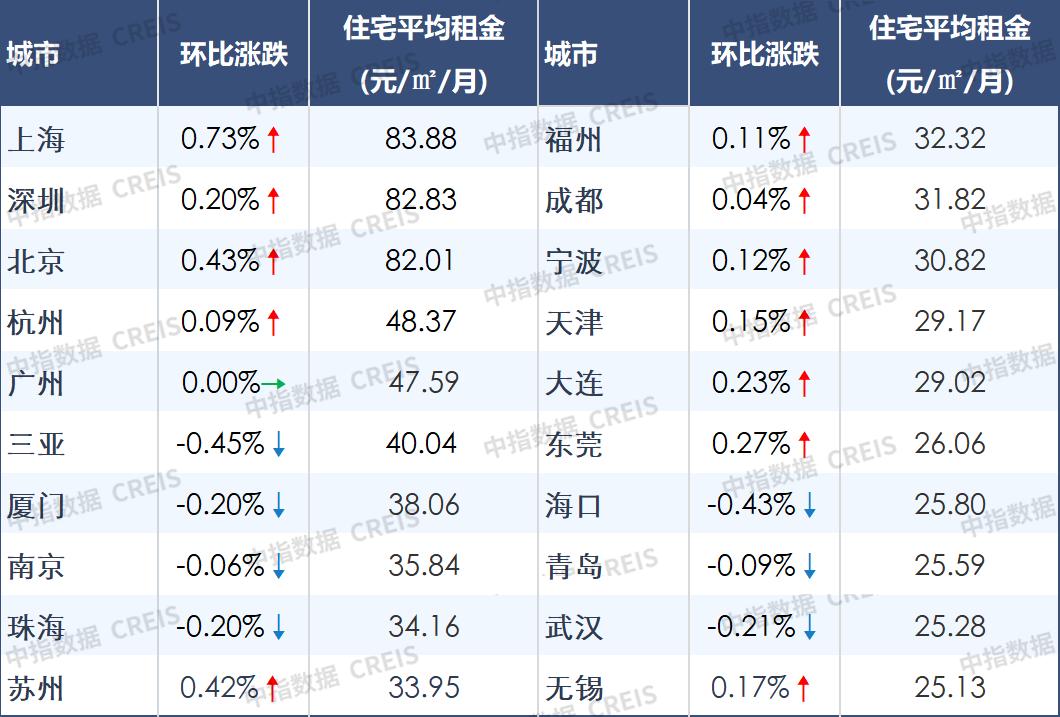
According to the monitoring of China Index Academy, in July, residential rents in the 50 cities saw 24 cities up, 25 down and 1 unchanged, with the number of cities with rising rents increasing by 8 compared with June. Among the top 20 cities in residential rent, 12 cities recorded month-on-month increase, 2 more than that in June. Rents in Shanghai, Beijing, Shenzhen, Hangzhou, Suzhou and other places continued to rise, rents in Chengdu and Ningbo turned from decline to increase, and the rent in Guangzhou remained flat month-on-month.
Looking at the performance of specific cities, as of July, residential rent in Tianjin has risen for 6 consecutive months, while that in Shanghai, Beijing and Shenzhen has risen for 5 consecutive months. Shanghai has topped the 50 cities in rent growth for 4 consecutive months, the rent growth in Beijing has expanded compared with June, and rents in Suzhou, Hangzhou and other places have also maintained a continuous upward trend in recent months. The rent recovery trend in core cities is further clarified.
Table: Performance of Top 20 Cities in Residential Rent among 50 Cities in July 2026
Looking at the internal rent performance of cities, the widespread rent increase across all districts in Shanghai continues, and the number of districts with rising rents in Beijing, Shenzhen and Guangzhou has increased significantly. In July, residential rents in all 16 municipal districts of Shanghai rose month-on-month, among which the month-on-month growth in Hongkou and Huangpu exceeded 1%, and the rent growth in Jing'an, Minhang, Yangpu, Pudong New Area, Xuhui and other districts also exceeded 0.5%. In Beijing, residential rents in 15 municipal districts rose and 1 fell, with the number of districts with rising rents increasing by 5 compared with June, and the month-on-month growth in Xicheng, Haidian, Dongcheng, Mentougou and other districts ranks top across the city. In Shenzhen, residential rents in 7 districts rose and 2 fell, with rent growth leading in industrial concentration areas such as Guangming, Bao'an, Futian or residential blocks adjacent to industrial clusters, and only Nanshan and Pingshan districts saw a slight rent decline. In Guangzhou, residential rents in 8 municipal districts rose and 3 fell, with the number of rising districts increasing by 4 compared with June, driving the average rent of the whole city to turn from decline to flat, and the growth in rigid demand residential areas such as Baiyun and Conghua ranks top.
Rents in Core Cities Are Expected to Continue Rising Supported by Rental Demand of Families with School-Age Children
The window period for concentrated release of graduation season rental demand in August is coming to an end, and the overall market heat will decline compared with July, but the accumulated recovery momentum in the early stage will still support the rent resilience in key cities, and the residential rent in the 50 cities will most likely show an overall stabilizing trend.
By city, first-tier and strong second-tier cities with solid industrial foundation, strong population absorption capacity and high-quality concentrated educational resources, including Beijing, Shanghai, Shenzhen, Guangzhou, Tianjin, Hangzhou, Suzhou, Chengdu, etc., are expected to maintain a rising rent trend driven by graduation season demand and rental demand of families with school-age children; most ordinary second-tier, third-tier and fourth-tier cities are still under adjustment pressure due to sufficient supply and other factors, but the downward space has narrowed significantly.
On the whole, differentiation will remain the main theme of the rental market. In August, the housing rental market will most likely continue the pattern of "overall stabilization, structural differentiation, and continued rent growth in first-tier cities". (All data in this article are sourced from CREIS by China Index Academy)
This article is from the WeChat Official Account "China Index Academy", and is authorized for release by 36Kr.