An epic public feud is unfolding in the AI circle, with the two heads of Codex and Claude Code openly trading insults with each other.
The two leads of Codex and Claude Code have fallen out completely.
A wave of developer account bans eventually evolved into a large public "spat" between the two Coding Agent leaders from OpenAI and Anthropic.
The dramatic part of the incident is that almost every possible plotline played out between the two sides:
The lead of OpenAI's Codex taught users step by step how to embed GPT-5.6 Sol into the "shell" of its competitor Claude Code, which was an extremely provocative move. On the other side, Claude Code was by no means a pushover: a month later, a developer who followed the tutorial found his Anthropic account suddenly suspended.
Tibo publicly questioned Anthropic on X, and Boris Cherny, the head of Claude Code, immediately stepped forward to clarify in person.
But the first thing Boris did was not to explain the account ban, but to directly ask Tibo: Would you like to come work at Anthropic?
Tibo not only rejected the offer, but also immediately reset all the quotas for Codex and ChatGPT Work users.
Behind this seemingly playful public spat in the Silicon Valley tech circle, an increasingly critical issue has been exposed:
For the real competition of Coding Agent in the future, will it be a competition of models, or a competition of Harness?
Incident Retrospective
The story dates back to July 12.
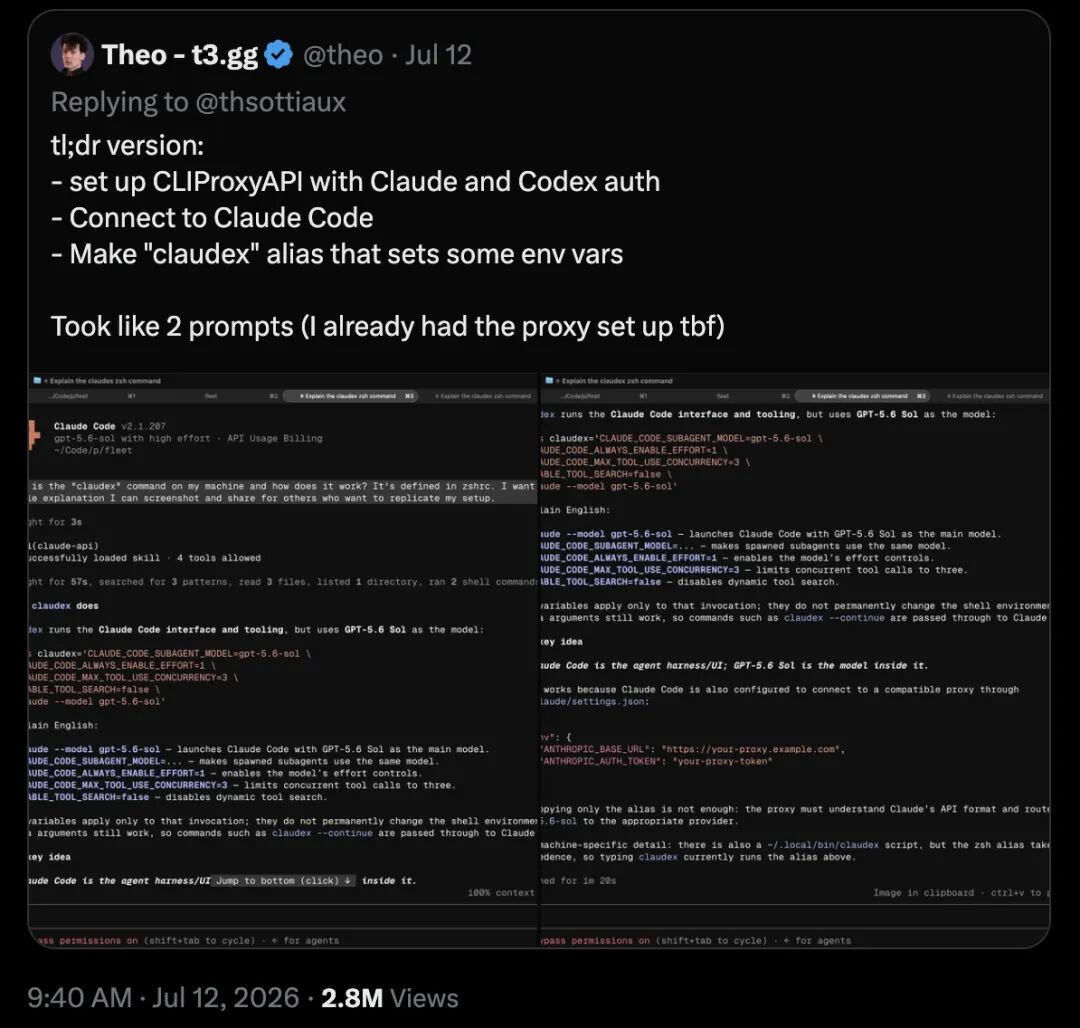
When developer Theo discussed GPT-5.6 Sol on X, he put forward a very interesting observation: the same GPT-5.6 Sol, when run in the Claude Code environment, performed even better on some tasks than when run in Codex.
In other words, the model itself did not change, what changed was the outer Agent harness. Then Tibo started to ask about the specific configuration method, and publicly shared the implementation the next day.
The Tibo here, full name Thibault "Tibo" Sottiaux. According to official OpenAI information, he is currently in charge of Codex, and serves as the lead of OpenAI's Software Engineering Agent.
On July 12, Tibo told developers on X that if you don't want to install the Codex App for the time being, you can stay with that "orange crab" — namely Claude Code — and let it call GPT-5.6 Sol.
The whole configuration can be completed in "five minutes".
More interestingly, he left a sentence at the end of the post:
If this method gets blocked, I owe everyone a reset.
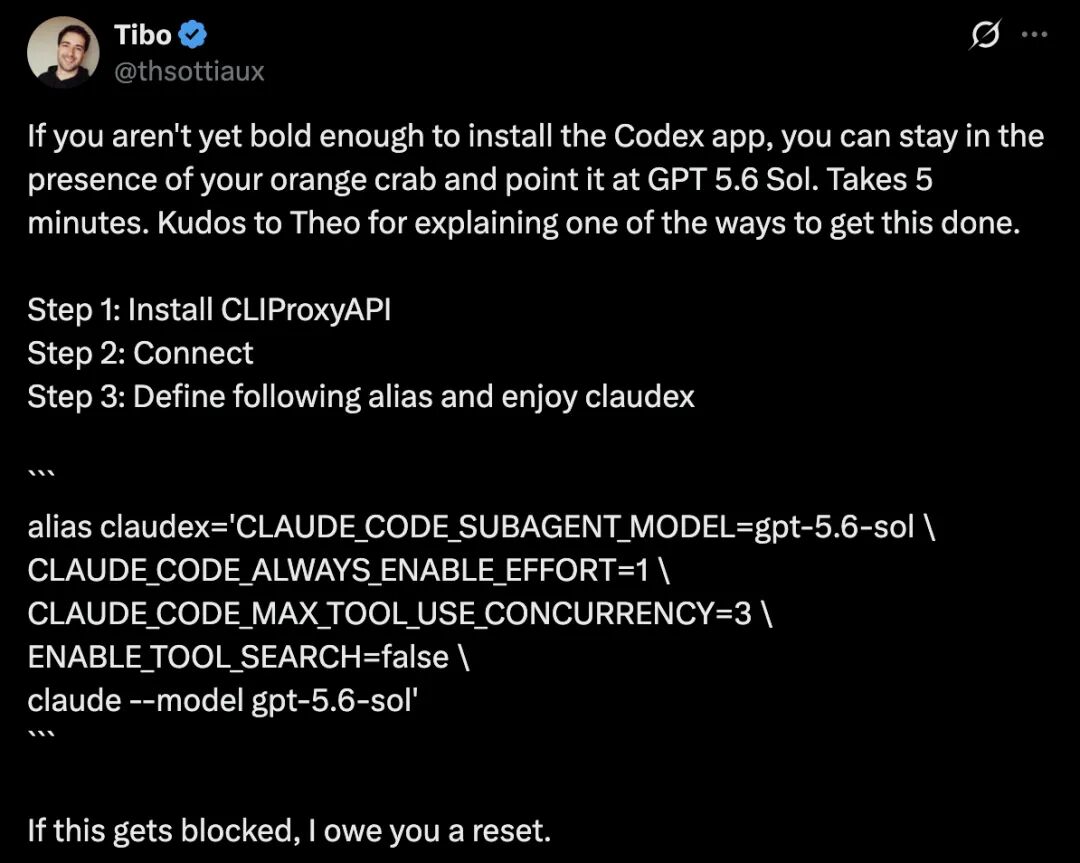
Tibo's original X post at that time can still be directly traced from the GitHub project later established by Alex Getman.
Github address: https://github.com/alexgetmancom/claudex?ref=explainx
The so-called "embedding" of GPT-5.6 Sol into Claude Code does not actually modify Claude Code itself.
Developers keep the official, unmodified Claude Code CLI, then start CLIProxyAPI on the local machine to forward model requests to other model providers. In the implementation Alex later made public, the interface, tools, Skills and permission system of Claude Code remain unchanged, only the underlying model responsible for inference is replaced with models such as GPT-5.6 Sol, Gemini, xAI, Kimi and others.
This is exactly the most interesting part of this controversy.
In the past, when people talked about Coding Agent, it was easy to regard "Claude Code" and "Claude", "Codex" and "GPT" as the same thing. But in fact, the model is only part of it.
When OpenAI introduced the technical architecture of GPT-5.6, it also specifically discussed Agentic Harness separately: the harness used by Codex and ChatGPT Work is a Rust orchestration system that connects models, tools and user environments, responsible for managing context, tool calls, repetitive tasks and the entire Agent loop.
Therefore, an increasingly realistic question has emerged: if models and Harness can be decoupled, does the best GPT necessarily have to run inside Codex? Does the best Claude necessarily have to run inside Claude Code?
Tibo is obviously very willing to test this boundary in person.
A month later, someone really got "banned"
When August came, the sentence "If I get blocked, I owe everyone a reset" unexpectedly turned into a boomerang.
Developer Alex Getman almost followed the method publicly shared by Tibo to rebuild the Claude Code + GPT-5.6 Sol setup.
According to the records Alex left on GitHub, he did not modify the Claude Code CLI, but ran CLIProxyAPI on local 127.0.0.1 to redirect inference requests to GPT-5.6 Sol.
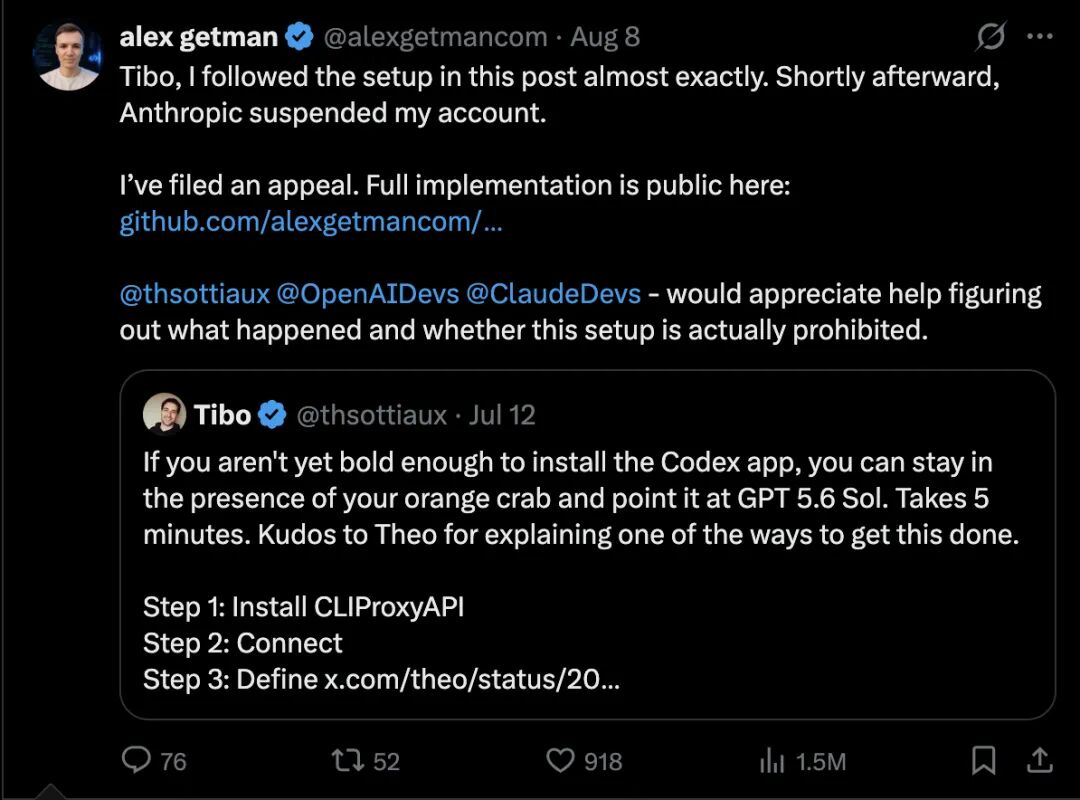
But shortly after testing, his Anthropic account was suspended.
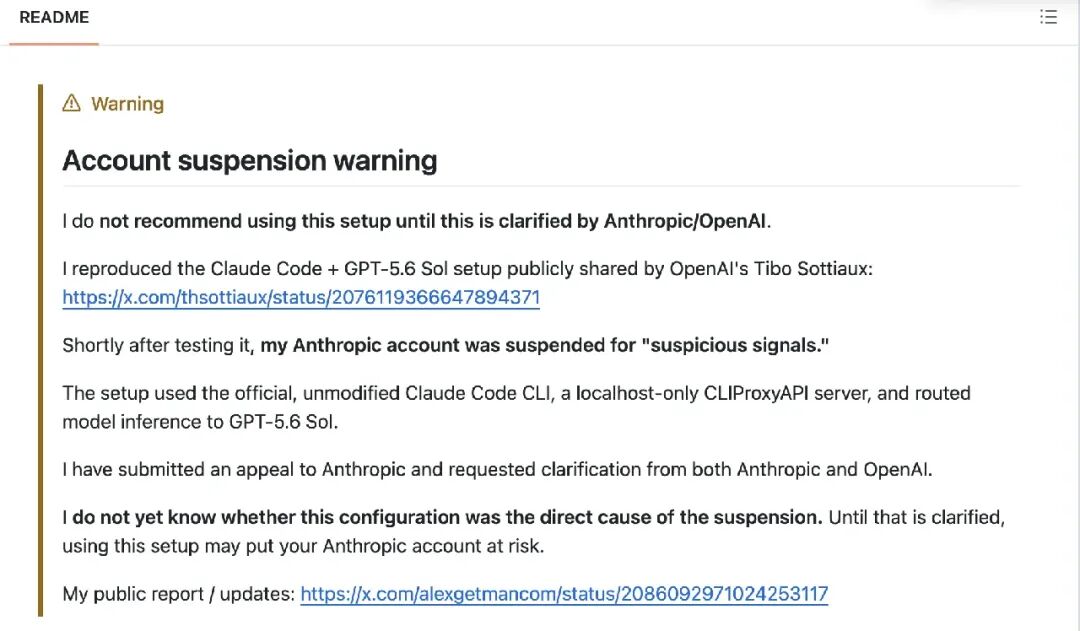
The only reason given by the system was: "suspicious signals".
Alex then submitted an appeal, and made the incident public on X, while tagging relevant people.
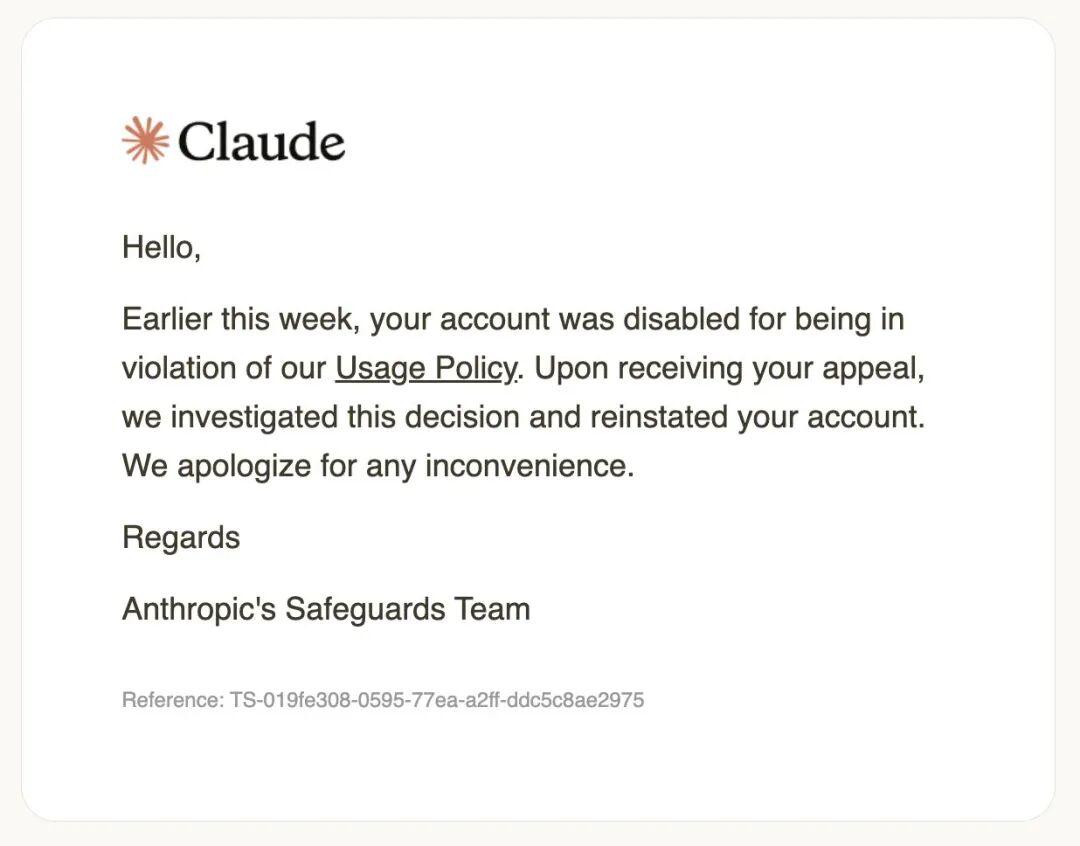
It is worth emphasizing that Alex himself was very cautious at that time.
He specifically added a Warning at the top of the GitHub project, temporarily advising other users not to copy this configuration; but at the same time, he clearly stated that he did not know whether this proxy configuration was the direct cause of the account ban.
In other words, the claim that "using GPT-5.6 Sol caused Anthropic to ban the account" has never been confirmed.
Then Tibo appeared in the comment section.
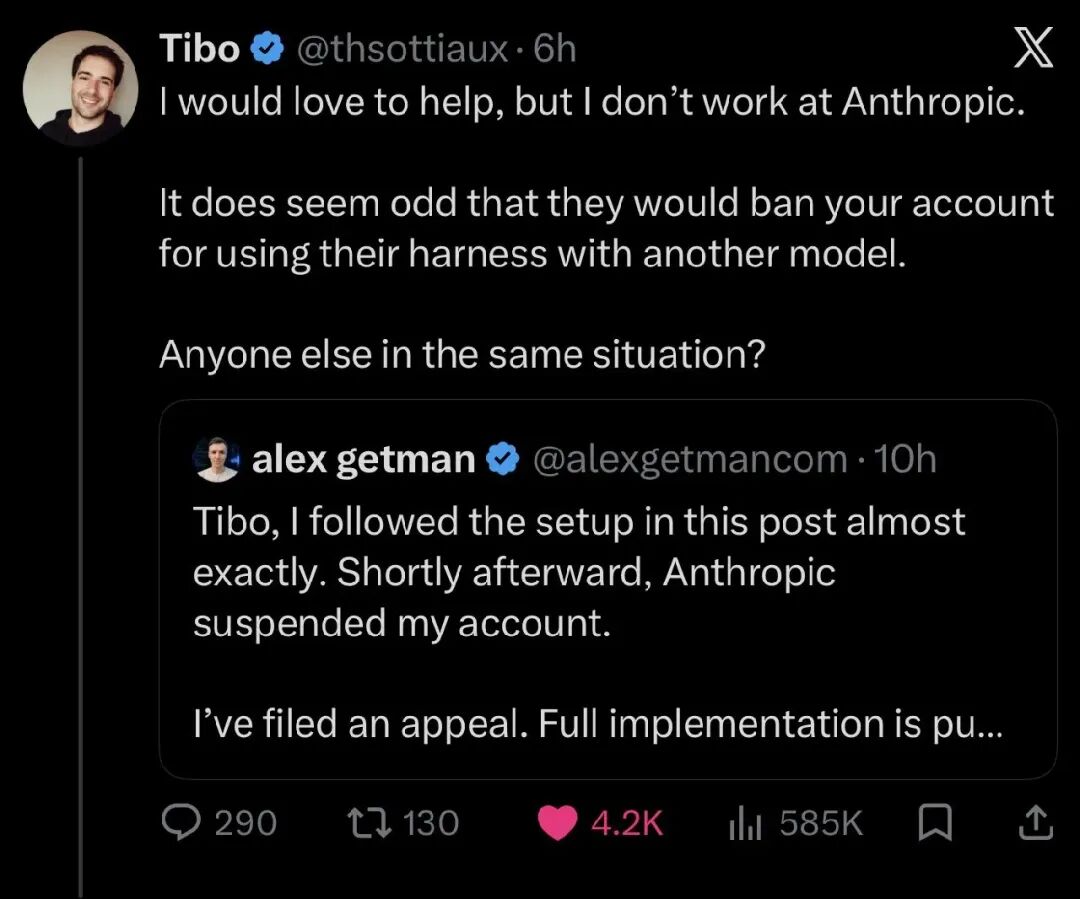
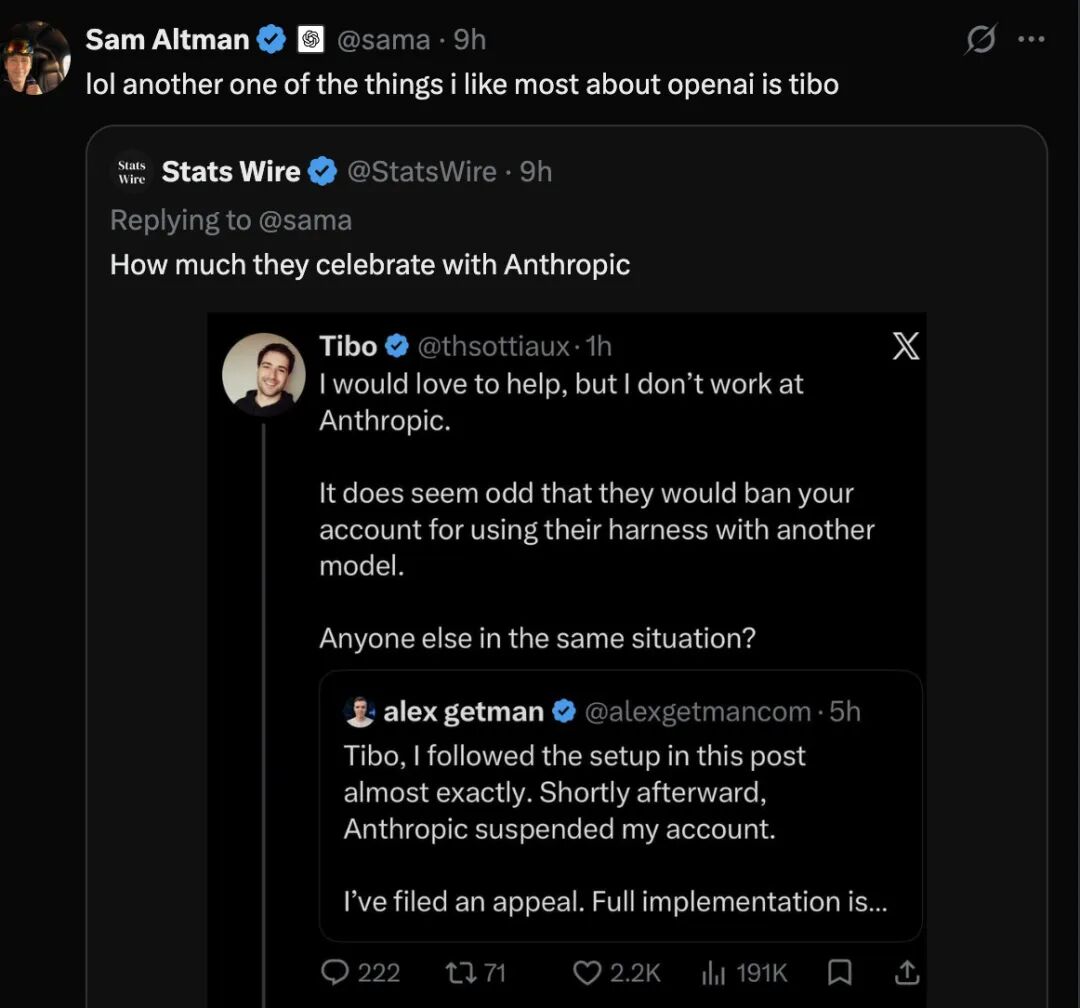
His response was more or less a public shout: he was willing to help, but "I don't work at Anthropic"; if users are banned just because they used other models in their harness, that would indeed be very strange. He then asked if anyone else had encountered a similar situation.
At this point, the head of Claude Code could no longer hold back.
Boris stepped in, and his first sentence was: Would you like to join Anthropic?
Boris Cherny is the creator of Claude Code, and currently serves as the lead of Claude Code at Anthropic.
Facing Tibo's public questioning, Boris quickly joined the discussion. But instead of arguing with Tibo first, he publicly poached him!
The gist is: Anthropic is hiring, come join us if you want to work here. It was a very bold move.
Then Boris started to deal with the real issue.
He made it clear that Anthropic will not ban accounts just because users use other models in their own harness. According to his preliminary judgment, this incident was "almost certainly" triggered by another account classifier, and Anthropic is conducting further investigation.
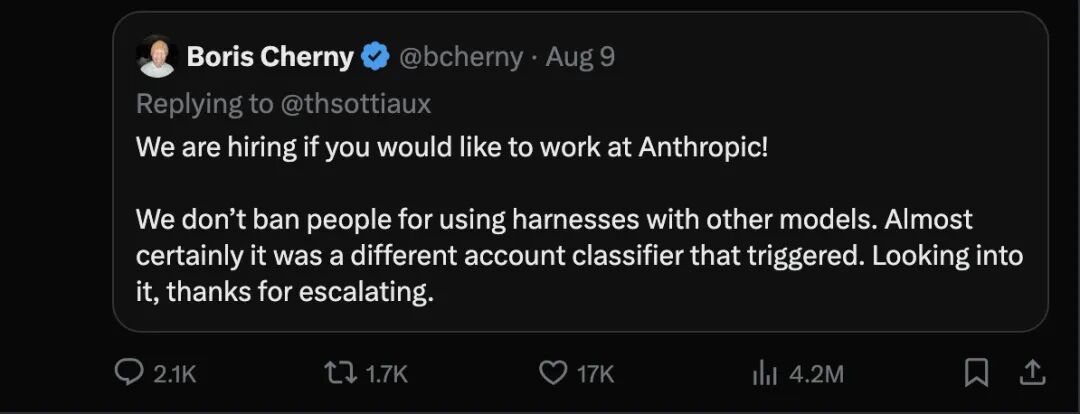
He further stated later that using other models with the Claude Code harness is supported by design, which can be achieved through proxy methods such as LiteLLM.
Shortly after, Boris updated that Alex's account should have been restored, and the team is taking measures to prevent similar incidents from happening again; then he confirmed again: "Unblocked."
At this point, the controversy that seemed to be about to escalate into "Anthropic blocking OpenAI models" was basically contained by both sides.
But Tibo did not stop there.
"Harness should be free", then Tibo rejected Boris
After Boris publicly poached him, Tibo's answer was also very interesting.
He first brought the topic back to product philosophy: the right to choose Harness is very important, users should be able to decide for themselves which model works best for them.
Then he responded to Boris's job offer. The answer was of course "no".
The reason was not that there was any personal feud between them, but that he "loved his current team too much" and was very looking forward to what would be released in the coming weeks.
However, Tibo suddenly remembered the promise he made a month ago.
"If this method gets blocked, I owe you a reset."
Now, although strictly speaking Anthropic did not intentionally block other models, the user was indeed banned once.
So Tibo decided to — pay off his debt.
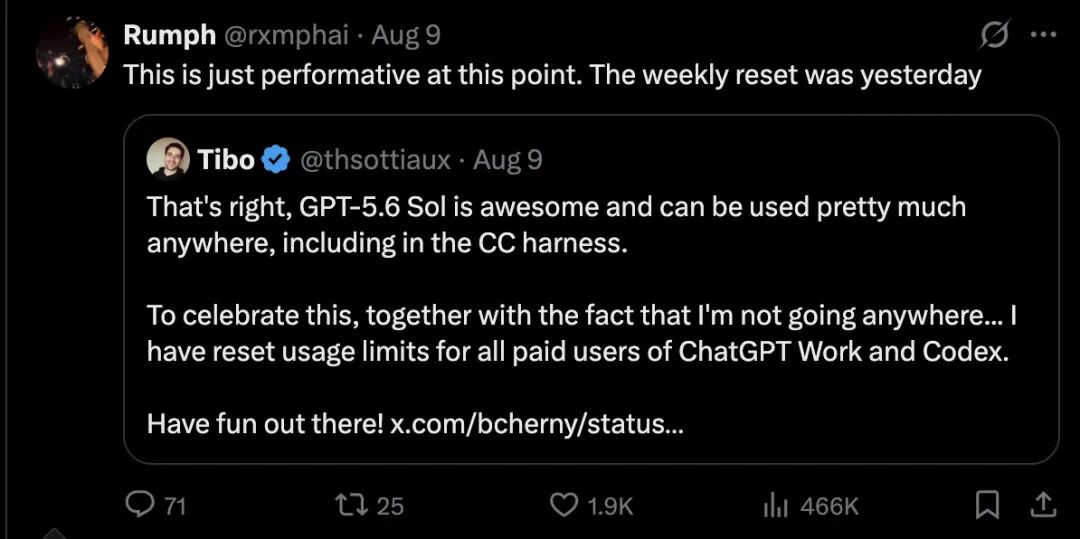
He announced that since GPT-5.6 Sol can run on different harnesses including Claude Code, and also to celebrate that he is "not going anywhere", he has reset the usage quota for all ChatGPT Work and Codex paid users.
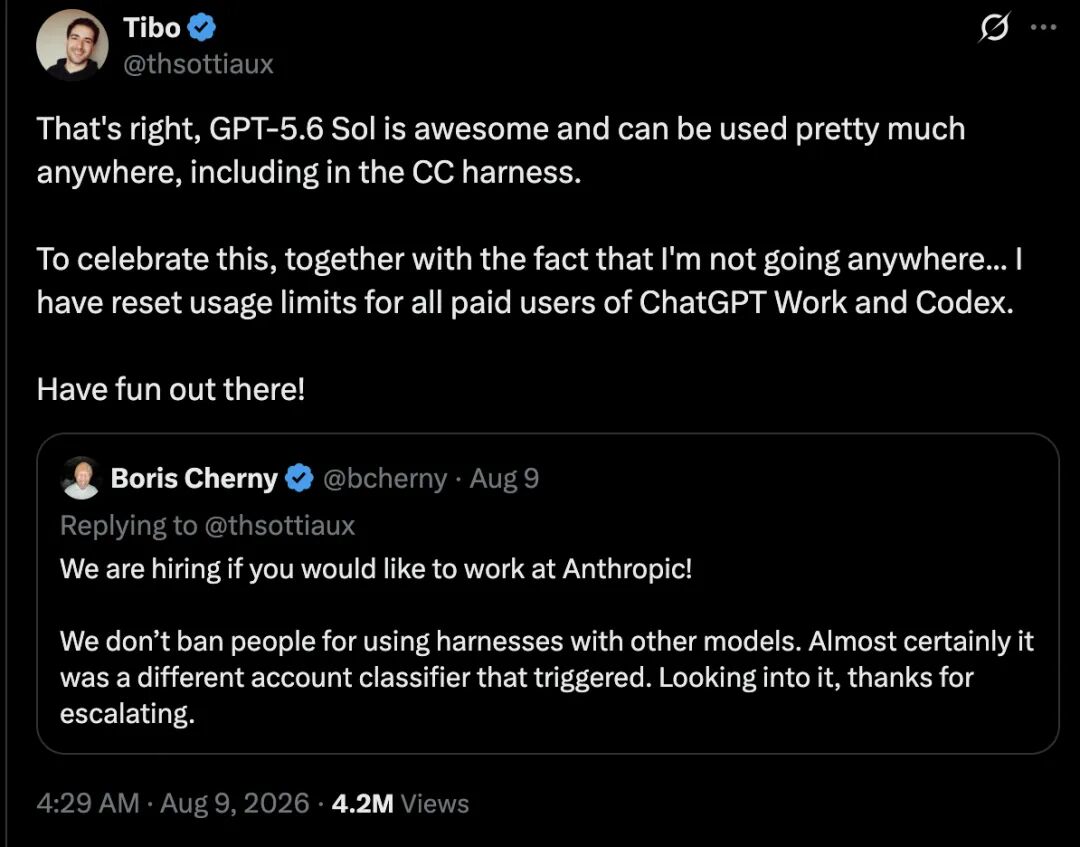
An Anthropic developer account was banned, and in the end all OpenAI users got a quota reset. The whole story at this point has the flavor of internet performance art, and netizens still thought the excitement was not enough.
At this point, Sam Altman finally couldn't hold back either. He didn't issue a serious official company statement, just left a sentence on X: "lol, one of my favorite things about OpenAI is Tibo."
Which roughly translates to: "Haha, Tibo is one of my favorite parts of OpenAI."
Not a welfare, but a performance?
After Tibo announced the reset, some users found an awkward problem: many people's weekly quotas had just been normally refreshed the day before, on August 8.
Therefore, X user Rumph directly complained that this reset was more like a "performative" move — the performance nature outweighs the practical significance.
Tibo did not avoid it either. His response was even more direct: then I will do another "performative" reset on Monday.
This sentence quickly led to a second round of discussion.
X user Shayan Spiel hopes that OpenAI will stop playing this little sudden reset game. Instead of creating temporary surprises, it is better to establish a quota recovery mechanism that users can store and use on demand.
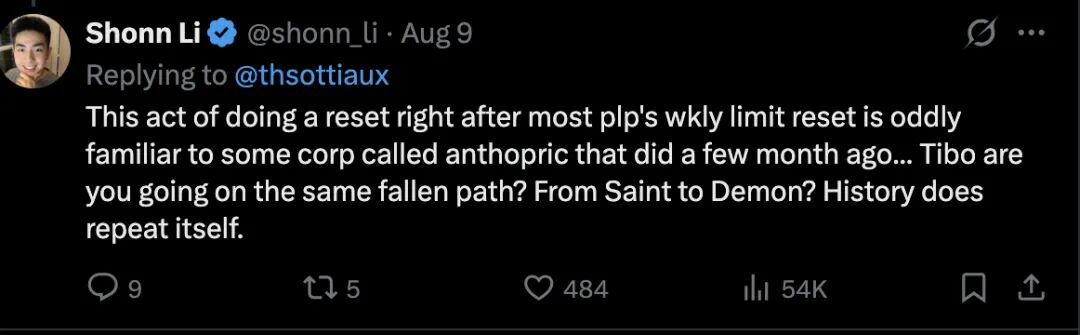
Shonn Li pointed out that Anthropic has done similar tricks before: announcing a reset right after the normal weekly quota refresh easily turns the "welfare" into a marketing event.
Another group of users had a much simpler attitude — since there might be another reset on Monday, why wait for the weekend?
Some people started canceling their weekend plans to burn through their quotas, while others directly asked Tibo if this was a "trap" and whether they could safely use up all their quotas.
A technical controversy originally triggered by account risk control, has thus turned all the way into a large public performance jointly participated by OpenAI and Anthropic product leads, developers and users.
But what is really worth noticing is that "models and Harness are being decoupled"
If you only look at the surface, this is just a public playful meme exchange between Tibo and Boris on X. But what is really worth paying attention to is Boris's sentence "we will not ban accounts for using other models in the harness", as well as Tibo's emphasis on "Freedom of harness".
Because this means that the competition logic of Coding Agent may be changing.
Models and Agent products are gradually being compared by developers as two separate layers.
The model determines inference, code understanding and generation capabilities; Harness determines what context the model can see, what tools it can call, when to execute commands, how to compress context, how to maintain long tasks, and how to build a complete loop between people, models and development environments.
OpenAI itself has publicly described Codex's harness as an orchestration layer connecting models, tools and user environments, and clearly stated that model calls, tool calls, context management and repetitive work all affect the final efficiency of the Agent.
Anthropic's official documentation has also defined a complete LLM Gateway Protocol for