In the first seven months of this year, there were more than 158 large winning bids for data center projects each worth over 100 million yuan, showing eight major trends.
According to incomplete statistics from Digital Intelligence Front, in the first 7 months of 2026, the number and total value of awarded data center projects (including intelligent computing centers) with a contract value of over 100 million yuan both increased by more than 18% year-on-year.
Recently, Digital Intelligence Front sorted out information through channels including China Government Procurement Network, China Public Bidding and Tendering Service Platform, Tianyancha, Qichacha, and Xunbiaobao, and found that in the public bidding market in the first 7 months of 2026, there were more than 158 domestic intelligent computing center and data center related projects with a single winning bid amount of over 100 million yuan. Among these projects, we have observed some noteworthy trends and features:
-- Computing power infrastructure continues to boom. Projects built in previous years are entering the delivery period intensively, with at least 30 to 40 projects put into operation across the country; new construction demands remain strong, with both the number of projects and total amount hitting new highs, and the computing power scale generally reaching thousands of P or even 10,000 P level; Token factories are also moving from concept to bidding and implementation.
-- Operators contribute to more than 50% of the projects, while local platforms such as urban construction investment and digital investment platforms, as well as industries including finance and energy, are also accelerating their layout.
-- Localization is accelerating, the localization rate of operators' centralized procurement has exceeded 100% for the first time, and domestic computing power frequently appears in bidding activities.
-- The integrated EPCO (Design-Procurement-Construction-Operation) model is accelerating its popularization, with bundled bidding for construction and operation, promoting the industry to transform from "leave after completion" to full life-cycle services.
-- Liquid cooling enters the first year of large-scale deployment, and the proportion of power investment in infrastructure costs continues to rise.
01
158 large contracts worth over 100 million yuan in 7 months
According to data from the China Academy of Information and Communications Technology, domestic AI computing power demand increased by 417% year-on-year in the first quarter of this year, while the supply growth rate was only 128%. In this context, data centers / intelligent computing centers are still at the peak of investment and construction.
According to incomplete statistics from Digital Intelligence Front, in the first 7 months of 2026, the bidding market has announced at least 158 data center (including intelligent computing center) related projects with a winning bid amount of over 100 million yuan, with a total winning bid amount exceeding 113 billion yuan, both the number of projects and the amount increased by more than 18% compared with the same period of last year. The bidding content covers a large number of EPC general contracting projects, as well as sub-procurement of substations, cold sources, electromechanical equipment, software and hardware, etc.
These projects are widely distributed in more than 63 prefecture-level cities across 24 provinces (autonomous regions and municipalities directly under the central government) in China, with the most concentrated projects in Ningxia, Guangdong, Inner Mongolia, Hebei, Anhui, Qinghai and other regions. Zhongwei in Ningxia (18), Hohhot in Inner Mongolia (11), Shaoguan in Guangdong (10), Wuhu in Anhui (7), Qingyang in Gansu (7), Shanghai (7) and other places have become hot spots at the city level.
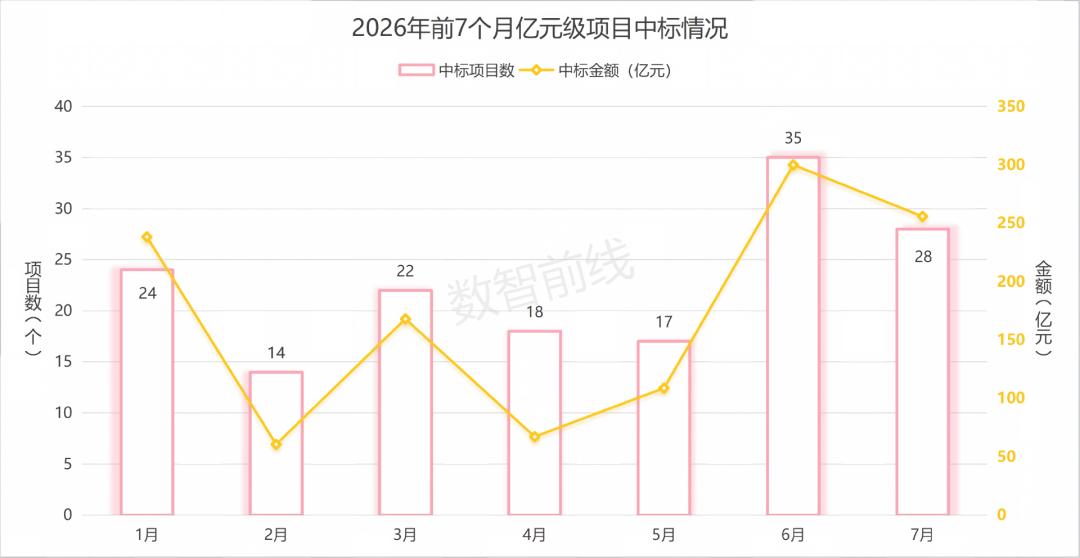
From the perspective of monthly trend, the number of 100-million-yuan-level projects was relatively stable overall in the first 7 months, and increased significantly in June and July, among which June hit the peak of the first 7 months with 35 projects and a winning bid amount of about 30 billion yuan.
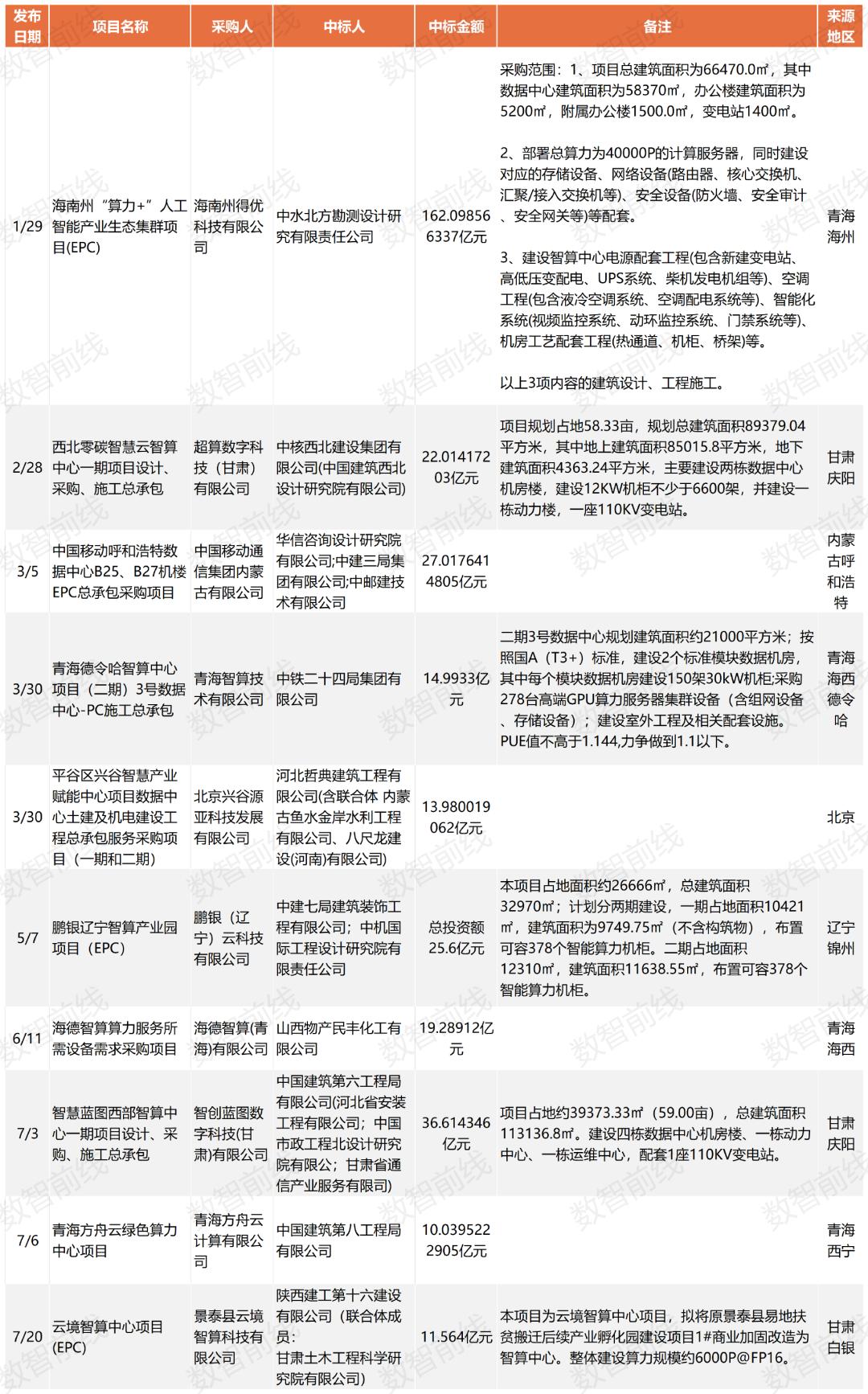
The construction scale of computing power centers continues to rise, generally ranging from several thousand P to tens of thousands of P. In terms of large projects, at least 23 projects have a winning bid amount of over 1 billion yuan. In addition to operators' server centralized procurement projects, the largest single order comes from the "Hainan Prefecture 'Computing Power +' Artificial Intelligence Industrial Ecological Cluster Project (EPC)", with a winning bid amount of about 16.2 billion yuan, and plans to deploy computing servers with a total computing power of 40,000P.
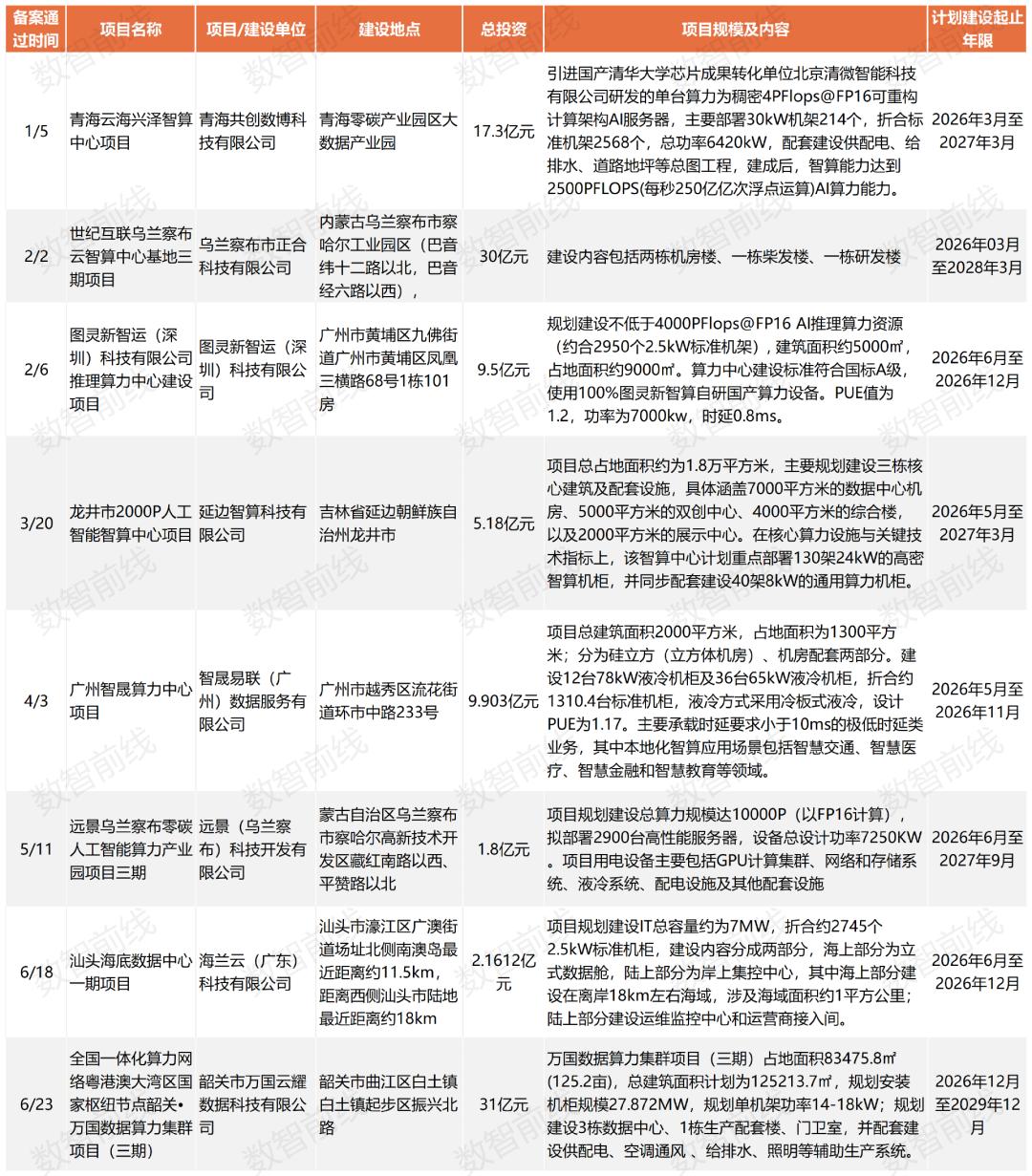
In addition to the projects that have completed bidding, according to incomplete statistics from Digital Intelligence Front, more than 50 projects have completed filing in the first 7 months of 2026, such as the 2000P artificial intelligence intelligent computing center project in Longjing City with a total investment of 518 million yuan, and the Qinghai Yunhai Xingze Intelligent Computing Center project with a total investment of 1.73 billion yuan. A small number of them have completed bidding, and more project bids will be continuously released in the follow-up period.
02
Token factory projects begin to emerge
In 2026, the "Token factory" is moving from concept to specific projects. In July, the "Domestic Intelligent Computing Token Factory" project of Hangzhou Hanrong opened for bidding, and Digital China won the bid with 717 million yuan, providing super-node servers and supporting products. This is the first 100-million-yuan-level state-owned intelligent computing hardware procurement project named after "Token Factory" in China's procurement system, which fully adopts the full-stack domestic architecture of Kunpeng + Ascend.
At the same time, Token factories across the country are intensively filed and started construction. In May, the Suihong Huachuang Token Factory under Hongxin Electronics signed a contract to settle in Wuxi, with 4 Huawei Ascend 384 super nodes deployed in the first phase. Hunan Malanshan Group, together with Alibaba Cloud and Hunan Telecom, jointly built the "Malanshan TOKEN Super Factory", aiming to build a daily output capacity of tens of billions of Tokens. In June, Beijing No.1 Word Element Factory was put into use, and the daily production capacity of the first phase has exceeded 1.4 trillion Tokens. In addition, the "Daqing Distributed Green Word Element Factory Project" in Heilongjiang and the "Ximeng Intelligent Computing Core Port Word Element Factory" in Inner Mongolia have all completed filing in the first half of the year. SenseTime plans to complete the first computing-power-electricity coordinated regional pilot and heterogeneous Token factory in Yancheng, Jiangsu.
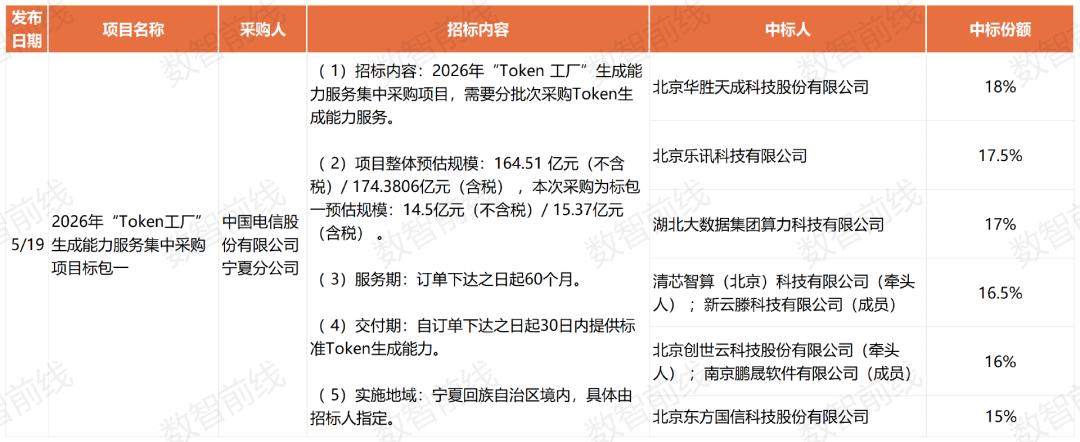
A bigger signal comes from operators. China Telecom has established Token operation as its core strategic direction. In April, China Telecom Ningxia Branch released a centralized procurement project for Token generation capability services with a total scale of 17.4 billion yuan, which is divided into 11 bid packages, requiring suppliers to deliver standardized Token generation capabilities with their own computing power, model adaptation, reasoning framework, etc., marking that the industry has begun to shift from selling servers and cabinets to selling reasoning capabilities and Token production capacity. In July, the first Token factory of China Mobile Zhejiang Branch - Southern Zhejiang Token Factory was inaugurated in Wenzhou, which encapsulates computing power and model capabilities in a standardized way and directly delivers finished Tokens to enterprises.
The rise of the Token economy has also given rise to the new proposition of "Token going global". Industry insiders believe that the essence of Token going global is the coordinated export of computing power and low-cost electricity. For example, when overseas users call large models deployed in Chinese data centers through platforms such as OpenRouter, tasks are transmitted to domestic GPU clusters through submarine optical cables for reasoning, and results are returned in seconds. In the whole process, electricity does not leave the country, but the value realizes cross-border settlement through Tokens. China's power production capacity is 2.2-3 times that of the United States, and the comprehensive electricity price is 40% lower. The economic value of producing AI Tokens with industrial electricity prices has exceeded that of traditional aluminum smelting and steelmaking, becoming the export method with the highest added value of electricity at present.
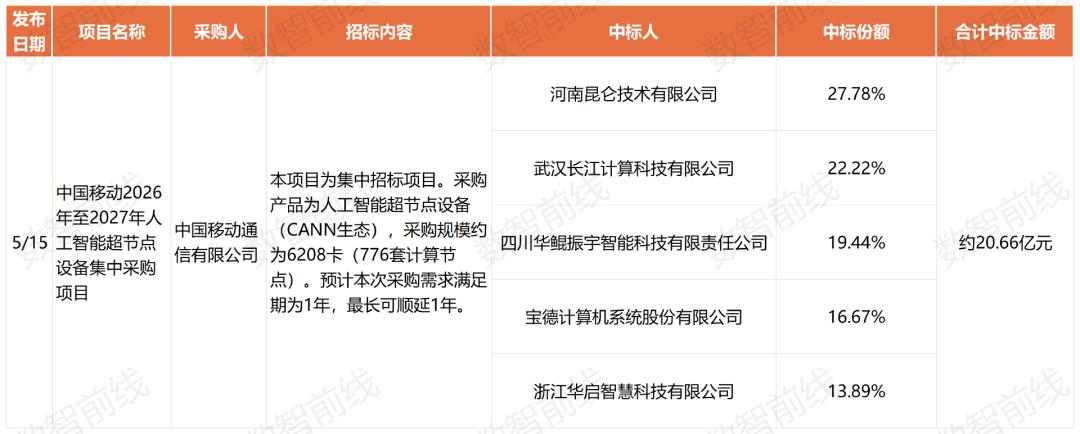
The rise of Token factories is also pushing super nodes to the center of the stage. Its core logic is to organize dozens or hundreds of GPUs to work collaboratively, so as to improve computing power utilization and reduce Token costs. China Mobile has completed the centralized procurement of super node equipment worth more than 2 billion yuan in the first half of the year. Data shows that the domestic super node market space is expected to reach 341.4 billion yuan in 2028, with a compound annual growth rate as high as 194% from 2026 to 2028. Large Chinese internet enterprises will deploy a large number of super node solutions in the second half of the year.
03
Operator projects account for more than 50%
In 2026, among the 158 100-million-yuan-level projects, the tenderees include directly government-owned enterprises such as urban construction investment and digital investment platforms, intelligent computing service enterprises, cloud vendors, operators, as well as multiple industries including finance and energy.
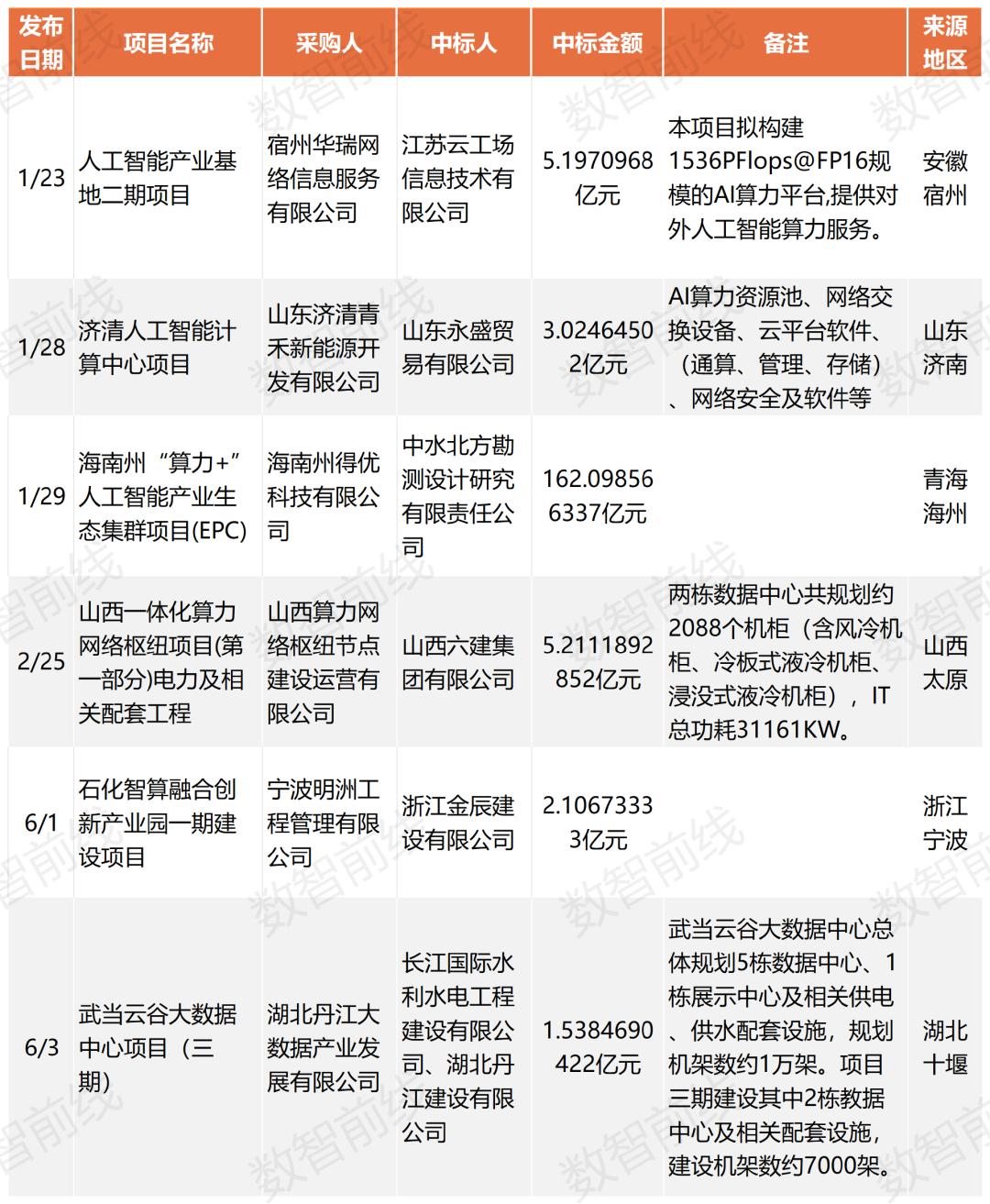
Local state-owned platforms such as urban construction investment, new district, and municipal big data groups are still important construction forces. For example, the second phase of the artificial intelligence industrial base project (520 million yuan), the Jiqing artificial intelligence computing center project (302 million yuan), etc. In particular, the "Computing Power +" project in Hainan Prefecture has a transaction value as high as 16.21 billion yuan.
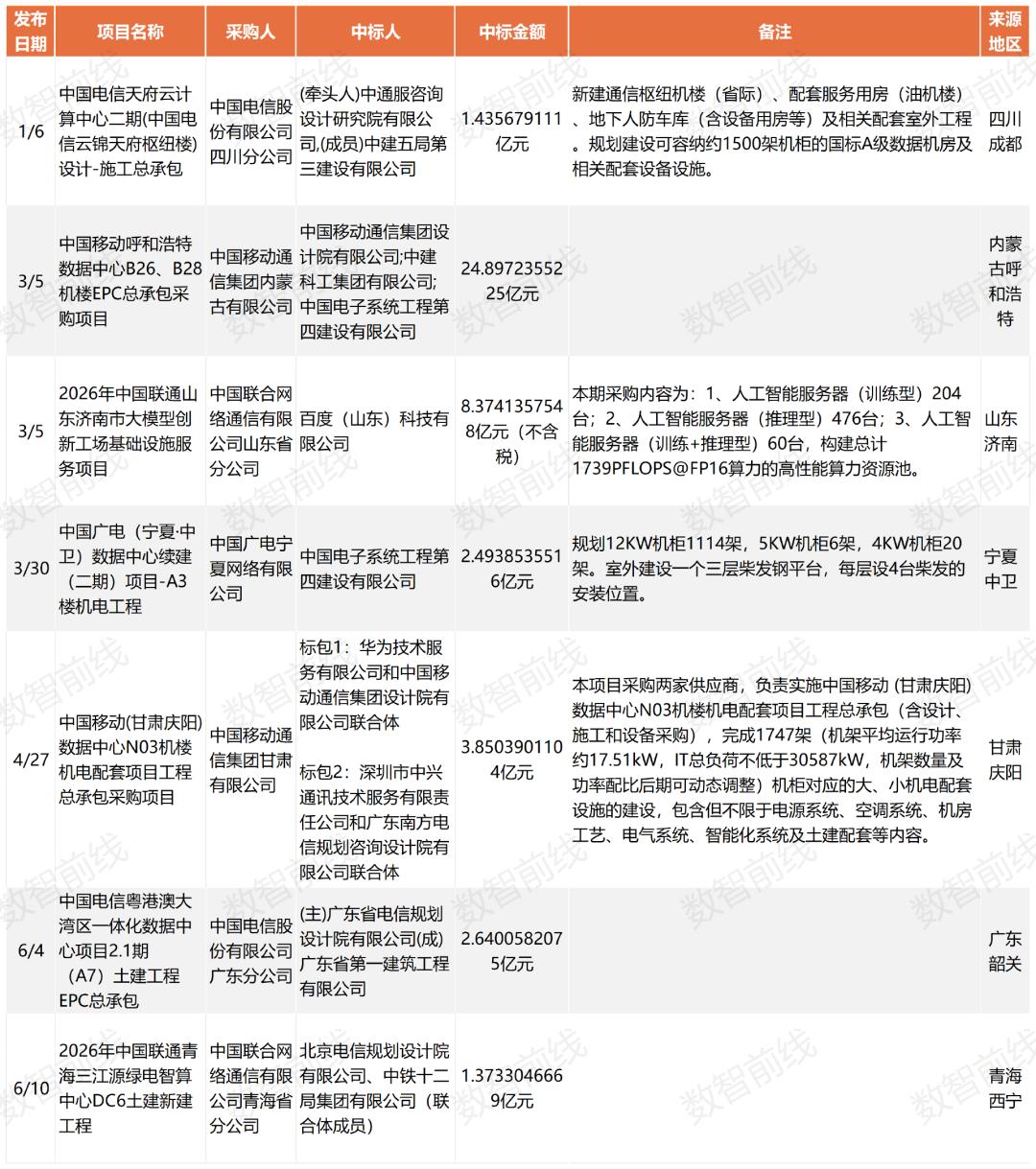
At the operator level, under the background of the reduction in total capital expenditure, the three major operators have all taken computing power as the main investment line in 2026, and the proportion of computing power investment in total investment has increased to more than 30%. Among the 158 large contracts worth over 100 million yuan, operator projects account for more than 50%, with a total transaction value exceeding 55 billion yuan.
Server centralized procurement is still the top priority. China Mobile has server centralized procurement projects with a total value of about 17.7 billion yuan, and China Telecom also has a large high-performance server centralized procurement order of about 11.5 billion yuan. Hub nodes of the "East Data West Computing" project such as Ningxia, Inner Mongolia, Hebei, and the Guangdong-Hong Kong-Macao Greater Bay Area are the regions where the three major operators invest most intensively.
In particular, Zhongwei in Ningxia leads the country with 18 100-million-yuan-level projects. China Unicom plans to invest 7.1 billion yuan in the Zhongwei Cloud Data Center during the "15th Five-Year Plan" period, aiming to build the group's first GW-level intelligent computing park. The total investment of China Mobile's Xuanhe Park and B Park is as high as 17.2 billion yuan and 6.149 billion yuan respectively. China Telecom's Zhongwei Hub's medium and long-term expansion plan adds 400 mu of land, with a planned investment of 6.5 billion yuan.
Behind the continuous increase of operators' investment, intelligent computing services are becoming a new growth engine. In 2025, the revenue of China Mobile's intelligent computing services increased by 279% year-on-year, and the revenue of China Unicom's artificial intelligence business increased by more than 140%. With the rapid rise of the Token economy this year, the three major operators have successively launched Token packages, trying to reconstruct their business models in the AI era.
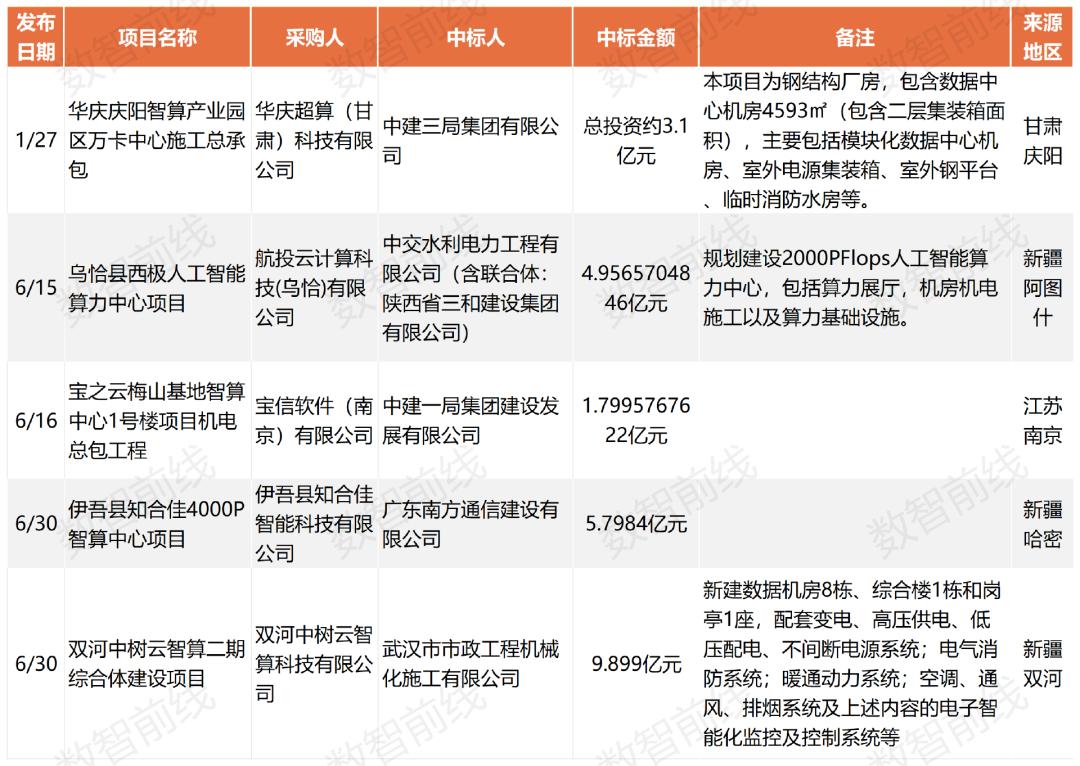
The number of projects of various private IDC service providers is second only to operators, including cross-regional layout of listed enterprises such as Baosight Software, such as multiple projects of Baozhiyun Meishan Base Intelligent Computing Center, as well as many small and medium-sized regional computing power companies. Market-oriented entities are playing an increasingly important role in computing power supply.
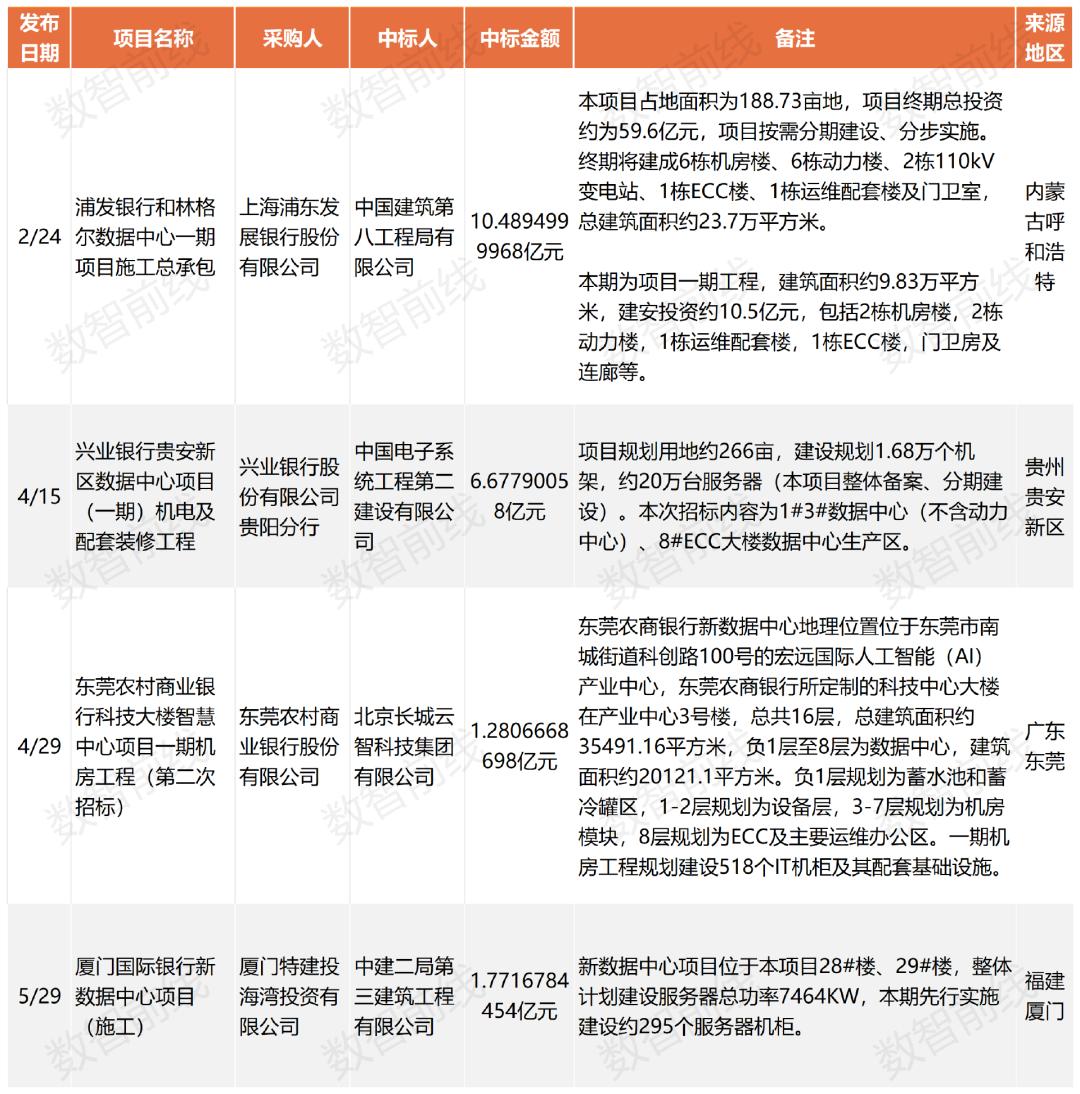
The financial industry is also active, with at least 6 large contracts worth over 100 million yuan in the first 7 months, such as the general construction contracting of the first phase of Shanghai Pudong Development Bank Helinger Data Center Project (about 1.05 billion yuan), and the electromechanical and supporting decoration project of the first phase of Industrial Bank Gui'an New Area Data Center Project (about 668 million yuan). Dongguan Rural Commercial Bank, Xiamen International Bank and other institutions are also building new data centers.
The energy industry, especially state-owned central enterprises in the energy sector, are also actively participating in the construction of data center related