Unitree Technology goes public, and the embodied intelligence sector kicks off its first "shakeout" phase.
In March 2026, at the site of Shanghai AWE Exhibition.
The booth of Unitree Robotics was crowded with visitors. At the center of the stage, a humanoid robot suddenly spoke: "If the whole world blames you, I will take you to have malatang." These seemingly awkward yet heartwarming remarks astonished the audience, filling the booth and its surroundings with a lively and pleasant atmosphere.
The booth of Deep Robotics presented a stronger "tech vibe", demonstrating its walking stability on uneven ground and dynamic balance capability when subjected to external interference.
Ubtech upgraded the motion fluency of its robots — they are no longer slow "Tai Chi performers", and every movement is evolving towards high dynamics and high intelligence.
This exhibition, where robots play the leading role, set the keynote for the embodied intelligence industry at the beginning of the year.
On August 10, Unitree Robotics opened the subscription for new shares and is about to be listed. Deep Robotics has also submitted its prospectus.
The already listed Ubtech has sparked widespread public discussion with its "990,000-yuan robot companion".
In addition, the GEM IPO application of Leju Intelligence has been accepted, and Dobot Technology has launched its "H-share to A-share" return plan.
This is the most bustling year for embodied intelligence: some players are sprinting forward, some are lingering, and some are suffering growing losses as their sales increase... The same industry has presented completely different fates for different participants.
01
The profit inflection point only belongs to some players
Its current performance in the capital market is a microcosm of its strategic layout over the past years.
From 2023 to 2025, the humanoid robot industry is in a stage of vigorous development and rapid expansion.
The revenue of all five companies is on the rise. However, even though they all caught the boom of the robot industry outbreak, different companies show significantly different capabilities in seizing the market outlet, with huge gaps in their growth rates.
Unitree Robotics seized the phenomenal marketing opportunity from the Spring Festival Gala, becoming the fastest-growing rising star. Its revenue soared from 159 million yuan to 1.699 billion yuan, registering a nearly 10-fold increase in three years, with a year-on-year growth rate of 332.6% in 2025 alone.
Deep Robotics has taken firm root by focusing on vertical industry scenarios such as power inspection. Its revenue increased from 50.11 million yuan to 337 million yuan, up nearly 6 times.
The 10-year-old Leju Intelligence focused on mass production and market expansion, with its revenue rising from 53.9883 million yuan to 258 million yuan, a nearly 4-fold increase.
Ubtech is the earliest listed company in this industry, but a large part of its revenue comes from non-humanoid robot businesses. Therefore, during the rapid development stage of the industry, Ubtech was somewhat out of alignment with the trend, with its revenue growing from 1.056 billion yuan to 2.001 billion yuan, nearly doubling.
Like Ubtech, Dobot once claimed to be "the first share of Chinese collaborative robots". It initially focused on robotic arms, and had to carry out transformation when the industry outlet came, so it had the slowest revenue growth, rising from 287 million yuan to 492 million yuan.
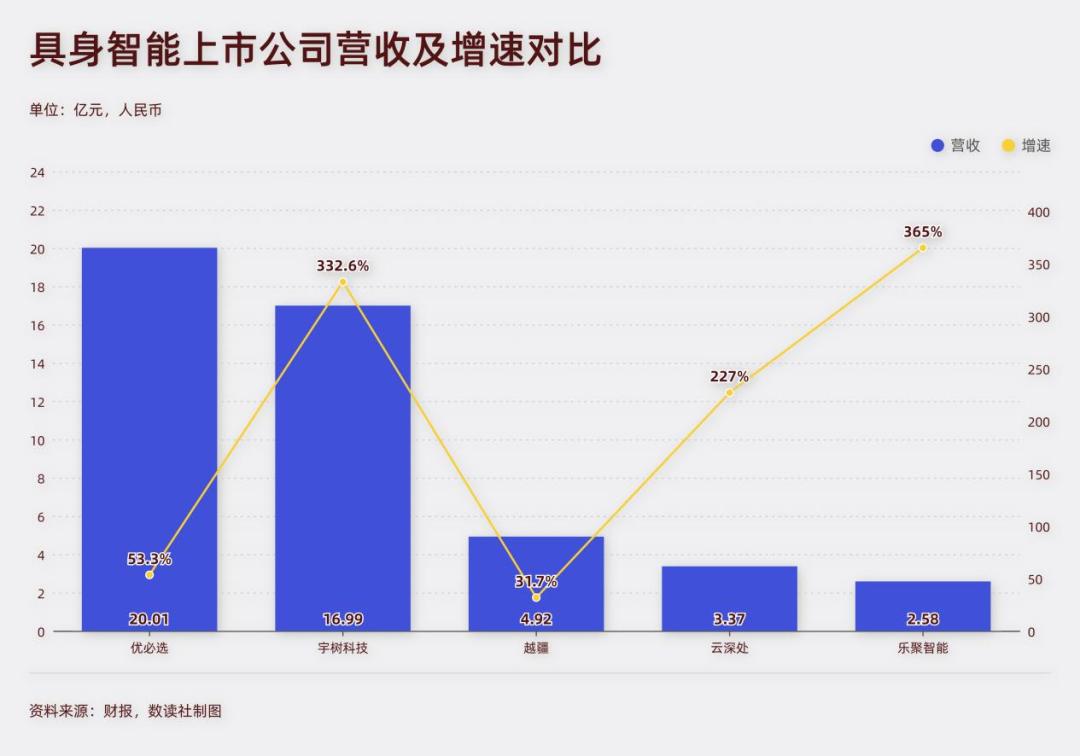
It can be seen from the scale that the embodied intelligence industry is currently in a period of drastic changes, which is also a key stage for overtaking on curves, and the market pattern is far from stable.
Compared with the leap-forward development of the industry, profit will become the watershed for embodied intelligence enterprises.
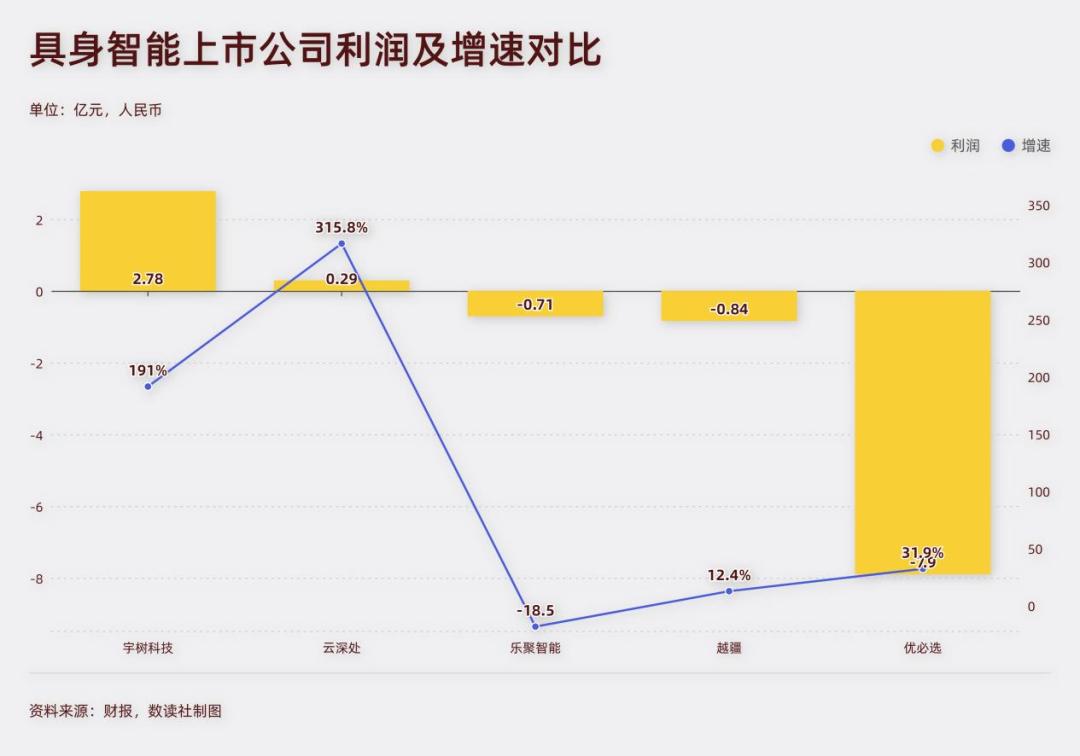
Among the five companies that have disclosed their performance, their profitability presents a mixed picture.
In the camp of profitable enterprises, Unitree recorded attributable net profit of 278 million yuan in 2025, and had crossed the break-even line to achieve net profit as early as 2024. Deep Robotics recorded attributable net profit of 28.68 million yuan in 2025, turning profitable for the first time. Both companies completed the transition from loss to profit between 2024 and 2025.
The camp of loss-making enterprises faces different difficulties respectively. Leju recorded attributable net loss of 71.25 million yuan in 2025, expanding by 18.49% year on year. Dobot's loss reached 83.535 million yuan, narrowing by 12.4% year on year. Ubtech's loss was 790 million yuan, narrowing by 37.4% year on year. While all of them are loss-making, Leju's loss is expanding, while the losses of Dobot and Ubtech are narrowing.
The differentiation of gross profit margin is more intuitive. Unitree's annual gross profit margin rose from 44.22% to 60.13% in the three years from 2023 to 2025, and Deep Robotics also saw a substantial increase from a low level. However, Leju's gross profit margin slid all the way from 50.45% to 40.78%.
However, it should be noted that as the industry is far from reaching maturity, the current stage is a period of competition for technology and products, and the status of revenue and profit is only temporary.
Unitree, which has the most outstanding revenue and profit performance, saw its growth rate drop to 68.49% in the first quarter, and its non-recurring profit and loss deducted net profit plummeted by 52.55%.
Compared with pure profitability, the coupling of strategy and operation is more critical.
02
The game between cost and efficiency
The poor performance of Unitree Robotics in the first quarter did not change the capital market's judgment on this company.
In the early development stage of the embodied intelligence industry, capital has high tolerance for profitability. What matters is not making money, but daring to invest in key stages.
In 2026, the embodied intelligence industry has gone through the pure product stage and entered a new cycle. A report from Morgan Stanley believes that 2026 is a critical year for humanoid robot integrators to sprint for commercialization and build an industrial ecosystem.
Manufacturers are forming product matrices that fit their own strategies.
The core models of Unitree Robotics include: H1 (the world's first electric-driven humanoid robot that completes backflips in place), G1, R1, and H2 (a new generation of bionic robots), with applications covering industry, scientific research, consumer entertainment and other fields.
As the most popular company in the track, Unitree Robotics is one of the few enterprises that have achieved results in both B-end and C-end markets. Its humanoid robot revenue rose to 868 million yuan in 2025, up 708.81% year on year, accounting for 51.78% of the total revenue, surpassing the revenue of quadruped robots.
Ubtech has gradually built its own moat in the B-end market, and is transforming rapidly towards embodied intelligence. It delivered more than 500 units of its Walker S series throughout the year, with partners covering Dongfeng Liuzhou Motor, Geely, FAW-Volkswagen, BYD, Foxconn, SF Express and other well-known enterprises.
Its humanoid robot revenue rose to 821 million yuan in 2025, up 2204% year on year, accounting for 41.1% of the total revenue.
In addition to leading players such as Unitree, Agibot and Ubtech, other enterprises still rely too much on one or two product series, and some enterprises even still focus on the quadruped robot field.
The Kuavo series of general-purpose humanoid robots of Leju Intelligence generated a revenue of 178 million yuan in 2025, contributing 69.5% of the total revenue, and is applied in five major industrial scenarios including logistics, intelligent manufacturing, and automobile assembly.
Deep Robotics still mainly focuses on quadruped robots, and its Jueying X series generated a revenue of 196 million yuan in 2025, accounting for 60.72% of the total revenue.
Dobot Technology mainly focuses on collaborative robots. In 2025, the revenue of collaborative robots accounted for 80.3% of the total, with its shipment volume ranking first in the world.
From the mainstream trend, the industry anchor has begun to shift from "robot dogs" to "humanoid robots", and the gap between different ecological matrices has emerged. According to Morgan Stanley's forecast, China's delivery volume will double to 28,000 units in 2026, which are still mainly small verification orders; the industry will remain in the continuous verification stage from 2026 to 2027, and large-scale implementation in specific scenarios will start in 2028.
This means that the current stage is still a period of large-scale investment, and the maximum time window may only be one and a half years.
For Unitree, Deep Robotics and Leju, the growth rate of their three expenses (sales, management and R&D expenses) is extremely fast.
In 2025, all three expenses of Unitree doubled. Among them, the management expense was about 400 million yuan, up 1498% year on year, and 349 million yuan of which was the share-based payment expense confirmed from capital increase of the equity incentive platform.
Unitree has entered the stage of "investing heavily to seize the future". Wang Xingxing has issued recruitment notices to attract talents for many times, and said bluntly that "we are extremely short of people in all positions".
The three expenses of Deep Robotics also doubled, increasing by 146%, 141% and 121% respectively. Leju's three expenses are also difficult to control, especially the R&D expense, which increased by 185% in 2025.
The expense expenditure is extremely rigid, and manufacturers generally need to make two preparations: pursue efficiency internally, and seek "ammunition" externally.
For non-popular enterprises in the track, as the primary market is completely different from that of ten years ago, they need to control their expenses as much as possible, live within their means, and "survive" first.
The sales and management expenses of Ubtech decreased in 2025, leading to the narrowing of its loss. Dobot reduced its management expense by 17.6%, which offset the 59.7% growth of R&D expense to a certain extent.
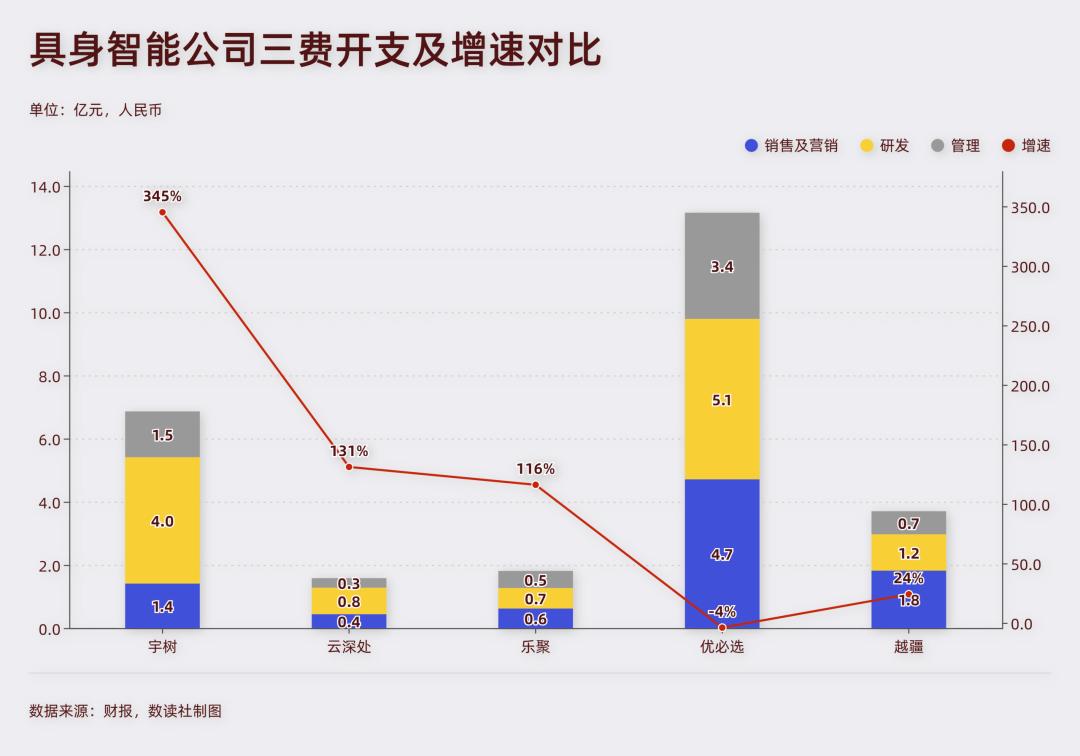
But the cruel reality is that the contraction of expense expenditure cannot bring about efficiency improvement.
Among the five enterprises that have published their performance, Unitree has the fastest growth in per capita revenue, jumping from 603,000 yuan in 2023 to 3.293 million yuan, up 5.5 times.
Deep Robotics' per capita revenue rose from 371,000 yuan to 790,000 yuan, up about 2 times. Leju's per capita revenue rose from 298,000 yuan to 552,000 yuan, also up about 2 times.
In contrast, Ubtech, which has strict control over expense expenditure, saw its per capita revenue rise from 596,000 yuan to 785,000 yuan, up about 32%. Dobot's per capita revenue almost stagnated at around 640,000 yuan.
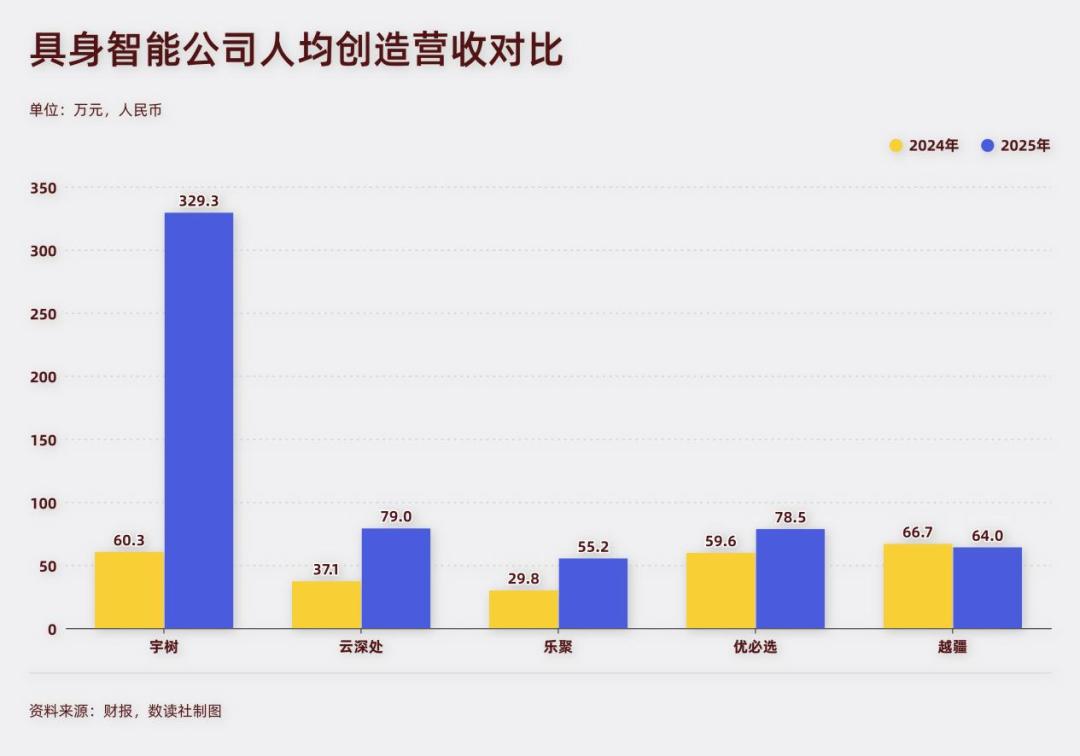
In the stage of large-scale industrial development, compared with internal cost control, manufacturers need to prioritize expanding their scale. In this case, external capital support is generally needed to support their strategy, which is largely the reason why they choose to land in the capital market.
03
Capital, strategy and the elimination round
In 2026, the capital process of the five companies presents a clear echelon.
Performance is the primary factor pursued by capital.
Unitree has fully bet on humanoid robots, seizing the biggest industry outlet, and the revenue proportion of its humanoid robot business has exceeded 50%.
Deep Robotics focuses on a single category of embodied intelligence (quadruped and wheel-legged robots), improving efficiency through specialization. In 2025, its revenue from the industrial application field of quadruped robots ranked first in the world. Achieving the ultimate performance in the segmented track can also win living space.
Dobot takes collaborative robots as its core business, and its shipment of collaborative robots ranked first in the world in 2025. However, its layout of embodied intelligence is late and the revenue proportion is low — only 4% of the total revenue in 2025. Whether it can catch up with the embodied intelligence wave is the biggest suspense.
Ubtech started early but failed to seize the opportunity, and its market share has been surpassed by Unitree and Agibot. It has increased its investment in the C-end market during the transformation process, which has enhanced its uncertainty. Although Leju has fully invested in humanoid robots (the Kuavo series contributes 69.5% of its revenue), it has lost its gross profit margin and suffered growing losses as sales increase. This enterprise, whose humanoid robot shipment ranks among the top four in the world, has fallen into the dilemma of "being highly praised by the market but failing to make profits".
The different performance of the five companies is determining their future fates.
Unitree Robotics, which has the most outstanding performance, got its Sci-Tech Innovation Board IPO approved on June 1, with only 73 days from acceptance to approval, refreshing the record. Its shareholder lineup covers top-tier institutions including HSG, Meituan, Matrix Partners and others.
As one of the "Six Little Dragons of Hangzhou", Deep Robotics followed closely and got its Sci-Tech Innovation Board IPO accepted. Its shareholders include state-level teams such as the National Artificial Intelligence Industry Fund, as well as a large number of industrial capitals including China Merchants Bank International, China Asset Management, and JD.
Tencent is behind both Leju and Ubtech. Among them, Tencent holds 7.32% of the shares of Leju.
However, Tencent seems to be no longer optimistic about Ubtech. Last year, Tencent reduced its holdings twice and cashed out 1 billion yuan, and its shareholding ratio dropped from 8.05% to 2.08%, which once made Ubtech's stock price fall below its issue price last year.
Dobot's performance on the Hong Kong stock market is sluggish, with a current market value of only about 10 billion Hong Kong dollars. The company is in urgent need of higher valuation, so it launched the plan to return to the A-share market.
In the capital market, it can be described as "some are happy while some are sad". Whether they can move forward smoothly will determine the performance of these manufacturers in key stages to a large extent.
Capital is certainly not