OpenAI has withdrawn, leaving AI browsers with only a narrow path forward.
On August 9, OpenAI's AI-native browser ChatGPT Atlas was officially shut down, less than 10 months after its launch.
In October 2025, OpenAI released ChatGPT Atlas. This Chromium-kernel-based browser was initially only available to macOS users, and CEO Sam Altman described it as a once-in-a-decade opportunity. On July 9, 2026, James Sun, head of OpenAI's browsing business, announced that Atlas would be decommissioned a month later. Right up until the final moment, the long-rumored native Windows version never materialized.
It is worth noting that Atlas's AI browser capabilities did not disappear along with the product. OpenAI stated in its shutdown announcement that the browser proxy function will be integrated into ChatGPT and Codex, and ChatGPT will deliver a more powerful browsing experience. Users are required to manually export bookmarks and important page data before August 9.
Judging from the way Atlas was phased out, in OpenAI's view, the AI browser has become a feature of ChatGPT and no longer needs to be built as a standalone product.
This decision has shaken the entire AI browser track. Overseas, Perplexity's Comet is still being updated, while Dia shifted to the enterprise market after being acquired by Atlassian; Google and Microsoft, which already own browser products, as well as Anthropic, which has no browser of its own, all chose not to build independent AI browsers from scratch, and followed the path of embedding AI into existing entry points. As for the domestic market, Alibaba's Quark, ByteDance's Doubao, and Tencent's QQ Browser all overlay AI search and conversation on existing browsers; the only player that has truly bet on building an AI-native browser from scratch is the GN06 team under Meituan (formerly Light Year Beyond), whose product Tabbit 1.0 was officially launched on June 9.
With Atlas exiting the market, players like Tabbit are still working their way through this track.
01. How high is the cost of building an AI-native browser?
Following the AI video application Sora, Atlas is another standalone consumer-facing product shut down by OpenAI within a year. Its shutdown can be explained by starting with the landscape of the AI browser track.
The AI browser track initially split into two paths: one is the integrated technology route, where Google and Microsoft add AI to their own browsers; the other is the AI-native route, which builds the product from scratch like Comet, Dia and Atlas. But in the past six months, several changes have taken place in this track: mature browsers have built-in Agents, model platforms have entered the market through extensions and desktop clients, and independent browsers have shrunk to enterprise scenarios, eventually forming a landscape where four deployment forms coexist.
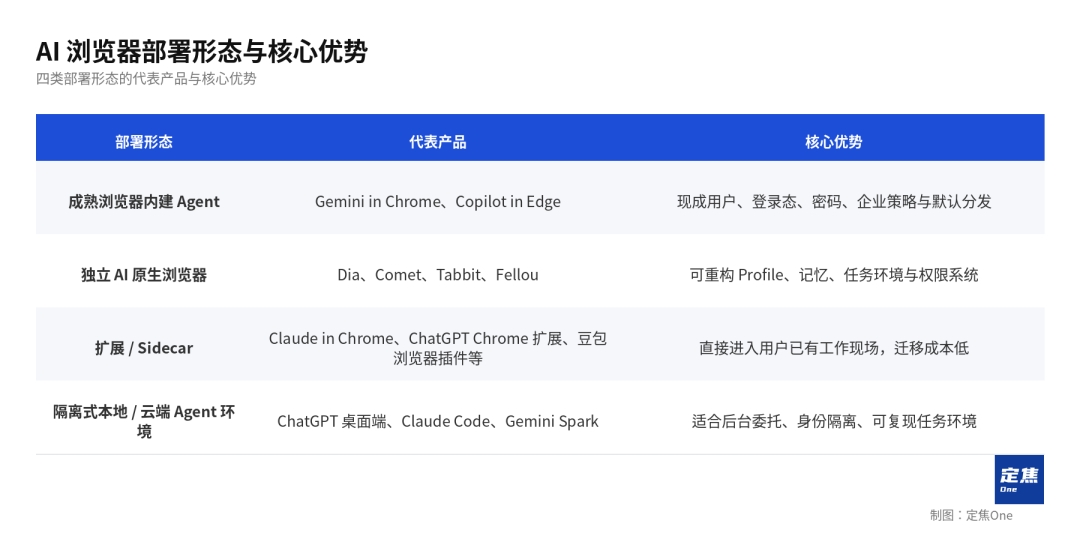
Among the four forms, the independent AI-native route has the highest fixed cost, and Atlas's exit is a clear proof of this.
This heavy investment is first reflected in the engineering architecture, that is, the "browser building" process. On the surface, Atlas is a Chromium browser, but OpenAI did not just make a shell based on Chromium. According to official statements, it built a self-developed architecture called OWL, which separates Chromium's browser process and runs it in the background, which is equivalent to running the engine independently, while almost all the interface of Atlas's main application is built from scratch using Apple's own SwiftUI and AppKit.
This approach means that OpenAI has become both a "browser vendor" and an "Agent platform" at the same time, and both businesses continue to burn money. Senior Agent practitioner Zhao Jiangjie splits the cost into two parts: one part is the hard cost of the browser, including Chromium version tracking, multi-platform compatibility, credential management, enterprise governance, etc.; the other part is the soft cost of building Agents, including page perception, permission system, prompt injection defense and auditing.
Keeping up with Chromium alone is no easy task. The technical lead of AI-native browser Phi Browser told "Dingjiao One" that Chromium itself is an extremely large, long-history software engineering project with rapid iteration, and it is never easy to keep up with its update pace.
How much more expensive is it than an AI plugin? This lead gave an intuitive order-of-magnitude comparison: "If you only make an AI function extension based on Chrome, a few engineers can get started; but to maintain a Chromium browser for a long time, plus a complete native interface, Agent runtime, memory system, background services, update and security system, it is very normal that the overall engineering investment is one order of magnitude higher, and it is not surprising that the R&D phase investment can be dozens of times or even nearly a hundred times higher."
Zhao Jiangjie made a more conservative estimation based on a smaller engineering scope: compared with a product that only makes AI function extensions based on Chrome, a cross-platform, enterprise-manageable, Agent-supporting AI-native browser can have 3 to 10 times higher investment in fixed R&D, security and QA.
What's more troublesome is that there is also security maintenance expenditure.
Atlas's core Agent Mode feature allows AI to directly operate users' web pages and accounts, which means that as long as hackers embed a piece of malicious text in a web page, the Agent may take it as the user's instruction and execute it. This kind of attack is very difficult to defend against. In the eyes of large language models, user instructions and web page content are the same text stream, and it is difficult for them to distinguish which sentence should be obeyed and which is just for reference. So security confrontation is an endless expense.
With such huge investment, Atlas did not get enough returns.
In terms of actual experience, some users reported that the actual performance of Agent Mode was not stable. Public tests also proved this point: when asking Atlas to place an order on Walmart, it encountered problems such as pop-up blocking, missing login status, and brand recognition errors; it took about 10 minutes to add 3 items to the Amazon shopping cart, which was slower than manual operation.
It also has inherent constraints in product design and business model. During its life cycle of more than 9 months, only the macOS version of Atlas was available, and other versions were never launched; the Agent Mode feature requires a ChatGPT Plus or Pro subscription to unlock, and Atlas itself does not make money independently. Its commercial value is almost only reflected in two indirect indicators: diverting traffic to ChatGPT, and collecting users' browsing behavior data.
According to statements from multiple practitioners, the net contribution brought by one user is roughly equal to the incremental gross profit he brings to ChatGPT, minus the expenses of browser maintenance, Agent tasks and security support. Only when this number is positive and significantly higher than that of the Chrome extension or desktop embedding solution, is it worthwhile to continue developing Atlas's independent browser route.
The shutdown in less than 10 months shows that OpenAI has finished this subtraction. Even if Atlas can provide a more complete Agent experience, the increment and user retention it brings cannot support the continuous investment of a standalone browser.
02. The product is gone, but the capabilities remain
Shutting down Atlas does not mean that the AI browser itself is a false proposition. OpenAI's approach is to split Atlas's capabilities one by one and integrate them back into ChatGPT.
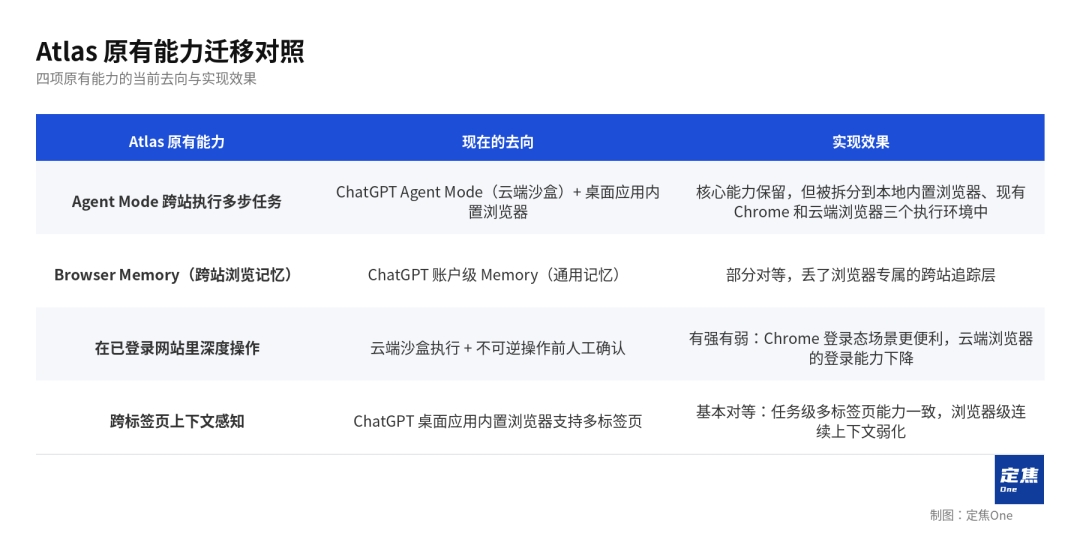
As a standalone product, Atlas has four main features: cross-site multi-step task execution (Agent Mode), cross-site browsing memory (Browser Memory), in-depth operation in logged-in websites, and cross-tab context awareness. After the shutdown, these four features have their own destinations respectively.
The first three features are basically retained. While shutting down Atlas, OpenAI has prepared three new destinations: the built-in browser in the upgraded ChatGPT desktop client, a dedicated cloud browser for Agents, and the Chrome extension Side Chat. The cross-site multi-step task execution feature is taken over by these three paths; while the two features of "in-depth operation in logged-in websites" and "cross-tab awareness" are mainly migrated to the Side Chat extension.
The only feature that is significantly reduced is the fourth one, the cross-site memory function, and only about half of it is retained. Previously, Atlas automatically remembered what users saw and did on different websites, but now ChatGPT will not take the initiative to record this information, and users have to tell it the key information manually.
So, does this "lost" half of the memory feature matter?
Combining feedback from practitioners and OpenAI's trade-offs, the answer is clear: Memory is important, but it cannot determine the final success of the product.
Zhao Jiangjie said that memory is not the biggest moat of AI-native browsers, nor the hardest part to replicate. Chrome, ChatGPT and Gemini can all build cross-scenario context through browsing history, account memory and other methods. The advantage of native browsers in memory is that they can more naturally put pages, tabs, history and task status in the same Profile, but this advantage is not irreplaceable.
He believes that the real possible barrier formed by native browsers is the "execution environment", that is, the combination of seven elements: identity, login session, memory, permissions, data sources, execution history, recovery and auditing. This means that an Agent not only needs to remember what users like, but also needs to know where the information comes from, whether it has expired, which operations require user confirmation, which step was stuck last time, and whether the current task result is actually completed. These deeper capabilities are difficult to achieve smoothly in non-AI-native browsers.
However, there is a prerequisite for this set of deep capabilities to be truly realized: users are willing to replace the browser they are currently using. For the execution environment to work, users need to entrust their accounts, operation records and other data to this new browser, so that it can take over the work. The problem is exactly here: changing browsers is a high-threshold action, and most people will not leave the browser they have used for many years just for stronger Agent capabilities.
The current choices of overseas large manufacturers show that they do not intend to bet on this prerequisite. Google announced at the 2025 I/O conference that Gemini will be embedded in Chrome, and the Gemini sidebar was fully rolled out in January 2026, following a three-layer superimposed route of on-device model, cloud sidebar, and automatic browsing for paid users. Microsoft added Copilot mode to Edge in July 2025, calling it "the first step in reinventing the browser for the AI era". Anthropic also did not build a separate AI browser, and what it launched in August 2025 was only a Chrome extension for Claude. They chose to take a step back and embed AI into the browsers or products that users are already using.
In other words, even if they do not have an existing browser available, most leading overseas AI giants would rather enter users' work scenarios through "extensions" than build a browser from scratch. The shutdown of Atlas further shows that even OpenAI, which has more than 900 million weekly active users, cannot easily take the "independent" path. Dividing Atlas's capabilities into existing products will cause some losses, but it is the most cost-effective choice.
03. After Atlas, there is still a narrow path left for independent AI-native browsers
So, are AI-native browsers still useful? Is it worth building a separate one?
The answer is "yes", but this path is much "narrower" than everyone thought a year ago. More than one practitioner believes that "independent AI browsers are hard to develop" does not mean that this category has no value.
For companies with super entry points such as Google and OpenAI, independent browsers are just one of the options, and they can embed AI back into their own products at any time. But for players who do not have super entry points to borrow, building an AI-native browser from scratch is almost the only way to enter this track head-on. It's just that the end point of this path has changed from "replacing Chrome" to focusing on more specific scenarios and becoming users' "second browser".
Image source / Unsplash
First of all, let's talk about why it is still useful.
The technical lead of Phi Browser believes that from the very beginning of design, AI-native browsers treat both humans and AI as users, allowing Agents to understand, operate, and even take over the browser after obtaining authorization, so that humans and Agents finally share the same working environment. The difference between it and "adding a plugin to the browser" is that what the plugin can do depends on how many APIs the browser vendor is willing to open. If you want AI to become a "first-class citizen" in the browser, operating tabs, switching windows, and managing Spaces like humans, the permissions of plugins will quickly hit the ceiling.
He said that if you force these capabilities into an ordinary extension, you will easily end up with a very typical software engineering situation: in order to insist that you are not a browser, you end up rebuilding half a browser next to Chrome.
But it needs to be clarified that this ceiling only applies to third-party plugins. Chrome and Edge are products of Google and Microsoft respectively, and there is no obstacle for them to open deep permissions to their own AI. This lead also admitted that it cannot be said that there is a technical ceiling in the large manufacturer route, and they can also achieve deep integration if they really want to.
At the same time, this may not be the battlefield that large manufacturers are best at. Traditional browsers have been designed around humans for decades. No matter how powerful the AI of large manufacturers is, it is just adding features on this old base, which is more like "adding a smart assistant to the browser", rather than reconstructing the entire system around "shared use by humans and Agents". Google also has an additional commercial concern: the more Agents can do work for users, the fewer search ads users click, so it may not dare to modify Chrome too radically. Technically it is achievable, but it requires coordinating the existing search, advertising and browser ecosystem at the same time, which brings extremely high commercial difficulty. This is exactly where independent players dare to place their bets.
Useful as it is, its prospect is shrinking.
Zhao Jiangjie believes that the space for independent AI browsers will shrink from the grand goal of "replacing Chrome" to several more specific scenarios, such as work-specific browsers, enterprise security browsers, Agent isolation environments, vertical task browsers, multi-model workspaces, etc. It is difficult for it to become the default browser for everyone, and a more realistic positioning is to become users' "second browser".
But even if it shrinks to these scenarios, there is a hurdle that no AI browser can bypass: permissions. If the permissions are too few, the Agent can only give suggestions and make summaries, and users still have to perform actual operations manually; if the permissions are too many, users will not trust to hand over their accounts, files and even the entire computer to the product. This dilemma also explains why AI browser demos have always looked very impressive, but their daily popularization is much slower. At the end of the day, users do not care about the label of "AI-native". What they want is to get sufficiently good and secure AI capabilities in the tools they are already using.
On this shrunk route, specific samples have emerged, and Tabbit under Meituan is one of them.
Its goal is very clear: to target office workers, students and content creators who use browsers to complete work with high frequency. In terms of pricing, basic conversation and web page reading are permanently free, while high-frequency automated tasks are placed in the weekly-paid professional version. Backed by Meituan, it has the conditions to make long-term investment and trial and error, betting on the narrow path that Atlas failed to get through. As for whether it can succeed in the end, there is no answer yet.
Liu Jiong, head of Meituan's GN06 team, previously expressed this pragmatic attitude: as an AI application team, the essence is to understand where users' context and scenarios are, and develop products closely around these scenarios. He holds an open attitude towards whether the final product is a browser or not.
Atlas's shutdown proves that under current technical conditions, it