If Honda had stayed out of the electric vehicle business, it would have been an absolute runaway winner.
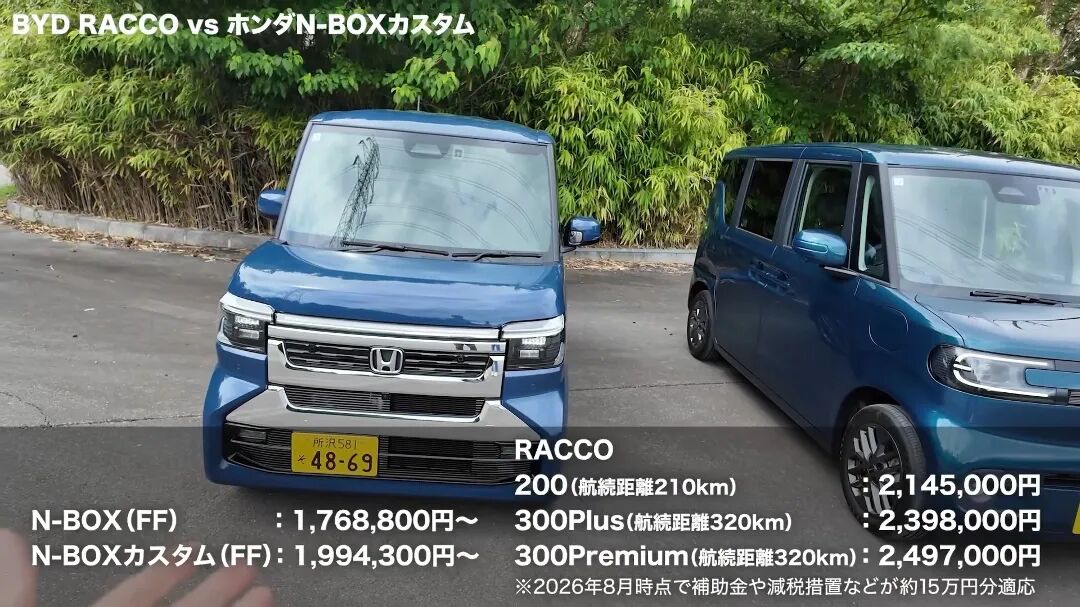
Finally, after BYD Raccoon was officially launched in Japan and drew massive public attention, Japanese media finally got the chance to compare it with Honda N-BOX, the top-selling K-CAR model.
After a series of actual tests, the seemingly equally matched product performances, set off by the all-electric identity of BYD Raccoon, make all the inherent advantages of Honda N-BOX far less impressive.
Japanese automakers have always been very conservative in developing electric vehicles, let alone Honda. To find out the reason, just as Honda N-BOX dominates the K-CAR market and even outperforms Toyota, the valuable experience and sufficient profits accumulated in specific niche markets allow Japanese enterprises to be complacent about the electrification transformation.
At present, even though BYD RACCO has caused a certain impact on Japan's K-CAR market, no matter how Toyota, Nissan and other brands respond, it is still hard to tell whether Honda itself has felt the crisis brought by external forces in the electrification field once again.
As a Japanese enterprise, Honda always considers whether the implementation of all strategies and the development of all new models can bring effective returns in the end. That is to say, while earning profits by its own capabilities is important, the input-output ratio still matters a lot. If Honda devotes all efforts to launching a hit product only to end up making losses for nothing, it will not be interested in such a business at all.
Affected by the new financial report data, Honda has raised its performance forecast due to the weakening of the yen and the strong demand for hybrid electric vehicles in the US market. The underlying message behind this move is: Honda would have reaped huge benefits if it had not been so active in developing electric vehicles.
After making a large provision for huge losses brought by the adjustment of its electrification strategy in advance, Honda expects its operating profit for the fiscal year ending March 2027 to reach 650 billion yen, while the previous forecast was only 500 billion yen. This further proves that Honda is committed to generating continuous revenue through its traditional businesses.
Perhaps Honda's lack of enthusiasm for electrification is never a sudden sign of timidity. Instead, after calculating all accounts, it finds that the electrification business in Honda's global layout is neither profitable, nor controllable, nor essential for its survival.
01
Motorcycle Business Division
That Created Honda's Glory Era
For a long time, just like China's Great Wall Motors, Honda has always regarded profits as a more important indicator than sales volume, scale and public influence. But different from the current moat of Great Wall Motors, Honda has an absolute defense mechanism that no other automaker of the same level has ever owned. The vigorous development of its motorcycle business division fundamentally eliminates Honda's concerns about its automotive business.
How does the strength brought by motorcycles support Honda to give full play to its own characteristics in the automotive market? You just need to see how astonishing the profitability of Honda's motorcycle business is.
In the first fiscal quarter, Honda sold 5.663 million motorcycles, with an operating profit of 233.9 billion yen and a profit margin of 20.5%; it sold 786,000 automobiles, with an operating profit of 192.1 billion yen and a profit margin of only 5.0%.
In secondary markets such as India, Brazil and Southeast Asia, the seemingly low-cost Super Cub and PCX models generate far more and more stable profits than automotive IPs such as Accord and Civic relying on huge sales volume. Even compared with Honda's performance in the North American market, no product can match the profit-making capability of Honda's motorcycles.
In this context, is it reasonable to blame Honda for its stagnant electrification transformation, or accuse this Japanese automaker of not attaching importance to the Chinese market? To be honest, if any Chinese automaker had such a business foundation, it would not make any difference even if it stopped producing automobiles directly.
Instead of struggling to earn returns that are even less than the interest from bank fixed deposits, it is much more pleasant to lie down in the motorcycle market and keep seeing high profits coming in, isn't it?
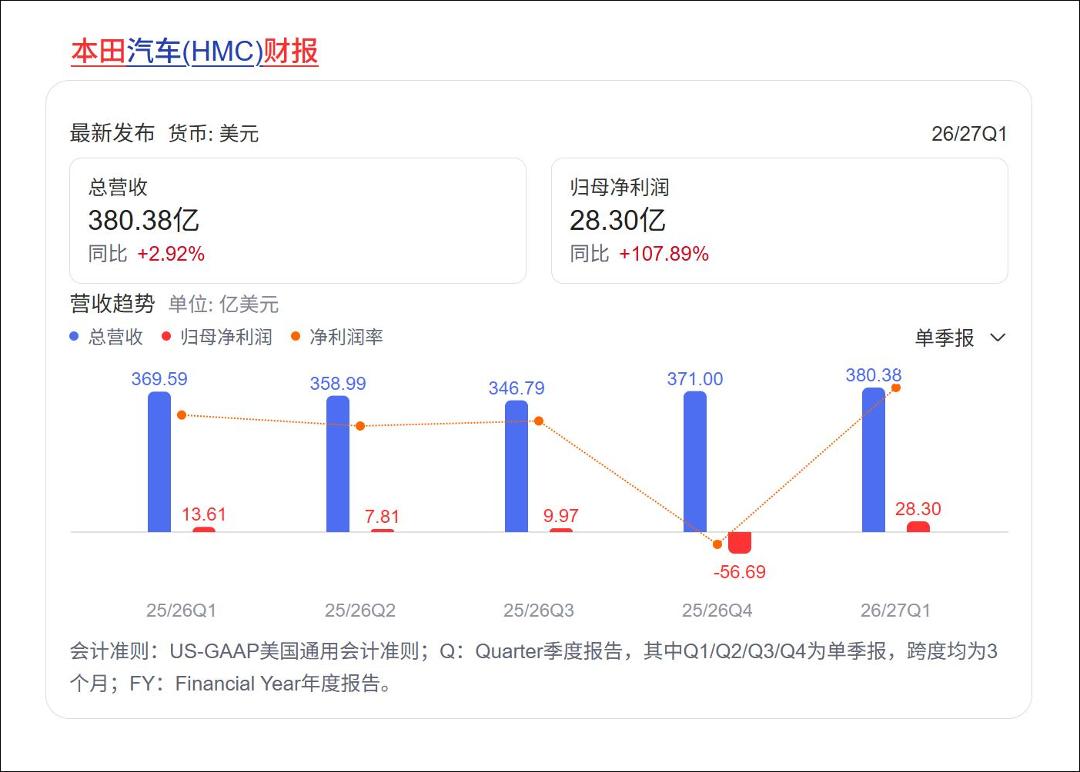
At the current stage, even if such a strong supporting factor is inseparable from the weakening yen exchange rate and the year-on-year change brought by tariff impacts, the automotive business alone contributes 52.2 billion yen from the exchange rate, and the improvement of tariff impacts adds 81.6 billion yen.
But essentially, Honda has an enviable source of profit, which makes it understandable that Honda is always not so active in the face of intense involution competition and high-investment forward-looking product layout.
In the last fiscal year, Honda made a provision of more than 1.45 trillion yen for EV-related losses, and its net loss for the whole year reached 423.9 billion yen, marking its first loss since its listing nearly 70 years ago. There are obvious financial operations behind this move, but the series of official announcements made by Honda is exactly sending a signal to the outside world: Honda will re-educate those who clamor for full electrification transformation.
Honda canceled the development of three "0 Series" all-electric models in North America, paid compensations to suppliers, scrapped existing molds and rearranged production lines; the $11 billion plan for the Ontario battery plant in Canada (jointly built with LG Energy Solution) was frozen, and all the upfront sunk costs were recorded; the e:N Series and Ye Series in China both performed poorly, the capacity utilization rate of new energy plants was dismal, and Honda officially announced the shutdown of the Huangpu plant of GAC Honda. Even at present, Honda may outsource the entire development work of its vehicle platform to Tata Technologies in India...
Such a radical restructuring plan, in Honda's view, is perhaps the correct attitude to correct its development direction.
What's more, since the birth of the brand, Soichiro Honda's passion for machinery and extreme pride in its own technology have also been profoundly influencing Honda's development.
Not to mention the previous termination of the cooperation with Sony, even the Prologue model, which carries the Honda badge and is built on GM's Ultium platform, still loses money for every unit sold. Honda could not bear such a situation at all, so it broke up with GM without any hesitation.
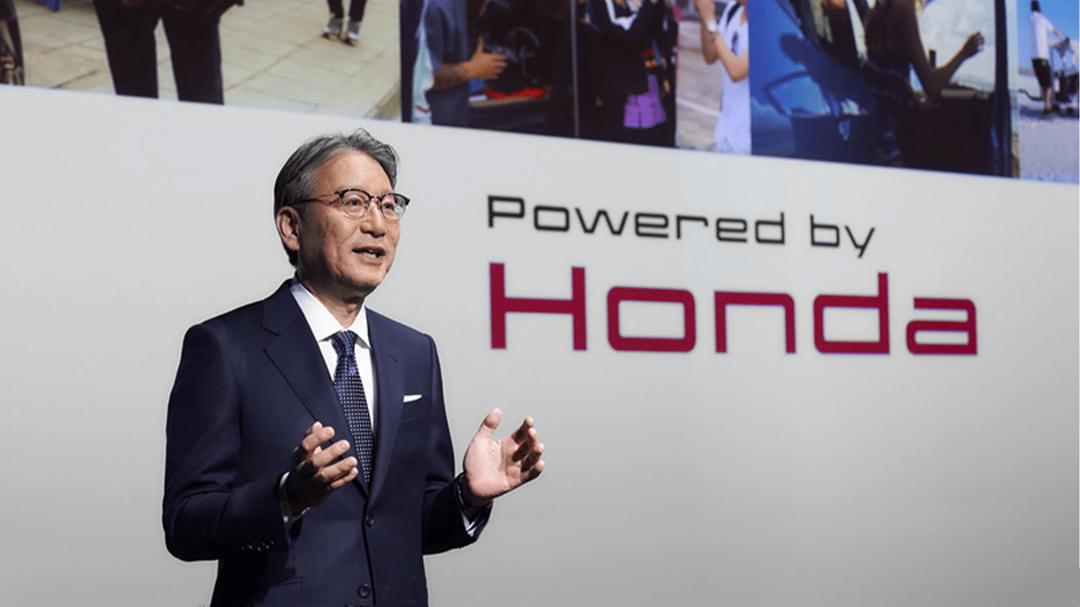
Facing the collective impeachment and "forced resignation" from the team of retired executives led by 90-year-old former president Nobuhiko Kawamoto, Honda's board of directors made the decision that "after careful consideration, it finally decides to retain Toshihiro Mibe as CEO". Do you think this is a helpless move for Honda?
In my opinion, it is precisely because everyone from top to bottom in Honda knows that the latest decision under the command of Toshihiro Mibe is not a move that will harm Honda's own interests.
After realizing the reality that "the global demand for all-electric vehicles has been overestimated, the policy dividends in North America have been stopped, Chinese automakers have completely suppressed the joint-venture all-electric products with intelligent driving technology and cost advantages, and India and Southeast Asia have not yet reached the inflection point of all-electric vehicles", it is extremely unrealistic to rely on its own limited experience to burn money for survival.
In contrast, "consolidating its foundation" has become the first step of Honda's strategic adjustment.
02
The Future
Global Market and Chinese Market Operate Separately
That's right, when slogans conflict with cash flow, Honda chooses cash flow. This is very typical of Honda, and also very typical of Japanese enterprises.
Simply put, when Honda consciously downgrades "electrification" from a global belief to a regional development direction, the only choice left for it is: develop business where it can make profits, and withdraw immediately where it needs to burn money.
Toyota adopted this idea in the first half of the year, and Ford, Stellantis and Volkswagen are all retreating in the US market as well. Now, Honda is the one that retreats most thoroughly, because it has suffered the heaviest losses and still has the deepest moat. In this case, stopping first is always a correct choice.
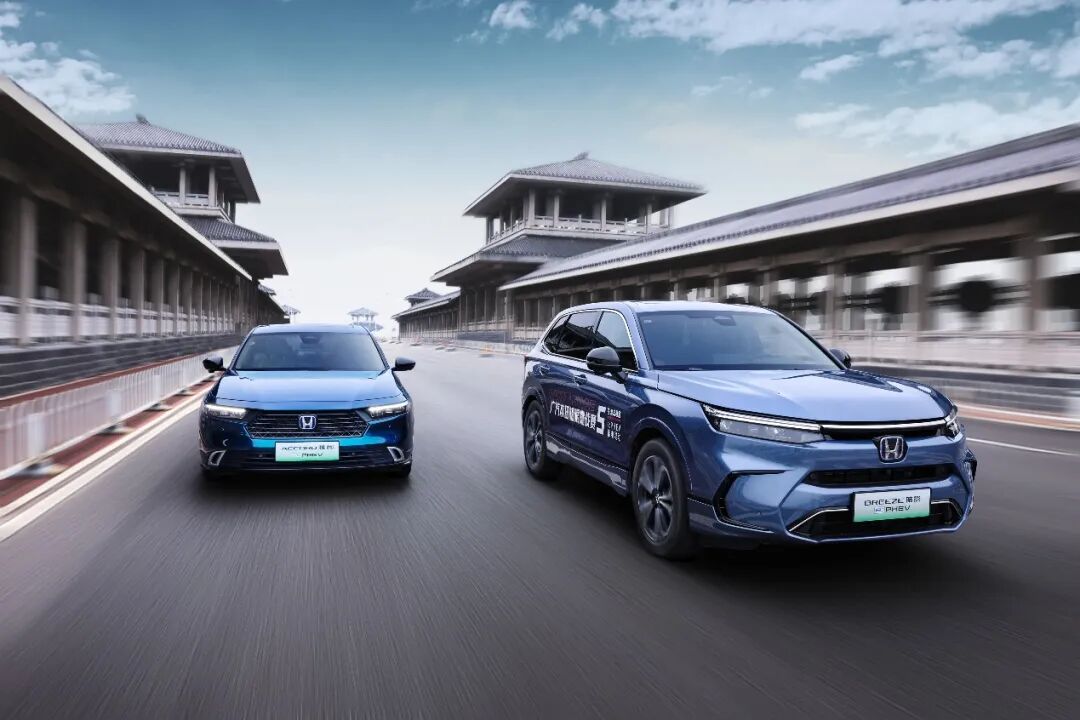
At present, in the Chinese market, we are very clear that different from overseas markets, Honda is in an awkward situation in China. It used to be a leading joint-venture automaker, but in just a few years, it has become the slowest responder in the entire camp. For such a Honda, the industry often believes that the Chinese market has not yet brought enough pressure to Honda, and Honda still has plenty of cards up its sleeve.
In fact, considering the money-making capability of Honda's motorcycle business division which is comparable to a money printer, even without the "joint-venture" title, I believe that Honda will not even blink or lower its posture even if competition in China's auto market becomes extremely fierce.
The only reason why Honda still thinks it necessary to sell cars in the Chinese market is that the renewal of the joint-venture agreement restricts its considerations.
Calculated based on the survival mode of foreign-funded enterprises in China in the future, what if they do not engage in retail business anymore? Hyundai and Kia did this before, and Chevrolet of GM is doing this now. Relying on China's huge and low-cost supply chain system to produce automobiles for export to overseas markets is much more comfortable than losing money in retail business.
Furthermore, as China's new energy industry chain becomes increasingly mature, Honda can still maintain a good development momentum simply relying on its cost advantages.
Philippe Brunet, then CTO of Renault Group, once cited the example of Twingo E-Tech to illustrate the benefits of this mode. On the one hand, the model is developed in Shanghai and manufactured in Slovenia, with a starting price of 19,490 euros for sale in Europe, bringing huge profit margins. On the other hand, its R&D cycle is only 22 months, setting the fastest record in Renault's history, and the order volume exceeded expectations by one time as soon as it was launched.
In this case, who can say that Honda cannot copy this mode if it really has a hard time in the future?
All in all, Honda is giving its joint-venture companies in China an opportunity. Ten years is not too long, nor too short a period. For Honda, this is not a matter of life and death, but an opportunity for the two Chinese enterprises under the Honda brand to achieve self-redemption.
Also in August, GAC Honda once released new information about the renewal of the joint-venture agreement to the public. The core message is: Honda will delegate power, and the Chinese side of the joint venture will master the decision-making power in multiple dimensions such as new product definition and R&D.
To put it in detail, considering Honda's business performance in the global market and its accumulation in new energy technologies, from this moment on, no matter how fierce the market torrent is, all the competition in the future will be the war of this authentic Chinese auto enterprise itself.
No matter it is GAC Honda or Dongfeng Honda, would you like to see Honda bring its experience of developing products like Super-one which has a range of less than 300km and a very high price to them?
Honda presses the pause button not because it does not understand the future, but because it has learned to survive in the present first -- to make enough profits through hybrid vehicles. That "electric Honda" may come back one day; but if it does not, its product matrix of motorcycles and HEV models is enough to support its development for a very long time. However, for Honda (China), it needs to realize that all the praises Honda has obtained globally are useless.
Faced with the reality that profit figures have improved significantly but China's automobile sales are still declining rapidly, all development related to the Chinese market must be fully localized in China.
Within Honda's joint-venture system, no matter whether the latest electric vehicle of Dongfeng Honda is an all-electric MPV, or whether GAC Honda will launch a product equivalent to Toyota's bZ3X with the help of GAC, everyone involved must completely abandon Honda's pride, and clearly realize in front of Chinese enterprises that they are no longer the senior players, but new students who have just stepped into the campus.
This article is from the WeChat Official Account "Auto Community" (ID: iAUTO2010), written by CAO Jiadong, edited by HE Zengrong, and published with authorization from 36Kr.