With daily sales of 1,000 cups and monthly revenue of 75,000 yuan, are a number of township coffee shops quietly making huge profits without attracting public attention?
Can't keep up with the fierce competition in big cities, but coffee shops in towns and villages are suddenly seeing explosive order volumes?
This summer vacation, many young people returning to their hometowns have found that the coffee shops at the entrance of their home villages are surprisingly prosperous. The Luckin Coffee store in Zhongcun Town, Pingyi, Shandong, serves over 1,000 cups on average daily; a township store in Pingjiang, Hunan records a monthly revenue of 75,000 yuan.
Brands including Starbucks and Cotti Coffee are also continuously expanding into the sinking market.
How is the real business of coffee shops in rural areas? I conducted a series of investigations.
1
The Trend of Coffee Going to Rural Areas:
"High-order-volume Stores" Are Emerging in Batches in Small Towns
"Shocking! Our town actually has a Luckin Coffee store now."
Life is getting better, I can enjoy coffee freedom in my hometown!
This summer vacation, many young people returning to their hometowns can't help posting on social platforms to sigh: big brands like Luckin Coffee have opened near their homes without them noticing.
From Guangdong, Sichuan to Jiangsu and Shandong, more and more young people find that the "style" of their hometowns has indeed changed a lot.
The main streets of towns and villages that used to be firmly occupied by hardware stores, agricultural supply shops and local small supermarkets are now hanging bright signs of Luckin Coffee and Cotti Coffee one after another. New-style coffee shops are next to sesame seed cake stalls, which looks a little disjointed at first glance, but strangely harmonious on closer inspection.
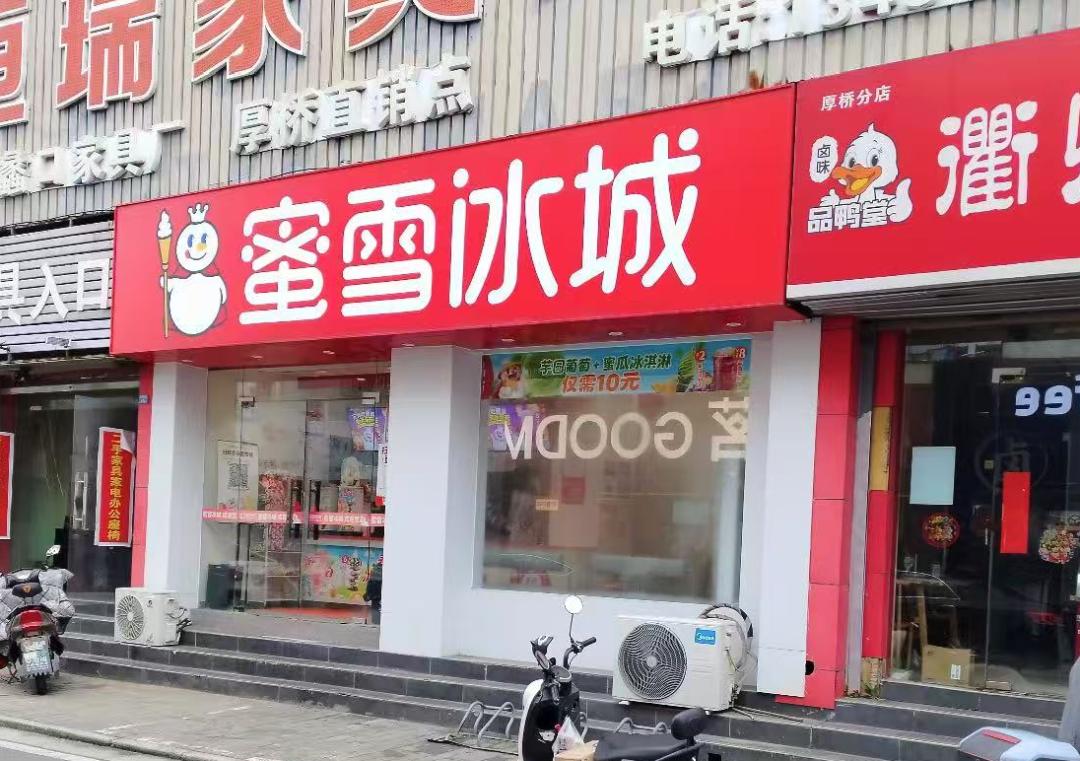
Images are sourced from Xiaohongshu blogger Langliboboxiong, which has been authorized together with the first cover image.
What's more surprising is that: Luckin Coffee and its peers not only settled in these areas, but also run pretty good businesses.
In Pingjiang, Hunan, a young man who returned to his hometown to start a business invested 700,000 yuan to open a 50-square-meter Luckin Coffee store in the town. The store stably serves 230 cups per day on average, with a monthly revenue of 75,000 yuan. After deducting various expenses such as rent, utilities and labor, the net profit is about 15,000 yuan per month. The store owner thinks that earning a stable income of over 10,000 yuan per month in the town is already a reliable livelihood.
In Zhongcun Town, Pingyi, Shandong, known as the "Hometown of Labor Protection Gloves in China", the coffee business presents a different scene.
The store is located in a self-built rural house in the town, with the iconic little deer logo standing out prominently among the storefronts along the street. The main road of the town is right at the door. Every morning, young people working in surrounding factories and masters who are purchasing and delivering goods are used to dropping by to grab a cup of coffee.
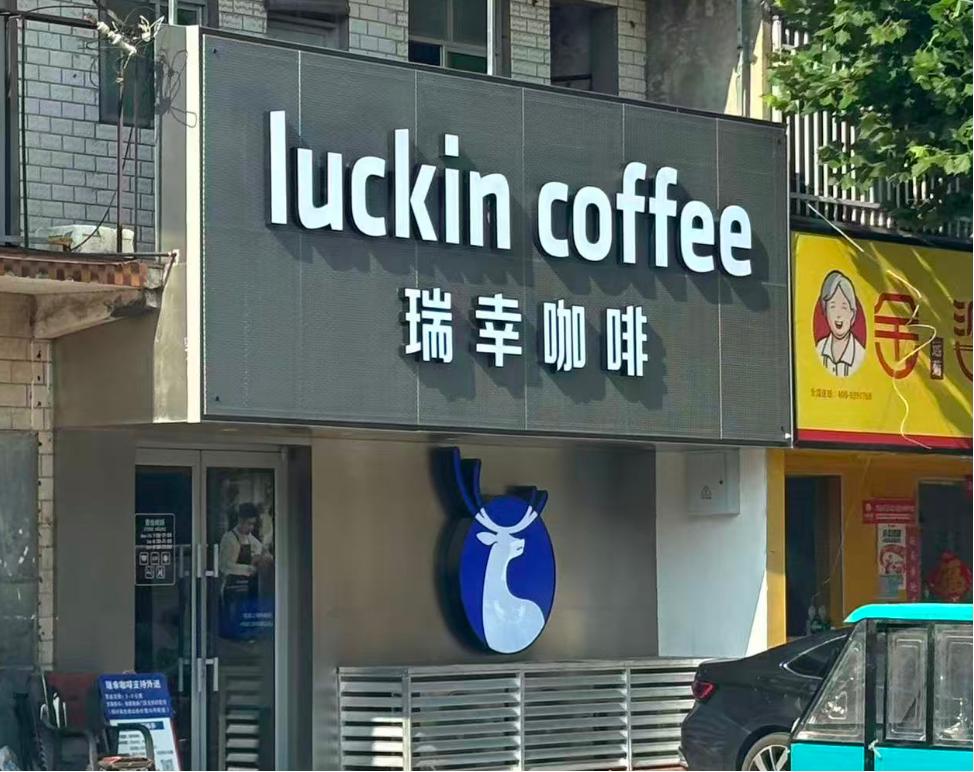
The store owner himself didn't expect that the daily cup volume on workdays stays stable at several hundred, and easily exceeds 1000 cups during holidays. A netizen left a message under the video: "In the past we bought farm tools at the market, now we buy coffee at the market."
In a township in Jilin, a blogger also squatted on the spot to record the daily turnover of the local Luckin Coffee store: starting from the initial order number 104, the last order number reached 432 when the store closed at 8 PM. This means that the number of orders in one day reached 328.
Similar cases keep popping up on short video platforms. Young people are competing to check in at the coffee shops in their hometown towns, with captions revealing a kind of unexpected surprise: "Who can understand how valuable it is to have a cup of coffee in the countryside?" "After harvesting the wheat, have an iced Americano to relieve fatigue!"
Some netizens even joked: "The good news is that Luckin Coffee has opened in the village, the bad news is that all the 'working dogs' have returned to the village."
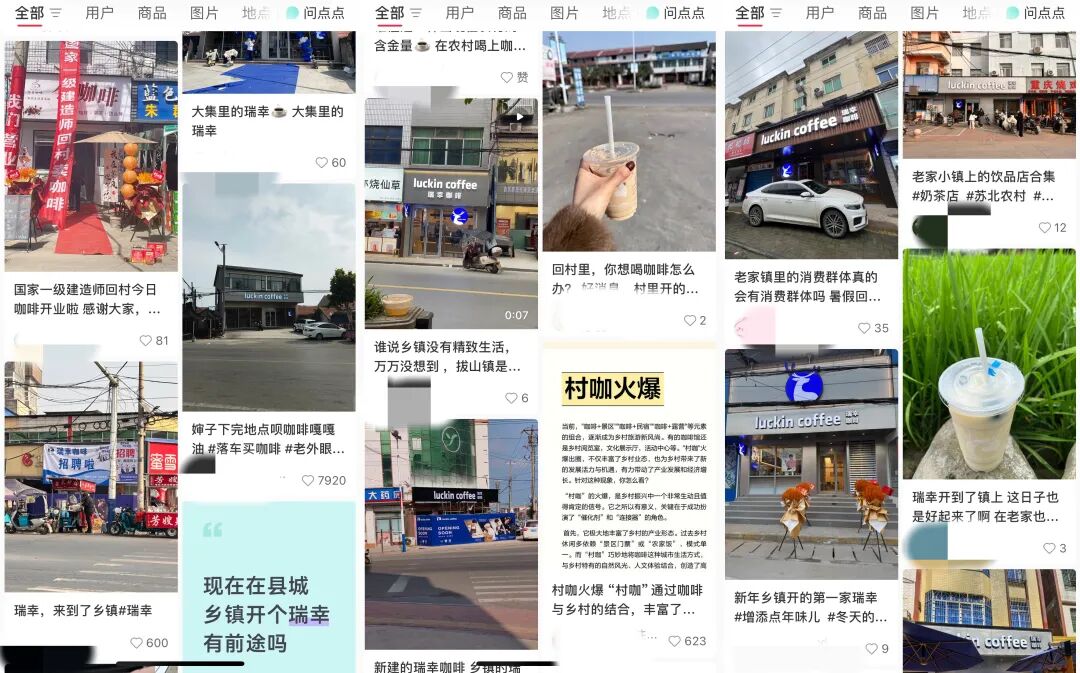
The popularity of coffee going to rural areas is clearly visible. But behind the hustle, a practical problem arises: can towns and villages with limited overall market capacity accommodate so many coffee shops and milk tea shops?
2
The Tiny Township
Can It Hold So Many Beverage Shops?
In Fujing Town, Shenqiu County, Henan Province, there are two Mixue stores on a not very large main street, plus Lucky Coffee, Luckin Coffee, Guming and Yihetang. You can run into a beverage shop after a few steps, the store density is completely unlike a township, but more like a commercial pedestrian street in a big city.
Local store owners can't help but sigh: "Competitors are everywhere no matter where you look."
This scene is not an isolated case. In Henan, Anhui, Shandong... similar scenarios are unfolding in more and more small towns.
After all, milk tea has already taken deep roots. The boom of tea drinks going to rural areas came earlier than that of coffee.

According to the 2026 Blue Book on Analysis of New Chain Tea Drink Stores in County Areas released by GeoQ, as of May 2026, the number of national new chain tea drink stores in county areas has reached 58,500, accounting for 37% of the total number of national chain tea drink stores. Among the 112 counted brands, 102 have completed their layout in county-level and sinking markets.
Names like Mixue, Yihetang, Aunt Fu Shang, and Shuyi Herbal Jelly have long been integrated into the daily life of small towns.
Nowadays, the signs of Luckin Coffee and Cotti Coffee are hung on the streets of small towns, and the attention of the same group of young people has begun to change quietly.
On the one hand, cultural tourism is being vigorously developed across the country, many towns and villages have built rural tourism and folk custom experience as local business cards. With a steady stream of tourists pouring in, coffee has been brought into small town life as a "standard configuration for cultural tourism".

On the other hand, the tea drink industry has cultivated the consumer soil for freshly made beverages in towns and villages. Young people in small towns have developed the habit of buying a cup of freshly made beverage casually, this consumption inertia has greatly lowered the entry threshold for coffee.
In essence, coffee can not shake the basic market of tea drinks in the sinking market for now, but it is indeed carving out a differentiated "territory" little by little.
For young people in small towns, when the prices are almost the same, they are naturally willing to embrace a new choice in addition to the familiar milk tea.
3
Leading Brands Are Collectively "Moving Downward"
The Proportion of Stores in Cities Below the Third Tier Has Exceeded 34%
Data from Narrow Door Restaurant Eye shows that as of July 2026, the total number of national coffee stores has reached 227,000, with 53,000 new stores opened in the past year.
Among them, the proportion of stores in third-tier cities and below reached 34.46%, exceeding one-third of the total. This means that one out of every three coffee shops is located in a city below the third tier or a township.
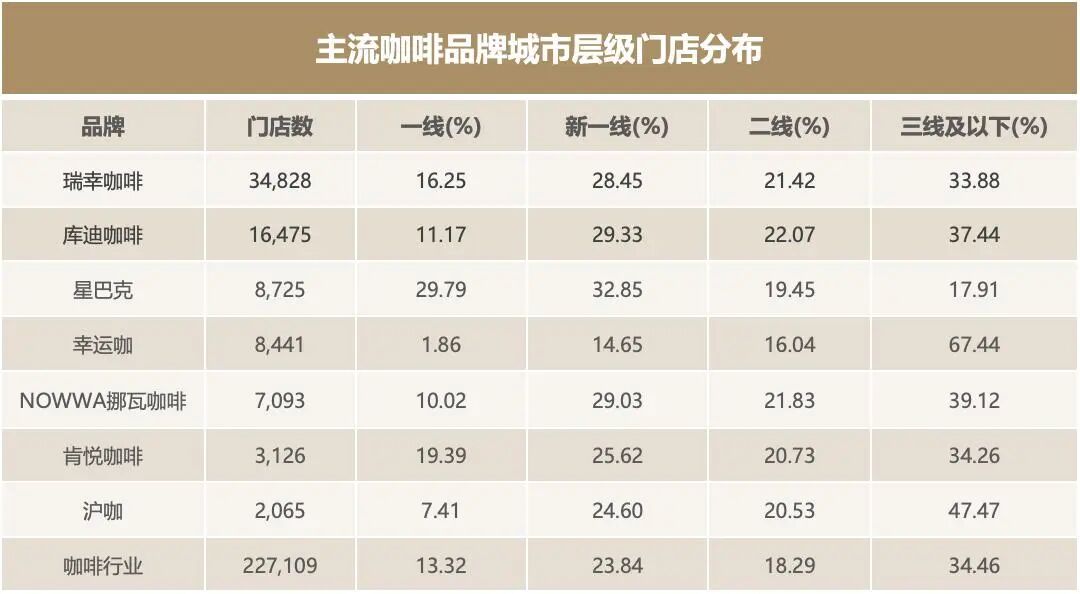
Data source: Narrow Door Restaurant Eye (as of July 13, 2026)
But when moving to the sinking market, different brands have very different strategies and paces.
Luckin Coffee has significantly accelerated its pace this year. In January 2026, it reached a cooperation with Gongsiao Daji, pushing stores to counties and towns with the help of its urban-rural network. The second-quarter financial report shows that Luckin Coffee's global stores have exceeded 36,310. Guo Jinyi, co-founder and CEO of Luckin Coffee, said that the brand will continue to improve its national network, and simultaneously deepen coverage in high-tier and low-tier cities.
Starbucks entered 166 new county-level markets in the whole year of 2025, the proportion of stores in third-tier cities and below climbed from 17% to 35%. In April this year, it completed a joint venture transaction with Boyu Capital, and has now settled in more than 1000 county-level administrative regions, planning to cover more than 1500 within three years.
In March this year, Cotti Coffee suspended the joint operation application in provincial capitals and above cities, and built directly-operated model stores to release signals for sinking. Last May, it launched special subsidies for township stores: when the daily sales volume is less than 40 cups, each cup is subsidized by 2 yuan, and when the sales volume is 40 to 70 cups, each cup is subsidized by 1.5 yuan.

Lucky Coffee chose a different path. In July 2026, it released an open letter, saying goodbye to "full-area expansion", shifted its strategic focus to prefecture-level cities and above, controlled the number of new stores within 2000 for the whole year, and focused on deep cultivation in 20 core prefecture-level cities.
It can be seen that sinking market expansion is a consensus, but every brand has its own pace and boundary.
4
"Coffee Going to Rural Areas" Has Become a General Trend
But Dividends Are Not Available to Everyone
The general trend of coffee going to rural areas is undoubtedly certain.
The 2025 China Coffee Consumption Insight jointly released by Meituan and the Dianping Research Institute shows that the coffee consumption growth rate in third-tier cities and below has exceeded 35% for three consecutive years, which is more than twice the growth rate of first-tier cities in the same period. In top 100 counties such as Zhuji in Zhejiang, Kunshan in Jiangsu and Jinjiang in Fujian, the annual per capita consumption of cups has soared from less than 5 cups to more than 20 cups in five years.

However, competition in towns and villages is no easier than in cities.
First, the core locations in towns and villages are extremely scarce, brands often cluster around industrial towns, school district towns or scenic spots. Just like Zhongcun Town in Pingyi, Shandong mentioned earlier, it relies on the industrial population of the "Hometown of Labor Protection Gloves" to support the miracle of 1000 cups of daily sales. In ordinary agricultural towns with population outflow, it is difficult for stores to fight against the natural passenger flow bottleneck.
Second, you need to rely on the "township store revenue" to survive the long payback period. Although the rent in towns and villages is cheap, the cost of decoration, equipment and transfer fee is not low. The store owner in Pingjiang, Hunan who invested 700,000 yuan has a payback period extended to four years even if he earns a net profit of 15,000 yuan per month. Most township stores cannot dilute costs by ultra-high revenue like urban business districts, and can only earn a stable hard-earned income.
Third, there are already too many players at the table. When Luckin Coffee, Cotti Coffee, Lucky Coffee and even local independent coffee shops fight hand to hand on a 100-meter long street, price wars and traffic anxiety will only come faster than in cities.
In the final analysis, this wave of coffee going to rural areas is the result of the combined effect of brand growth demands, mature supply chains and the return of consumption habits of young people returning home.
The market ceiling is very high, but the road underfoot is not smooth. This is destined to be a long-distance race that tests endurance, rather than a simple sprint for speed. What do you think about the future of township coffee? Welcome to leave a message and discuss in the comment section.