DeepSeek raises its prices, Alibaba takes a commission cut: Will major clients buy in or walk away?
Alibaba follows Moonshot AI's path, large language models start to count returns with a balance.
On August 6, DeepSeek added a notice in its official API documentation: it plans to raise the overall pricing of API services in the near future, "the expected increase will be significant", and the specific plan will be notified separately.
A day later, Reuters cited two people familiar with the matter as reporting that Alibaba plans to add new commercial license terms to its next-generation flagship model Qwen3.8-Max: the model weights will still be open, but large commercial users may need to share part of their revenue with Alibaba. The revenue sharing ratio is still under discussion, and Alibaba has not officially released the license text.
The "price hike" logics of the two parties are different. What DeepSeek raises is the unit price of model calls, while what Alibaba tries to change is the revenue distribution after weight opening. However, both incidents reveal that the commercialization of domestic large language models is crossing the same threshold: low prices and openness are responsible for bringing models into more products, while charging and price adjustment are targeting those who have already built large businesses with the models.
Over the past two years, model companies have competed to sell Tokens at lower prices. Next, when cloud vendors, inference platforms and application companies make money with these models, what model companies compete for is how much revenue they can take back.
01
Low prices are not over, the charging targets have changed
According to the currently announced V4-Flash price of DeepSeek, the input for cache miss is 1 yuan per million Tokens, and the output is 2 yuan. The corresponding prices for V4-Pro are 3 yuan and 6 yuan. The official has not yet announced the new price, only clearly indicating that the overall increase will be relatively large.
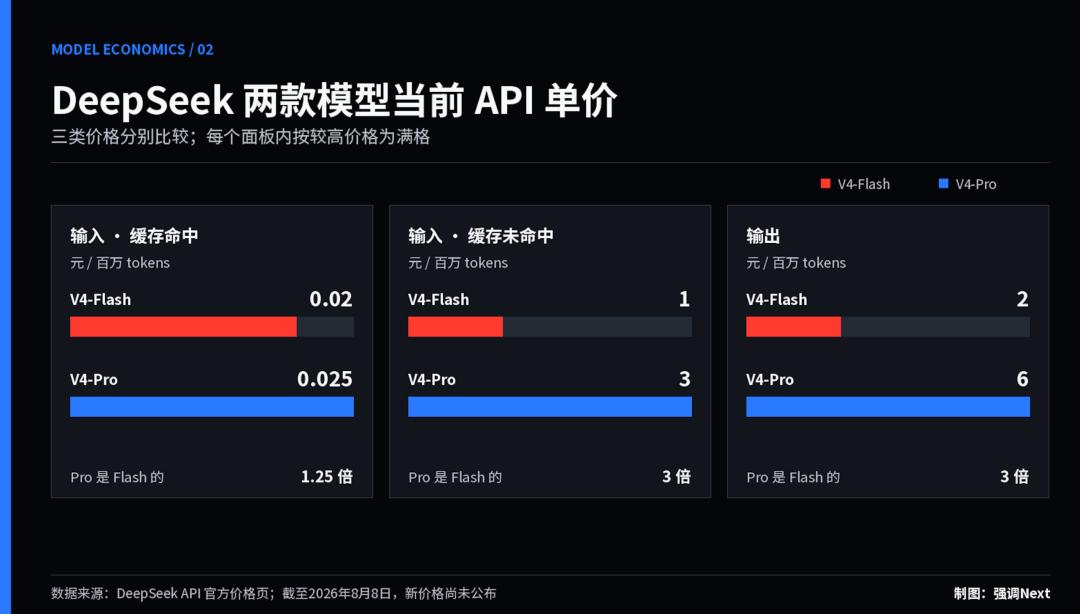
"Significant increase" is easily interpreted as the end of the price war, but it depends on the starting point of the price.
Previous estimates by research firm Artificial Analysis show that the average cost of V4-Flash to complete a set of standard tests is about 0.03 USD, that of Kimi K3 is about 0.86 USD, that of OpenAI GPT-5.6 Sol is about 1.86 USD, and that of Anthropic Claude Fable 5 is about 3.15 USD. Even if DeepSeek raises prices significantly, it may not lose its low-price advantage.
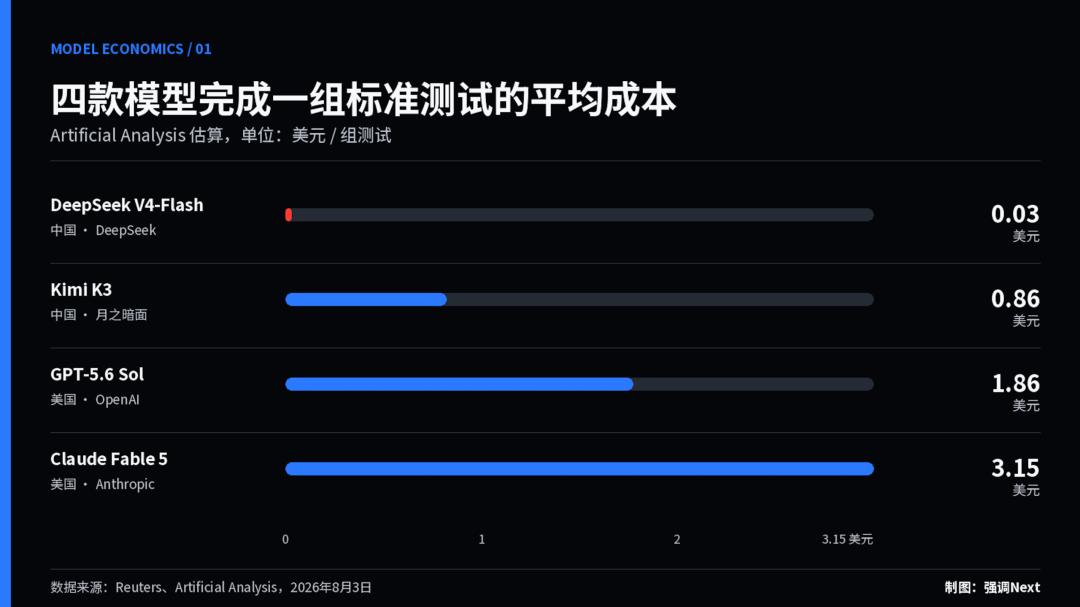
Therefore, DeepSeek is more like repairing unit revenue on the basis of extremely low prices, rather than giving up cost performance. The official has not explained whether the price hike comes from demand, computing power, new model costs, or the company's initiative to improve commercialization.
Alibaba's approach goes a step further. Previously, Alibaba could charge for Qwen calls deployed on Alibaba Cloud, but after customers downloaded the open weights to their own data centers, Alibaba usually could not get continuous revenue. The new license mentioned by Reuters is precisely to close this commercialization gap: the weights can still be downloaded, deployed and modified, but when customers package the model into services and build a sufficiently large business, they need to renegotiate.
This means that the charging logic extends from "how many Tokens are used" to "how much money is earned using the model". The former sells computing power and calls, while the latter fights for the value share of the model in the industrial chain.
02
Alibaba follows Moonshot AI's path
Moonshot AI's Kimi K3 has provided a more complete sample.
The public license of Kimi K3 stipulates that if the licensee operates MaaS, that is, provides model inference or fine-tuning capabilities as services to third parties, and the total revenue of itself and its affiliates in 12 consecutive months exceeds 20 million USD, a separate agreement with Moonshot AI is required before commercial use. The license does not specify a fixed revenue sharing ratio. Citing anonymous sources, Reuters reported that in actual negotiations, Moonshot AI's required revenue share can be as high as 30%.
The license also sets boundaries: end products that only embed the model into specific functions are not automatically regarded as MaaS. Pure internal use, calls through official products or certified inference partners are exempted. If the monthly active users of a commercial product exceed 100 million, or the monthly revenue exceeds 20 million USD, "Kimi K3" also needs to be prominently displayed on the interface.
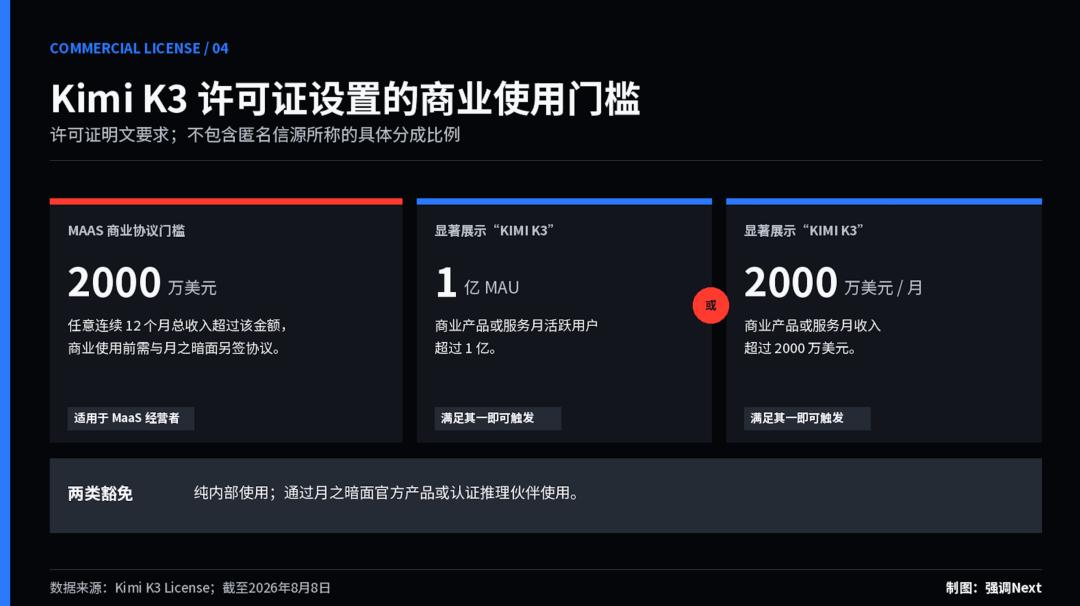
The focus of this set of designs is not to charge all developers, but to retain the long-tail ecosystem while blocking the commercial channels that are most likely to bypass the official API: third-party inference platforms and model service providers.
If Alibaba adopts a similar plan, the change will be deeper than a one-time API price hike. The current main Qwen3 model uses the Apache 2.0 license, which allows royalty-free use, modification and distribution. If Qwen3.8-Max switches to a custom license with commercial thresholds, Alibaba can still gain the spread and developer scale brought by open weights, but no longer promises permanent free of charge for large-scale commercial use.
Open weights have thus changed from a product concept to a set of tiered pricing tools: individuals and small and medium-sized teams contribute to the ecosystem, and large customers contribute revenue; self-deployment is responsible for expanding coverage, and commercial licenses are responsible for recovering value after the scale is formed.
Strictly speaking, "open weights" does not mean "open source and permanently free". The fact that weights can be downloaded only determines whether the model can be deployed locally. Whether it can be used unconditionally for commercial purposes, whether it can provide MaaS, and at what scale payment is required, are still determined by the license.
03
Alibaba wants to regain channel bargaining power
Alibaba is now in a position to try this step, because Qwen is no longer just a model project that needs subsidies to acquire customers.
Qwen3.8-Max, which was unveiled on August 3, has 2.4 trillion parameters, adopts a Mixture-of-Experts architecture, and activates about 95 billion parameters per request. It subsequently became the highest-ranked Chinese text model on Arena.AI, and ranked second in the world in the vision ranking list.
In tests more focused on enterprise workflows, the results are also at the top. The Agentic Index of Artificial Analysis mainly examines tool calling, task planning and multi-step execution capabilities. As of August 9, Qwen3.8-Max entered the global first echelon with a score of 58.
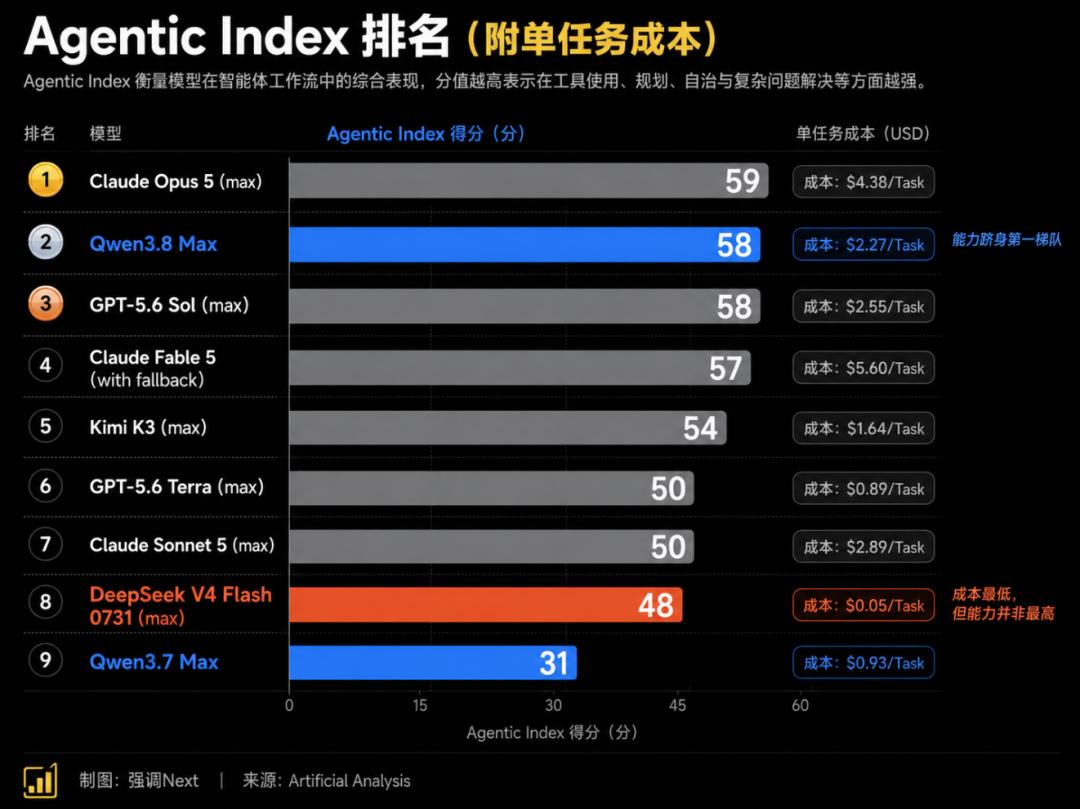
Ranking lists cannot directly determine enterprise procurement, but they increase Alibaba's bargaining power to negotiate commercial terms with large customers.
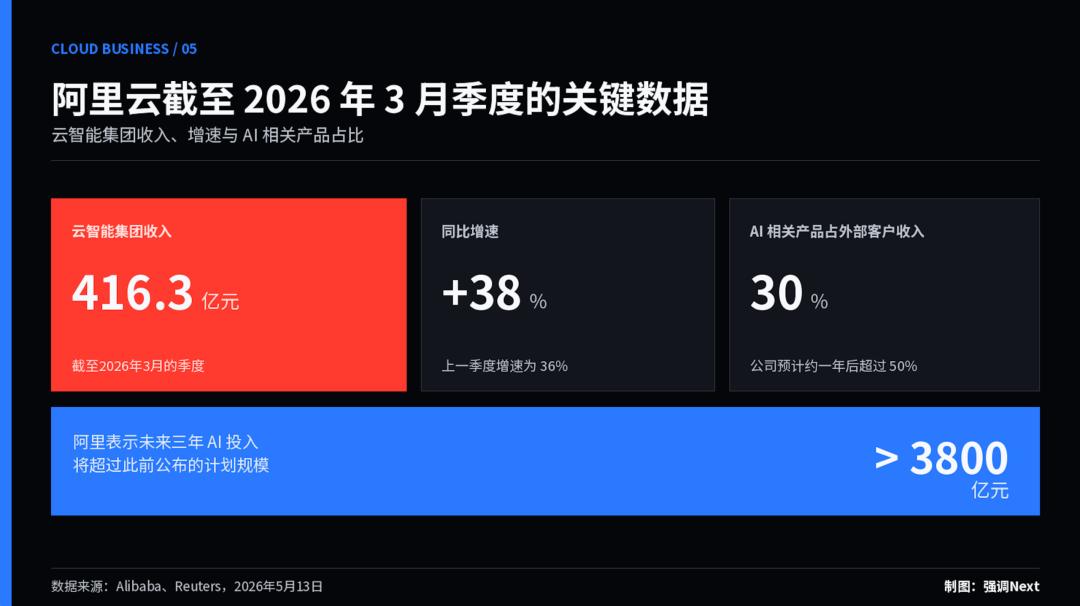
A more direct signal comes from the cloud business. In the quarter ending March 2026, Alibaba Cloud Intelligence Group's revenue increased by 38% year-on-year to 41.63 billion yuan. AI-related products accounted for 30% of external customer revenue. Alibaba also stated that its AI investment in the next three years will exceed the previously announced 380 billion yuan plan, and the management prioritizes expanding market share over short-term profit margins.
Therefore, Alibaba is obviously not satisfied with exchanging open weights for influence. The next step of competition is not just about the number of downloads, but about who controls the call entry, enterprise customers and settlement relationships.
Third-party inference platforms are the most sensitive layer. They download the weights, optimize inference on their own clusters, and then sell them to customers in the form of APIs. The model capabilities come from Alibaba, but the computing power and customer relationships are in the hands of the platforms. According to the traditional loose license, the larger the scale of the platform, the more potential cloud revenue Alibaba loses.
Revenue sharing tries to bring this part of the external premium back to the model company: it not only makes money from Qwen calls on competing clouds, but also may divert some customers to official clouds and certified partners. The license is not just a legal document, but also a channel policy.
But Alibaba's bargaining power is not without upper limit.
Once the commercial terms are too strict, large customers can continue to use the old version of the Apache licensed model, or switch to other models such as DeepSeek. DeepSeek is still completely free under Apache 2.0, Zhipu's GLM-5.2 uses MIT with no revenue threshold, and Meta's Llama only sets a 700 million monthly active user threshold without revenue sharing.
Alibaba must consider whether this billing will drive people away when setting the rate. The leading capability of Qwen, migration cost and tool ecosystem will ultimately determine how much Alibaba can charge.
04
Revenue sharing is more difficult to implement than price hikes
The logic of API price hike is very simple: model companies announce the unit price, and customers settle according to Tokens. For revenue sharing, it is necessary to first clarify how much revenue the model has created.
For pure MaaS platforms, this problem is relatively clear. But in code tools, customer service systems and enterprise software, the model is only part of the product. Is the revenue shared based on the revenue of the entire product, or only the revenue corresponding to the model function? How to attribute fine-tuning, distillation and multi-model routing? Every caliber may become a point of contract negotiation.
The revenue sharing ratio also affects whether the interests are aligned. If the ratio is too low, it is difficult to cover the model investment; if the ratio is too high, application companies will think that the model side has taken the value that should belong to products, channels and customer services. If the 30% maximum share of Kimi K3 mentioned by Reuters becomes the reference, the dispute will fall on how much value the model contributes to a commercial service.
As of August 8, the outside world only knows that Alibaba is discussing commercial thresholds similar to Kimi K3, and the specific applicable objects, revenue thresholds, sharing bases, ratios, audit methods and exemption scopes are not clear. Any change in terms will change the actual impact.
Therefore, it cannot be said that domestic large language models have bid farewell to the price war now. But at least the price war is being stratified: basic calls still lower the threshold, and leading capabilities start to raise prices; weights continue to be open, while large-scale resale is required to renegotiate.
DeepSeek's next official price list will tell the market where the cost bottom line of low-cost models lies. The final license of Qwen3.8-Max will answer another more important question: after the open ecosystem grows bigger, can model companies take back part of the value taken away by channels without driving away developers?
These two documents are closer to the real inflection point of the commercialization of domestic large language models than the slogan of "open source or closed source".
Note: The data in this article comes from public sources and does not constitute investment advice
This article is from the WeChat Official Account "Emphasis Next" (ID: leo89203898), author: Xin Jian, editor: Xiao Bai, published by 36Kr with authorization.