With a single robotic hand costing hundreds of thousands of yuan, are robot component players more profitable than Unitree?
Robots have not yet entered thousands of households, but capital has scrambled to snap up their core components such as "brains", "hands" and "joints".
Data from IT Juzi shows that in the first half of the year, 322 financing deals were completed in the domestic embodied intelligence sector, totaling 93.5 billion yuan, five times the figure of the same period in 2025.
As robot bodies become increasingly mature, part of the capital flows to the core components of embodied intelligence.
Specifically, Yimu Technology, which focuses on robot tactile perception, recently closed a Series E financing of over 10 billion yuan, with a post-money valuation exceeding 100 billion yuan, making it part of the "100-billion-yuan Valuation Club" for embodied intelligence. At present, there are more than 20 enterprises in the embodied intelligence track with a valuation of over 100 billion yuan, and the top camp of the industry is taking shape at an accelerated pace.
According to IPO Exclusive, Lingxin Qiaoshou, a core component manufacturer for humanoid robots, plans to file for IPO on the Hong Kong Stock Exchange in 2027. Some institutional investors in the primary market predict that Lingxin Qiaoshou's valuation is expected to reach one trillion yuan by then.
At the pre-IPO roadshow held by Unitree on August 7, its supply chain partners also received wide attention. Those component enterprises hidden behind the robot bodies are expected to share this capital feast as Unitree moves forward with its listing process.
01
A single dexterous hand costs up to hundreds of thousands of yuan, robot components are priced like luxury goods
Liu Diwei, Investment Director of Jinding Capital, revealed to Tech Planet that the vast majority of the nearly 1000 billion yuan of financing in the embodied intelligence sector in the first half of the year went to "brain" manufacturers, namely model-side enterprises, which is the core barrier of current humanoid robots. Especially in the past six months, enterprises represented by world models have absorbed most of the capital.
At the component level, the top three investment hotspots are joint modules, dexterous hands and brain controllers in sequence. Taking Jinding Capital as an example, its current investment in the field of embodied intelligence components focuses on two types of targets: one is joint modules with high cost proportion and large consumption; the other is key components with high technical barriers and great impact on the performance of the whole machine, such as the tactile sensing solutions that are rarely adopted by body manufacturers at present.
Due to high technical barriers, high cost and scarcity, some core components have shown market characteristics similar to "luxury goods" in the first half of this year.
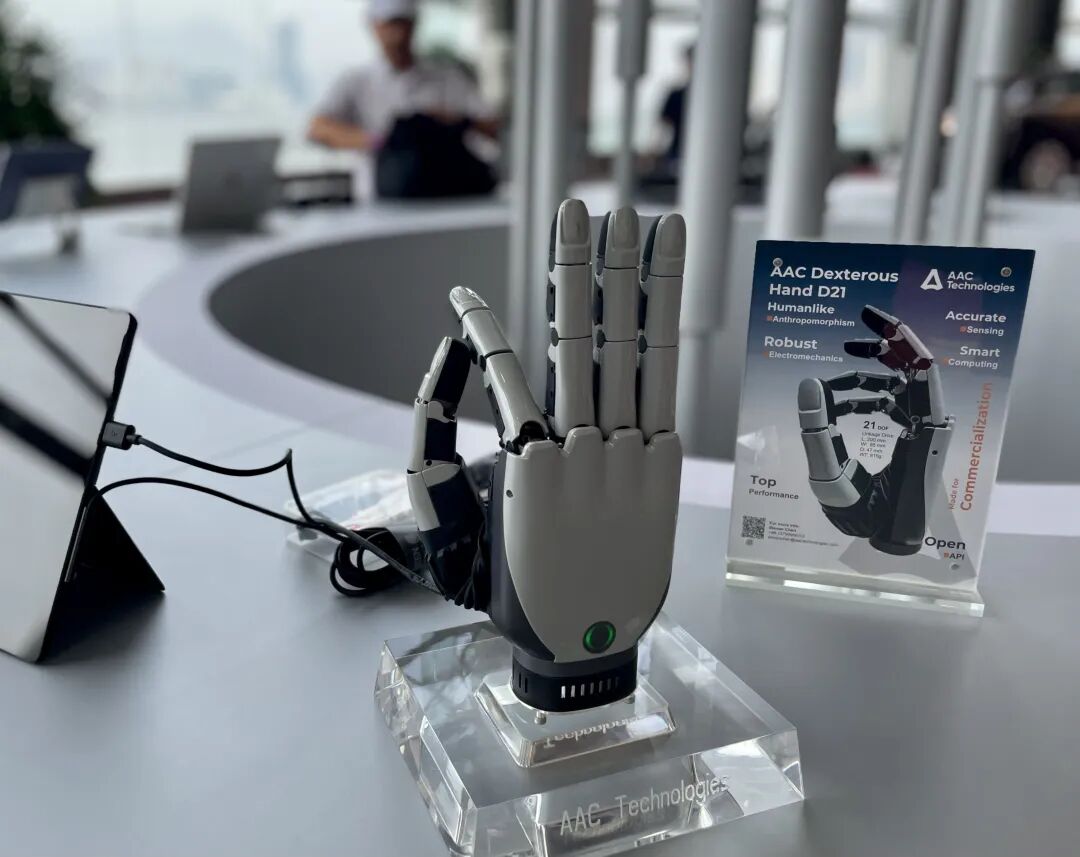
Caption: A dexterous hand exhibited at an event at the Hong Kong Convention and Exhibition Center on August 8. (Photo by Tech Planet)
Among them, dexterous hands are particularly typical. It itself is a highly integrated micro system, including micro motors, precision transmission and force tactile sensors, with an extremely complex structure. At present, the unit price of a high-performance five-finger dexterous hand on the market can reach up to hundreds of thousands of yuan. Third-party research reports show that dexterous hands account for about 14%-18% of the total cost of humanoid robots.
Moreover, there are multiple challenges such as easy damage. An example that has been widely discussed since the end of last year is that the dexterous hand of Tesla Optimus has a service life of only 6 weeks in the training of sorting express parcels, but the cost of a single hand exceeds 6000 US dollars. If other vulnerable parts are added, the annual cost of replacing parts for an in-service robot is close to 100,000 US dollars, equivalent to about 710,000 yuan.
If we expand the perspective from a single robot part to the whole machine, the total price of joint modules cannot be underestimated. According to calculations from multiple institutions such as CSC Financial and Goldman Sachs, a humanoid robot needs about 28 joint actuators all over its body (distributed in shoulders, elbows, hips, knees and other parts), and its hardware procurement cost accounts for about 30% of the BOM of the whole machine.
In the past, these component manufacturers were mostly hidden behind the "body" and rarely entered the public view. But in the past six months, this pattern has been broken.
On the one hand, as Unitree submitted its prospectus, the heat of the upstream and downstream industrial chain of embodied intelligence has risen simultaneously. Different from Tesla, which outsources important robot modules, domestic embodied intelligence enterprises like Unitree tend to develop modules independently.
At the pre-IPO roadshow, Wang Xingxing, founder of Unitree, said that Unitree adopts two modes of "self-research + procurement". Components that affect or restrict the core performance of robots, such as body structure, motion control system and joint modules, will continue to be independently developed. For functional components with diverse and scattered demands, the company will continue to purchase some models from external suppliers.
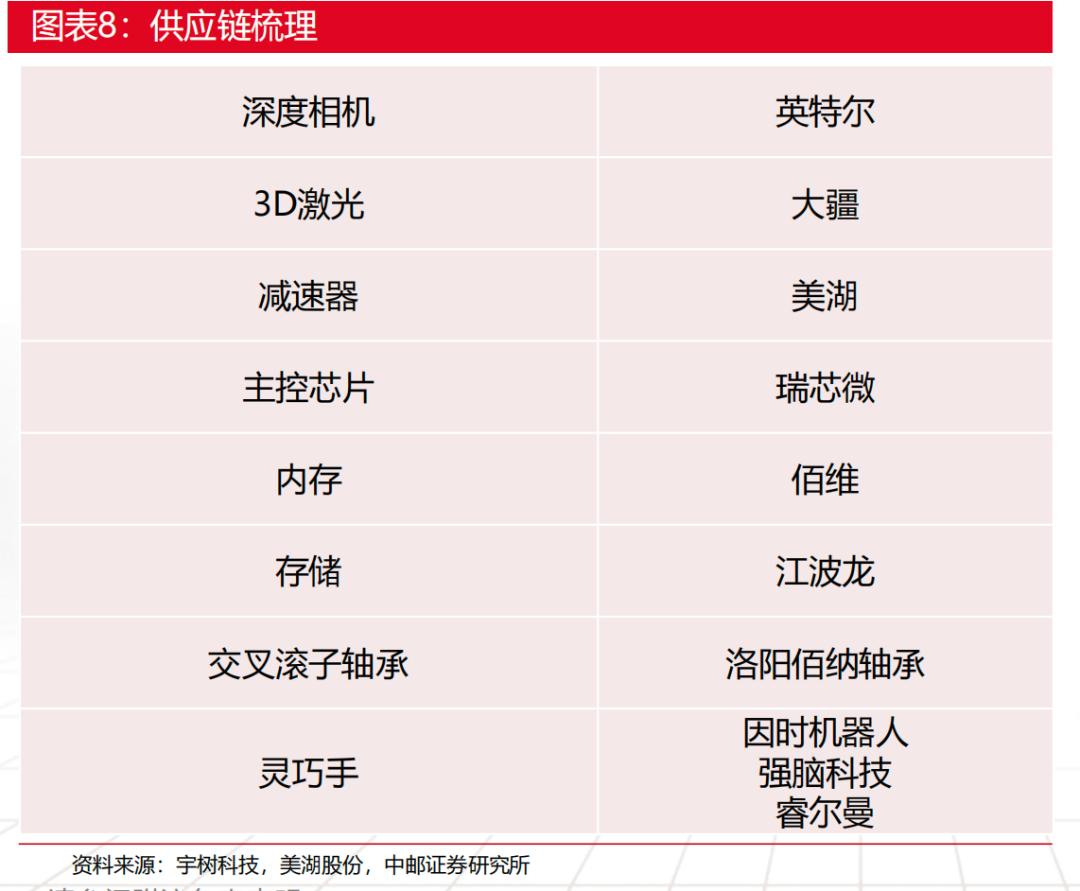
Caption: Sorting out the supply chain of Unitree's G1 product, Source: China Post Securities
However, functional modules such as components and reducers may still be supplied externally. At present, many companies including Changshu Bearing, DioMicro, Pantum Technology, Shenzhen Huaqiang and others have stated on the interactive platform that their related products have established cooperative relations with Unitree. In addition, some securities firms have also sorted out the supply chain of Unitree's core on-sale product G1.
On the other hand, as a supplier of dexterous hands, the valuation of Lingxin Qiaoshou has risen sharply. In April this year, Reuters reported that Lingxin Qiaoshou launched a new round of financing with a target valuation of 6 billion US dollars (about 424 billion yuan). This valuation has attracted much attention because it exceeds that of many current robot body manufacturers.
Entering the second half of the year, many robot component enterprises have obtained financing intensively. Xinuo Future, a full-stack self-research enterprise of dexterous hands, announced the completion of 500 million yuan of Series A+ financing, led by Meituan. Yimu Technology recently completed a Series E financing of over 10 billion yuan, with a valuation exceeding 100 billion yuan.
In the past, robots could see and speak, but they could not tell the difference between soft and hard when touching objects. Taking Yimu Technology as an example, its business starts from tactile sensors, converts touch signals into data, and then trains them into the robot's "tactile memory", so that the robot can understand objects through touch like humans. This is equivalent to installing a layer of "electronic skin" on the robot, targeting the industry's common pain point of "being able to reason but not operate".
The shipment side also verifies the warming of the track. Taking Lingxin Qiaoshou as an example, the company currently has 7 series and more than 10 products, with a price range covering 3999 yuan to 100000 yuan. Its core components are 100% self-developed, and the monthly output has reached the level of 1000 units. According to GGII data, the total sales volume of dexterous hands in 2025 was 19200 units, with In times Robotics shipping more than 10000 units, ranking first, and Lingxin Qiaoshou and BrainCo tied for second.
02
Capital pours in intensively, involution intensifies
The accelerated flow of capital to the upstream is directly related to the fact that current humanoid robot body enterprises are still in the stage of technical verification and small-scale implementation, and the profit model has not been fully established.
Unitree is one of the few profitable cases in the track. According to the prospectus, it achieved a revenue of 1.708 billion yuan in 2025, a non-net profit of 600 million yuan, and a gross profit margin of 60.27%. Even so, 73.6% of Unitree's humanoid robot revenue comes from "scientific research and education purposes", and only 9% comes from industrial deployment. The products are still far from large-scale implementation in mature scenarios.
The industry as a whole also confirms this dilemma. Data shows that the global shipment of humanoid robots in 2025 is about 18000 units, and it is expected to be between 50000 and 100000 units in 2026. The growth rate is very fast, but at this level of shipment, it is difficult for body companies to achieve a quantitative breakthrough in revenue.
At present, commercial scenarios are mostly concentrated in cultural and entertainment, commercial performances, tour guide and welcome links, and have not really created productive value, so there is the label that "robots without intelligence are just expensive toys after all".
On the one hand, capital places bets along different paths of technological evolution. For example, a number of start-ups focusing on the "spatial intelligence" track have recently received intensive investment from leading institutions. Taking Zhengqi Future as an example, in simple terms, its business solves the problem of whether the robot can move from point A to point B to complete autonomous movement tasks, so that the robot can truly have the ability to "navigate properly" in unstructured spaces.
On the other hand, it is to bet on components. Liu Diwei told Tech Planet that the main engine and the supply chain belong to different links. The main engine needs to be verified in mass production first, while the supply chain has a relatively low cost proportion, and its development rhythm is slightly slower than that of the main engine. In the future, with the expansion of mass production of body companies, the body manufacturing end will need foundries to meet the demand, and the value of the upstream supply chain is expected to be further released. Focusing on the upstream and downstream industries, Jinding Capital has successively invested in many enterprises such as StarSeas Map, StarMov Epoch, Accelerated Evolution, Ruierman, Daimeng, and Linghou.
Liu Diwei introduced that component manufacturers have their own valuation system. On the one hand, their shipment volume does not fully depend on the sales volume of robot bodies. Taking dexterous hands as an example, they can be independently used in factory stations, paired with robotic arms to complete fine operations directly, so the shipment volume of hands is usually much larger than that of robot bodies, and the two are not strongly correlated.
On the other hand, as more participants pour in, involution is also intensifying. Some have different technical paths. There are many technical routes for tactile sensors such as piezoresistive, piezoelectric, and capacitive, and the matching solutions are still diverse; although the technical path of joint modules is relatively clear, there are many competing companies, and it is still uncertain which company will win in the end. From the dual perspective of industry and investment, there are multiple uncertainties in the component track.
03
Prices are driven down, while competitors are pouring in
2026 is regarded as the first year of mass production of humanoid robots. The competition for components has also exceeded expectations. Body manufacturers will not only be "parts buyers", but also get involved in the field in person or grasp the lifeline of the supply chain by investing in upstream and downstream.
The previous teardown results of Unitree's core on-sale product G1 by China Post Securities showed that in the first three quarters of 2025, Unitree purchased 1210 In times dexterous hands, with an amount of 17.2 million yuan, accounting for 96% of the total outsourcing amount of dexterous hands, making In times Robotics the number one supplier of outsourced dexterous hands for Unitree.
According to the prospectus, Unitree subsequently launched the self-developed dexterous hand series Dex3 (three-finger) and Dex5 (five-finger), and the trend of self-research in the dexterous hand link is obvious.
Another major variable in the competition landscape is that a large number of players are not "professional background", but cross-border from seemingly unrelated industries.
For example, some enterprises cut into the robot tactile field from the water quality testing industry, and quickly grew into a 100-billion-yuan unicorn. Transforming years of technical accumulation into a more attractive scenario for implementation, similar stories have happened repeatedly in the first half of this year. These cross-border players bring not only new technologies, but also cost control, mass production technology and supply chain management capabilities accumulated in different industries. All these are changing the competition rules of the component track.
Prices have already started to decline. Liu Diwei revealed to Tech Planet that the entire industrial chain has now entered a price reduction channel. Whether in industrial scenarios or home scenarios, body and component manufacturers are reducing costs, and the price of some components has dropped by 50%.
Another industry insider analyzed to Tech Planet that on the one hand, this comes from the scale effect. When the shipment volume rises, the marginal cost naturally decreases. On the other hand, it comes from the catfish effect of cross-border players. Competitors entering the market with different cost structures also force the whole industry to reprice.
From the perspective of the industry, the shipment volume and business territory of component enterprises have also taken initial shape.
According to data from China Business Industry Research Institute, the shipment of dexterous hands in China achieved explosive growth in 2025, with market sales of about 19200 units, a year-on-year increase of 236.84%; it is expected to reach 70200 units in 2026, a year-on-year increase of 265.63%, and it is expected to exceed 430000 units by 2030.
The relevant person in charge of Yimu Technology told Tech Planet that its business territory has covered many fields such as humanoid robots, automobiles, data collection, pharmaceuticals, and food. There are three main customer groups: first, global robot manufacturers, which embed vision and tactile solutions into dexterous hands and operation modules to meet the rigid demand of mass production and installation; second, data collection companies, which purchase sensors and data collection solutions to build physical interaction data required for embodied model training; third, high-end manufacturing scenario parties such as automobiles, pharmaceuticals, and food, which use them in high-precision operation links such as industrial flexible assembly and automatic liquid dispensing systems.
Up to now, the humanoid robot track is entering a full-scale game around core component supply, supply chain controllability and industrial ecosystem dominance.
This article is from the WeChat official account "Tech Planet" (ID: tech618), author: Lin Jing, published with authorization from 36Kr.