Survive: The opportunity for medical device manufacturers to break through has arrived
Since the full implementation of the centralized procurement of medical equipment at the end of 2024, the domestic mid-to-low-end imaging equipment track has undergone a complete reshuffle.
During this period, the share of GPS in primary medical and health institutions plummeted, and domestic equipment spread rapidly. The domestic substitution that had been advocated for several years was implemented by relevant policies in less than two years.
However, the industry presents a fragmented contradiction: manufacturers have won bids for orders and their shipment volume has increased significantly, but they have collectively fallen into the dilemma of rising revenue without rising profits and continuous losses. A number of leading and mid-tier equipment enterprises such as Wandong Medical, SonoScape, Sinovision, and Anjian Technology are all under operational pressure.
With the implementation of the new centralized procurement policy in July 2026, the old rule of "winning bids only at the lowest price" in the industry will be rewritten, and equipment manufacturers will also face a brand new proposition in the second half of the centralized procurement reform.
01
The Industry Is Trapped In The Dilemma Of Rising Increment But No Rising Profit
Centralized procurement has opened a market increment window for domestic equipment, and Wandong Medical is one of the most typical beneficiaries.
In the whole year of 2025, it won bids for 34 projects, covering four product categories: MR, CT, DR, and gastrointestinal machines, securing 932 equipment orders with a total winning bid amount of 520 million yuan, and its primary market share of DR rose directly from 23% to 34%.
The growth momentum did not slow down in 2026. Wandong Medical made breakthroughs in county-level centralized procurement in Fujian, Zhejiang, Ningxia and other regions, and even entered the high-end market, including its own 3.0T MR in the local procurement list.
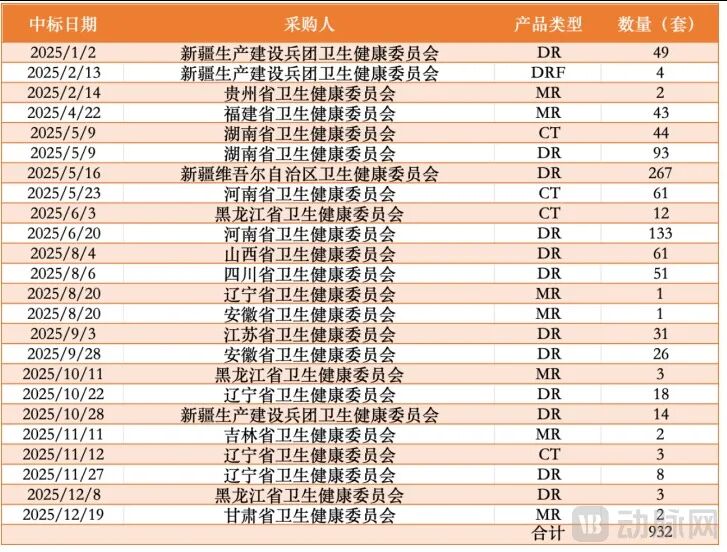
Wandong Medical's participation in centralized procurement projects in 2025 and the main product types, sales regions, and sales quantities involved (part of the data is merged)
However, the surge in orders has not been converted into corporate profits.
In its 2025 annual report, Wandong Medical delivered its first loss in the 18 years since its listing; and the downward trend continued in H1 2026. It is expected that the net profit attributable to owners of the parent company in the first half of the year will be a loss of 82.5 million yuan to 101 million yuan, while it made a profit of 51.3 million yuan in the same period last year.
Not only Wandong Medical, losses have become a common phenomenon across the industry. In the first three quarters of 2025, the revenue of SonoScape's ultrasound products decreased by 6% year-on-year due to the impact of centralized procurement, the gross profit margin decreased by more than 6 percentage points year-on-year, and the net profit attributable to owners of the parent company dropped by nearly 70% year-on-year.
The company explained in its quarterly report that the number of centralized procurement projects in the domestic ultrasound industry has increased significantly compared with previous years, which has put pressure on the unit price of ultrasound products and led to an overall decline in the industry's gross profit margin.
Even United Imaging Healthcare, which achieved contrarian growth through high-end breakthroughs, was not completely immune to the disturbance of centralized procurement. In 2025, the gross profit margin of United Imaging Healthcare was about 47%, down by about 1.5 percentage points year-on-year, mainly due to the disturbance to product prices brought by the centralized procurement policy for equipment renewal and intensifying industry competition.
In the first half of 2026, United Imaging continued to win bids in centralized procurement across multiple regions, from the DR project in Suzhou, Anhui to the high-end CT procurement of Tianjin hospitals, but the intensity of price competition also rose simultaneously.
Affected by the centralized procurement of medical equipment, the overall market size of national medical device bidding and procurement decreased by nearly 13% year-on-year in the first half of 2026.
From January to April, the market remained in a year-on-year negative growth range, the decline did not narrow until May, and the year-on-year growth rate turned positive only in June. In the core imaging equipment tracks such as CT, MR, and DR, the decline in the scale of monthly bidding and procurement at the beginning of the year all exceeded 20%.
In order to beautify their financial statements in the short term, some manufacturers forced distribution channels to release inventory, leading to hidden dangers of channel data distortion.
In the past, distributors purchased goods on demand with extremely low inventory. Under the pressure of the centralized procurement price war, enterprises drove distributors to stock up in large quantities in advance through assessment tasks, resulting in a huge gap between the equipment signing volume and the real terminal digestion demand of hospitals, which raised the book shipment data in the short term but could not change the fundamental of weak long-term profits.
When evaluating the medical business in the middle of the year, Fang Hongbo, Chairman of Midea Group, described the medical sector including Wandong Medical as an industry that the group is still exploring: "Fight if you can, exit if you can't."
02
Why Are Enterprises Still Losing Money After Sales Volume Rises
As a representative enterprise in the first and second echelons of centralized procurement, Wandong Medical's loss logic is the epitome of the whole industry, which is mainly under two-way pressure from both ends: heavy investment in high-end sectors and severe involution in low-end sectors.
Since Midea took control of the enterprise, Wandong Medical has changed its previous steady operation style, greatly accelerated its high-end transformation strategy, and its R&D investment has risen straight up, gaining first-mover advantage in decision-making.
By 2025, Wandong's R&D investment as a proportion of revenue has risen to 21.30%, and its annual R&D expenses increased by 59.28% year-on-year.
During this period, the company launched a cluster of high-end products such as the world's only mass-produced helium-free MR, quantum DSA equipped with independent rare earth detectors, and 288-row ultra-high-end panoramic dynamic CT, with R&D achievements beginning to show.
However, the R&D, registration and commercialization cycles of high-end medical equipment are very long. Vigorously promoting new high-end products such as MRI, CT and DSA not only requires large-scale investment in the R&D end, but also requires market promotion and channel layout for new products, resulting in persistently high cost pressure.
The other end of pressure comes from the mid-to-low-end basic market which is impacted by centralized procurement. Basic standard equipment such as DR and low-end permanent magnet MR has been fully included in provincial centralized procurement, and competition in the existing stock market has become white-hot.
Bidding in many regions takes low price as the core evaluation criterion. In order to maintain regional market share, manufacturers are forced to cut prices significantly, and the gross profit margin of the industry continues to hit new lows.
Once a manufacturer fails to win the bid in regional centralized procurement, it may lose the access qualification to the local public market for a long time, and the distributor system will shrink simultaneously, forcing manufacturers to grab orders at all costs, forming a vicious cycle of low-price competition.
In the already saturated stock competition market, the price war is becoming more and more intense, and the gross profit margin is further compressed, making it difficult to support sufficient profits during the transformation period. This has formed a dual consumption state of "burning money to develop high-end products on one hand and losing money to grab low-end market share on the other".
03
Policy Inflection Point Brings Breakthrough Opportunities
When the long-term development of the industry is hijacked by short-term goals, enterprises can only continue to increase investment, not for profit, but to grab market share from competitors and survive until the arrival of the upward cycle.
Fortunately, the new centralized procurement policy was issued in July. Three departments including the National Health Commission, the National Administration of Traditional Chinese Medicine, and the National Disease Control Administration jointly issued the Notice on Further Improving the Centralized Procurement of Medical Equipment in Public Medical and Health Institutions, officially launching the second half of the centralized procurement reform and alleviating the survival pressure of manufacturers at the institutional level.
The new policy establishes a three-level centralized procurement framework:
● Provincial health authorities are responsible for the centralized procurement of Class B large-scale equipment, completing the first round of centralized procurement before the end of 2026, and organizing procurement in a normalized manner in the first half of each year;
● The pilot of prefecture-level centralized procurement will be fully rolled out by the end of June 2027, with standardized and formalized procurement rules;
● Set a red line for rejecting abnormally low bids to eliminate suicidal quotations: the policy clarifies that the review shall comprehensively consider the full-cycle costs of quality, price, supporting consumables, and long-term maintenance;
● Suppliers whose quotations are lower than 50% of the valid average price, 50% of the second-lowest price, or 45% of the maximum price, and cannot provide complete cost supporting documents, will be directly reviewed or even disqualified from bidding.
The policy has been put into practical operation: in the CT centralized procurement in Fujian in June 2026, Fujian Sinopharm Medical Equipment was directly disqualified for touching the abnormally low price standard; in the same period, in the county-level DR centralized procurement in Fuzhou, three suppliers were also eliminated due to the low price red line.
The key turning point brought by this new policy is that the bottom price of mid-to-low-end equipment has been determined, and bottomless price cuts are no longer allowed; at the same time, high-end innovative equipment will not be included in the low-price centralized procurement catalogue immediately after registration, leaving a profit window for enterprises' high-end R&D and alleviating the pain of transformation.
04
The Breakthrough Battle In The Second Half Of Centralized Procurement
Under the new environment, the development strategy of medical equipment has long begun to change.
Although the introduction of the new policy will eliminate some of the previous negative emotions of equipment manufacturers, the price reduction of centralized procurement equipment is a long-term irreversible trend. Relying solely on low prices to drive sales volume can no longer support enterprise survival. When centralized procurement of medical equipment implements unified pricing at the provincial and municipal levels, the premium space will be further squeezed.
For the long-term and sound development of enterprises, the first consideration should be to transform from the pure hardware sales model to an integrated model covering hardware, consumables and services.
In the past, small and medium-sized manufacturers relied on ultra-long free maintenance terms to win bids at low prices, leading to frequent chaos such as broken capital chains afterwards and no one responsible for equipment maintenance.
At present, the procurement review of public hospitals pays more attention to the comprehensive operation capability of enterprises. A complete product line, stable supply chain and national after-sales maintenance network have become the core competitive advantages. The case of ultrasound centralized procurement of provincial hospitals in Hainan in 2025 shows that there are 27 sets of equipment in 6 ultrasound procurement packages in total, and the top brand won 18 sets, accounting for about 67%.
As Class B equipment is fully included in provincial unified procurement, market resources continue to concentrate on leading enterprises with complete product matrices, stable supply chains and perfect national service networks.
Therefore, relying on differentiated technology to break away from homogeneous price competition and focus on high-end sectors has become a necessary choice.
Wandong Medical continues to increase investment in high-barrier products such as 3.0T MR, ultra-high-end CT, and interventional DSA to build a complete high-end equipment matrix.
In order to solve the "stuck neck" problem of upstream components, Wandong Medical invested 100 million yuan in April 2026 to establish a wholly-owned subsidiary Wanxin Yuan, focusing on independent R&D of core CT components, covering three types of high-end CT tubes: conventional ball bearings, large heat capacity, and liquid metal bearings.
According to estimates, a high proportion of self-produced CT tubes can reduce the cost of the whole machine by 8%-10%, leaving sufficient room for price reduction in centralized procurement bidding, while keeping the bottom line of profits and solving the rigid pain point of upstream costs.
Its essence is to get rid of the mid-to-low-end involution track. The core goal is no longer to simply sell hardware, but to provide integrated imaging diagnostic platform solutions to increase product added value.
Furthermore, the overseas market has become a key increment to hedge against the pressure of domestic centralized procurement.
Still taking Wandong Medical as an example, its overseas revenue in 2025 was 360 million yuan, a year-on-year increase of 54%, accounting for nearly 30% of the total revenue, and there is growth space for all segments of its products in overseas markets.
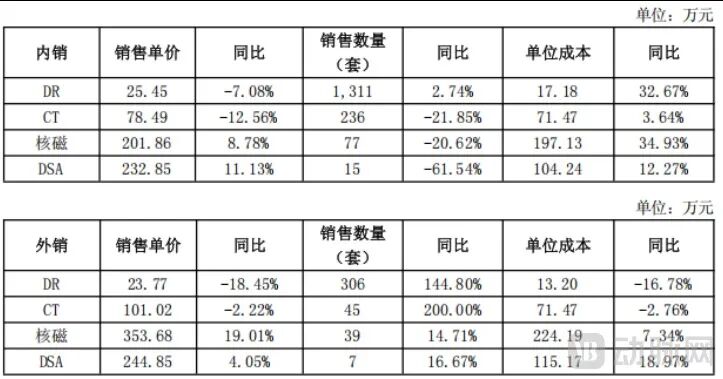
The changes in Wandong Medical's main products in domestic and overseas markets in 2025 by product category
In terms of product operation, the enterprise has implemented layered operation: the mid-to-high-end DR products New Oriental 1000L and CBCT are all sold domestically, while exports are dominated by mid-to-low-end DR and permanent magnet MR with lower unit cost; high-end models such as helium-free high-end MR are focused on overseas markets; DSA exports adopt non-standard high-configuration solutions with higher unit prices than domestic sales products, forming a complementary pattern between domestic and overseas markets.
Under this positive trend, making up for the product pipeline through mergers and acquisitions and reusing global channels for coordination is also a key decision.
In May 2026, Midea Group completed the acquisition of the remaining 77.5% equity of the Italian ultrasound giant Esaote, making up for the shortcomings of Wandong's ultrasound product line.
Esaote has more than 30 subsidiaries around the world, and its ultrasound products hold a leading market share in Europe. Relying on its mature global channels, it can promote Wandong Medical's MR, CT, and DR high-end products to quickly complete overseas access and achieve large-scale sales.
05
Core Proposition At The Present Stage: Survive And Enter The First Echelon
Centralized procurement has reshaped the pattern of the medical equipment industry. Long-term price reduction and rising industry concentration are the definite trends, and small and medium-sized manufacturers lacking technology, channels and full industrial chain capabilities will gradually be eliminated from the market.
Back to Fang Hongbo's speech. The medical industry is a sector that requires long-term investment, and many equipment manufacturers will continue to lose money during the painful period of transformation.
Therefore, what manufacturers need to prioritize at present may not be when they can turn losses into profits, but to rely on the window period of the new policy to quickly complete the transformation in the directions of promoting high-end R&D, independent R&D of core components, service model upgrading, and globalization strategy, so as to enter the first echelon of the industry.
It is necessary to complete industrial upgrading during the industry downturn cycle and secure the foundation for long-term survival.
This article is from the WeChat Official Account "Arterial Network" (ID: vcbeat), written by Zhao Hongwei, and authorized for release by 36Kr.