Large-bottle beer is selling like crazy.
Do large-format beer bottles sell better?
In recent years, 1L tinplate beer bottles have gained huge popularity, with major manufacturers stepping into this segment one after another, making bottles larger and increasing product capacity. Even 5L and 10L super-large beer kegs have appeared in all kinds of sales channels.
The reason is simple: the adoption of large bottles cuts costs and lowers prices, so retailers are willing to promote them, consumers are willing to buy them, and overall industry sales have also increased. This strategy has delivered remarkable results in both the beverage and beer markets.
However, the industry competition is shifting from deep-level differentiation to low-level homogeneity, which indicates that the beer market has not found a new core competitive edge for the time being, and has thus returned to the low-level competition of chasing larger capacities, a trend worthy of vigilance.
Do Large Beer Bottles Sell Better?
As the rising star in the beer market, what else has Jinxing Beer brought to the market besides the popularity of Chinese-style tea beer?
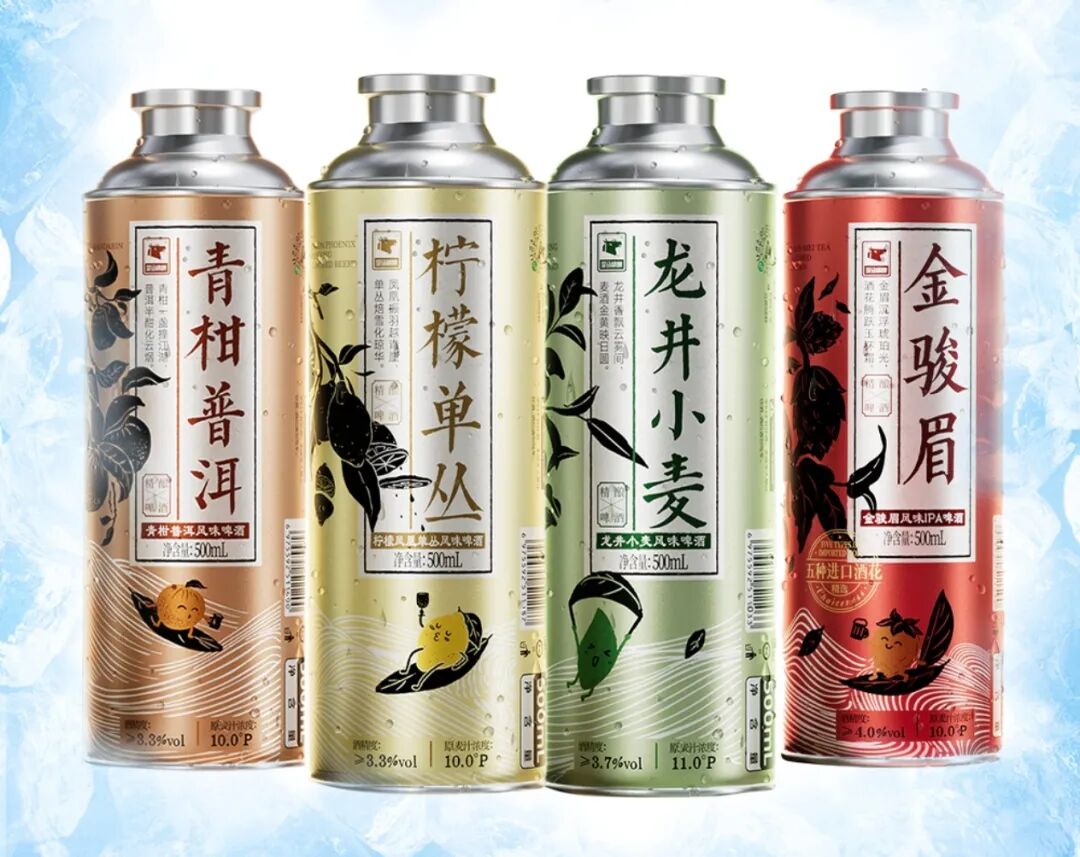
Under the operation of Jinxing, with the hot sales and viral spread of Maojian craft beer, candied hawthorn craft beer and jasmine tea craft beer, the 1L tinplate beer bottle, a previously rare specification and packaging, has become popular in the beer market.
For decades in the past, the most popular product in the Chinese beer market for a very long period was 600ML green glass bottle, which gave rise to the nickname "big green stick".
Later, some beer brands highlighted trendiness, premiumization and youthfulness with attractive appearances, and adopted 500ML transparent glass bottles with slightly smaller sizes.
Aluminum cans of different sizes have always existed in the beer market. They were rarely seen in traditional distribution channels in the early years, but in recent years, with the rise of new channels such as e-commerce and instant retail, canned beer in the market has gradually increased, and the canning rate of beer has approached 30%.
Barreled beer has been used since the draft beer era. However, it was mostly used in small B-end scenarios such as catering before, and was rarely seen in C-end channels.
After Jinxing Beer made tinplate packaging popular, the beer industry rushed to make bottles larger, and 1L packaging has gradually become the standard configuration.
China Resources Snow Breweries, Tsingtao Brewery (600600.SH), Zhujiang Beer, and Jinlongquan Beer under AB InBev have successively launched 1L tin-can beer, which is mainly used for differentiated categories such as fresh beer and tea beer. On the one hand, it adapts to younger channels and scenarios, and on the other hand, it forms a distinction from their traditional beer products.
Chongqing Brewery (600132.SH) under Carlsberg explicitly stated in its financial report that it takes 1L products as an important starting point for premiumization, and has launched 1L tin-can versions for almost all core categories.
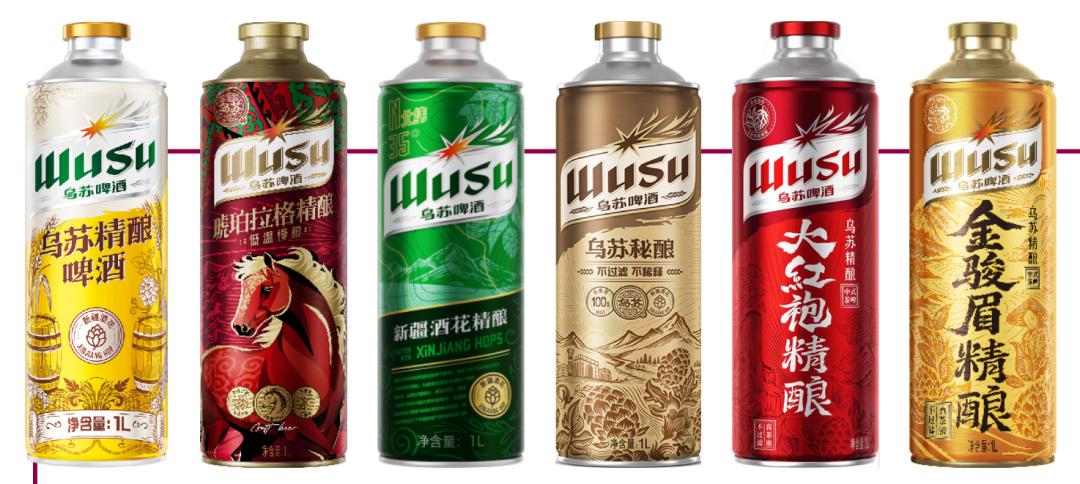
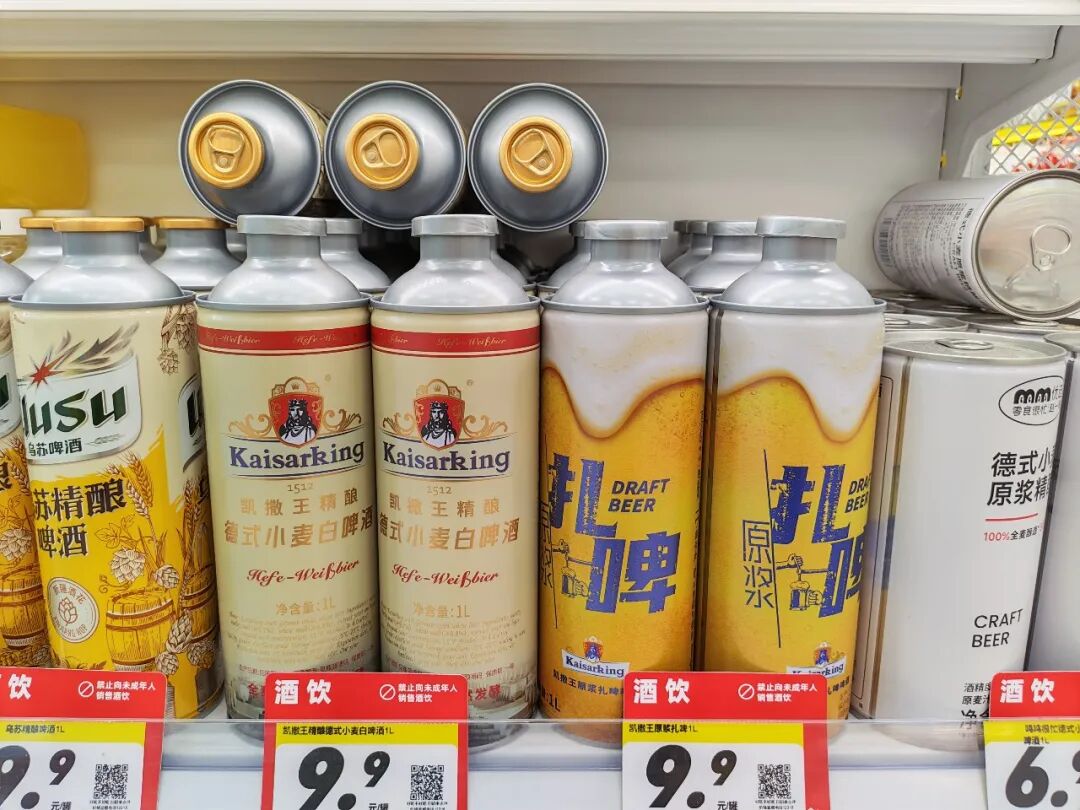
In traditional KA channels and discount snack stores, we can also see that 1L tin-can large-format beer has increased significantly. Even 5L and 10L large kegs of beer are frequently found in C-end markets, many of which come from private labels of channel operators.
Driven jointly by beer brands and channel operators, the penetration rate of tinplate keg beer is getting higher and higher. Industry data shows that the glass bottle usage rate in the entire beer market has dropped from 75% in 2020 to 55% in 2025.
Scenarios Determine Product Specifications
In recent years, with the product upgrading of China's beer market, a round of industry-wide premiumization has arrived as scheduled, with the price band upgraded from the long-maintained 3-5-8 RMB to 5-8-10 RMB. The changes in specifications and packaging in the beer market are exactly based on this foundation.
It is precisely because the products have been upgraded that people feel the necessity to upgrade specifications and packaging. In the early era of Chinese beer, light lager was popular, with similar flavors, and there was no differentiation even for the products themselves, let alone spending extra efforts on packaging.
Nowadays, beer products are diversified, including classic lager, draft beer, wheat beer, craft beer, non-alcoholic beer and so on, all of which need to select appropriate packaging and specifications according to their respective target audiences and main consumption scenarios.
With beer prices raised, manufacturers have more room for operation. As a result, the entire industry has collectively chosen aluminum cans or tinplate cans with higher costs instead of traditional glass bottles.
In the past, the vast majority of beer consumption was completed in catering channels; even for self-drinking, most of the beer was consumed with meals. Glass bottles and their corresponding specifications were fully sufficient for such needs.
Things are very different now. Beer rarely appears in business banquets, and the proportion of catering channels in total beer consumption is also declining. Industry data shows that the proportion of on-premise consumption channels for beer has dropped from 55% before 2020 to 40% today.
Nowadays, beer is more often consumed in scenarios such as parties and camping, which requires the satisfying drinking experience brought by large-format bottles. Since large bottles are not very suitable for glass or aluminum materials, tinplate has gained huge room for application.
Of course, for beer manufacturers, large-format beer is easier to achieve high sales volume. Let's assume that you are going camping tomorrow and go to the supermarket to purchase supplies tonight. If all the beer is in small packages, even if you carry a whole case, the total sales volume is very limited; if there is a large keg of your favorite flavor at a much lower unit price, the satisfaction brought by carrying several kegs cannot be matched by traditional packaging.
If calculated solely based on the packaging cost per single bottle, tinplate is more expensive than aluminum, and far more expensive than glass. However, the capacity of a 1L tinplate beer bottle is equivalent to 3 small aluminum cans. Calculated by unit capacity cost, the overall packaging cost of the industry has actually been reduced.
Is Beer Competition Gradually Becoming Shallow?
Before the beer market, many categories in the beverage market had experienced the "large bottle war", including soda, sugar-free tea, electrolyte water, and the popular large-bottle lemonade this year, etc.
In the highly homogeneous market competition, brands have chosen to make bottles larger and increase product capacity, using simple and straightforward strategies to attract consumers. Judging from the final effect in the beverage market, this strategy works very well.
The same applies to the beer market. Consumers get more products with one purchase, and market sales increase accordingly. Retailers do not add much extra cost with one sale, but achieve a higher growth rate of operating revenue — for almost all alcoholic and non-alcoholic beverage products, packaging accounts for a large proportion of the total cost.
Moreover, in the era of scenario-based consumption, large-capacity products can not only occupy consumers' minds, but also form a certain exclusivity in consumption scenarios.
When you go to the supermarket to buy beer, if all products are in small packages, you are likely to choose multiple products from different brands. However, if you buy one large keg or several large-format bottles, you are unlikely to choose competing products in the same consumption trip.
When market competition enters the stage of pursuing large volume and low prices with simple and crude strategies, it actually indicates that the competitive points in the industry, including products, channels, brands and so on, are no longer sufficient. When there is no more room for differentiation, the market will retreat to the low-level stage of competing on product capacity.

The core reason why beer market competition is shifting from deep-level to shallow-level is self-evident. China's beer market has entered the stock stage, and there will be no substantial growth in production and sales in the short term; as the tide of full premiumization recedes, the industry's growth direction has entered the second half of single-point breakthrough and refined operation.
Take Carlsberg's Chongqing Brewery as an example, the high sales volume brought by large-format bottles is inherently in conflict with the brand's premium positioning. This strategy also indirectly indicates that Carlsberg has turned to passive defense, using high-volume sales rather than improving product and brand value to solve its underperformance in the Chinese market.
Only when the beer market finds a new core competitive edge, or industry giants find a new development direction, can the market be brought back to a new cycle of value upgrading.
This article is from the WeChat Official Account "Zebra Consumption" (ID: banmaxiaofei), written by Yang Wei, authorized for release by 36Kr.