Insights into the top-level design of the leading AI enterprise brand from the World Artificial Intelligence Conference (WAIC)
The World Artificial Intelligence Conference is held at the peak of the fiercest AI competition between China and the US. What are the emerging industry trends?
As an AI enterprise, we should how to find the brand positioning, category occupancy and scenario matching that fit our own development, so as to become a top industry brand that is specialized, refined, differential, innovative, or even leading in the most niche segments?
As an enterprise in traditional industries, how should we carry out AI innovation, industry application and organizational efficiency improvement to keep up with the trend of the times?
In today's rapidly changing AI environment, technology can no longer represent the entire AI market. Top-level brand design has become an unavoidable link for all AI enterprises, and it has become the most essential and critical entry point, trigger point and growth point for AI to integrate with category products, industry applications and business scenarios!
Brand is the second must-win card for AI enterprises
During the evolution of the artificial intelligence industry, the capability breakthrough of large language models (LLM) used to be the absolute standard for measuring the core competitiveness of enterprises.
However, by analyzing the recent commercial dynamics of the domestic large model market and combining the trends of major exhibitors at the 2026 World Artificial Intelligence Conference (WAIC), we find that the industry competition logic has undergone a fundamental and irreversible shift.
Relying solely on the leading edge of pure technical indicators such as model parameter scale and computing speed can no longer be the only condition for AI enterprises to build a long-term brand moat, nor even a core condition.
The competition focus of the entire AI industry is shifting from the arms race of "computing power and models" to the reconstruction of business models, ecological implementation, and deep penetration into the deep water zone of actual business.
The computing power of large models is irresistibly moving towards public infrastructure, and this trend has been particularly thorough in the past year.
The prices of mainstream large models at home and abroad have plummeted in a widespread manner. This phenomenon marks that the computing power resources and the basic text and image understanding capabilities of models have officially entered an infrastructure stage similar to "water and electricity".
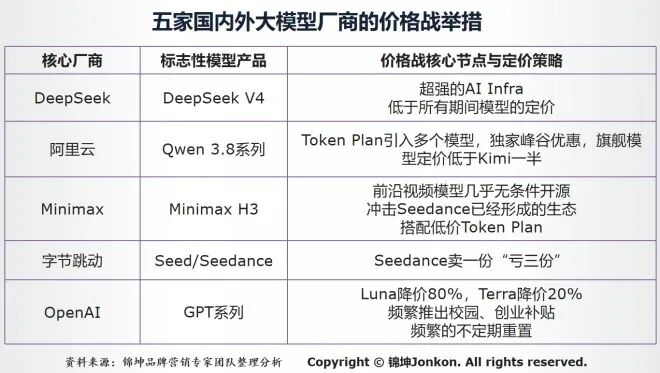
With the full open source of frameworks, the intensification of homogenization trend of model architectures, and the exponential improvement of the scheduling efficiency of domestic computing power clusters represented by Ascend, the basic capabilities of leading large models are rapidly improving.
Looking back at the market evolution from the fourth quarter of 2025 to the middle of 2026, a "price war" that profoundly reshapes the industry pattern has swept the entire AI industry chain. This price war not only reflects the extreme desire of model manufacturers for market share, but also reflects the pain of the transformation from the "hundred-model war" to the "application war".
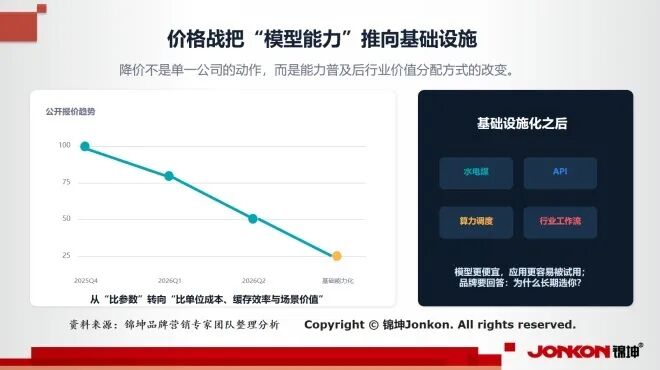
Under this industry-wide profit margin compression, the entire large AI model industry is currently in an overall loss state.
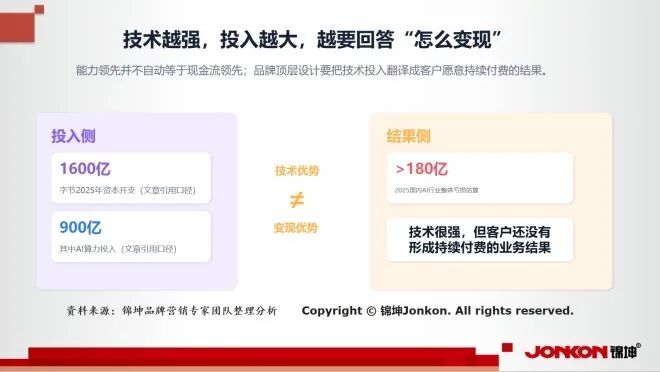
According to estimates from institutions such as China International Capital Corporation, the overall loss of the domestic AI industry in 2025 exceeded 180 billion yuan, and this figure is expected to break through the 200 billion yuan mark in 2026.
ByteDance's capital expenditure in 2025 alone reached about 160 billion yuan, of which 90 billion yuan was used for AI computing power procurement, equivalent to maintaining a daily computing power investment intensity of 438 million yuan.
At the same time, ByteDance's series of models such as Seed and Seedance are constantly impacting the rankings, with almost impeccable capabilities.
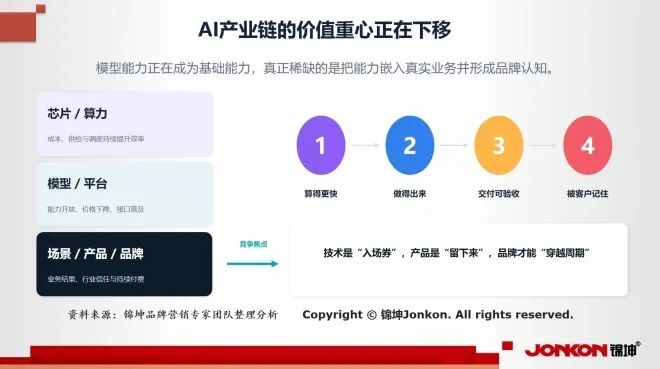
The gap between high capital investment, powerful models and unrealized monetization capabilities shows that relying solely on technology is not enough at all.
The low price of models and mature public technology systems have paved the way for the springing up of AI applications.
Shi Zhangqiang, founder of Jin Kun Brand, a well-known national industrial park and enterprise brand service provider that has coached and served more than 400 specialized, refined, differential and innovative enterprises, over 300 top industry brands, more than 200 listed companies and over 100 city brands, expert of the Ministry of Industry and Information Technology for specialized, refined, differential and innovative enterprise evaluation, and expert committee member of Xinhua News Agency Brand Project, believes that the focus of the AI market is accelerating to shift to products and brands that can find actual business scenarios, and brand is the second must-win card for AI enterprises after the technology war, no exceptions.
Why did AI short dramas become the first industry application that successfully landed in the AI sector?
Against the background that general large AI models are trapped in fierce battles, the AI short drama (manhua drama) industry has unexpectedly ushered in a big boom first, becoming one of the first industries to realize end-to-end commercial landing of AI technology.
Exploring the industrial logic behind it, the core lies in the emergence of AI image-text and multimodal video generation technology, which has accurately eliminated the original core production restrictions of this industry with a devastating force at the tool level.
Comparing the traditional live-action short drama industry with the booming AI short drama industry, the original short drama industry has almost followed a highly standardized and homogenized structure in most aspects such as content narrative logic, organizational structure, business monetization direction and distribution channels across the entire industry.
Under the traditional model, the main development bottlenecks and limiting factors of the industry are almost all concentrated in cumbersome work links that require strong technical support, take up most of the time and human cost, such as production time, capital cost, and high dependence on external live-action production teams.
The average production cost of a traditional live-action short drama often reaches hundreds of thousands or even millions of RMB, and it requires a production cycle of as short as several weeks or as long as several months for crew preparation, venue rental, actor scheduling, on-site shooting and post-editing.
However, the maturity of video generation large models and related production tools has broken this shackle.
With Seedance 2.0 under ByteDance as the flag, the entire short drama industry almost completely abandoned the original base shooting mode within two months, and fully shifted to AI manhua dramas.
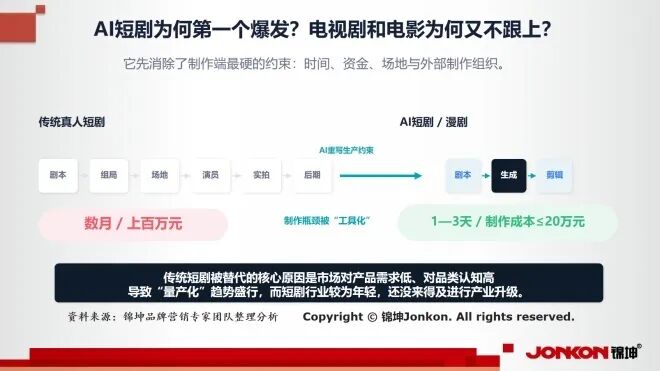
The threshold of AI short dramas has been infinitely lowered, and the production cost has dropped sharply. At present, the production cost of high-quality AI simulation live-action short dramas has been strictly controlled within 200,000 RMB, and data shows that the cost has dropped by an astonishing 90% compared with that of live-action short dramas.
As the production cycle is greatly shortened, there has even been an extreme production capacity of "one person can produce one drama within one to three days".
According to statistics, in the first quarter of 2026, the total number of short dramas launched in the domestic industry was about 128,000, of which AI short dramas reached 122,000, accounting for more than 95%, with an average of more than 1,300 new dramas launched every day; only in March 2026, the number of new native ongoing AI dramas and manhua dramas approached 50,000, almost equal to the total supply of 2025.
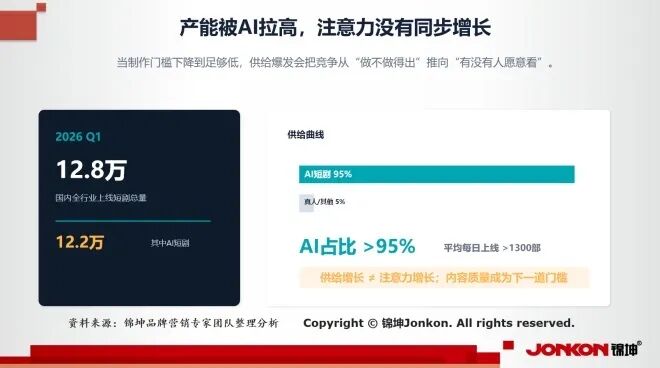
However, although the restrictions on the production link have been greatly reduced and the production capacity has seen a nuclear explosion-level growth, the current short drama industry has not ushered in great changes rapidly as expected. It still relies heavily on large-scale channel distribution and advertising investment (traffic delivery) to obtain revenue, showing typical characteristics of the "primary industrial stage".
By disassembling the financial data of the current AI short drama industry, we find that the industry cost structure has not changed essentially because of AI.
The sharp reduction in production costs has led to a flood of massive low-quality AI short dramas pouring into the market, bursting the originally limited user attention bandwidth, resulting in advertising bidding (traffic purchase cost) being continuously and frantically raised.
The traffic delivery cost was originally the largest expenditure item of short drama projects, and now it has intensified, accounting for 70% or even 90% of the total revenue.
This means that even if AI compresses the production cost to the limit, most of the saved funds flow back to the hands of traffic distribution platforms (such as Douyin, Kuaishou, etc.).
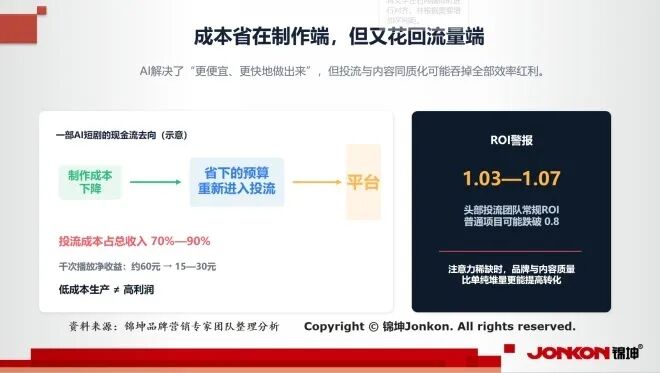
This economic model relying on traffic purchase has led to severe profit challenges for current AI short dramas.
At the macro level, the average daily delivery consumption of the current AI short drama industry has reached an astonishing scale of 150 million yuan to 170 million yuan.
At the micro level, the traffic acquisition cost has doubled compared with last year. Due to the serious homogenization of content leading to aesthetic fatigue, the net revenue per thousand plays has dropped sharply from about 60 yuan in 2025 to the current 15 yuan to 30 yuan, a drop of more than 50%.
Under the double squeeze of "high-cost traffic delivery + low-unit-price revenue", the industry ROI is in full emergency.
At present, even for the leading traffic delivery teams with rich experience and accurate algorithm support, their regular ROI can only be stably maintained in the small profit range of 1.03 to 1.07; for a large number of ordinary projects, the ROI may have fallen below the 0.8 lifeline, facing serious losses.
Following the collapse of profits, the original model-distribution-delivery short drama ecosystem established by ByteDance has rapidly disintegrated under the situation of over-subsidy and expanding loss gap.
The direction of the AI short drama industry is already very clear. At this stage, AI still plays the role of an auxiliary tool to improve efficiency, which successfully solves the engineering problem of "how to make short dramas cheaper and faster", but cannot answer the question of "how to touch people's hearts".
The current mainstream large models have achieved full "equalization" in video generation technology, and mastering a set of AI production tools only requires a few days of learning. The future competitive barrier will no longer be the mastery of technical tools themselves, but the deep professional capabilities of film and television such as script depth, audio-visual language, emotional value and artistic thinking.
Only by promoting the industry to completely shift from relying on crude traffic delivery distribution of low-quality content to in-depth content competition focusing on artistic quality and ideological core, can the AI short drama industry truly cross the primary industrial stage and achieve sustainable commercial evolution.
As Shi Zhangqiang, founder of Jin Kun Brand, Secretary-General of Shanghai Brand Committee, part-time professor of Shanghai Jiao Tong University & East China Normal University, and senior economist, believes: In the year from the second half of 2026 to the first half of 2027, it is very likely that at least one high-quality short drama with high-quality and high-investment products will lead the AI short drama industry back to the path and mode that the content industry should follow, and become a brand model and phenomenal benchmark integrating "technology + product + IP"!
The market is gradually differentiating, and only by deeply integrating technology into the industry can enterprises gain a firm foothold
Looking at the current overall AI application ecosystem, and through a comprehensive review of the technical displays and business positioning of exhibitors at the 2026 World Artificial Intelligence Conference WAIC, we can clearly observe that the development path of AI products is undergoing significant differentiation.
1. Not only programmers need to use
General-purpose AI applications are facing increasingly involuted and highly homogenized red ocean competition.
Taking the highly anticipated Baidu Dazi at this exhibition and Tencent's newly launched Workbuddy product as examples, they represent the mainstream form of the current Agent track.
The competition logic of these all-powerful AI assistants is exactly the same as that of the mainstream Codex and Claude Code platforms in the industry, and their battlefields are mainly concentrated in the scale of underlying model parameters, fine-tuning control accuracy, and pricing strategies.
However, anchoring the product positioning in the broad "general office scenario" inevitably means that although there are many functions, there is a lack of in-depth exploration for specific industries.
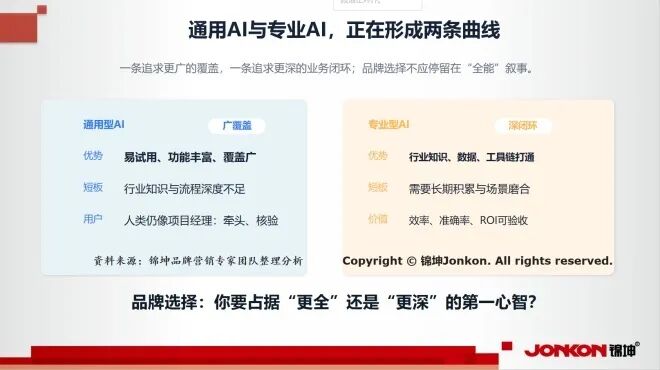
Due to the lack of professional insight into complex business processes in vertical segments, precipitation of historical data and in-depth understanding of industry compliance standards, general tools are often difficult to achieve "direct usability" in the true sense when facing the strict requirements of enterprise-level business flows.
More often, they play the role of a senior intern, and still require human employees as project managers to lead tasks, verify results and take final responsibility.
At the same time, current general-purpose AI applications generally require users to carry out long-term and continuous maintenance and optimization to give full play to more effects, which requires users to have a deep understanding of AI applications, long-term attention and even certain technical capabilities.
This leads to the fact that current general-purpose AI applications are largely limited to the "programmer" and student groups.
Furthermore, the orientation of related model and application development is gradually tending to cater to these two groups. A specific manifestation is that the importance of Agent capabilities and coding capabilities on major lists is constantly rising, while text and OCR capabilities are gradually fading out of sight.
In our opinion, this is likely to be a rather extreme and biased direction