OpenAI has proven over the past year that you do not need to switch browsers for AI.
On the night of October 21, 2025, when OpenAI released Atlas, its AI-native browser, the headlines of global tech media were dominated by the same phrase: "Chrome Killer".
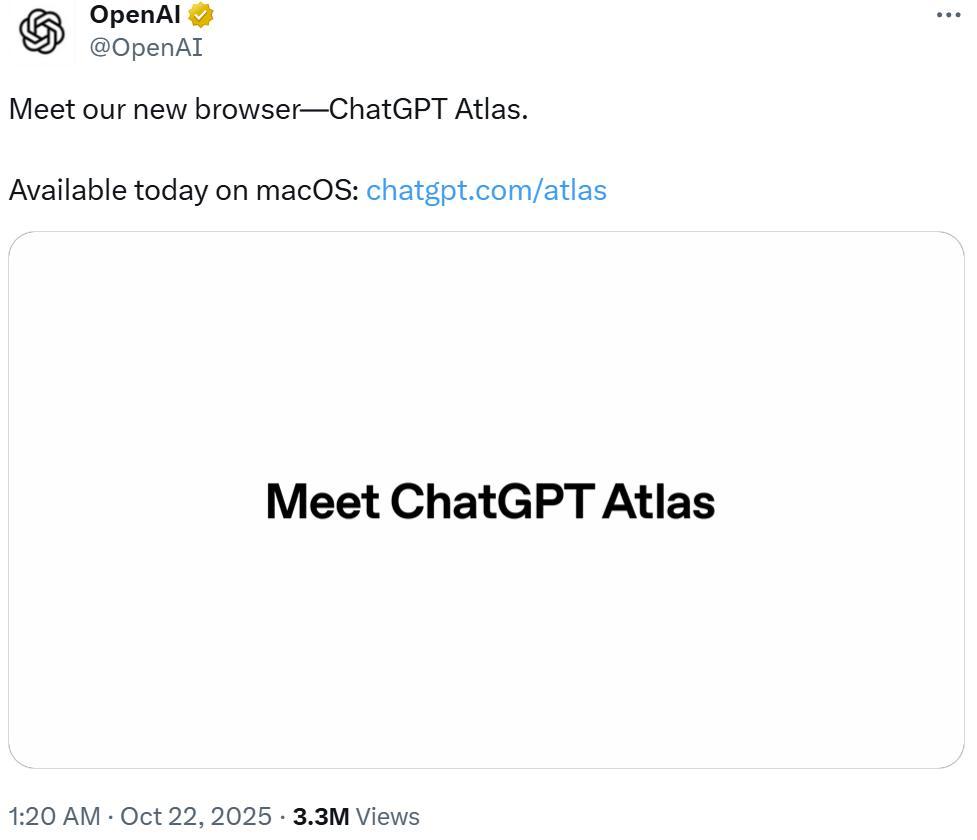
OpenAI's self-developed AI Agent browser ChatGPT Atlas was launched in October 2025 | Image source: OpenAI official account
It was the first entry-level move by OpenAI, which had 800 million weekly active users. Many people believed that the browser, which had dominated the internet for 30 years, had finally ushered in its generation-upgrade moment.
Even the news that OpenAI was going to release a browser triggered a not-so-small rush of product pre-releases in Silicon Valley: many teams of large and small companies dedicated to developing AI browsers chose to release their products in advance to avoid their hard work being completely overshadowed by OpenAI, which actually contributed to a wave of AI browser boom in 2025.

To promote its own AI browser, OpenAI once sold it by giving away ChatGPT credits | Image source: X
292 days later, on August 9, 2026, Atlas ceased operation.
During these 292 days, Chrome's global market share remained at two-thirds. On the side of the challengers, Arc stopped updating, Sidekick shut down, The Browser Company was acquired by Atlassian, and now even OpenAI itself has stopped its operation. The "killers" exited one after another, and the besieged one didn't even have time to launch a decent counterattack.
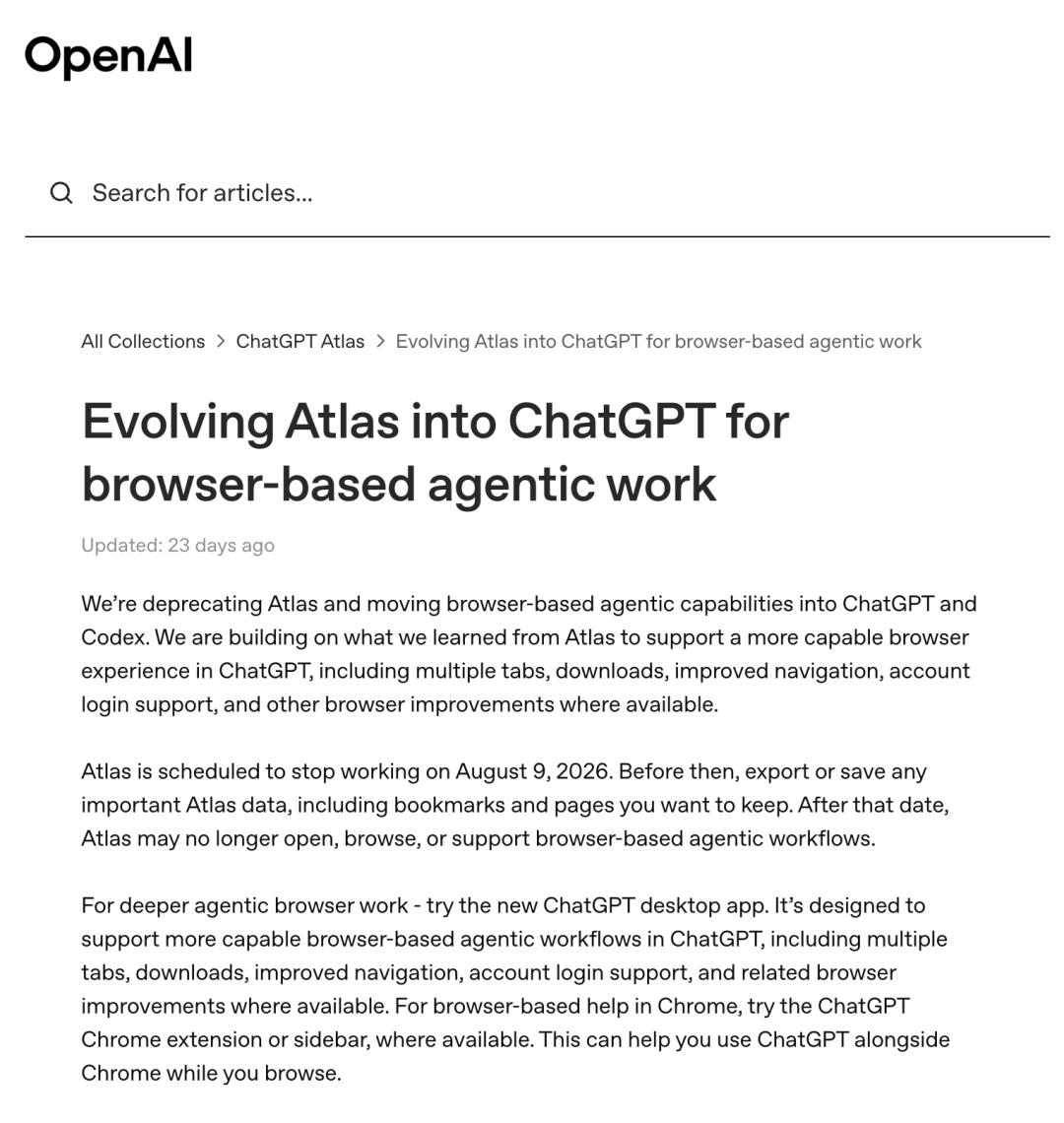
OpenAI officially released an announcement to discontinue the Atlas browser | Image source: OpenAI official website
In the past year, AI browsers have exited in four postures. Arc stopped updating: in May 2025, Josh Miller, founder of The Browser Company, released an open letter announcing the discontinuation of development of this star product, and the whole team turned to the AI browser Dia. Sidekick was absorbed: its team was acquired by Perplexity in the same month, and the product was shut down in August — if you open its official website today, the page will directly jump to comet.perplexity.ai.
The Browser Company itself was acquired: in September, Atlassian bought the entire company for 610 million US dollars. The company that makes Jira acquired the company that makes browsers, a deal that was interpreted at the time as a decent exit.
And Atlas adopted the most straightforward way among these four endings: shut down directly.
It survived for 292 days, only had a macOS version, and never waited for the Windows version or the mobile version. I found the last guide left by OpenAI for users in its help documents: please export your bookmarks as HTML files before August 9.
A company that wanted to reinvent the browser taught its users the last thing: how to pack and migrate back to Chrome.
01
Chrome Did Not Fight Back
Over the past year of being "besieged", Chrome has had a pretty stable time.
Although the figures given by different statistical agencies vary slightly, its global market share stays around two-thirds, and the fluctuation over the past year has never exceeded two percentage points.
But the data on the challenger side has never been very good: the sum of all AI browsers in the past year did not even reach 1% in the share statistics. They never even got the qualification to sit at the table.
When a16z released the top 100 consumer AI applications list in March this year, it simply excluded all AI browser products — the reason was that they could not be measured at all in traditional traffic statistics. Even Comet, which has the largest number of users, only has monthly active users in the order of 10 million, and Atlas has even fewer. Behind Atlas is ChatGPT with 800 million weekly active users. From the entry of 800 million people, the overflowing users are only in the order of 10 million.
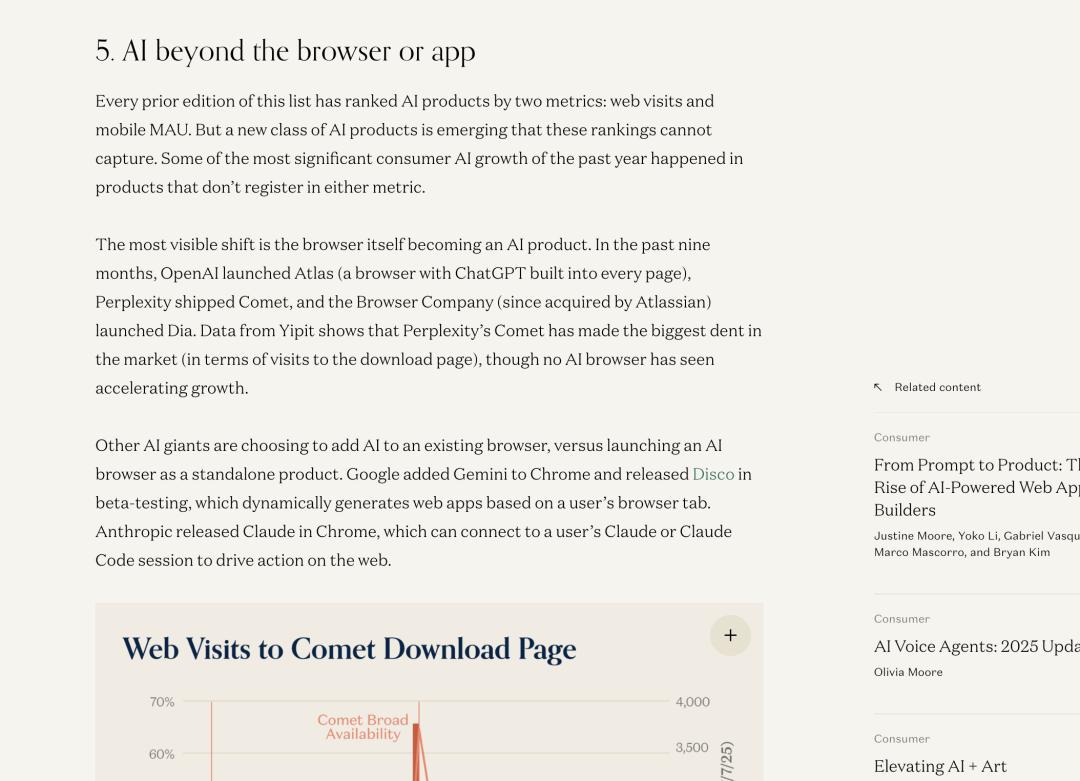
In the year of being besieged, the performance curve remained almost flat | Image source: StatCounter
Why can't AI browsers pry away Chrome's users? The first factor is the cost of habit. When users switch to a new browser, they need to migrate bookmarks, passwords, plugins and payment information, and re-adapt to every interaction detail — but installing an AI plugin in Chrome only takes two clicks. Challengers ask users to move house, while the incumbent only asks users to open a window. This competition was unequal from the very beginning.
Browser giants have long known this well. To retain the default search position on Apple devices, Google needs to pay Apple about 20 billion US dollars every year. This exactly shows that the essence of the entry business is distribution, not products, and this has been the case for 30 years.
The second factor is the absence on the mobile end. Almost all of this batch of AI browsers prioritize desktop use, and Atlas only had the Mac version until it was shut down. But the vast majority of browsing behavior already happens on mobile phones — you can hardly besiege a city that you have never even been to.
The most fatal blow is: the absorption and transformation speed of large tech companies has in turn surpassed the innovation speed of startup teams.
Last September, Gemini was integrated into Chrome, and the Copilot mode in Edge was also rolled out in the same period.
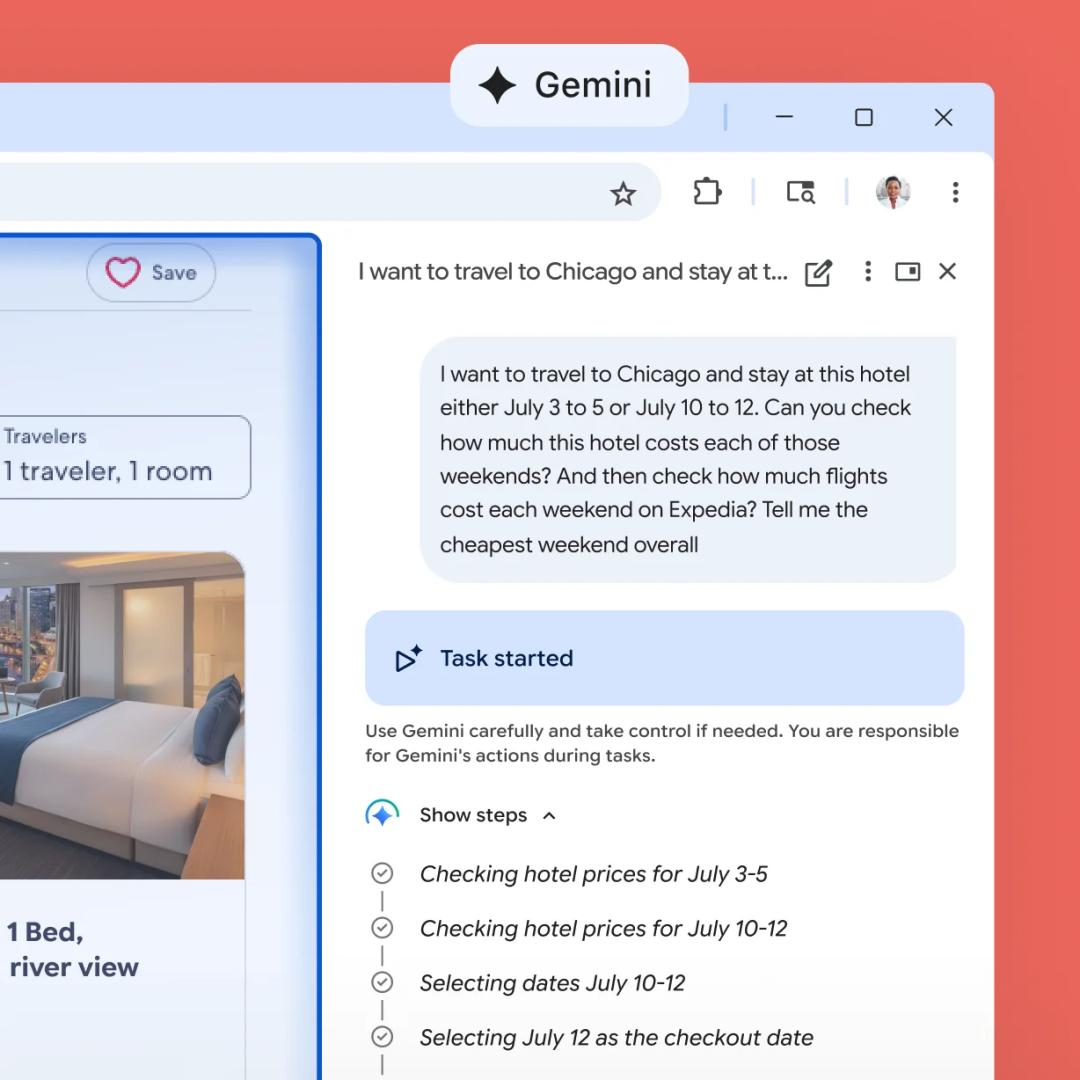
Google also quickly integrated Gemini into the Chrome browser within 2025 | Image source: Google
The selling points that challengers spent half a year polishing, including sidebar Q&A, page summarization, and agent execution, have become the native functions of large companies with just one version update.
Although the term "Innovator's Dilemma" has been overused in the past two years when AI products are booming, it has a frequently overlooked premise: incumbents are always afraid that innovation will harm their old businesses and dare not follow up, so challengers can have a window of opportunity.
This time, the browser itself does not make money directly, and AI functions will not harm the old business of any giant, so the incumbents followed up without hesitation. The window of opportunity never existed from the very beginning.
Chrome won without even fighting. It just turned AI into a setting option, and dismantled the proudest moat of these AI browsers.
02
It Is a Feature, Not a Destination
But the AI browser track is not completely a mess. After all, there are still surviving names on the list. If you look closely at how they survive, you will find another fact.
Behind Comet is Perplexity's subscription business. This browser was later directly opened to all users for free, which is essentially a way to acquire customers for its main business. Behind Dia is Atlassian, and the browser has become an extension of the office suite.
Opera Neon charges $19.9 per month, relying on Opera's 20+ years of accumulated resources. Smaller products like Strawberry rely on venture capital — Sweden-based Strawberry just raised a $6 million seed round this year.
None of the survivors make money by "the browser itself". Browsers are either a customer acquisition tool, or a functional carrier, or a piece of puzzle in someone else's business territory.
This is almost the most thorough denial of the category of "independent AI browser" — it's not that no one can do it well, but that it was never a good business from the start.
Following this logic, the endgame of the survivors is most likely not to die, but to be incorporated into a feature by their respective parent companies. The browser category will always exist, but "AI browser companies" will not.
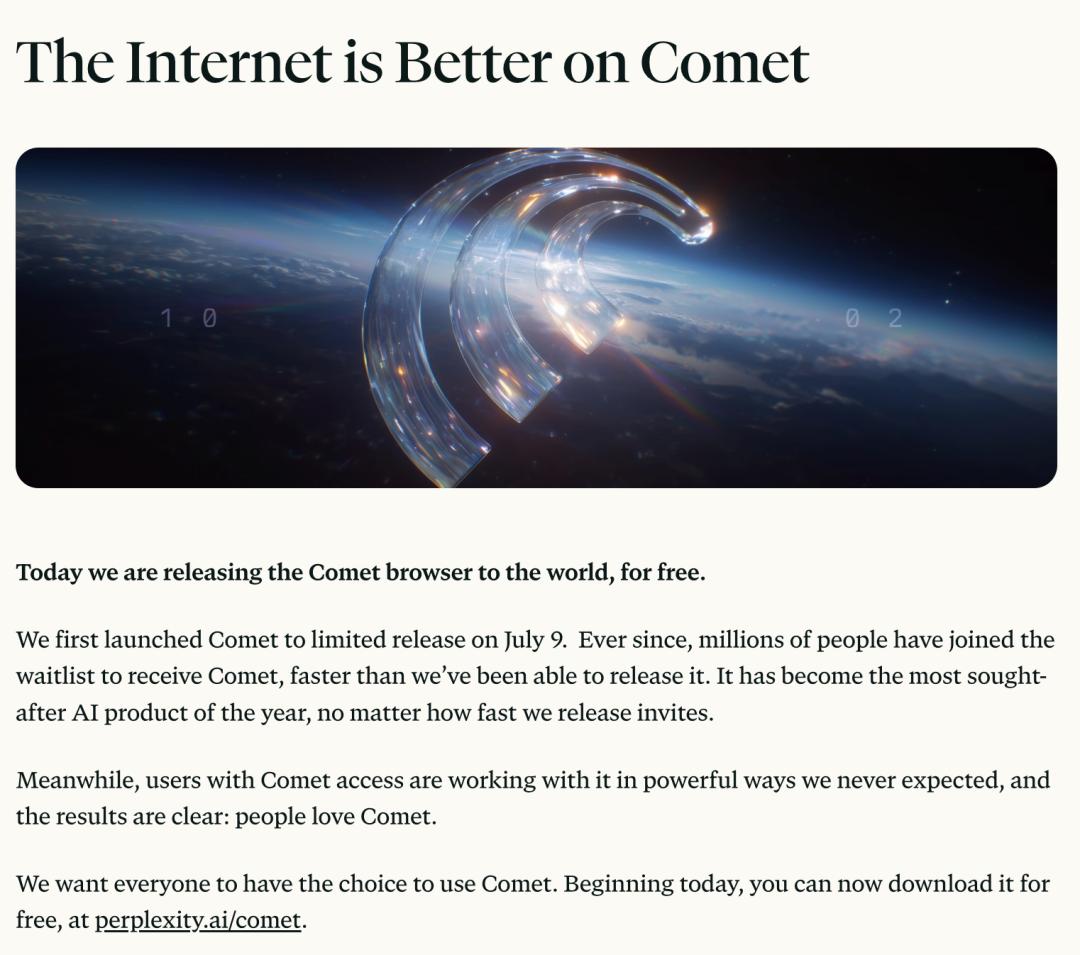
Comet that has been opened to all users for free | Image source: Perplexity
This endgame has actually been staged in China in advance: no one has ever tried to build a completely new independent browser from scratch. Quark under Alibaba has grown into an AI workstation, QQ Browser has integrated Hunyuan to move towards the direction of office assistant, and 360 has embedded AI into its security browser — all are existing products added with AI, no large Chinese tech company has developed a brand new browser specifically for AI.
The fact proved by the survival methods of the survivors was pointed out in one sentence by OpenAI, the company that has the most money and the least willingness to follow the crowd, in its shutdown announcement:
AI browsers should be a feature, not a destination.
This sentence is very suitable to be the epitaph of AI browsers: in the past year, OpenAI itself has paid the most for the browser direction — it formed a team, released the product, and ran for 292 days under the expectation of being the "Chrome Killer". Now it admits in its own words that the direction itself is wrong.
OpenAI shutting down Atlas is not a single product failure, but the failure of an entire development route.
But obviously OpenAI has not given up on the entry, this ambition has found a new carrier. Atlas's capabilities have been split into two parts: one part has been integrated into the ChatGPT desktop client, including the cloud browser that can operate web pages for you; the other part has been made into a Chrome extension.
The battle for entry is far from over, it just left the shell of the browser. The next contest is not about whose tab page looks better, but about who can get things done for users — in that battlefield, the opponent is still Google, and the weapon has been replaced by agent.
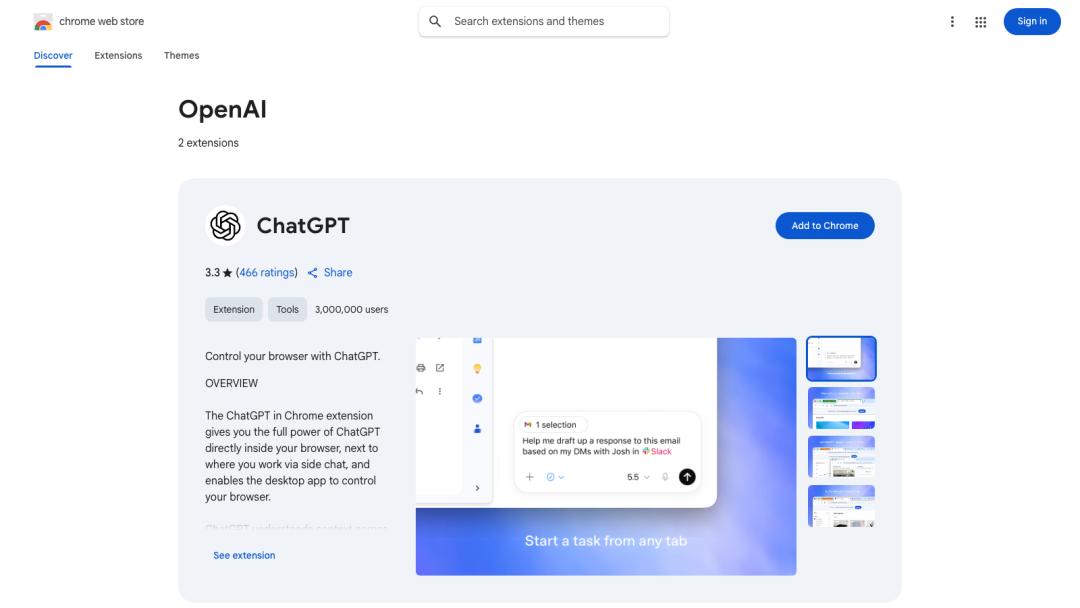
The new home of the challengers is the Chrome Web Store | Image source: Chrome Web Store
After the shutdown, Atlas users will go back to their respective homes with their exported bookmarks, and most of their destinations are still Chrome, the browser they are most familiar with.
For AI Agent browser users, the lessons learned from this year can be summed up in only one sentence: There is no need to move your data for AI, installing a plugin is enough.
*Header image source: Generated by AI
This is an original article from GeekPark. For reprint, please contact the official WeChat account geekparkGO.
Geek Question
Are you still using AI browsers now?
This article is from WeChat official account "GeekPark" (ID: geekpark), author: Zhang Yongyi, authorized for release by 36Kr.