Behind the viral 550,000-yuan fine that has been trending across all major platforms, the supervision and regulation system is evolving in a more refined and granular direction.
Penalties for violations in the 2026 electricity market transactions are frequent, with additional fines ranging from 460,000 to 550,000 yuan, and supervision is becoming increasingly strict.
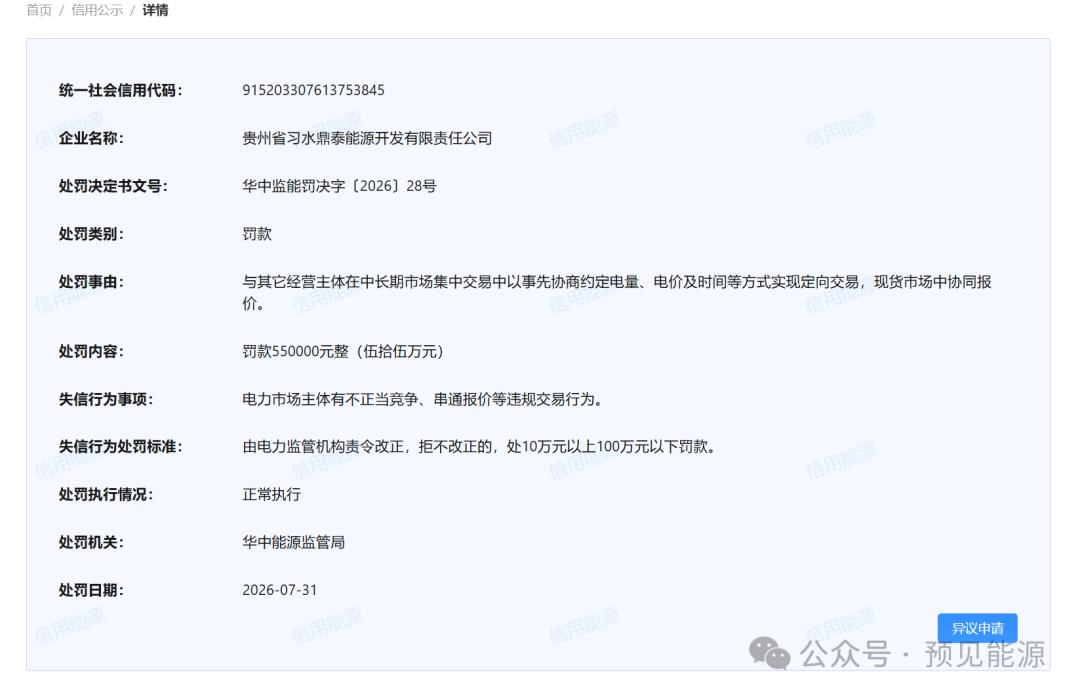
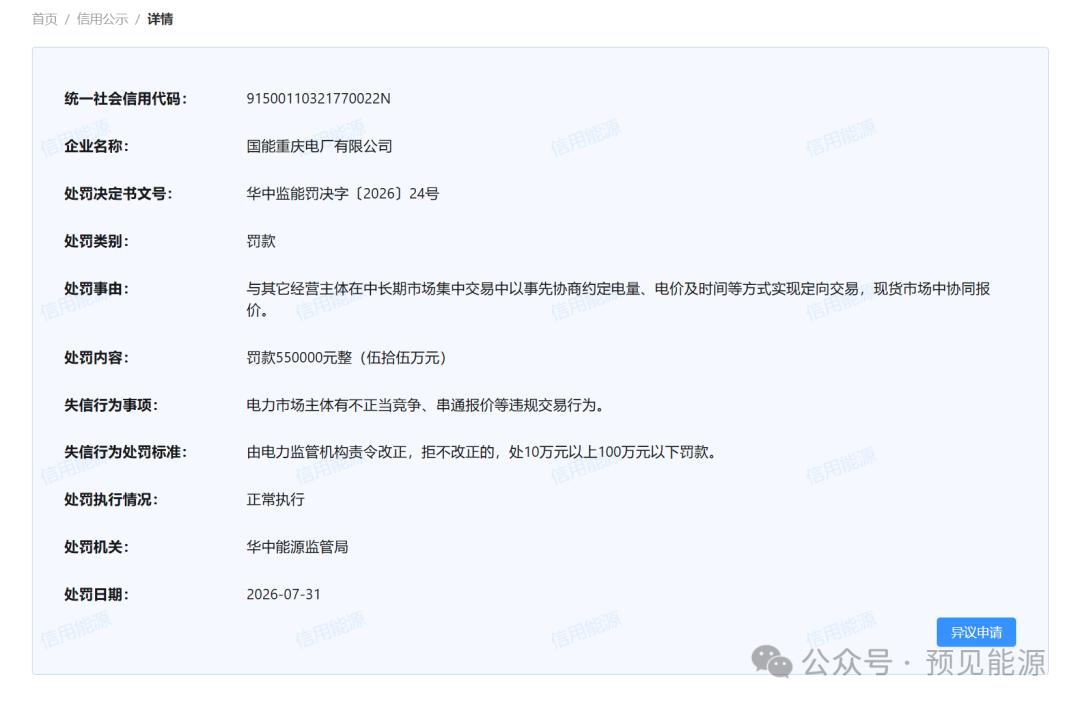
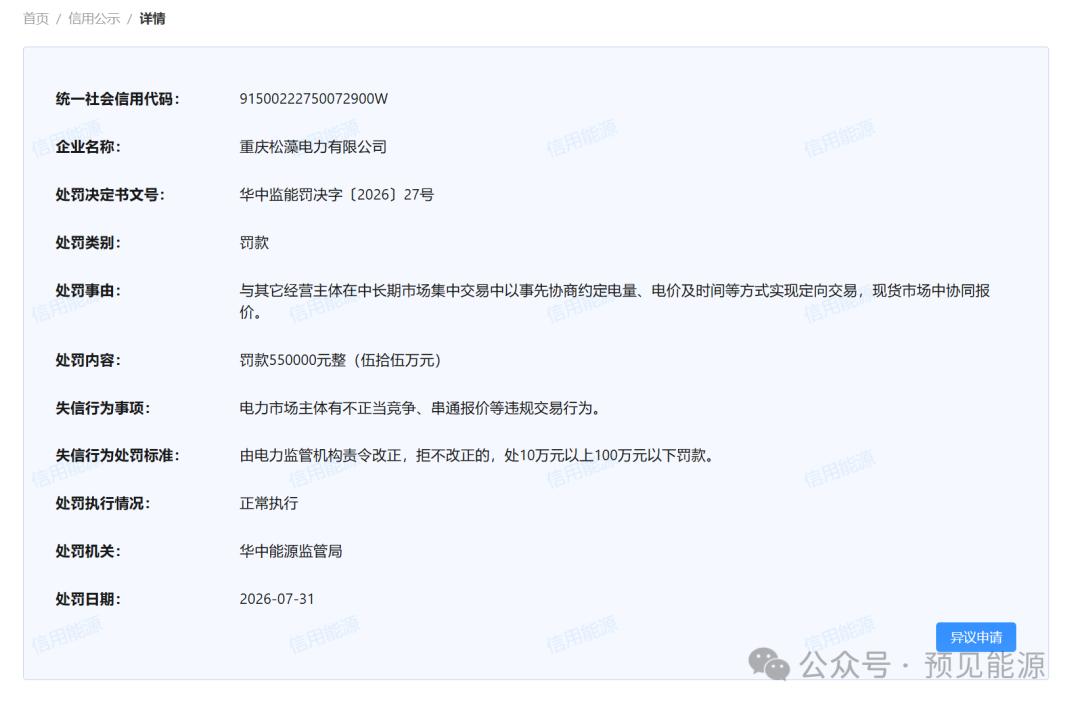
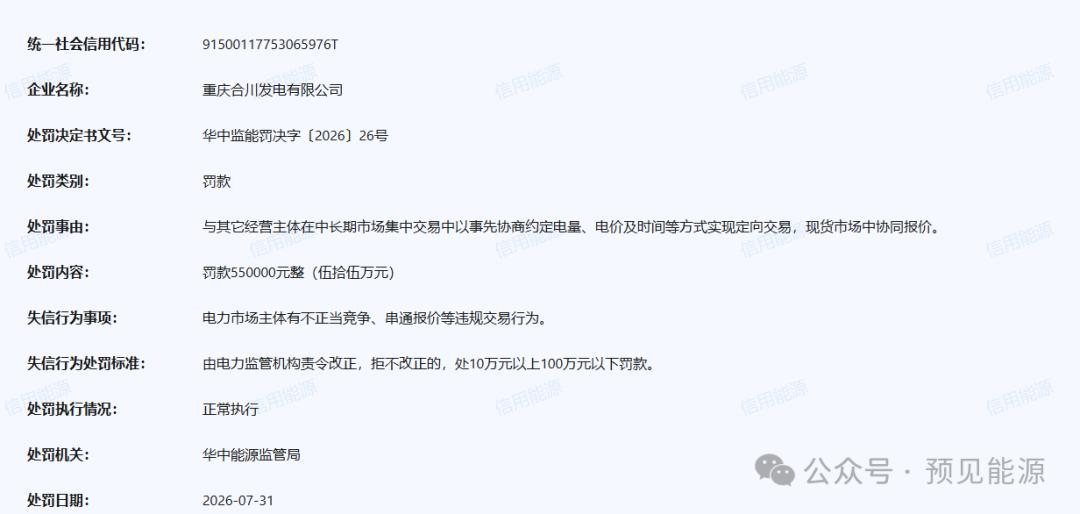
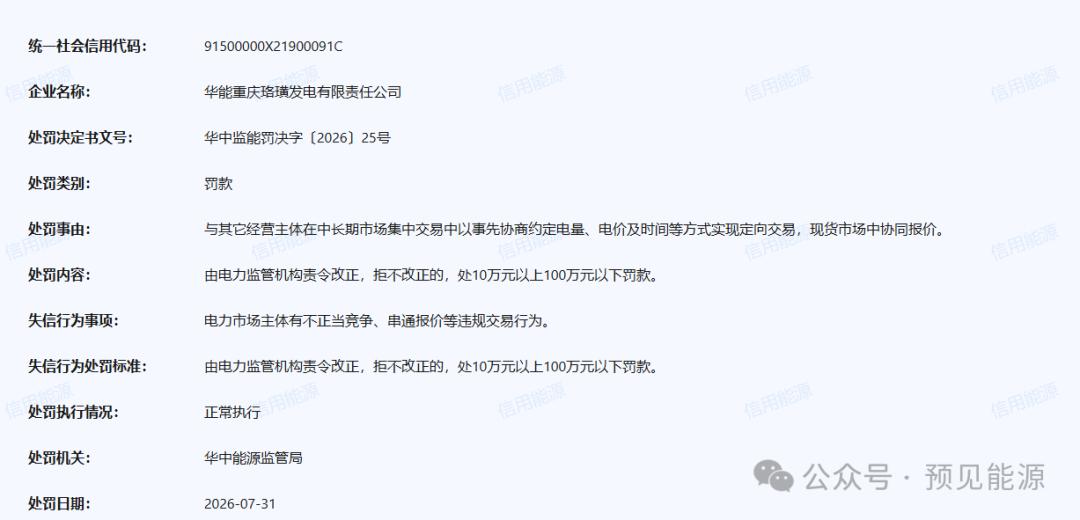
Energy Foresee has learned that recently, the Central China Energy Regulatory Bureau issued a fine of 550,000 yuan each to five power generation enterprises, namely China Energy Chongqing Power Plant, Huaneng Chongqing Luohuang Power Generation, Chongqing Hechuan Power Generation, Chongqing Songzao Power, and Guizhou Xishui Dingtai Energy. The reason for the violation is exactly the same: prior negotiation and agreement on electricity quantity, electricity price and time in the centralized trading of the medium and long-term market, and coordinated quotation in the spot market.
This is not an isolated case. Entering 2026, penalties in the electricity market are becoming more frequent — the frequency is accelerating, the scope is expanding, but the fine amount is stuck at a subtle "standard line".
01
Nearly 20 penalties issued in half a year
Supervision is accelerating but fines are "standardized"
Sorting out the public administrative penalty information on the Credit Energy website and local energy regulatory agencies since January 1, 2026, penalties in the electricity market sector show an obvious "high-frequency" feature.
On April 27, the Hunan Energy Regulatory Office issued a total fine of 6.9 million yuan to 15 power generation enterprises, involving leading power generation groups such as China Huadian, China Datang, China Huaneng, State Power Investment Corporation, China Energy Investment Corporation, and Shaanxi Coal, with 460,000 yuan for each enterprise. This is the largest number of enterprises penalized in a single penalty in 2026 so far.
In June, the Shandong Energy Regulatory Office fined Huaneng Shandong and Datang Shandong 550,000 yuan each; the Guizhou Energy Regulatory Office fined Huadian Guizhou Branch, Guizhou Energy Group, and Guizhou Yueqian Power 460,000 yuan each. The total fine for the five enterprises is 2.48 million yuan.
At the end of June, the Central China Energy Regulatory Bureau fined four enterprises, namely Chongqing Baihe Power Plant, Chongqing Datang International Shizhu Power Plant, Huadian International Fengjie Power Plant, and China Energy Chongqing Wanzhou Power, 550,000 yuan each.
In July, the Fujian Energy Regulatory Office fined Huadian Furi Lianjiang Kemen Branch 460,000 yuan; the Northwest Energy Regulatory Bureau fined Qinghai Upper Yellow River Hydropower Development 460,000 yuan.
Only for the publicly available cases mentioned above, more than 25 power enterprises have been penalized for violations in market transactions since 2026, with a total fine of over 15 million yuan.
But a close look at these penalties reveals an obvious rule: the fine amount is highly concentrated between 460,000 yuan and 550,000 yuan. The fine range stipulated in Article 31 of the Electricity Regulation Regulations is from 100,000 yuan to 1 million yuan. Both 460,000 yuan and 550,000 yuan fall in the upper middle part of the range, forming a "standard price" — neither the maximum 1 million yuan nor the lenient 100,000 yuan.
For power generation groups with annual revenue of tens of billions of yuan, this kind of "standardized" penalty has limited deterrent effect.
02
The direction of supervision is changing
Shifting from "qualification management" to "behavior management"
Compared with previous years, a significant change in supervision in 2026 is the shift of focus.
In the past, penalties from energy regulatory agencies were mainly concentrated in the field of qualification licensing — unlicensed operation, operation beyond the scope, failure to maintain licensing conditions, etc. Such penalties still exist in 2026: Huadian (Beijing) Thermal Power was confiscated of illegal gains and fined about 9.11 million yuan for unlicensed power supply; an enterprise in Henan was confiscated of 13.1662 million yuan of illegal gains for unlicensed operation; Bachu County Yueshui Power was fined and confiscated of over 31 million yuan for unlicensed power supply.
But what is really noteworthy in 2026 is another line — the supervision of electricity market trading behavior is being fully rolled out. From 15 enterprises in Hunan, 2 in Shandong, 3 in Guizhou, 9 in Chongqing to 1 in Fujian, the coverage of penalties has expanded from individual provinces to multiple regions including Central China, East China and Northwest China.
The logic of supervision is changing. In the past, it was "whether you are qualified to do business", now it is "whether the way you do business is correct". The deeper the market-oriented reform of electricity is promoted, the more the compliance of trading behavior will become the core focus of supervision.
Another detail worth noting: the two penalized enterprises in Shandong — State Energy Group Shandong Electric Power Co., Ltd. and Huadian Shandong Branch — are not penalized for the first time. In January 2025, the two companies were fined 280,000 yuan each for "failing to abide by the operation rules of the electricity market". After a year and a half, the fine rose from 280,000 yuan to 550,000 yuan, almost doubling.
Repeat offenders face higher fines, which indicates that supervision is escalating in a "stepwise" manner.
03
Violations are highly concentrated
Collusive quotation has become a "standard configuration"
Judging from the publicly disclosed penalty cases in 2026, the types of violations in electricity market transactions are highly concentrated.
Collusive quotation and unfair competition are the most frequent keywords. The reason for the 15 enterprises in Hunan is "failing to abide by the operation rules of the electricity market"; the cases in Shandong, Guizhou, Chongqing and Fujian clearly state "unfair competition and collusive quotation".
The specific operation method is not complicated: power generation enterprises negotiate and agree on electricity quantity, electricity price and time in advance in the centralized trading of the medium and long-term market to realize targeted transactions, and coordinate quotations in the spot market at the same time. This dual-track operation of "medium and long-term + spot" essentially turns the two markets that should have checked and balanced each other into a tool for collusion.
The deeper problem is that this kind of violation is not a "spur-of-the-moment decision" of individual enterprises. The typical violation case notified by the National Energy Administration at the end of 2025 shows that some power generation enterprises implement collusive quotation by unifying market strategies, organizing personnel of their affiliated power plants to work centrally, and carrying out transaction guidance. This is an organized and pre-planned systematic behavior.
When the subsidiaries of many leading power generation groups violate regulations in different provinces and at different times in almost the same way, it is difficult to explain with the reason that "individual enterprises take risks out of desperation".
04
A fine of 550,000 yuan cannot bring a lesson
Unless enterprises recalculate the cost themselves
Faced with the reality of accelerating tightening of supervision, power generation enterprises need to make adjustments. This is not an empty slogan of "compliant operation", but changes at three specific levels.
First, the operation process of the trading department needs to be reformed. Many enterprises' violations are not "subjective malice", but problems in the transaction decision-making process — the quotation strategy is decided by a few people in a small scope, lacking internal review and trace retention. It is recommended that enterprises establish a "double review system for quotation decisions". All quotation plans for the medium and long-term and spot markets must be jointly signed by the trading and compliance departments, and the whole decision-making process shall be traced. This is not to increase costs, but to prevent a trader's "sudden whim" from turning into a 550,000-yuan fine one day.
Second, internal compliance training should keep up with the pace of supervision. The electricity spot market was fully rolled out across the country at the end of 2025. Many trading personnel of enterprises still understand the rules at the level of "what price can be quoted", and lack clear cognition of "what behavior constitutes collusion". Since 2026, Shandong, Guizhou and other places have successively issued electricity market supervision measures and abnormal behavior identification guidelines. The legal and trading teams of enterprises need to check these new regulations one by one to clarify the "red line".
Third, and the most important point — re-evaluate the cost-benefit of violations. In the past, a fine of 550,000 yuan was regarded as a "operating cost" for power generation enterprises. But the change in 2026 is that the National Energy Administration has made it clear that "serious violations" may face the risk of revocation of the electricity business license. For a power generation enterprise, what does it mean to lose the electricity business license? It means being unable to connect to the grid, unable to trade, and unable to survive. This is not a problem that can be solved by a fine.
When "market entry prohibition" becomes a possible penalty option, power generation enterprises need to recalculate their accounts. A 550,000-yuan fine may be painless, but a decision to revoke the license is enough to shut down a power plant.
The direction of the market-oriented reform of electricity will not turn back, and the refinement of supervision will only become higher and higher. For power generation enterprises, instead of playing games between "being penalized or not", it is better to turn compliance capability into core competitiveness. In an increasingly transparent market, whoever can run through the compliant trading process first will take the lead in the next stage of competition.
The following are screenshots of regulatory information:
This article is from WeChat Official Account "Energy Foresee", author: Wang Mengjiao, published with authorization from 36Kr.