Pharmaceutical CXOs rally sharply across the board: who is witnessing real recovery and who is just jumping on the hype bandwagon?
On the evening of August 3, WuXi AppTec released its 2026 first-half performance report: net profit attributable to shareholders exceeded 110 billion yuan, and the growth rate of non-recurring profit and loss deducted net profit approached 90%.
This better-than-expected performance directly boosted the CXO sector. Starting from August 4, the sector posted four consecutive days of gains, and the market has widely reached a consensus that "the CXO industry is fully recovering".
However, the collective rally in the secondary market has obscured the extremely differentiated landscape inside the industry.
The current CXO industry presents obvious structural differences: some enterprises have entered a period of rapid profit release, some are still in the stage of order ramp-up and recovery, while others are mired in the growing pains of business transformation.
While the market trend is converging, the fundamental recovery pace of different enterprises is completely different, showing typical K-shaped differentiation characteristics.
Against this backdrop, in this round of CXO recovery rally, which enterprises have achieved real fundamental recovery, and which are only passively rising along with the sector without substantial improvement in fundamentals?
01
Performance Differentiation Under the Resonant Market Rally
As of August 7, around 11 domestic CXO enterprises have released their 2026 semi-annual reports or performance forecasts.
If you only look at the performance of leading enterprises, the market can easily get the illusion that the whole industry is recovering simultaneously. But when the core data disclosed by the 11 CXO enterprises are put together, their performance shows structural differentiation.
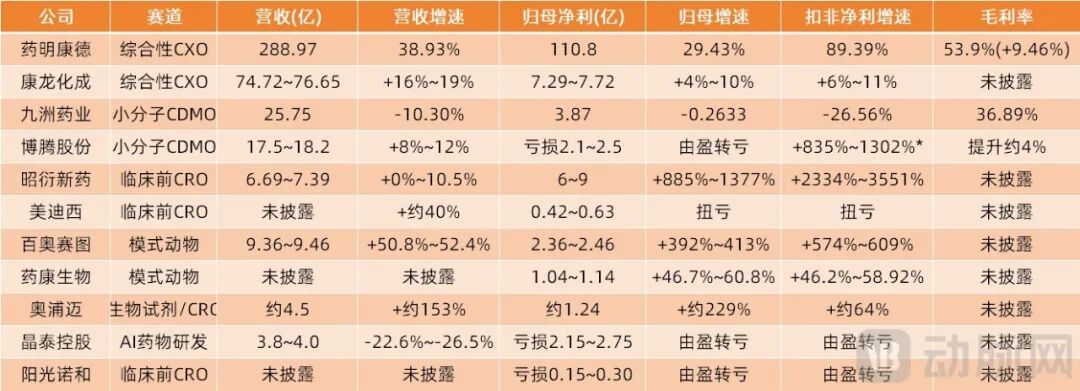
*Note: The non-recurring profit and loss deducted growth rate of BrightGene is calculated after excluding the one-time impairment in Slovenia; the high non-recurring profit and loss deducted growth rate of Joinn Laboratories includes the fair value change of biological assets of experimental monkeys.
Combining the financial data disclosed by various enterprises, three signals are very clear:
First, the overall recovery of the industry is supported by solid fundamentals.
More than 70% of the sample enterprises achieved positive revenue growth. WuXi AppTec's nearly 90% non-recurring profit and loss deducted growth rate, BioMice's non-recurring profit and loss deducted growth rate of more than 500%, and OPM's 229% year-on-year growth rate of net profit attributable to shareholders confirm that this round of recovery is not a short-term concept hype, but a sector-level substantive repair.
Second, the hierarchical differentiation among enterprises continues to intensify.
Some enterprises' profit growth rate significantly outpaces revenue growth rate, and the recovery of capacity utilization drives the continuous improvement of profit margin; while some manufacturers see declining revenue and continuous losses, lingering at the bottom of the industry.
Third, this round of performance recovery covers multiple sub-sectors. Comprehensive CXO, model animal, and innovative drug CDMO all achieved high growth, which is not an independent rally of a single track.
Arterial Network's observation shows that this round of recovery does not come out of nowhere, it is the result of the industry cycle clearing in the past four years.
In 2021, CXO enterprises stood at the peak and expanded production collectively, breeding bubbles; from 2022 to 2024, the industry faced overcapacity and price war involution, starting three consecutive years of clearing; at the end of 2025, low-end ineffective capacity was basically cleared, and industry orders bottomed out and rebounded; in the first half of 2026, the industry officially walked out of the cycle bottom and ushered in a full recovery rally.
Overall, the overall recovery trend of the CXO industry is clear, but the recovery pace, profit quality and realization strength of different sub-sectors vary greatly, and structural differentiation runs through the whole process of this recovery.
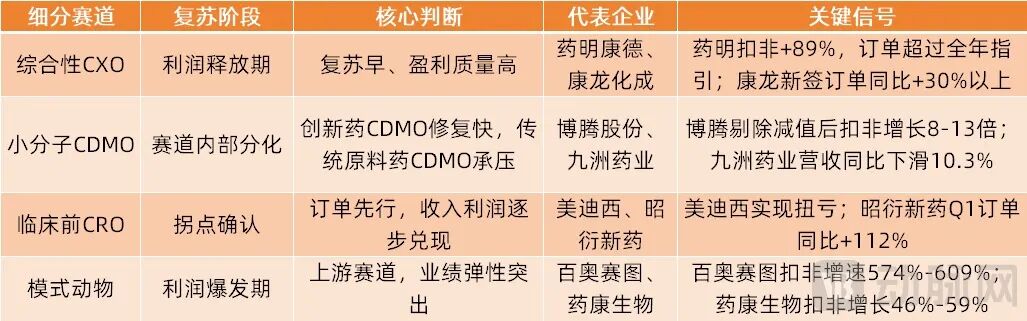
Recovery status of different sub-sectors
From the performance of various tracks, the industry recovery presents clear hierarchical differences:
The small molecule CDMO track has significant internal differentiation. Enterprises that laid out new molecular directions such as peptides and ADCs in advance can fully capture the dividends of emerging pipelines and achieve rapid performance recovery; enterprises that still focus on traditional API CDMO generally face the dilemma of under pressure on order prices and compressed profit margins.
In contrast, the model animal track has the most robust recovery momentum.
As a rigid demand track upstream of innovative drug R&D, the industry prosperity continues to rise, and the whole sector has entered a stage of rapid profit explosion. Leading enterprises have fully released their performance elasticity, becoming one of the core highlights of this round of CXO recovery.
The representative enterprise BioMice recorded a non-recurring profit and loss deducted net profit growth rate of 574%-609%; the non-recurring profit and loss deducted net profit growth rate of Cyagen Biosciences was 46.2%-58.92%.
Clinical CRO is a typical post-cycle track, and its recovery pace lags significantly behind other sub-sectors. At present, the overall industry orders have steadily rebounded, but limited by the ultra-long project delivery cycle of 3-5 years, there is an obvious time lag in the conversion of orders to revenue and profit.
Taking Tigermed as an example, its backlog of orders at the end of 2025 reached 18.2 billion yuan, and the newly signed orders in the first quarter of 2026 maintained high double-digit growth, with sufficient demand-side reserves. However, performance realization still requires long-term transmission, showing the typical feature of "orders come first, performance follows".
It is worth noting that some CXO enterprises have turned from profit to loss or faced under pressure performance, which is mostly affected by "one-time factors" and "high base effect":
Affected by the termination of the API project in Slovenia, BrightGene made a one-time impairment provision of about 330 million yuan; if this non-recurring gain or loss is excluded, its core business non-recurring profit and loss deducted net profit surged by 835% to 1302%.
Jingtai Holdings had a high base due to the recognition of a large BD down payment in the same period last year. If this one-time income is deducted, the endogenous growth of its core business remains strong, with a year-on-year growth rate of over 65%.
In addition to the differentiation of major tracks, the recovery difference in high-end CDMO sub-sectors is also significant, and the new molecular track has become the core driving force of this round of industry growth.
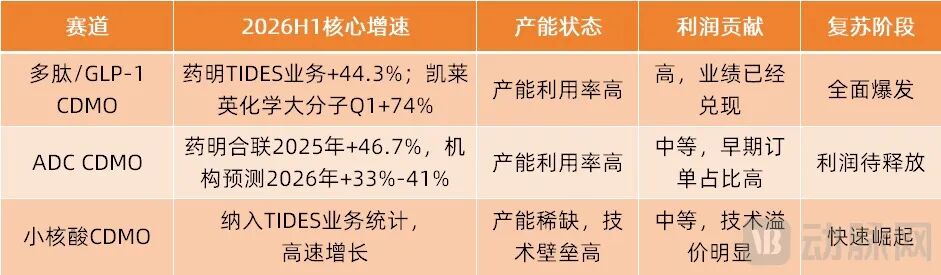
Observations show that peptide/GLP-1 CDMO is the track with the highest prosperity and the fastest recovery at present. The global GLP-1 weight loss drug market continues to boom, driving the upstream CDMO demand to surge. The order growth rate of this track far exceeds the capacity expansion speed, realizing simultaneous rise in volume and price.
ADC and small nucleic acid CDMO are in the second echelon with high prosperity, with sufficient track popularity but relatively lagged profit realization rhythm. Most projects in the ADC field are still in the early clinical stage, and commercial release still takes time; the small nucleic acid track has high technical barriers and scarce high-end capacity, with significant technical premium, but the overall business volume is still in the ramp-up stage.
Combining the performance of various tracks, the core industrial logic of this round of CXO recovery is: new molecular tracks focus on capacity, and CRO tracks focus on time. Peptides, ADCs, small nucleic acids and other new molecular pipelines are advancing intensively, and high-end capacity is in short supply. The scarcity of capacity directly determines the profit ceiling of enterprises; while the CRO track obtains incremental orders relying on the recovery of global innovative drug financing, but limited by the attribute of long-cycle projects, performance realization requires time for transmission, and the recovery pace is more gentle.
02
Uncover the True Quality of Enterprises
Revenue and net profit are the final results of enterprise operation, which can only reflect the surface recovery situation.
To accurately judge the true position of enterprises in this cycle and distinguish real recovery from fake recovery, we need to rely on four core underlying indicators: order volume determines the "incremental space" of recovery, gross profit margin determines the "profit quality" of recovery, capital expenditure determines the "sustainability" of recovery, and overseas revenue structure determines the "growth ceiling" of enterprises.
■ Orders: The Foundation of Future Performance
Orders are the most core leading indicator in the CXO industry, which can predict the performance trend in the next 1-2 years in advance.
The overall recovery trend of the industry is confirmed at present, but there is a huge gap in order implementation and revenue conversion efficiency among different enterprises: WuXi AppTec stands out with sufficient orders that have been quickly converted into revenue and profit; most of the other leading enterprises are in the stage of order delivery ramp-up; clinical CRO enterprises are limited by the project cycle, and performance realization still requires a long wait.
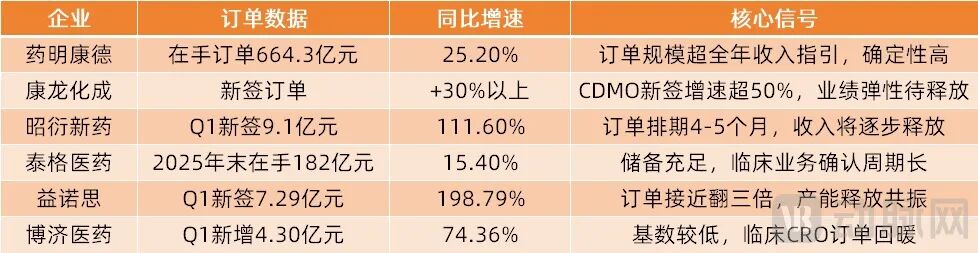
Specifically, WuXi AppTec's backlog of orders reached 66.43 billion yuan, with an order coverage rate of over 110%, and its revenue in the next year is basically locked, making it the core benchmark for the deterministic recovery of the industry.
Pharmaron, Joinn Laboratories, and Wuxi Yinuo have impressive new order growth rates, but it still takes some time for orders to be converted into revenue and profit.
Especially in the clinical CRO track, the signal of order recovery is clear, but performance realization still needs time to land, showing the significant feature that the market trend leads the fundamentals.
■ Gross Profit Margin: "Real Growth" and "Low-price Order Snatching"
Order scale determines whether an enterprise has business to do, while gross profit margin determines whether the enterprise can make money from its business.
For the same revenue growth, high-margin orders obtained by relying on new molecular technical barriers and scarce high-end capacity, and low-end orders grabbed by low-price involution, have vastly different profit quality and development potential.
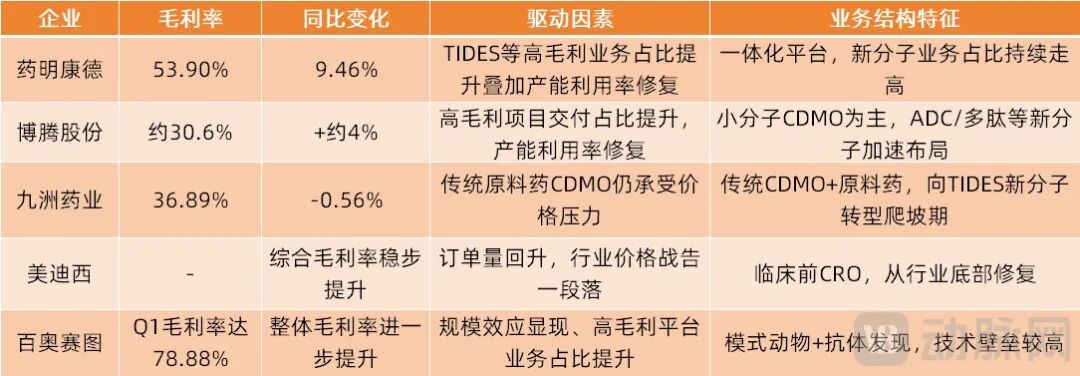
From the perspective of gross profit margin performance, leading enterprises have the best profit recovery quality.
The significant increase in WuXi AppTec's gross profit margin is mainly benefited from the dual positive factors of the rising proportion of high-margin new molecular business and the continuous recovery of capacity utilization;
BrightGene's gross profit margin is steadily improving, but historical asset impairment still drags down the book net profit;
Jiuzhou Pharmaceutical's gross profit margin declined slightly, which is mainly due to the shrinkage of high-margin orders caused by the patent expiration of the big single product of key clients, the weakening of scale effect, and the TIDES (peptide/conjugate/small nucleic acid) new business is still in the ramp-up stage.
■ Capital Expenditure: Shift from Blind Capacity Expansion to Targeted Capacity Expansion
After experiencing the bubble cycle of blind capacity expansion in the industry in 2021, the capital expenditure logic of CXO enterprises has been completely reconstructed.
The industry has bid farewell to the previous mode of all-category and indiscriminate capacity expansion. In 2026, the industry's capital expenditure is highly focused. Many enterprises have precisely made efforts to expand high-end scarce capacity such as peptides, ADCs, and macromolecules, and abandoned the expansion of low-end ineffective capacity.
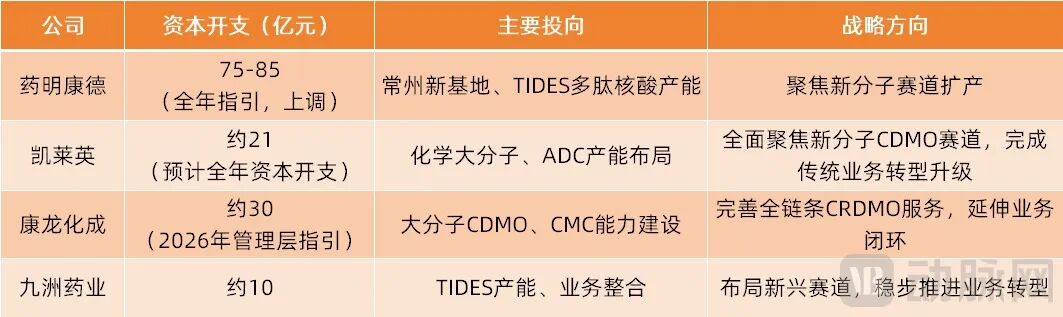
The current industry capacity pattern presents extreme structural features: it is not the overall capacity shortage, but the severe shortage of high-end new molecular capacity, while the traditional small molecule low-end capacity continues to be oversupplied.
Therefore, the industry no longer builds large-scale new low-end general small molecule capacity. The focus of enterprise capital expenditure shifts to high-end scarce capacity such as peptides, ADCs, and small nucleic acids; for the existing traditional small molecule capacity, more efforts are focused on process upgrading, cost reduction transformation, and capacity maintenance, stopping extensive new capacity investment, and structural capacity mismatch has become a long-term status quo.
It can be seen that WuXi AppTec, Asymchem, Pharmaron, and Jiuzhou Pharmaceutical are expanding peptide capacity, BrightGene and WuXi Xiamen are laying out ADC capacity; WuXi AppTec is increasing investment in small nucleic acid capacity.
In the capacity layout, the production bases of CXO enterprises are distributed globally rather than in a single region, to hedge the geopolitical supply chain risk.
■ Revenue Structure and Overseas Expansion Capability Determine the Ceiling of Enterprises
CXO is a global industry deeply bound to global innovative drugs. The overseas expansion capability and overseas revenue structure of enterprises directly determine their anti-cycle capability and long-term growth ceiling, which is one of the core indicators to distinguish enterprise tiers.
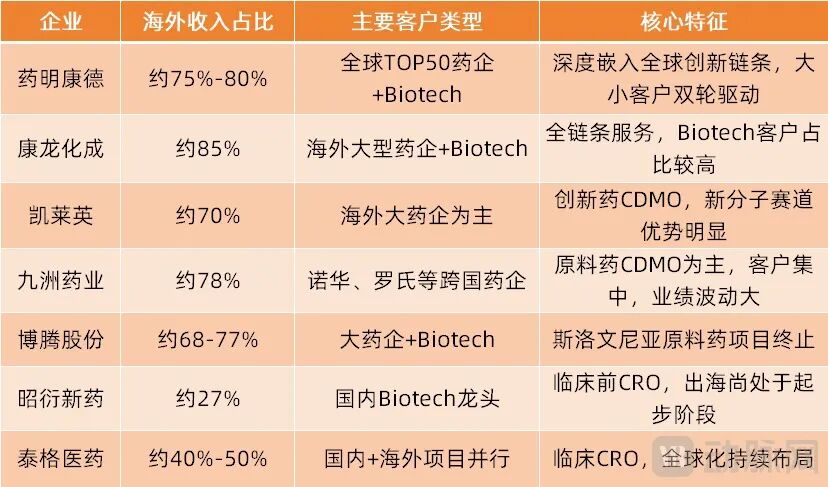
WuXi AppTec has been deeply embedded in the core of the global CXO industrial chain, which is not a simple overseas order receiving mode.
The huge reserve of global top pharmaceutical enterprises and Biotech clients allows the company to hedge risks in the industry downturn cycle and take the lead in enjoying the dividends of global R&D recovery in the recovery cycle.
In contrast, enterprises focusing on the domestic market have their performance highly dependent on the financing boom of local innovative drugs, with drastic cyclical fluctuations and insufficient stability.
At the same time, there are differences in the overseas expansion quality of CXO enterprises: undertaking innovative drug projects of new molecules has high technical barriers and high profit margins; while the traditional API OEM business has low technical added value and fierce price competition, and the growth space of the two is not