Latest scoop: Demis Hassabis actually wants to leave too, but Google is getting cold feet.
The biggest personnel shakeup in the AI industry this week undoubtedly belongs to Google — Chief Scientist Jeff Dean announced his departure, ending his 27-year tenure at the company; Demis Hassabis also stepped down as CEO of DeepMind, and will serve as Chairman of DeepMind and Chief Scientist of Alphabet, Google's parent company.
However, what no one anticipated is that under this major personnel shift, there are hidden undercurrents surging. Just last night, an organization named "Pathfounders" reported that it learned from industry insiders that Hassabis originally planned to leave together with Jeff Dean, but Google persuaded him to stay out of concerns over a sharp plunge in its stock price.
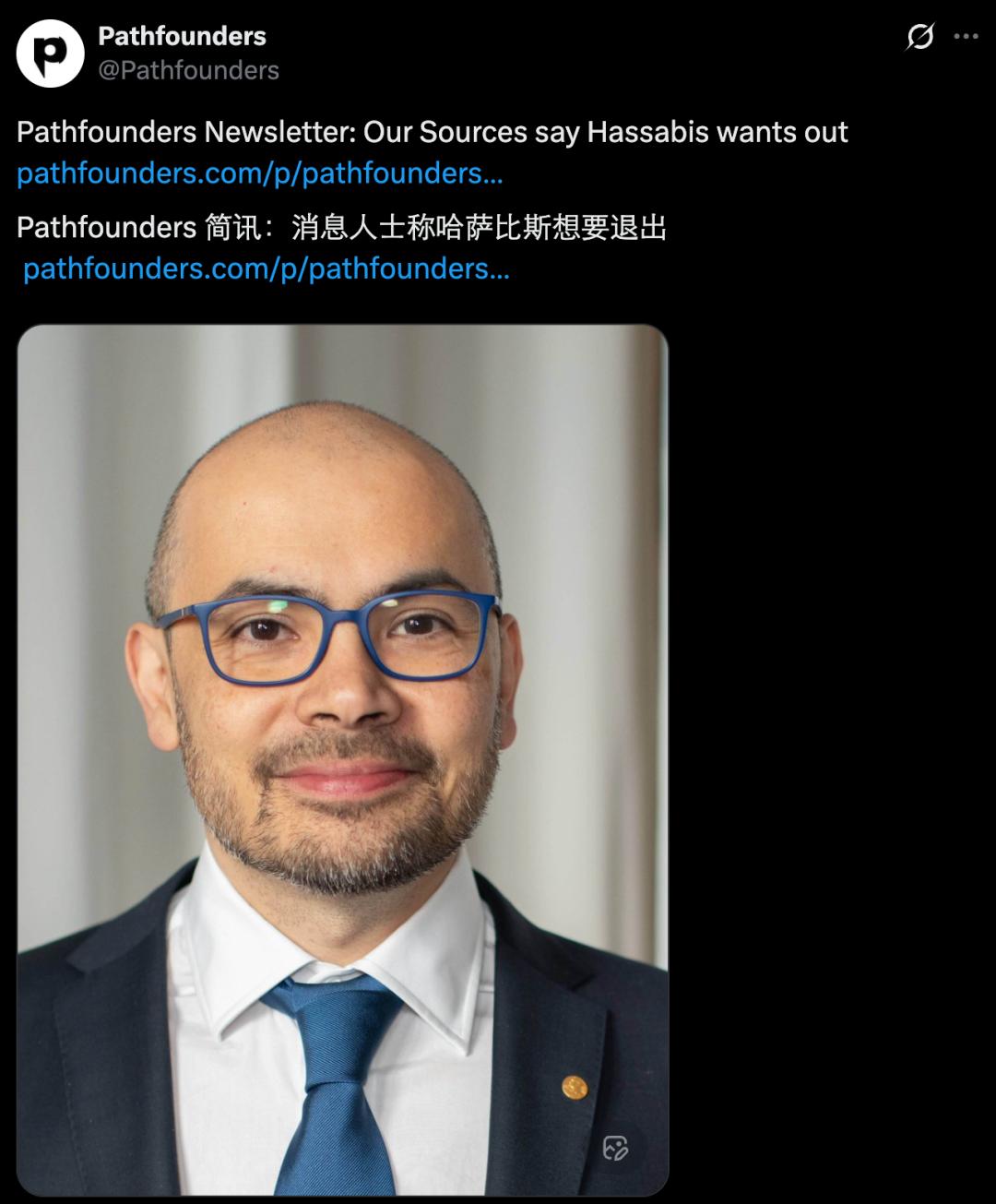
The organization further noted that "Hassabis was eventually persuaded to take the chairman position, allowing the institution to maintain a smooth transition for a period of time, so that he can formally leave the company decently at a later stage."
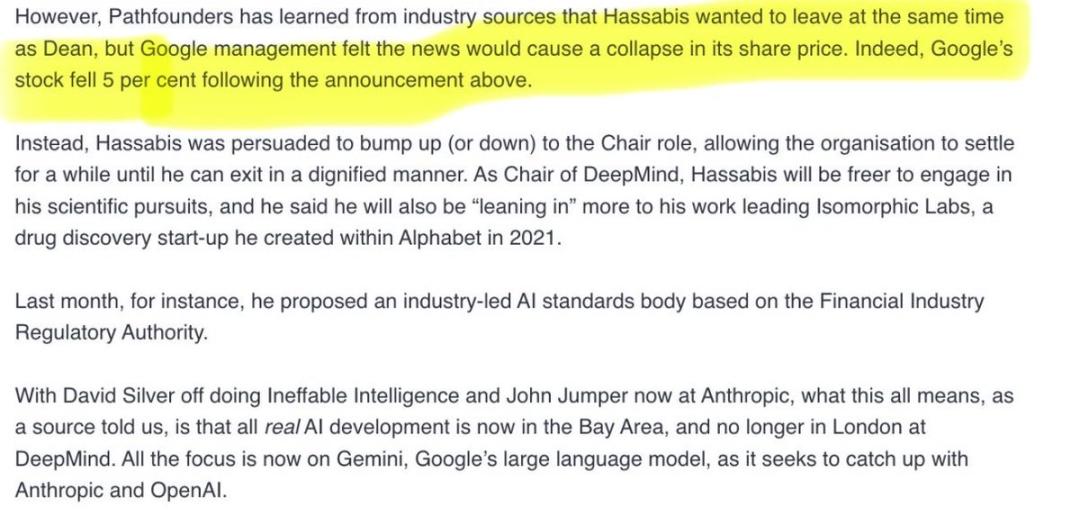
If the claims from this media outlet are true and Hassabis is only "temporarily" retained, the possibility of him leaving the company after a period of time remains very high.
In fact, the outside world has long had speculations about this. The reason does not only lie in this round of personnel changes, but in the past period of time, there have been a series of meaningful shifts inside Google DeepMind.
The most obvious one is that Google is further concentrating the AI power center in the United States, especially in Mountain View. Koray Kavukcuoglu, who took over Hassabis to be responsible for the daily operation of Google DeepMind, has moved from London to California. At the same time, core work including Gemini model development, product iteration and post-training is increasingly centered around the US headquarters. In other words, DeepMind, which once took London as its base and had a strong independent research institute attribute, is being more deeply embedded into Google's product system.
Another more symbolic move is the restructuring of the AlphaFold team. Last month, Google DeepMind disbanded the originally independent AlphaFold team. Over the past year, most of the authors of AlphaFold papers have been reassigned to projects covering Gemini, code generation, genomics, enzyme design, nuclear fusion and other fields, while some others have moved to Isomorphic Labs led by Hassabis. Google DeepMind explained that the company's scientific strategy has shifted from "solving specific scientific problems one by one" to leveraging general models like Gemini to accelerate scientific discovery.
This matter is subtle because AlphaFold is almost the most representative product of "Hassabis-style DeepMind". The DeepMind in the past was very much like a basic research institute nurtured inside Google. It could spend years playing Go, challenge protein folding, and work on projects that might not directly contribute to revenue in the short term.
But the environment Google faces today is completely different.
Companies including OpenAI and Anthropic have pushed the competition to the track of Gemini, Agents, programming and consumer-facing products. What Google needs is not just the next paper published in Nature or the next Nobel Prize, but a faster, more powerful Gemini that can truly be integrated into Search, Workspace, Android and Cloud. As a result, the role of Google DeepMind is also changing quietly: from a research institution that prioritizes scientific breakthroughs first, it is increasingly becoming the core model and product department in Google's AI war.
Here comes the crux of the problem. What Google wants is to win the current Gemini war; while what Hassabis is truly passionate about seems to always be AGI and scientific discovery. This point can be clearly seen from his interviews.
Hassabis said that he entered the AI field originally because he was interested in "those big problems in the world". In his view, the best use of AI should be to improve human health and accelerate scientific discovery, and AlphaFold is exactly "the best embodiment" of this ideal so far.
Even for how AGI should be born, he once had a quite "scientist-style" script in his mind.
In his ideal final stage, it should not be a group of companies rushing forward desperately, but more like CERN (the European Organization for Nuclear Research): the best scientists gather together, use scientific methods to understand every step very carefully, precisely and rigorously, and move towards AGI step by step. Even if this makes AGI appear ten or even twenty years later, he believes it is worthwhile.
While waiting for the arrival of AGI, people can keep developing more specialized systems similar to AlphaFold, and apply the progress of general AI to specific scientific problems such as cancer, new energy and new materials. In his own words, this was "the most ideal development path" he envisioned two or three decades ago.
But history did not follow this script. After ChatGPT became an unexpected hit, AI quickly turned from a relatively leisurely scientific exploration into a full-blown product war.
Hassabis called the current situation a "fierce competitive race under commercial pressure" in an interview. Its advantages are obvious: technological progress is faster, the most cutting-edge models can be quickly delivered to hundreds of millions of users, and massive real users can also help teams find problems that cannot be discovered in laboratory tests. But he then added a very thought-provoking sentence: "This is not the way I dreamed of many years ago."
He originally envisioned that people could think about AGI in a more philosophical way, and decide the next step more cautiously. "But we are no longer in that world." As someone who is both a scientist and an engineer, he chose to accept the reality, and continue to promote Gemini and AlphaFold as responsibly as possible in such a competitive environment.
This passage almost brings the looming tension between Hassabis and today's Google to the surface. Google is increasingly emphasizing productization, commercialization and the fast pace of the Gemini war; while the main line in Hassabis's mind never seems to have really changed: AGI, basic science, life sciences, and "using AI to solve everything else".

Therefore, if the news from Pathfounders is eventually confirmed, Hassabis's intention to leave Google may not be so surprising. What is really coming to an end may not just be the tenure of a CEO, but the "old DeepMind" that was personally shaped by Hassabis and took scientific exploration as its primary goal.
If the news is true, this job adjustment may not be the next stop in Hassabis's career, but more like a buffer period before he truly leaves Google.
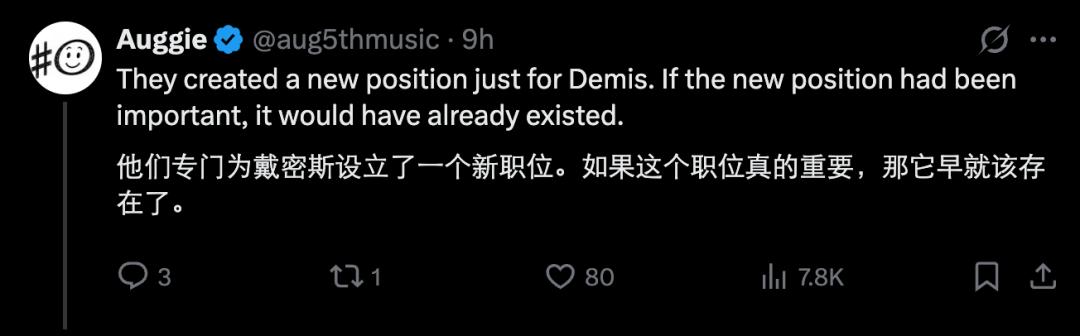
At the same time, this strategic shift also leaves a bigger question: as DeepMind, a research institute that once emphasized long-term scientific exploration, gets more deeply involved in the Gemini product war, is Google paying organizational costs for this change?
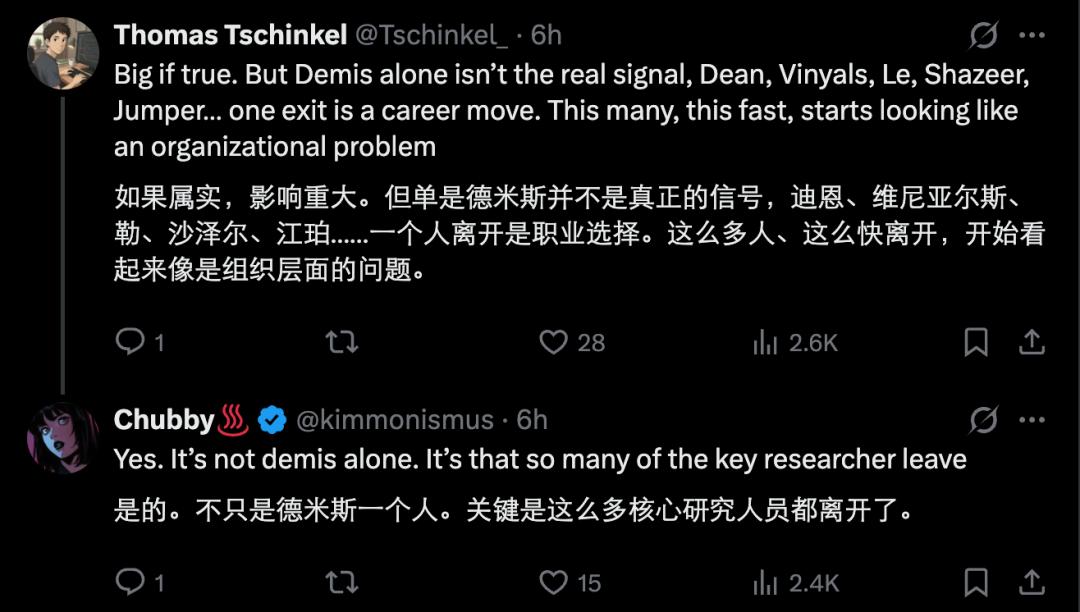
After all, Jeff Dean has left, and Hassabis's future at Google is now in doubt. If talents of such a high level begin to reconsider their relationship with Google, the next problem will no longer be limited to "who will take over the position".

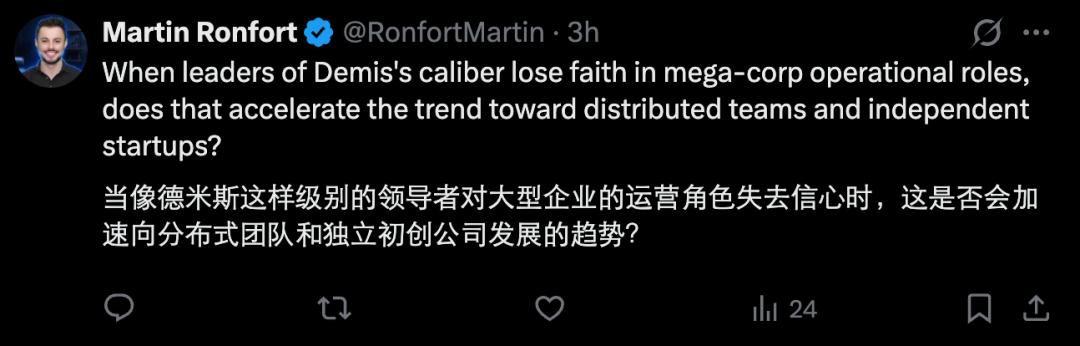
Can Google still continue to retain the top AI talents? Can it maintain its position in the next stage of AI competition while undergoing drastic organizational adjustments?
These questions are probably only just beginning to surface now.
This article is from WeChat official account "Synced" (ID: almosthuman2014), author: Synced, published with authorization from 36Kr.