SpaceX is betting big on AI, is this 100-billion-yuan grand pie all that appealing?
Overall, this quarter marks SpaceX's first ever earnings report, with solid performance across the board — revenue continues to grow faster than expected, while losses on the profit side are narrowing at an accelerated pace, putting the company barely a step away from the break-even line. However, the concerning trend is the drastically accelerating surge in capital expenditure. Overall:
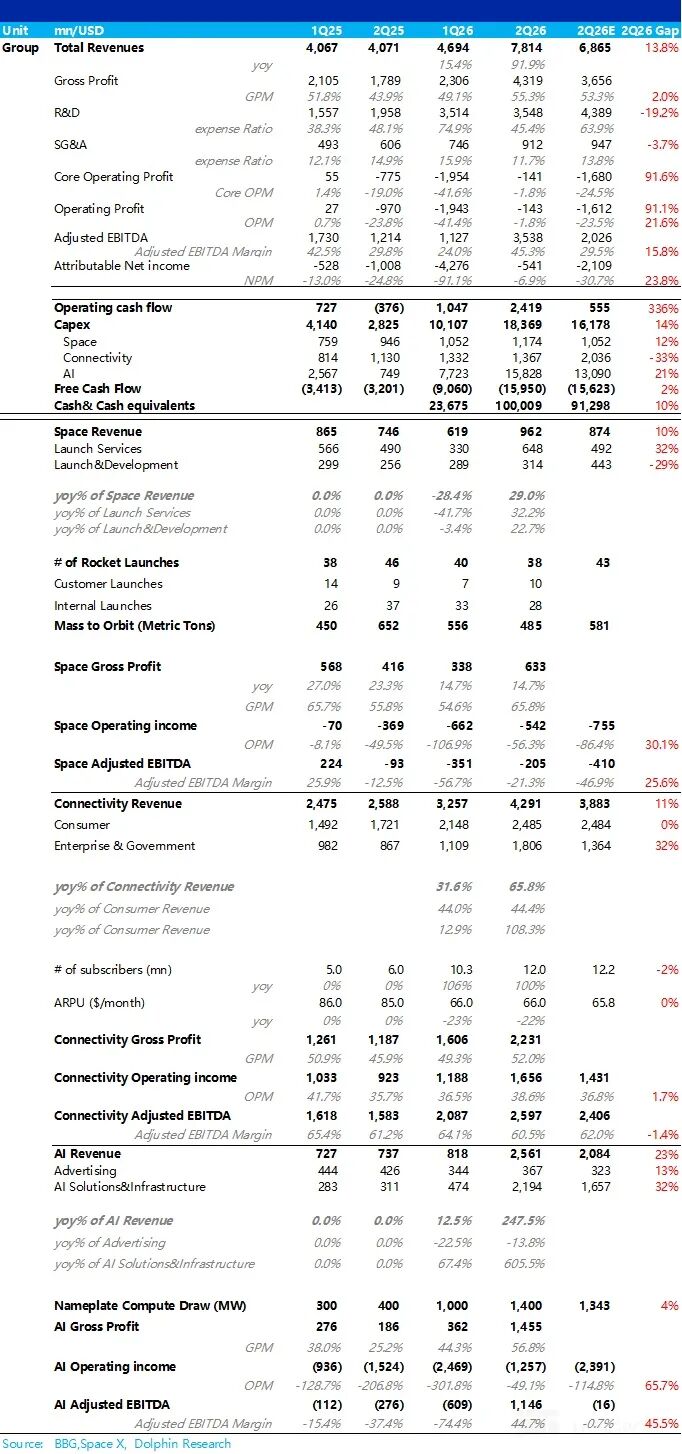
① Total revenue beat expectations, explosive growth in the AI business drove a sharp year-over-year increase in total revenue: In Q2, SpaceX posted total revenue of $7.8 billion, higher than the market expectation of roughly $6.9 billion, representing a 92% year-over-year surge, a sharp acceleration from Q1 (approx. +15%).
The core driver behind the accelerated revenue growth mainly comes from the AI business (especially the computing power lease contracts starting to contribute incremental AI business revenue, with AI segment revenue up 247% YoY), as well as a substantial increase in Starlink's To B/G revenue.
② Gross margin continued to rise quarter-over-quarter: In Q2, SpaceX's gross profit reached $4.3 billion, exceeding the market expectation of around $3.7 billion, with gross margin rising roughly 6 percentage points QoQ to 55.3%. The substantial improvement in gross margin is mainly driven by higher profit margins in the AI business — as the computing power leasing business began to recognize revenue this quarter, the high-premium leases brought high gross margins, lifting AI business gross margin 32 percentage points YoY to 56.8% (25.2% in Q2 last year).
③ Operating leverage release drove a sharp reduction in operating losses: In Q2, SpaceX's operating profit stood at -$140 million, far exceeding the market expectation of -$1.68 billion. Operating margin rose 40 percentage points QoQ to -1.8% (vs. -41.4% in Q1), which is mainly due to the substantial improvement in overall revenue and gross margin brought by the AI computing power leasing business, coupled with the release of operating leverage, putting operating profit right on the edge of break-even.
④ Performance of each business in detail:
a. Rocket launch business: Higher number of external launches, rising launch unit price and profit margin against the trend
Revenue side: In Q2, rocket launch revenue hit $960 million, beating the market expectation of $870 million, up 29% YoY. This is mainly driven by a 32% YoY increase in launch service revenue to $650 million, while launch and R&D services only recognized $310 million in revenue this quarter, up 23% YoY.
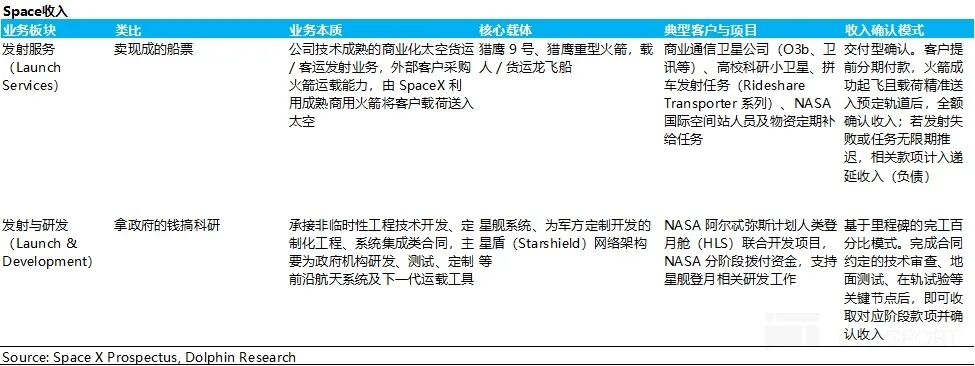
Launch services: SpaceX's launch services are mature commercial orders charged by launch times/weight. In terms of launch volume, the number of external commercial Falcon 9 launches reached 10 times this quarter, higher than 7 times in the first quarter and 9 times in the same period last year, mainly due to the increased number of launch missions from large clients.
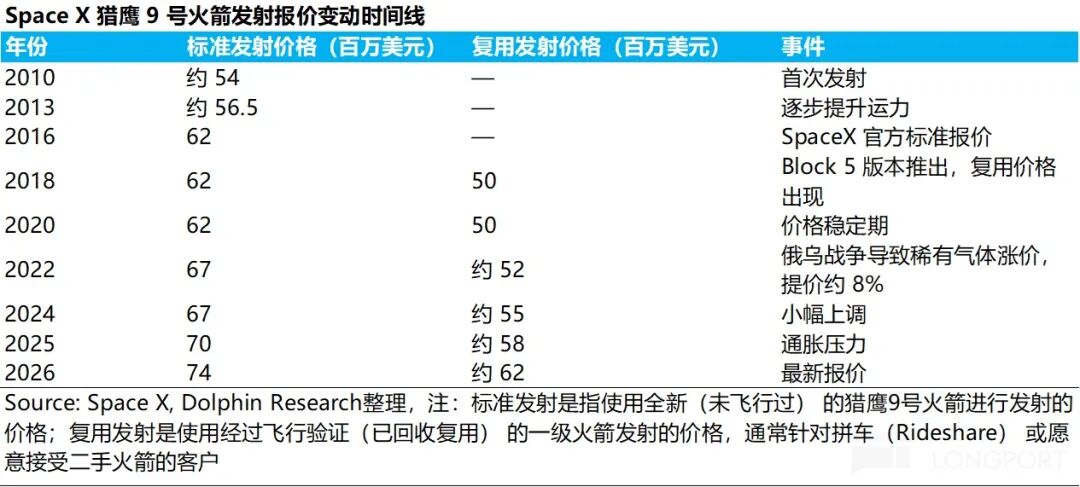
As for the launch unit price, revenue per launch is estimated to have risen from $54 million/launch in the same period last year to $65 million/launch (estimated value). The launch unit price rose instead of falling, which is mainly due to the optimization of client structure (higher proportion of large clients).
This reflects that SpaceX is using its monopoly position to earn high profits, while the market lacks low-cost and mature alternative supply (currently Falcon delivers about 2,500 tons to orbit every year, while all other players in the world deliver a total of about 300 tons, meaning SpaceX accounts for 80%–90% of the global annual mass sent to orbit).
Launch and R&D services: Launch and R&D services refer to revenue from government R&D projects such as NASA (HLS human-rated lunar lander) and the U.S. military. These deeply customized projects are recognized based on the "milestone/completion progress method", with revenue coming from the budget allocation rhythm of government agencies, as well as SpaceX's breakthrough speed at key technical nodes (such as passing the preliminary design review, completing the engine ground ignition, and achieving specific orbit tests).
As for the human spaceflight and moon landing plan, it is expected to reach the safety level required for human spaceflight by the end of 2027 after Starship can launch satellites with high reliability. Therefore, the Artemis III mission is scheduled for 2027, when it will dock with the Orion spacecraft; after that, an uncrewed direct lunar surface cargo mission will be carried out, with the goal of achieving a moon landing in 2028, when large amounts of launch and R&D service revenue will be recognized.
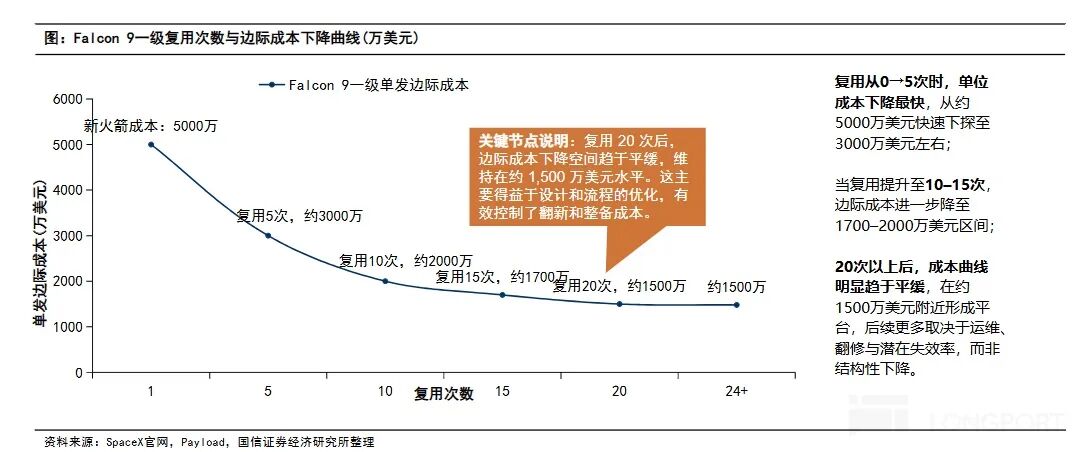
Profit side: From the profit perspective of the rocket business, the gross margin of this business also rose roughly 11 percentage points QoQ to around 66%. Even when the test flight cost of Starship (including the loss of rocket hardware) is directly recorded in the current launch business cost, which would drag down gross margin, the gross margin of the rocket launch business still rose against the trend, mainly benefiting from the increase in launch unit price and the systematic cost reduction brought by rocket reusability (mainly Falcon 9), which lowers marginal cost as the number of reuses increases.
However, as Starship R&D accelerates, the R&D expenses of rocket launch services rose 55% YoY to $1.1 billion, which finally dragged the operating margin down 7 percentage points YoY to -56%, still far exceeding the market expectation of -86.4%.
b. Starlink business: Revenue beat expectations mainly driven by To B/G revenue growth, user growth basically in line with expectations
Revenue side: In Q2, Starlink business revenue reached $4.29 billion, up 66% YoY, slightly higher than the market expectation of $3.88 billion. This is mainly driven by the doubling of To B/G business revenue to $1.8 billion, while Consumer business revenue maintained steady growth, rising 44% YoY to $2.5 billion.
To B/G business: SpaceX has reached in-flight WiFi agreements with multiple airlines and put them into operation, and its Starshield business has also secured multi-year contracts worth more than $6 billion from the U.S. government.
TO C business: The number of Starlink users has grown to 12 million, roughly doubling YoY, with a net increase of about 1.7 million QoQ, basically in line with expectations. While expanding its user base this quarter, the company maintained a stable unit price QoQ (ARPU $66/month), although it still fell 22.4% YoY.
In terms of mobile communication business, SpaceX has obtained the right to use 65 MHz of spectrum in the United States (the original 2GHz band of EchoStar) and several global mobile satellite service spectrum licenses. Although this business is still in its early stage, SpaceX has directly declared war on traditional telecom operators — it plans to launch V2 mobile satellites using EchoStar's 65MHz spectrum next year and build a ground network to seize market share from the three major operators AT&T, Verizon and T-Mobile.
By the end of 26Q2, the total number of in-orbit communication and direct-to-cell satellites reached 10,200 (9,600 in 1Q26), including 9,600 communication satellites providing 800TB/s downlink rate, and 600 mobile satellites.
Profit margin: The overall profit margin of the Starlink business remained stable. In Q2, the gross margin of the Starlink business stood at 52%, up 2.7 percentage points QoQ, which also lifted the operating margin by 2.1 percentage points QoQ. This is mainly because this business is similar to SaaS, with high upfront fixed investment (rocket launch cost + satellite manufacturing cost) but extremely low marginal cost in the later stage, and the increase in user base also drives the profit margin to continue to rise.
c. AI business: Revenue beat expectations, profit margin improved significantly
Revenue: In Q2, AI business revenue reached $2.56 billion, higher than the market expectation of $2.08 billion. This is mainly driven by a 6x YoY increase in AI solution and infrastructure revenue to $2.2 billion (among which the cloud service agreements signed with Anthropic and other parties contributed about $1.6 billion in incremental AI infrastructure revenue this quarter). Revenue from the Grok large model is estimated to be $600 million in Q2, up 26% QoQ from $470 million in Q1.
As for the advertising revenue from the X platform, it reached $367 million in Q2, up 7% QoQ from $343 million in Q1. This is mainly because in Q1 2026, to completely reverse its technical disadvantage, the X platform fully reconstructed its underlying AI advertising infrastructure, with key deployments including: fully automated delivery system, AI probabilistic attribution tracking, Grok-powered real-time brand safety risk control, and underlying integration of advertising and recommendation stream algorithms.
After the reconstruction, advertising revenue rebounded, but it still fell 14% YoY. Therefore, it still needs continuous observation whether this reconstruction can truly recover the lost advertiser budget.
Profit operating margin is about -49%, far exceeding the market expectation of -115%; Adjusted EBITDA Margin is about 45%, turning positive sharply both YoY and QoQ (AI Adjusted EBITDA reached $1.146 billion for the first time in Q2).
The improvement in profit margin is mainly due to the extremely tight supply of computing power in the current context, and the profit margin improvement brought by SpaceX's computing power leasing premium (estimated at $30-50 billion per GW, far exceeding the $10-15 billion per GW of peers).
However, it should be noted that all AI lease agreements contain a clause that either party can terminate the agreement with 90 days' prior notice — which means that despite the current strong revenue, there is inherent uncertainty in revenue visibility.

Dolphin Research's overall view:
Overall, Dolphin Research believes that judging from the earnings report itself, SpaceX performed well — both revenue and profit sides beat expectations, operating losses narrowed sharply, and the company is already on the edge of break-even. However, its share price has fallen nearly 50% from its high point, about 20% lower than its IPO price, and remained weak after market close, which is mainly due to the following reasons:
a. Excessive capital expenditure investment, but the scale of new AI orders is not enough to fully match the explosive growth rate of Capex
In this earnings season, Dolphin Research observed a notable phenomenon: when cloud service providers announce higher-than-expected capital expenditure investment, but cannot deliver matching growth rate on cloud business revenue or order volume, the market will start to question the ROI of capital expenditure, especially when free cash flow is deeply negative (such as Meta).
Although SpaceX has the triple attributes of aerospace + Starlink + AI, in the short term, AI has become its second largest revenue source (about $2.56 billion in Q2, second only to Starlink's $4.29 billion), and about 86% of its capital expenditure went to the AI business (about $15.8 billion in Q2 alone). It is also expected that the AI business will surpass Starlink for the first time in the whole year of 2026 and become its largest revenue source.
At the same time, SpaceX continues to accelerate the expansion of its computing power scale: its nominal computing power reached 1.4 GW in 2Q26, higher than 1 GW in the first quarter and 400 MW in the same period last year, and is expected to exceed 2 GW by the end of this year; the cumulative online computing power by the end of next year will be several times that number — according to the management, the magnitude is closer to 10 GW rather than 5 GW.
On the capital expenditure side, single-quarter Capex in 2Q26 reached $18.4 billion, and the management expects the capital expenditure in the next two quarters to be comparable to this quarter, which means that the total capital expenditure for the whole year of 2026 will be about $65.2 billion, far exceeding the previous market expectation of $45.5 billion.
As for next year's capital expenditure, the current market expectation is about $89.7 billion. But if calculated based on the full-capacity planning of 10GW computing power by the end of 2027 (assuming the investment per GW is about $30-35 billion, referring to the $15.8 billion capital expenditure corresponding to the 400MW new addition in 1Q26, which translates to about $39.5 billion/GW), the corresponding total capital expenditure scale in 2027 may reach $240-280 billion — far exceeding current market expectations.
Although SpaceX's computing power leasing business, relying on the current tight computing power pattern and flexible agreements that can be revoked with 90 days' prior notice, charges a computing power premium far exceeding that of its peers (unit price per MW is about $31-50 million, 3-5 times that of peers), and the management also expects the investment payback period to be only about one year, the market still needs to see order volume matching the high capital expenditure investment.
This earnings report only announced about $6.7 billion in new cloud service agreements, which does not mean there are no new orders. But the problem is: under such a large-scale Capex investment, the marginal increment of new orders is very limited compared with the previously announced large orders — Anthropic ($45 billion/3 years) and Google (about $30.36 billion/33 months). The market is starting to worry: whether the investment rhythm of Capex has run ahead of the verifiable return of orders, especially when SpaceX's computing power leasing orders have clauses that allow early revocation.

b. Operating cash flow has