The exchange has taken action, and the LOF clearance process is officially launched.
On the afternoon of August 7, the Shanghai and Shenzhen Stock Exchanges synchronously solicited public opinions on the "Notice on Improving Relevant Arrangements for Listed Open-Ended Funds (Draft for Comment)" (hereinafter referred to as the "Draft for Comment"). The draft for comment clarifies the delisting standards and implementation procedures for LOFs (Listed Open-Ended Funds).
The LOF delisting scenarios this time involve two dimensions: first, the product dimension. The draft for comment clarifies that QDII (Qualified Domestic Institutional Investor) LOFs shall be delisted, and the Shenzhen Stock Exchange also includes commodity futures LOFs in the delisting scope. Second, the scale dimension: LOFs whose net asset value on the exchange is lower than 10 million yuan for 60 consecutive trading days shall be delisted. QDII-LOFs and commodity futures LOFs on the Shenzhen Stock Exchange will have a transition period until December 31, 2027, while no transition period is set for small-scale products.
According to statistics from Wind by *Caijing*, there are 402 listed LOFs in the whole market, with a total on-exchange scale of about 54.9 billion yuan (the overall scale including off-exchange shares is about 491 billion yuan). Among them, there are 34 mandatory delisting products of QDII and commodity futures types specified in the draft for comment, with an on-exchange scale of about 24.6 billion yuan; there are about 112 LOFs whose on-exchange scale has been below 10 million yuan for nearly 60 consecutive trading days, with a total on-exchange scale of about 458 million yuan.
It should be noted that delisting does not mean liquidation. If an LOF is transformed into an off-exchange fund after delisting, the investors' shares still exist, and only the trading venue is transferred from the exchange to off-exchange channels. If liquidation is finally chosen, investors will also get back the remaining funds according to the net value after liquidation, instead of losing all their principal.
What is worth noting is that after the LOF is delisted, its on-exchange trading function will be terminated, and the shares previously bought at a high premium will lose the channel to sell at a high price in the secondary market.
"No matter what price you buy the shares on the exchange, the amount of money you can get back in the end depends on the net value of the fund at the time of delisting. If the purchase cost is much higher than the net value, the difference in between is the actual loss, and the high premium bubble on the eve of delisting will definitely burst," a fund observer said. The new rules specifically require that relevant products be marked with an * before their abbreviations before delisting, and the managers will continuously release risk warnings. Investors need to treat these marks rationally and should not regard them as hype signals.
1
Twenty Years of LOF: From Innovation to Clearance
The full name of LOF is Listed Open-Ended Fund. In August 2004, the Shenzhen Stock Exchange officially launched LOFs; on December 20 of the same year, the first domestic LOF, Southern Active Allocation Fund, was listed and traded on the Shenzhen Stock Exchange.
The original design intention of LOF is quite ingenious: investors can not only subscribe and redeem at the net value through off-exchange channels such as banks, but also trade on the stock exchange like stocks, and can also transfer shares between the two markets through custody transfer.
This design connects the on-exchange and off-exchange markets, allowing open-end funds to enter the auction trading system for the first time, and also providing investors with an arbitrage mechanism. When the market price is lower than the net value, investors buy in the secondary market and redeem at the net value; when the market price is higher than the net value, investors subscribe off-exchange and sell in the secondary market. In theory, this can make the price and net value tend to be consistent.
However, the arbitrage mechanism of LOF has an inherent shortcoming: arbitrage takes time. Due to the time lag of custody transfer, LOF cannot realize instantaneous arbitrage like ETF. This gap in the mechanism has been repeatedly utilized by the market later.
Over the past two decades, the problems accumulated by LOF have gradually been exposed.
The first is the on-exchange premium risk. In June 2026, multiple LOFs under Caitong Fund hit the 10% limit up collectively, and the intraday premium rate of Caitong Fuxing Regular Opening Mixed once approached 50%. The premium rate of Global Chip LOF also exceeded 33% in early August 2026. Some industry insiders commented that such high premiums that deviate from the fundamentals are like a game on quicksand. Once the sentiment fades, investors will face the dual risks of price regression and premium burst.
The second is that funds with small scale are easy to be controlled and hyped on the exchange. Because the on-exchange floating share of some LOFs is extremely small, a small amount of capital can drive the price. In April 2026, the Science and Technology Innovation China Life LOF with a scale of only 73 million yuan experienced a "limit up to limit down" swing in just four days. In 2024, the China Securities Regulatory Commission once issued an administrative penalty decision, revealing that some investors controlled and used other people's accounts to manipulate 31 LOF products.
The third is the risk of investor suitability mismatch. Due to the existence of arbitrage space, the "tractor arbitrage" model of opening multiple brokerage accounts once caused a large number of investors to follow suit and subscribe. Take SDIC Silver LOF as an example, during the period when the fund's daily purchase limit was 100 yuan, a large number of arbitrage and recommendation tutorials appeared on social media. Improper subscription behaviors not only amplified the premium bubble, but also aggravated the stampede risk when the price collapsed later.
The repeated premium hype, small-cap manipulation and arbitrage chaos finally promoted the two exchanges to jointly introduce the new LOF delisting rules. From an innovative product in 2004 to a clearance object in 2026, LOF has gone through more than 20 years and has reached the stage where structural clearance is required.
2
New Rules Focus on QDII, Commodity Futures and Small-Scale LOFs
From the framework of the draft for comment, the Shanghai and Shenzhen Stock Exchanges are basically consistent, and delisted LOFs can be roughly divided into two categories: "mandatory product delisting" and "scale-triggered delisting".
In terms of product types, the Shanghai Stock Exchange clarifies that QDII LOFs belong to "other circumstances under which the Exchange deems it necessary to terminate the listing" stipulated in the Shanghai Stock Exchange Rules for the Listing of Securities Investment Funds.
The only substantial difference is that the Shenzhen Stock Exchange includes both commodity futures LOFs and QDII LOFs in its statement. At present, the only product that meets the definition of commodity futures LOF, UBS SDIC Silver Futures Fund, is listed on the Shenzhen Stock Exchange.
The draft for comment clarifies that the above two types of products must be delisted before December 31, 2027. Among them, the Shenzhen Stock Exchange requires the manager to submit the delisting-related documents to the exchange no later than November 12, 2027 after the arrangement is determined; if the documents are not submitted as required, the exchange may directly terminate its listing in accordance with the rules.
The draft for comment requires that from the date of implementation of the notice to before the delisting, the on-exchange abbreviations of relevant products must be prefixed with an *. The fund manager shall issue an announcement before the market opens on the implementation date to warn of the delisting risk, and remind holders to arrange their shares through redemption, selling, or cross-system custody transfer to off-exchange channels.
In terms of scale, both the Shanghai and Shenzhen Stock Exchanges have put forward delisting requirements for funds with too small on-exchange scale. Specifically, if the daily on-exchange net asset value is lower than 10 million yuan for 60 consecutive trading days, the fund shall be delisted.
This period is calculated from the date of implementation of the notice. If the net value is below this line for 40 consecutive trading days, the fund manager must report to the exchange, and disclose the risk warning announcement day by day from the next trading day until the relevant situation is eliminated or the delisting procedure is initiated. No transition period is set for small-scale products.
According to the draft for comment, delisting can be promoted through two ways: transformation or liquidation. Transformation means that the LOF terminates its on-exchange business and is transformed into an off-exchange fund; liquidation means liquidating the fund property and terminating the fund contract in accordance with the law.
For those applying for transformation, the Shanghai Stock Exchange requires a 20-trading-day investor selection period, and relevant subscription and trading arrangements during the selection period shall be implemented in accordance with the notice. Both exchanges require member units to include LOFs that have issued delisting announcements in key monitoring, and remind customers of risks through multiple channels.
3
LOFs such as SDIC Silver Will Be Delisted
How much impact will this draft for comment have on the LOF segment?
According to statistics from Wind by *Caijing*, there are 34 products under the mandatory product delisting category, with a total on-exchange net asset value of about 24.6 billion yuan, accounting for about 45% of the total on-exchange scale of all LOFs.
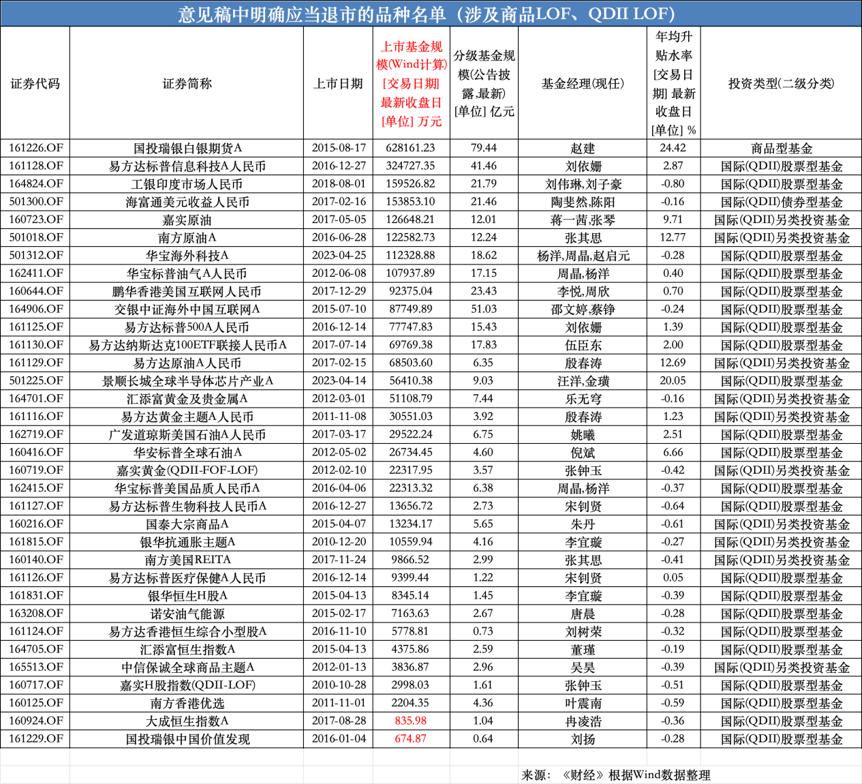
In terms of structure, QDII equity funds are the main type, including QDII alternative funds (crude oil, gold, commodity themes, etc.), QDII bond funds, and 1 commodity futures LOF (UBS SDIC Silver Futures Fund).
Among them, the products with large on-exchange scale include: UBS SDIC Silver Futures, E Fund S&P Information Technology, ICBC India Market, Haifutong Dollar Income, Harvest Crude Oil, Southern Crude Oil, etc.
Some products are still in a high premium state at present. The premium rate of Invesco Great Wall Global Semiconductor and Chip Industry LOF reaches 32%, that of UBS SDIC Silver Futures is 27%, that of Southern Crude Oil is 22%, and that of E Fund Crude Oil is 21%.
From the perspective of the whole market's LOFs, the current high premiums are mainly concentrated in products with limited off-exchange quotas, including factors such as insufficient QDII quotas and purchase restrictions that cut off arbitrage supply, leading to the secondary market price continuing to rise relative to the net value.
Industry insiders analyze that this is related to the LOF trading mechanism: on-exchange prices can be traded in real time, while off-exchange subscription and redemption are restricted by confirmation cycle, quota, and purchase limit. When it is difficult to increase a large number of shares at the net value off-exchange, the secondary market price is easy to be at a premium relative to the net value. Crude oil, silver and some overseas equity themed LOFs have experienced high premiums many times in the periodic market.
According to the statistics based on the mandatory scale delisting standard, there are about 112 relevant LOFs, with a total on-exchange scale of about 458 million yuan. These products account for nearly 30% of all LOFs, but their on-exchange volume is extremely limited, and the median on-exchange scale of a single product is only about 3 million yuan.
Overall, the scale of mandatory product delisting LOFs (about 24.6 billion yuan) is significantly larger than that of small-scale LOFs (about 458 million yuan). In terms of on-exchange capital volume, the impact of the draft for comment is more concentrated on QDII and commodity futures products.
From the relevant layout of domestic public offering commodity funds, in addition to silver, there are also gold, soybean meal, energy and chemical futures, non-ferrous metals and other directions, but the only LOF listed in the form of LOF is the silver futures LOF, and the rest are mostly pure off-exchange open-end funds or ETFs. After the draft for comment includes commodity futures LOFs and QDII LOFs in the delisting arrangement, the on-exchange tools for domestic investors to participate in relevant commodity and cross-border allocation will be more transferred to ETFs and remaining off-exchange products.
This article is from the WeChat official account "Dushu Yizhi" (ID: dushuyizhi007), Author: HUANG Huiling, Editor: GUO Nan, released with authorization from 36Kr.