From now on, re-evaluate the profitability of a company.
In recent years, most operators share a common feeling: changes are accelerating, competition is getting more complex, and it is increasingly difficult to make profits.
One of the most obvious changes behind this trend is that the market is shifting from incremental competition to stock game.
In the past, when there was market increment, enterprises only needed to move fast enough to seize the dividend. Now, although growth has not disappeared, it has become more costly — every additional customer acquired and every extra unit of revenue generated may come with higher costs behind it.
At the same time, many products have moved past the stage of "whether it is useful" to the stage of "whether its functions have already been excessive". When there are more and more usable products in the market, what users truly lack has turned out to be attention and selection cost.
This also makes competitors increasingly unpredictable. Industries that were completely unrelated in the past may now suddenly face head-on competition as they target the same user needs. You may think you are competing with your peers, but the product that finally takes away your users may come from a totally different category.
In addition, AI has pressed the acceleration button for this competition: tasks that used to take a team several months to complete can now be finished by a few people with tools in just a few weeks. The boundary of enterprise capabilities is being redrawn, and the originally solid barriers in many industries have begun to loosen.
Stock game, demand collision, and AI acceleration — when these three forces collide, focusing only on the internal performance report of the company is no longer sufficient.
The anxiety of many operators precisely comes from being "too close to growth": chasing new channels today, learning new technologies tomorrow, and fixing eyes on a new index the day after tomorrow. The more information you browse, the less stable your judgment becomes.
Now, we increasingly need to step back a little from the front line of operation, change our perspective, and re-understand a company.
Therefore, in the latest course of Hundun, we have invited Liu Kai, who has 10 years of experience in quantitative strategy research.
The instinct of operators is to rush forward, focus on orders, stores, users and profits, and solve specific problems one by one in front of them. Investors, however, will hold back their applause for a while, put the company back into the context of upstream and downstream players, peers, substitutes and industry changes, and continue to ask:
When revenue rises, is it because demand has actually strengthened, or is it driven by promotions? How much of the earned money is finally retained? Why do customers still choose you? How much value do the advantages you used to be proud of still have today?
In this course, we will stand from the investor's perspective to examine the operating status of a company: what is real growth, what is only short-term prosperity; what remains an advantage, what has quietly expired.
01
Growth does not equal profitability, do not be misled by impressive data
Why can revenue growth not represent the improvement of operating quality? I will give a common example in daily life, and you will understand it immediately.
Suppose a person loses 5kg in a month, many people may think this result is pretty good. But a responsible doctor or nutritionist will continue to ask: is the lost weight fat or muscle? Or is it just lost water? How is his sleep and mental state recently? Have his physical indicators improved? Weight loss does not necessarily mean good health, and there may be completely different reasons and results behind it.
Similarly, for the result of "enterprise revenue growth", the reason may be that the product is really more popular, or it may be achieved through price cuts, subsidies, and extended payment terms. If the reason is the latter, is this growth result necessarily worth celebrating?
Of course, we have to admit that the word "growth" is really attractive and confusing, so most people will not dig deeper once they hear about growth.
But this may also be the most dangerous moment in operation, because when the growth data is unsatisfactory, everyone will get nervous, investigate the reasons, and control risks. What we should be alert to is: growth looks very impressive, but the operating quality may be deteriorating.
Operators are deeply involved in daily work, so it is natural for them to notice achievements first, such as new products launched, new markets opened up, more users acquired, and revenue increased. However, if revenue cannot be converted into profit, it cannot be sustained; if profit cannot be converted into cash flow, it is only book prosperity; if cash cannot form competitive advantages, it may only be a phased dividend.
We need a more penetrating thinking framework than only looking at growth results. So in this course, we borrow the external perspective of investors to learn to see clearly the ability of an enterprise to make sustainable profits. I divide this judgment framework into four layers, namely four questions:
Value creation — Why do customers keep choosing you and are willing to pay you?
Value retention — Can the money you earn be retained?
Irreplaceability — Is it possible for customers to turn to other suppliers?
Continuous evolution — After the environment changes, can you still maintain today's advantages in the future? Can you rebuild your advantages?
If a company cannot even answer these four questions clearly, no matter how impressive its growth story is, you should still maintain a degree of caution.
What data do you need to check for each layer of judgment? What are the possible signals? How to locate specific problems?
Next, we will expand on these points step by step. In this process, we will help you build the systematic and structured thinking ability of the investment system, so as to understand a company more clearly.
02
The upstream and downstream sectors are the actual sites where profit distribution takes place
First, zoom in to look at the upstream and downstream: Why do customers buy? When do they make payments? Who does the enterprise purchase from? When does it make payments? How long does the goods stay in the warehouse? Does the profit finally turn into cash?
These are questions you are more familiar with, because the upstream and downstream relationships are very close to daily operations. Every order, every contract, and every payment redistributes profits, and exposes the position of both parties. The party that takes the initiative can better retain value.
For example, for the same 100 million yuan of revenue, some companies collect payment before delivery, while some companies are still urging payment half a year after delivery. From the perspective of investors, these are two completely different types of revenue.
First of all, let's look at how to judge your revenue quality. I suggest asking three questions first: Are customers willing to pay for you continuously? Can customers make payments on time? Is the switching cost high for customers to leave you and choose other suppliers?
But these three points alone are not enough. A good customer also has the feature of "accepting reasonable prices". If revenue growth relies on giving benefits for a long time, it is like pushing today's pressure to tomorrow — the pressure will not disappear, it will only come sooner or later.
To help you analyze more systematically, I list "seven signals of customer relationship" here: customer concentration, accounts receivable, payment terms and bad debts, repurchase and renewal, price adjustment capability, switching cost, and contract terms.
You need to continuously collect and observe these signal data and indicators, then go deep into the business front line to look at the actual transaction relationship and make judgments. Because there are multiple possibilities behind any indicator:
For example, high customer concentration may be a passive dangerous dependence, or an active high-quality long-term cooperation. Revenue growth may mean that the brand is getting stronger, or it may be driven by a pre-sale of large promotions. Therefore, you need to further observe repurchase and renewal to judge whether customer demand is stable and whether the growth is healthy. At the same time, you can test the price adjustment capability to verify whether the brand is getting stronger and whether the value is recognized by customers.
Indicators can only indicate abnormalities, and business relationships determine conclusions. The sense of propriety of professional judgment is reflected here: stay sensitive when you see signals, and keep space for different interpretations when you see signals.
Similarly, you also need to continuously collect and observe "seven signals of upstream relationship": supplier concentration, resource scarcity, procurement price, advance payment, accounts payable, inventory, and supply interruption risk.
These data and indicators also need to be judged in the context of actual transaction relationships. For example, an increase in advance payment may mean that upstream suppliers are in a strong position, or it may be that the enterprise actively locks in prices. A good analysis does not mean picking a pleasant explanation by feeling, but continuing to find evidence that can distinguish between the two explanations.
Putting these upstream and downstream signals together can help you judge the position of the enterprise and identify risks in advance.
For example, if customer payment terms are extended, suppliers require advance payment, inventory is backlogged, and raw material prices are still rising. When these four things happen at the same time, the profit statement may still look relatively calm for the time being, but in fact, the cash flow of the enterprise has begun to tighten. Because the goods have been sold but the money has not been received, raw materials need to be paid in advance, part of the funds is occupied in the warehouse, and the rising cost has not been transmitted through timely price adjustment.
The common feeling of such enterprises is that "they are very busy every day, but there is no money in the account", because at this time they are like standing in a corridor that is getting narrower and narrower, with both sides squeezing towards the center at the same time.
Let's take another case for analysis. A domestic catering chain enterprise achieved simultaneous growth in revenue, net profit and capital scale in 2025. As an investor, I will analyze "what drives the growth" according to the structure:
In 2025, this enterprise had nearly 60,000 stores worldwide, of which only about 30 were directly operated. So its store expansion relies almost entirely on the franchise network.
Then we need to ask both sides at the same time: for franchisees, can a single store make profit, how long does it take to get the cost back, and what is the situation of renewal and store closure; for the headquarters, can the supply, distribution, training and supervision keep up with the expansion. Because the more stores there are, the larger the management radius, and the system capability will determine the quality earlier than the store opening speed.
Further look at the revenue structure. Its franchise and related service revenue only accounts for about 2.4%, and the main revenue comes from selling goods and equipment to franchisees. So its business model cannot be simply understood as "collecting franchise fees", but to expand the scale of commodity supply through the franchise network, and turn procurement, production, equipment, warehousing and distribution into sources of revenue.
Then the follow-up questions are very specific: can the gross profit of supply remain stable? Can the rise in raw material prices be transmitted? Are franchisees willing to continue purchasing and expanding after making profits? If the single-store model of franchisees deteriorates, the headquarters may still achieve growth through store opening and supply in the short term, but the long-term relationship will loosen.
Then we found that this company produces 100% of its core ingredients by itself, has 5 production bases, 28 warehousing nodes, and its distribution covers more than 300 cities.
Thus, a scale transformation path emerges: self-production of core ingredients helps to control quality and cost; production bases turn formula and procurement into stable production capacity; warehousing nodes shorten the replenishment chain; the distribution network allows nearly 60,000 stores to replicate operations more stably.
But this system ultimately needs to be proved by operating results: whether the stockout rate is reduced, whether the distribution cost is reduced, whether food safety is stable, whether inventory turnover is healthy, and whether new stores can still obtain similar delivery quality. Because the scale of the supply chain itself does not equal advantage, it is the stable transformation of scale into cost, quality and speed that constitutes the advantage.
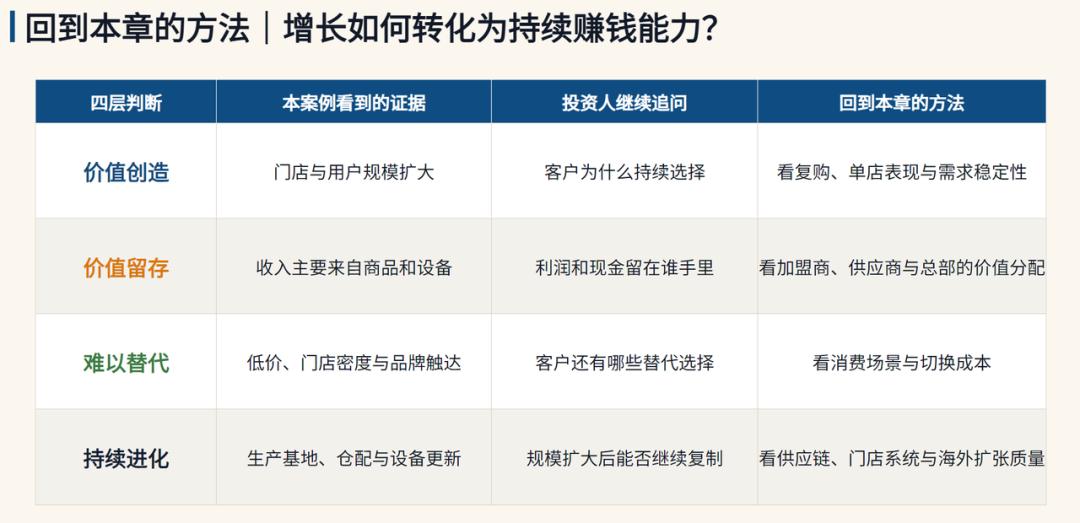
I hope you remember: the upstream and downstream sectors are the actual sites where profit distribution takes place. Revenue means there are people paying for the product, and cash means whether the enterprise has a strong position. Whether an enterprise can make money depends on whether it has the initiative in the transaction relationship.
When you see a company's revenue growth in the future, don't rush to label it as a "good business". Follow the payment terms, inventory and cash flow, then check who has more options between customers and suppliers, and many of the operating quality issues will emerge on their own.
03
Do not only compare with yourself or your peers, but return to customers' choices to see clearly your advantages
Next, we zoom out to the medium shot: what position does the enterprise actually occupy relative to its peers? Do customers have better choices?
If a company's revenue this year is higher than last year, its profit margin is better than before, and its stores and teams are expanding, this kind of growth only means that it has made progress compared with its past self. Once you only compare with yourself, it is easy to mistake your own progress for industry leadership.
For example, your growth is 15% this year, but your peers and the whole industry have grown by 30% on average. Looking at yourself alone, you have achieved growth. But when placed in the whole industry, the truth is that you have not become stronger, and you may even be losing market share.
Therefore, enterprises must put themselves in the whole industry and compare with their peers. The value of this comparison is not to rank, but to know where the gap comes from, so as to guide the improvement of enterprise operation.
But before that, first select truly comparable peers, and the comparison objects should be few but accurate. Here is a simple selection criterion: facing the same customers, charging in a similar way, and bearing similar costs and delivery responsibilities.
The business models should be similar, because only when you make the same type of money can the cost structure be comparable; the revenue structure should be similar, otherwise if one company relies on hardware and another relies on subscription, the meaning of profit margin is different; the price range, channel form, customer structure and development stage should also be close, otherwise the direct comparison of expense ratio between a company with rapidly expanding new stores and a company with a mature store network will often lead to distorted conclusions.
Similarly, comparing with peers also requires continuous collection and observation of signal data and indicators. I suggest dividing them into three groups:
The first group is operating results: revenue, market share, gross profit margin, net profit margin, operating cash flow, ROE and ROIC.
The second group is efficiency: inventory and asset turnover, store and channel efficiency, per capita output, customer acquisition efficiency.
The third group is input structure: sales, management, R&D and talent input.
It should be reminded that the significance of these three groups of indicators lies in their combination and time dimension. Looking at a single indicator or a single year alone is easy to lead to misjudgment. For example, cutting R&D and brand expenses today may lead to a rapid improvement in profit margin, but it may also weaken the competitiveness of products at the same time. On the contrary, a temporary increase in input expenses may be for building channels and technical capabilities.
Therefore, when doing analysis, you need to restore the capabilities and advantages corresponding to each indicator, and at the same time think about what other explanations can overturn it. For example, your gross profit margin is higher than your peers, which may come from cost control, brand premium or product structure, but it may also only be caused by a phased drop in raw material prices.
Data are clues, and capability is the real explanation. Only when you can break down "being stronger or weaker than peers" into specific capabilities can you clearly judge or build advantages, and consolidate the three dimensions of the moat.
But in addition, enterprises that are already leading in the industry will also have a doubt: why are my customers constantly leaving? Even customers of the whole industry are leaving?
This is because you missed the comparative perspective of cross-industry substitutes. The reason for competition between products is not whether the products themselves are similar, but that the customer problems and needs solved behind the products are the same.
For example, film serves the purpose of recording, storing and sharing images, and its comparable products are not only other types of film, but also digital cameras and smartphones; instant noodles serves the purpose of getting a meal quickly, cheaply and conveniently, so takeout, convenience store fast food and self-heating food may all become substitutes; long dramas meet the needs of pastime, emotional experience and social topics, so short videos, live broadcasts and games will also compete for the attention of customer groups with such needs.
Once you shift your perspective